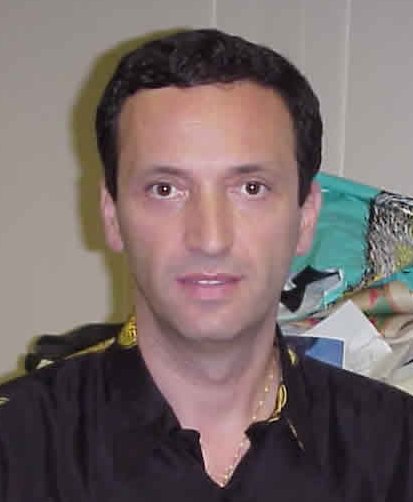
Frank de Boer is a researcher at Centrum Wiskunde & Informatica (CWI), Amsterdam , focusing on formal methods , concurrency theory , and software verification . His work bridges theoretical foundations with practical applications in object-oriented programming and parallel systems. Key research areas: Separation logic for heap reasoning Behavioral subtyping and history-based verification Active objects and actor models Concurrency and deadlock analysis Selected scientific recognition: Best Paper (ESSOC 2017) Bronzen Achievement Award (Trust4All 2008) Forum-Architectuurprijs (Archimate 2008) Recent publications (2025–2021) emphasize footprint logic, history-based reasoning, and formal verification of concurrent systems. Collaborations span institutions in The Netherlands, Germany, and China, with applications to Java collections, multicore memory systems, and transition system models.
Dr. Rutger Kramer is a Lecturer at Utrecht University's Department of History and Art History within the College of Humanities. His research focuses on medieval power dynamics, religious narratives, and the Carolingian Empire's cultural legacy. Kramer is also affiliated with the Humanities Research Institute for History and Art History. Medieval culture Power Religion Public religion and politics His research explores the interplay between authority, community formation, and hagiographical narratives. Kramer's 2019 book Rethinking Authority in the Carolingian Empire examines feedback loops in elite decision-making during Louis the Pious' reign. Current projects include analyzing Saint Nicholas' transformation from Eastern saint to cultural icon and studying modern medievalism's impact on pop culture. Recent articles and presentations investigate Carolingian court narratives, monastic influence on governance, and gender roles in early medieval marriage. Kramer frequently contributes to public discourse through media engagements, including National Geographic and podcast appearances, discussing topics like medieval monastic beer production and the historical roots of modern institutions.
Andy D. Pimentel is a Full Professor at the University of Amsterdam, where he chairs the Parallel Computing Systems (PCS) group within the Systems and Networking Lab at the Informatics Institute. His research focuses on multi-core and multi-processor computer systems, with emphasis on design, programming, and run-time management. Dr. Pimentel earned his PhD in Computer Science in 1998 and MSc in Computer Science in 1993, both from the University of Amsterdam. His educational background laid the foundation for his extensive work in computer architecture and embedded systems. His research interests span a wide range of topics including multi-core embedded systems, system-level design and simulation, design space exploration, performance and power analysis, system dependability, hardware/software co-design, run-time resource management, and Edge AI. His work consistently addresses the extra-functional aspects of computing systems such as performance, energy consumption, and system dependability, while also considering the productivity of designing and programming these complex systems. Analyzing his recent publications reveals a clear trajectory toward sustainable and efficient computing systems. His work has evolved from foundational research in embedded systems design space exploration to cutting-edge research in Edge AI, distributed deep learning, and energy-efficient computing. His publications demonstrate strong interdisciplinary connections between computer architecture, artificial intelligence, and sustainable computing. IEEE CEDA Outstanding Service Recognition Award DATE Fellow Award Professor Pimentel has held significant leadership roles in the academic community, serving as Chair of the Board for the Advanced School for Computing and Imaging (ASCI) since 2021, and as a Board member of ICT Research Platform Nederland (IPN) since 2020. He has organized major conferences including serving as General Chair for Design Automation and Test in Europe (DATE) 2024 and IEEE/ACM Embedded Systems Week 2026. His extensive service to the community demonstrates his leadership in the field of computer architecture and embedded systems. At the University of Amsterdam, Professor Pimentel leads the Parallel Computing Systems group, which investigates the design, programming, and run-time management of multi-core and multi-processor systems. The group's research emphasizes modeling, analysis, and optimization of performance, power/energy consumption, and system dependability, while also focusing on improving the productivity of designing and programming these complex systems.
G.C. Christodoulou, PhD, is a researcher in the Department of Electrical Engineering, Mathematics and Computer Science, focusing on data-intensive systems. His work spans cloud computing, stream processing, and interval data management, with recent publications addressing transactional cloud applications, stateful dataflows, and indexing innovations. Current affiliation: Electrical Engineering, Mathematics and Computer Science (data-intensive systems) Key collaboration networks: University of X, academic institutions in cloud computing Research Interests Christodoulou's research centers on optimizing cloud computing infrastructures and stream processing systems. His studies explore transactional stateful functions, autoscaling mechanisms, and data migration challenges. He also contributes to indexing frameworks for interval data, including hierarchical structures and temporal database efficiency. Article Trends Recent work highlights transactional consistency in cloud applications, dynamic dataflow execution, and scalable interval indexing. His publications emphasize cloud-native architectures, stream processing benchmarks, and temporal query optimization, reflecting a focus on bridging distributed systems with database innovation.
Nikolaos Alachiotis is an Associate Professor at the Digital Society Institute, specializing in Artificial Intelligence, Field-Programmable Gate Arrays (FPGA), and Genomics. His work bridges Hardware Acceleration with Bioinformatics , focusing on scalable solutions for genomic analysis and evolutionary biology. Research Themes: AI Hardware, FPGA Optimization, Population Genetics Key Collaborations: Delft University of Technology, Zenodo, Frontiers in High-Performance Computing Research Focus Alachiotis develops deep learning and FPGA-based tools for selective sweep detection and phylogenetic inference , enabling faster genomic analyses. His work spans convolutional neural networks , spiking networks , and adaptive computing for bioinformatics and radio astronomy. Recent articles highlight trends in AMD Versal SoC applications, deep learning for natural selection , and scalable genomic pipelines . Scientific Awards Outstanding Student Paper Award (2023) Supervised Work His supervised projects include Accelerating Selective Sweep Detection and Effective Data Preprocessing Techniques , often in collaboration with institutions like Zenodo and Frontiers journals.
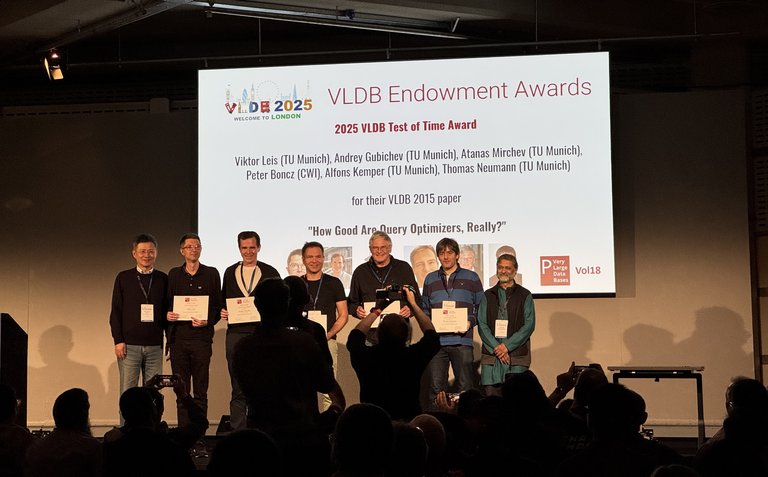
Peter Boncz is a Professor in the special chair of Large Scale Analytical Database Systems at Vrije Universiteit Amsterdam and leads the Database Architectures (DA) research group at CWI (Centrum Wiskunde & Informatica), the Netherlands' national research institute for mathematics and computer science. He serves on the CWI management team and is actively involved in multiple research initiatives and industry collaborations. Professor Boncz is internationally recognized as a pioneer of column-store databases, introduced through his PhD project MonetDB. His research spans database architecture, query processing optimization, and analytical database systems. His work on vectorized query processing with his first PhD student Marcin Zukowski has become foundational in modern analytical databases including BigQuery, Databricks, Snowflake, and DuckDB, which has millions of monthly downloads. Current research focuses include GPU data processing, vector search optimization, confidential computing, and graph data management. Boncz's recent publications reveal strong trends toward optimizing database systems for modern hardware architectures, particularly GPUs and cloud CPUs. His work bridges theoretical database concepts with practical implementation, focusing on performance optimization through innovative data layouts, compression techniques, and hardware-aware processing. The research shows a clear trajectory from foundational database concepts toward specialized optimization for emerging hardware and application requirements. VLDB Test of Time Award 2025 (second time, previously won in 2009) CIDR Test of Time Award 2024 ACM Fellow (2022) Humboldt Research Award (2013) ICTRegie Award (2006) Boncz has co-founded six spin-off companies in data systems, including MonetDB BV, and serves as an advisor to ventures like Databricks Corp. His research is supported by multiple external funding projects including Actian Research Grants, Databricks research agreements, and Motherduck Service Agreements. He has advised numerous students, with Marcin Zukowski being notably mentioned as his first PhD student who co-developed vectorized query processing. As leader of the Database Architectures research group at CWI, Boncz oversees a team focused on pushing the boundaries of database technology. The group maintains close ties with industry through projects with Databricks, Motherduck, and RelationalAI, while continuing to develop open-source technologies like DuckDB. The team is particularly active in GPU acceleration, confidential computing, and graph data management through the Linked Data Benchmark Council (LDBC), which Boncz founded.
Alex Nicolau is a Professor of Computer Science at the University of California, Irvine within the Donald Bren School of Information and Computer Sciences and an IEEE Fellow. He serves as Editor for PeerJ Computer Science and leads research at the Center for Embedded Computer Systems, focusing on high-performance computing systems and compiler-driven hardware optimization. His research spans Parallelizing Compilers , High-Performance Java , Power-aware Computing , and Reconfigurable Computing , with current projects including Julius C (divide-and-conquer algorithm modeling), EXPRESS (retargetable compiler framework), FORGE (distributed embedded systems optimization), SPARK (C-to-VHDL synthesis), and CoReComp (reconfigurable architecture compilers). These initiatives address critical challenges in energy efficiency, hardware-software co-design, and performance optimization for embedded platforms. Recent publications (2003-2004) reveal concentrated efforts on mobile energy efficiency and reconfigurable systems, with recurring themes of power management in multimedia streaming, task partitioning for watermarking algorithms, and network topology exploration in mesh architectures. His work demonstrates a cohesive vision bridging theoretical compiler advances with practical hardware implementations. His professional recognition includes: IEEE Fellow Professor Nicolau has mentored over 20 Ph.D. students to completion, including current advisees Weiyu Tang and Radu Cornea, and alumni like Sumit Gupta and Joseph Hummel who now lead industry and academic research. His editorial leadership as Editor-in-Chief of the International Journal of Parallel Programming and program committee roles for ICS and LCTES conferences reflect his significant contributions to the field. Based at UC Irvine's Center for Embedded Computer Systems (CECS 204), he directs a research ecosystem focused on compiler-driven hardware adaptation, with ongoing exploration into dynamic resource management and energy-aware system design for next-generation computing platforms.
Daniel de Oliveira serves as a Professor of Computer Science at Fluminense Federal University, Brazil, within the Computer Science Department since February 2013. He maintains active roles in academic publishing and conference organization while contributing to Brazil's computational research landscape. His research focuses on scientific workflows, data provenance, cloud computing, data-intensive and scalable computing, high-performance computing, and distributed parallel databases. Notable contributions include co-authoring the book "Data-Intensive Workflow Management For Clouds and Data-Intensive and Scalable Computing Environments" (Morgan & Claypool, 2019), establishing foundational frameworks for reproducible scientific computing in distributed environments. His work bridges theoretical computer science with practical implementations for large-scale data challenges. Analysis of recent publications reveals a consistent trajectory toward integrating machine learning with provenance tracking to enhance scientific workflow automation, particularly in deep learning contexts and distributed data management systems. This research demonstrates increasing sophistication in handling complex computational pipelines while maintaining reproducibility and efficiency across cloud and high-performance infrastructures. Professor de Oliveira actively contributes to the academic community through editorial roles at PeerJ and program committee memberships for premier conferences including VLDB, IPAW, IEEE eScience, and SBBD. As a member of IEEE, ACM, and the Brazilian Computer Society, he participates in shaping discourse around data-intensive computing standards and methodologies.
Miltiadis (Miltos) Kofinas is a Postdoctoral Researcher at the Climate Extremes Group within the Institute of Environmental Studies (IVM) at Vrije Universiteit Amsterdam. He holds a Diploma (MSc equivalent) in Electrical and Computer Engineering from Aristotle University of Thessaloniki and is completing his PhD at the University of Amsterdam's Video & Image Sense Lab under Prof. Efstratios Gavves. His work focuses on AI methods for climate science, particularly foundation models for weather forecasting, and has explored applications in autonomous vehicles and geometric deep learning techniques. Research interests include graph neural networks, neural fields, parameter-space networks, and equivariant representations. He has collaborated on projects involving explainable AI, hybrid dynamical systems, and benchmarking neural field training methods. His academic journey includes a Diploma thesis on Scene Graph Generation using GNNs at Aristotle University and industry experience at P.A.N.D.O.R.A. Robotics as a computer vision engineer. Key research trends in his publications span AI-driven climate modeling, geometric deep learning innovations, and improving interpretability of complex AI systems. His work often bridges theory with practical applications in environmental science and autonomous systems. Active collaborations focus on interdisciplinary challenges in AI and environmental studies. Currently affiliated with VU Amsterdam's Climate Extremes Group, his research integrates advanced machine learning techniques to address climate-related forecasting challenges. He has contributed to foundational work in neural field optimization, hybrid system modeling, and equivariant architectures that respect physical symmetries.
D. Spinellis is a Professor at Athens University of Economics and Business with continuous affiliation since 2000, specializing in Software Engineering within the broader field of Computer Science. His research spans critical domains: Software Engineering Computer Science Data Engineering Artificial Intelligence Cybersecurity High-Performance Computing Recent publications (2024-2025) demonstrate consistent focus on practical system-level challenges including Linux analysis on supercomputers, graph processing efficiency, AI-generated content ethics, security system modernization, and data workflow engineering. These works bridge theoretical research with real-world software applications. Professor Spinellis actively engages public discourse through media coverage of his 2025 study on AI-generated publication fraud, which received significant attention across news outlets, academic platforms, and social media including X, Facebook, and Bluesky.
Monika Trimoska is an Assistant Professor at the Coding Theory and Cryptology group at Eindhoven University of Technology (TU/e) , where she has worked since 2023. Previously, she was a postdoc at Radboud University and obtained her Ph.D. in cryptography at the University of Picardie Jules Verne under the supervision of Gilles Dequen and Sorina Ionica. She has also served as a Teaching and Research Assistant at her alma mater. Current Affiliation: Assistant Professor, TU/e (2023–present) Previous Affiliations: Postdoc at Radboud University (2021–2023), Teaching/Research Assistant at University of Picardie (2017–2021) Research Interests revolve around cryptanalysis of post-quantum cryptosystems , focusing on multivariate , code-based , and isogeny-based systems. Her work bridges theoretical and practical security analysis, particularly through SAT solvers and fault injection attacks . Recent Publications demonstrate expertise in algebraic attacks against digital signature schemes like MQ-Sign and CSIDH , with a focus on code equivalence problems , trilinear forms , and parallel collision search . She has also contributed to homomorphic encryption applications. Teaching Activities include courses on Applied Number Theory and Algebra and guest lectures on isogeny-based cryptography at Radboud University. She has co-supervised multiple Ph.D. , Master’s , and Bachelor’s students. Technical Contributions include open-source tools like WDSat (SAT solver for Weil descent) and MCE (Matrix Code Equivalence implementations).
Arnold Meijster is a Lecturer in the Faculty of Science and Engineering at the University of Groningen, specializing in Computer Science with focus areas in Parallel Computing, Programming, Signal Processing, and Algorithm Design. He teaches courses including Imperative Programming, Functional Programming, Signals and Systems, Compiler Construction, and Artificial Intelligence. His research spans parallel computing, image processing algorithms, and artificial intelligence, with particular expertise in developing efficient algorithms for morphological image processing and watershed transforms. His work frequently involves parallel algorithm design for shared-memory systems applied to large-scale image data. Publications from 1996 to 2018 demonstrate consistent focus on image processing and parallel computing, with recent work on hybrid shared-memory algorithms and machine learning applications. Early contributions centered on watershed transformation and connected component algorithms. Best young author paper award (1998)
Bin Shi is a Research Fellow at Eindhoven University of Technology's Department of Electrical Engineering, focusing on photonics, optical communication, and neuromorphic computing. He is a core member of the ECO Research Centre for Integrated Nanophotonics (2014–2025), contributing to next-generation optical networks and photonic integrated circuits. His research expertise includes photonic integrated circuits (PICs), semiconductor optical amplifiers (SOAs), and neural network implementations using optical systems. Key projects involve developing low-cost metro-access networks using SOA-based optical add-drop multiplexer (OADM) nodes and exploring photonic computing architectures for deep learning applications. Recent work emphasizes non-invasive characterization techniques for cascaded SOAs, software-defined electro-optical neural networks, and photonic beamforming systems. He has contributed to over 44 research outputs since 2018, with notable publications in Optics Letters and Optics Express . Shi collaborates internationally on topics like photonic neural networks and nanophotonic devices. He teaches the course 'Brain-inspired optical computation' and has been featured in media for his work on light-based neural networks.
C Giuffrida is an Associate Professor at the Faculty of Science, Vrije Universiteit Amsterdam, with affiliations to the Network Institute and the Systems and Network Security group. His research focuses on computer systems security, hardware vulnerabilities, and software reliability. Giuffrida holds a PhD in Computer Systems from Vrije Universiteit Amsterdam (2014). His academic contributions span multiple areas including transient execution attacks, fuzzing techniques, and hardware-software co-design for security. Research Interests: Hardware Security: Investigating vulnerabilities like Spectre, Rowhammer, and speculative execution risks. Software Security: Focusing on memory safety, compiler optimizations, and exploit mitigation strategies. Systems Research: Developing tools like BinRec for binary analysis and VPS for C++ vulnerability protection. His work has been recognized with awards such as the Distinguished Paper Award in 2021. Giuffrida supervises advanced courses in operating systems and hardware security, and has guided 16 PhD theses to completion.
Bas Luttik is an Associate Professor in the Department of Mathematics and Computer Science at Eindhoven University of Technology (TU/e), with a secondary appointment as an EAISI Foundational Associate Professor. His research focuses on concurrency theory, process algebra, and formal methods applied to railway systems. He holds an MSc and PhD from the University of Amsterdam, followed by postdoctoral work at Vrije Universiteit Amsterdam. His academic contributions include foundational work on parallel decomposition, process algebra semantics, and the integration of concurrency theory with automata theory, notably through the theory of Reactive Turing machines. Education background: MSc Computer Science (1996), University of Amsterdam PhD Computer Science (2002), University of Amsterdam (supervised by Jan Friso Groote at CWI) Research interests emphasize formal verification, process algebra, and practical applications in railway safety. Notable awards include the FMICS Best Paper Award (2018). He teaches courses like Logic and Set Theory, developing innovative digital tools for self-paced learning and homologation recommendation systems. Active in conference organization, he has chaired program committees for EXPRESS/SOS (2011–2013) and contributed to CONCUR, TTCS, and others. His work bridges theoretical foundations (e.g., bisimulation, executability) with applied systems (e.g., EULYNX railway interfaces). Supervised 30+ students, though specific names are not listed here. Research collaborations span international teams, focusing on concurrency, automata, and formal methods in critical systems.