Pascal Welke is a PostDoc Researcher at the Department of Machine Learning, Technical University of Vienna, working on the StruDL project (2023-2027) funded by the Vienna Science and Technology Fund (WWTF). His research focuses on enhancing graph neural networks (GNNs) through theoretical and practical advancements in expressivity, pooling mechanisms, and global feature integration. Active in graph representation learning, neural architecture design, and model interpretability Collaborates on interdisciplinary projects involving material science and computational linguistics Contributor to NeurIPS, ICLR, and ACL conferences Recent publications analyze the role of expressivity in GNN performance, introduce loop-based WL hierarchies, and develop model distillation techniques. His work spans both theoretical insights (homomorphism-based representations) and practical applications (edge device optimization, nonwoven material analysis). No formal awards or students listed in available records.
Delphine Bernhard is a Lecturer in Computer Science at the Faculty of Languages, University of Strasbourg, since September 2011. She serves as head of the computer science department at the Faculty of Languages and co-head of the Master's degree in Language Technologies since 2016. Her research focuses on natural language processing, text mining, and lexical resource creation for under-resourced languages like Alsatian dialects. Institution: University of Strasbourg Academic Unit: Faculty of Languages Department: Computer Science Role: Lecturer & Department Head Teaching: Databases for CAWEB Master's program Her research explores natural language processing for under-resourced languages , particularly focusing on Alsatian dialects . Key areas include POS tagging , syntactic annotation , lexical resource development , and language revitalization through digital tools. She works on corpus creation , parallel corpora , and machine learning adaptation for regional language processing . Delphine Bernhard's publications demonstrate expertise in computational dialectology , low-resource language processing , linguistic annotation , and regional language preservation . Her work spans POS tagging , dependency parsing , emotion analysis in theater , and metadata management for regional languages of France . She contributes to the RESTAURE and DIVITAL projects, focusing on computational processing for regional languages . Her work includes FAIR corpus creation , spelling normalization , and lexicon development for Alsatian dialects . She explores cohesive features for text readability and develops crowdsourcing solutions for language resource bottlenecks .
Daniel Henkel is a Lecturer in Linguistics and Translation at the University of Paris 8. His research focuses on contrastive linguistics and translation studies across English, French, and Italian, with expertise in corpus linguistics and syntactic analysis. He holds the academic rank of MCF (Maître de Conférences) and is affiliated with the Department of Linguistics and Translation. His work emphasizes comparative syntax, lexical semantics, and digital translation practices. Research interests include: (1) syntactic profiling of adjectives, (2) cross-linguistic analysis of conditional structures, (3) collaborative strategies in multilingual literary translation, and (4) conceptual divergence/convergence in cultural lexicons. His methodologies involve quantitative corpus analysis and comparative parallel corpora studies. Recent publications (2020) explore adjective subclasses, conditional perfect constructions, multilingual translation collaboration, and cross-linguistic lexical associations across English, French, and Italian. These works appear in outlets like Lexis , Springer Text Analytics , and Palgrave Studies . No scientific awards were explicitly mentioned in the provided text. His professional activities include doctoral supervision and participation in research projects on digital translation and language heritage. Contact: daniel.henkel@univ-paris8.fr
Dr. Lasha Abzianidze is an Assistant Professor at Utrecht University's Department of Languages, Literature and Communication (Faculty of Humanities). He is affiliated with the Institute for Language Sciences, contributing to the Logic, Language, Information group and Computational Linguistics group. His research focuses on NLP, computational semantics, and formal reasoning systems like LangPro, a tableau-based theorem prover for NLI. He co-leads the Parallel Meaning Bank (PMB) project for semantically annotated corpora and the NALOMA workshop series. He holds a PhD from Tilburg University (2017), with earlier roles as a postdoc in the PMB and ROCKY projects, and lectureships at the University of Groningen. His expertise includes semantics, NLP, computational linguistics, and human-centered AI. Education: PhD in Linguistics (Tilburg University, 2017); Double MSc in Language & Communication Technologies (Charles University & University of Lorraine); BSc in Pure Mathematics (Tbilisi State University). Research Interests: Natural Language Inference (NLI), formal semantics, theorem proving, cross-lingual semantic annotation, and explainable AI. Current projects include explainable natural language reasoning via the NWO XS grant and developing spatial reasoning datasets like SpaceNLI. His work bridges logic-based methods with deep learning, emphasizing transparent and interpretable systems. Grants & Supervision: Holder of an NWO XS grant (2023) for explainable NLI research. Supervises AI master's theses, favoring students from his courses on formal languages and NLP. Involved in teaching courses like 'Reasoning with Natural Language' and 'Machine Learning for Vision and Language'. Labs/Teams: Leads the NALOMA workshop series and contributes to the PMB project. Active in the Computational Linguistics group at ILS, collaborating on semantic parsing tools like CCGweb and LangPro. His work integrates logic-based reasoning with modern NLP techniques to advance explainable AI systems.
Professor Kayo Matsushita is a distinguished scholar in Translation and Interpreting Studies at Rikkyo University in Tokyo, Japan. She serves as Professor in the College of Intercultural Communication, Department of Intercultural Communication, and holds concurrent appointments in both the Master's and Doctoral Programs of the Graduate School of Intercultural Communication. Previously an Associate Professor at Rikkyo University (2017-2022) and International Christian University (2014-2017), she also maintains visiting positions at European institutions including KU Leuven and University of Tartu. Her academic career builds upon extensive professional experience as a journalist with The Asahi Shimbun and as a professional interpreter. Professor Matsushita's academic background reflects her interdisciplinary expertise across journalism, translation, and intercultural communication: PhD in Intercultural Communication from Rikkyo University Master of Science in Journalism from Columbia University Graduate School of Journalism Bachelor of Arts in Journalism from Sophia University Professor Matsushita's research focuses on the intersection of translation, journalism, and intercultural communication, with particular emphasis on risk management in translation decision-making. Her work explores remote interpreting technologies, corpus-based interpreting studies using the Japan National Press Club (JNPC) Interpreting Corpus, and the unique translation practices of Japanese newspapers. She investigates how political speeches are translated across cultures, the impact of the pandemic on interpreting practices, and develops innovative methods for interpreter training using parallel corpora. Her research bridges theoretical frameworks with practical applications in the translation industry. Professor Matsushita's recent publications reveal a strong focus on the transformation of interpreting practices during and after the pandemic, with several studies analyzing remote simultaneous interpreting (RSI) technologies and their impact on the Japanese interpreting industry. Her work consistently applies corpus-based methodologies to examine translation and interpreting phenomena across multiple language pairs. She has pioneered research on the JNPC Interpreting Corpus, exploring linguistic interference patterns in Japanese-English, Japanese-Chinese, and Japanese-Spanish interpretation. Her scholarship demonstrates increasing interest in AI applications for translation quality assessment and the cognitive aspects of interpreter performance. Professor Matsushita's scholarly contributions have been recognized with prestigious awards: 2002: Association of Alternative Newsweeklies (AAN) Alternative Newsweekly Awards (1st place, Feature Writing) for 'Seven Days at Ground Zero' 1996: Sophia University Russel Brines Scholarship Professor Matsushita actively supervises graduate students in the Master's and Doctoral Programs of Intercultural Communication at Rikkyo University, guiding research on translation, interpreting, and intercultural communication. Her courses include Advanced Seminar series, Conference Interpreting, Translation and Interpreting Practicum, and Master's Thesis Supervision. She has led significant research projects including the construction of the Japan National Press Club Interpreting Corpus, a government-funded four-year project (2016-2020) that created a valuable resource for interpreting studies. Her research has been supported by grants from Japanese academic funding bodies, and she serves on the Science Research Committee of the Japan Society for the Promotion of Science. Professor Matsushita co-leads the research team developing the Japan National Press Club (JNPC) Interpreting Corpus, a bilingual Japanese-English resource that has expanded to include Chinese and Spanish language pairs. This collaborative project involves multiple institutions and has produced significant research outputs in corpus-based interpreting studies. She is actively involved with the Japan Association for Interpreting and Translation Studies (JAITS), where she previously served as Head of the Kanto Chapter and Director. Her research group focuses on applying corpus linguistics methodologies to solve practical problems in translation and interpreting, particularly examining risk management strategies in professional practice.
Marie Pierre Escoubas is a Researcher at the Department of Methods and Models for Economy, Territory and Finance, Sapienza University of Rome, specializing in French language teaching and corpus linguistics since March 2008. She teaches at both the School of Economics and School of Humanities. Bilingual lexicography and terminology Contrastive analysis and translation studies French morphosyntax acquisition challenges for Italian learners Specialized language description Linguistic intercomprehension methodologies Corpus linguistics applications Her recent publications focus on comparative economic text analysis (ILCEA 2025), parallel press corpora studies (2022), and support verb constructions in third language acquisition (2023). Current research includes NoVerFra database development for analyzing French morphosyntax acquisition by Italian speakers. She coordinates in-person and hybrid teaching activities (Zoom/Virtual Classroom) and participates in interdisciplinary projects like the PCTO program. Her work connects corpus linguistics with educational applications across multiple universities.
Zeltia Blanco Suarez is a Professor of English Philology at the University of Santiago de Compostela, affiliated with the Faculty of Philology and the Department of English and German Philology. She is a member of the VLCG research group (Variation, linguistic change and grammaticalization). Her doctoral thesis (2017), supervised by Dra. María José López Couso, focused on Death-related intensifiers in the history of the English language: grammaticalisation and other processes of language change . Her research interests center on historical linguistics, grammaticalization processes, diachronic analysis of intensifiers (especially 'dead', 'deadly', and 'mortal'), and corpus-based studies of Early Modern English. She has conducted groundbreaking work on the evolution of grammatical structures in Irish English through analysis of the 1641 Depositions corpus and pioneered studies on CLIL (Content and Language Integrated Learning) in primary education. Her publications span over 15 years, consistently exploring lexical semantic change, syntactic evolution, and the interplay between context and language structure. Notable contributions include analyses of the Irish English habitual 'do V' construction and the cognitive mechanisms behind intensifier development. She has also reviewed major works in intensification studies, contributing to theoretical debates in historical linguistics. Blanco Suarez holds no explicitly listed awards but maintains an active research agenda through participation in international conferences and collaborative projects. Her work bridges historical linguistics with contemporary corpus methodologies, offering new perspectives on language change dynamics.
Inna Kozlova Mikurova serves as a Researcher in the Department of Translation and Interpreting and East Asia Studies at Universitat Autònoma de Barcelona, actively supervising PhD candidates and leading the Grup Tradumàtica research collective. Her institutional affiliation demonstrates continuous academic engagement through project leadership until 2024. Her research profile reveals deep specialization in Chinese-Spanish translation interfaces with particular emphasis on classical Chinese texts. Key focus areas include: Translation of Romance of the Three Kingdoms Classical Chinese function words adaptation Parallel corpus development for machine translation Cognitive processes in translation workflows Language resources for specialized translation Publication trends since 2019 demonstrate sustained output in high-impact translation journals, with recent work analyzing classical Chinese particles, pandemic-era educational adaptation, and machine translation post-editing. Her research consistently bridges theoretical translation studies with practical linguistic applications, particularly in Chinese-Spanish language pairs. As principal investigator for DESCRIBING POST-EDITESE IN MACHINE TRANSLATION (2020-2024) and contributor to Apertura cosmopolita al otro (2012-2015), she has secured significant research funding from Spain's Ministry of Science and Innovation. Her doctoral supervision capacity extends to 13 graduate projects according to institutional records. Her research infrastructure includes the Grup Tradumàtica collective which develops cognitive translation tools and maintains specialized language resources, particularly focused on East Asian language processing within European academic contexts.
Tariq Yousef is an Associate Professor in Data Science at the Department of Mathematics and Computer Science, University of Southern Denmark. He is actively engaged in interdisciplinary research combining computer science and the humanities, particularly in natural language processing for ancient and classical languages. His research interests include Named Entity Recognition, Visual Analytics, Deep Learning, and Digital Humanities. He focuses on developing robust NLP models for under-resourced languages such as Ancient Greek and Classical Arabic, leveraging parallel corpora and handwritten text recognition. His work bridges computational techniques with philological and historical research. The recent publications indicate a strong trend in applying AI and visualization tools to ancient language processing, with a focus on annotation, evaluation, and model enhancement. His work frequently appears in computational linguistics and language technology venues, demonstrating sustained contributions to NLP for cultural heritage. Professional Activities and Leadership: Organizer, The First Workshop on Visualization for Natural Language Processing (May 2024) Co-organizer, DH workshop “Data Stories: Analyzing and Visualizing Textual Narratives” (May 2024) Organizer, Ugarit: Translation Alignment Technologies for Under-resourced Languages (July 2022) Research Projects: Carlsberg Foundation - E-Rhetoric: HTR for Medieval Greek (2025–2028) VERNE: Circular Solutions for Sustainable Tourism (EU, 2024–2027) AlgaeProBANOS: Product Development in Baltic/North Sea (EU, 2023–2027) Empowering Humanities Education with Deep Learning (2023–2024) Teaching and Supervision: Teaching: Introduction to Web Data Science (2023–2023), DS838: Web Development (2024) Supervision: Retrieval Augmented Chatbot for Algae Researchers (2024)
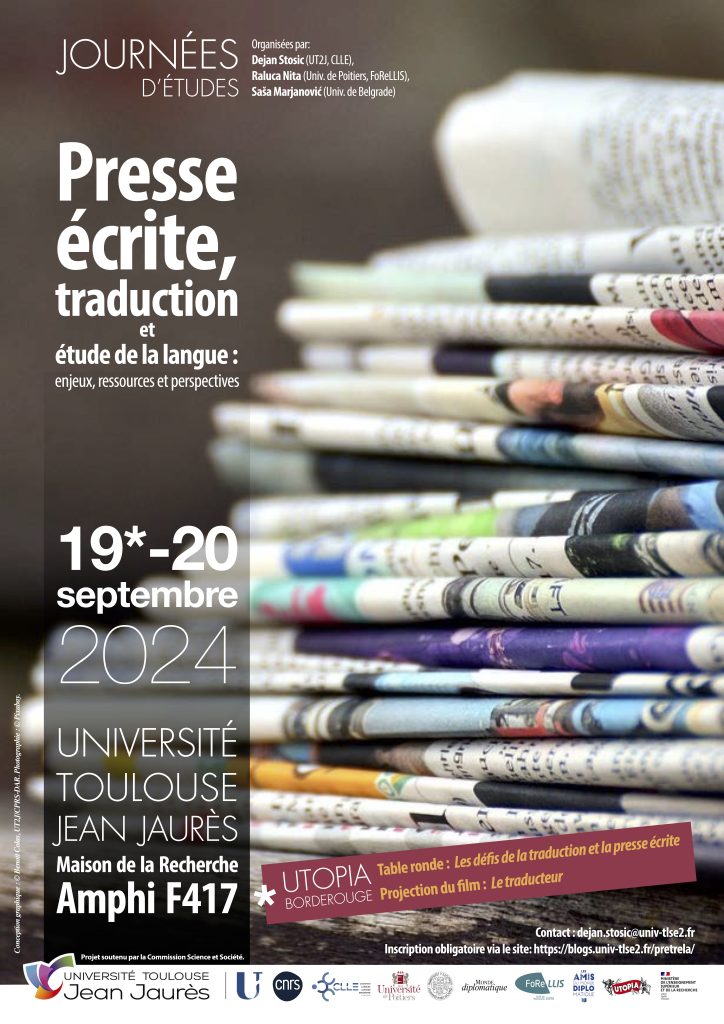
Dejan Stosic is a Professor in the Department of Language Sciences at the University of Toulouse Jean Jaurès, where he has been employed since 2003, first as Lecturer (2013-2022) and currently as University Professor (since 2022). He is a member of the CLLE Laboratory (Cognition, Languages, Language, Ergonomie), a joint research unit (UMR 5263) of the CNRS. His academic career spans multiple institutions, including previous positions at the University of Artois. Stosic's research focuses at the interface of semantics and syntax, with specializations in spatial semantics, prepositional semantics, expression of manner, nominal semantics, and lexical/grammatical polysemy. His work primarily examines French, with significant comparative components involving Serbian and English. Methodologically, he combines introspection with corpus analysis in his linguistic investigations. His most recent publications (2023-2024) demonstrate a continued focus on complex prepositions in French, polysemy patterns, spatial-temporal mappings, and the expression of manner across languages. These works reveal consistent research trajectories examining how spatial concepts structure temporal domains and how complex prepositional constructions evolve across European languages. Stosic is actively involved in multiple research projects including the ANR DIVITAL project (2021-2025) focused on increasing the digital vitality of regional French languages, and the SALTA project examining spatial asymmetries across languages. He regularly organizes academic events such as the PrETrELa event (2024) on written press and language study, and the MoCo Workshop on Motion & Cognition. His scholarly contributions include several significant books such as 'Complex Adpositions in European Languages' (2020), 'The Semantics of Dynamic Space in French' (2019), and 'Les prépositions complexes en français. Théories, descriptions, applications' (2023), establishing him as a leading expert in prepositional semantics and complex adpositions across European languages.
Ivan Markov Zlatev is a Senior Lecturer at the Department of Russian Language within the Faculty of Modern Languages at St. Cyril and St. Methodius University of Veliko Turnovo in Bulgaria. He holds a PhD and has established himself as a specialist in Russian linguistics with a focus on morphology, lexicology, and comparative studies between Russian and Bulgarian languages. Dr. Zlatev's research primarily centers on interjections and onomatopoeia, with extensive comparative analysis of emotional expressions across Russian and Bulgarian. His scholarly work demonstrates a systematic approach to understanding semantic components in interjections, examining how concepts like surprise, fear, and emotional valence are expressed linguistically in both languages. He has also investigated the relationship between interjections and other parts of speech, exploring word formation and semantic motivation. His publication record spans over two decades (2002-2024), showing consistent scholarly productivity with works appearing in academic journals like 'Bulgarian Russistics' and proceedings from international symposia. His research output includes book-length publications such as the two-part 'Russian Orthography: Rules and Exercises' and the 2023 monograph on 'Interjections in Russian and Bulgarian Languages.' Dr. Zlatev participated in the significant research project 'Database for two-way parallel Russian-Bulgarian electronic corpus' (2013-2015), which created a bilingual database connecting parallel corpora of original and translated texts. This project provided valuable tools for translation equivalence research, linguistic asymmetry studies, and contrastive description between the languages. He maintains active participation in academic service through the Department of Russian Language's Annual Linguistic Readings at Veliko Tarnovo University and has contributed to major departmental milestones, including the 60th anniversary of the Russian Language Department as evidenced by his 2024 publication.
Yves Lepage is a Professor at Waseda University's Faculty of Science and Engineering, specifically within the Graduate School of Information, Production, and Systems. He maintains an active research laboratory (lepage-lab.ips.waseda.ac.jp) and teaches courses including Example-based machine translation/NLP, Natural language processing, and Master's/Doctoral thesis supervision for the 2025 academic year. His research focuses on the application of analogical reasoning to natural language processing problems, particularly machine translation. Lepage's work spans formal analogy between strings, sentence-level analogies, morphological analysis, and multilingual systems. His research interests include machine translation, analogy, multilingual alignment, multilingual large language models, and foreign language aids. He has made significant contributions to understanding analogical density in corpora and developing methods to leverage analogies for translation, especially in low-resource scenarios. His publication record shows consistent output through 2024, with research evolving from foundational work on proportional analogy to sophisticated applications with neural networks. Recent work explores masked prompt learning for analogies, fuzzy analogies for translation, and organizing lexica into analogical grids for morphological generation across languages. Waseda University Teaching Award (Spring semester 2016) Lepage has successfully led multiple research projects funded by the Japan Society for the Promotion of Science, including "Theoretically founded algorithms for the automatic production of analogy tests in NLP" (2021-2024) and "Self-explainable and fast-to-train example-based machine translation using neural networks" (2018-2021). His work has involved international collaboration, including a 2023-2024 research period at the University of Montreal. He serves as Concurrent Researcher at the Waseda Research Institute for Science and Engineering (2024-2026) and has been active in professional organizations including the Information Processing Society of Japan and the Japanese Natural Language Processing Association.
Antonio Toral is a leading researcher at the University of Groningen, focusing on Neural Machine Translation (NMT) , human evaluation , and parallel corpus curation . His work spans low-resource language modeling, lexical diversity enhancement, and multilingual figurative language detection. Affiliations: University of Groningen, MaCoCu Project, CREAMT Consortium Key projects: MaCoCu (Massive collection of under-resourced language data) CREAMT (Creativity in literary translation) Research interests include: Improving NMT naturalness and lexical richness Document-level evaluation of machine translations Character-level modeling and downsampling techniques Reproducibility challenges in human NLP evaluation Cross-lingual formality transfer without parallel data His recent articles (2021–2025) demonstrate expertise in: Reinforcement learning for naturalness preservation Statistical analysis of translationese effects Dependency-based reordering models Pivot translation for Catalan→Chinese Domain-specific corpus creation for EU Digital Service Infrastructures
Deniz Zeyrek Bozsahin is a Professor in the Cognitive Science Department at Middle East Technical University's Graduate School of Informatics. She has held significant leadership roles including Director of the Graduate School of Informatics (2016-2022) and Head of the Cognitive Science Department (2003-2012). Her educational background includes a PhD in Linguistics from Hacettepe University (1990), an MA in Linguistics from the University of Kansas (1982), and a BA in Linguistics from Hacettepe University (1979). Professor Zeyrek Bozsahin's research focuses on discourse structure, discourse relations, linguistic annotation, language acquisition, pragmatics, and language resource development . Her work particularly emphasizes Turkish discourse structures and cross-linguistic discourse relations through major projects like the Turkish Discourse Bank and TED Multilingual Discourse Bank. Her recent publications (2020-2025) demonstrate continued scholarly activity in discourse analysis, Turkish linguistics, and computational approaches to discourse. These works primarily explore discourse relations in multilingual contexts, Turkish discourse connectives, and discourse annotation methodologies, with strong connections to natural language processing applications. She has served as editor for DILBILIM ARASTIRMALARI since 2010 and is active in international linguistic organizations including SIGANN (ACL Special Interest Group for Annotation) and CIPL (Permanent International Committee of Linguists). With over 50 graduate students supervised throughout her career, Professor Zeyrek Bozsahin has made substantial contributions to linguistics education in Turkey. Her work bridges theoretical linguistics with practical applications in computational linguistics and language resource development.
Dr. Krishna S. Nayak serves as Dean's Professor of Electrical and Computer Engineering at the University of Southern California's Viterbi School of Engineering. He directs the Signal and Image Processing Institute, Dynamic Imaging Science Center, and Magnetic Resonance Engineering Laboratory (MREL), leading interdisciplinary collaborations with radiologists, cardiologists, pulmonologists, and obesity researchers. His educational background includes a PhD (2001) and MS (1996) in Electrical Engineering from Stanford University, and BS degrees in Electrical Engineering, Computer Science, and Applied Mathematics from Florida State University (1995). Nayak's research pioneers MRI technology development with core expertise in pulse sequence design, real-time imaging, and quantitative reconstruction. His lab focuses on translating innovations to clinical applications for cardiovascular disease, obesity, and speech production through low-field systems, compressed sensing, and machine learning techniques. Current projects target high-performance imaging for coronary disease, cancer biomarkers, and vocal tract dynamics. His publication portfolio shows consistent advancement in MRI methodology, with recent work emphasizing low-field systems (0.55T), real-time speech imaging, and artifact correction. Key trends include clinical translation of quantitative biomarkers and hardware-software co-design for specialized applications. Jan 2022, Fellow, IEEE Apr 2020, USC Viterbi Use-Inspired Research Award May 2019, ISMRM Board of Trustees Apr 2018, Fellow, SCMR Apr 2017, Fellow, AIMBE Apr 2009, GE Healthcare Thought Leader Award His research program receives sustained funding from NIH, NSF, American Heart Association, and Coulter Foundation, supporting mentorship of graduate students and postdocs. As evidenced by his USC-Mellon Mentoring Award, he maintains strong commitment to training next-generation engineers through the MREL's collaborative environment. The Magnetic Resonance Engineering Laboratory operates as a multidisciplinary hub developing state-of-the-art imaging solutions, with active projects spanning hardware configurations, real-time cardiac imaging, and quantitative pulmonary assessment through close clinical partnerships.