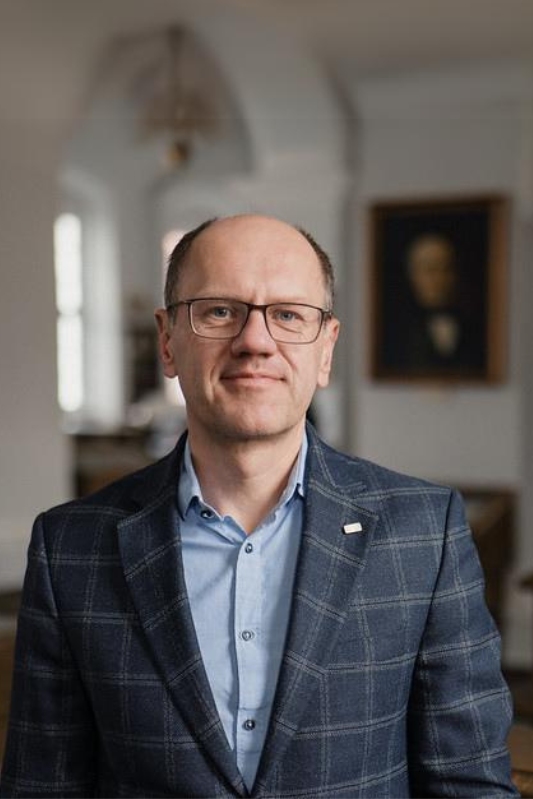
Dr. Stepas Toliautas is an Associate Professor at the Institute of Chemical Physics (Vilnius University), specializing in quantum chemistry and AI applications in physical sciences. His research spans computational chemical physics, focusing on electronic excitations, potential energy surfaces, and high-performance computing (HPC) methods. Key Research Areas : Quantum Chemistry, AI in Physical Sciences, HPC, Molecular Rotors Teaching : Physical Kinetics, Computational Chemistry, Parallel Computing, Artificial Intelligence His recent publications highlight viscosity-sensitive BODIPY fluorophores for bioimaging, sigma-conjugated polymers for phosphorescence, and machine learning integration in quantum chemical models. He actively participates in HPC workshops and popularizes science through media appearances and educational initiatives. Supervision : Mentors 1 PhD student (R. Garbačauskas) and supervised 4 Master’s theses Expertise : National HPC Competences Center (2020–present), EuroCC Workshop co-instructor Science Communication : Café Scientifique speaker, children’s science educator
Assoc. Prof. Vassia Atanassova, PhD is an Associate Professor in the Bioinformatics and Mathematical Modelling Department at the Institute of Biophysics and Biomedical Engineering , Bulgarian Academy of Sciences. She holds a PhD in Informatics and Computer Sciences (2013) and has been actively contributing to generalized nets, intuitionistic fuzzy sets, and decision-making under uncertainty since 2002. Education : PhD in Informatics and Computer Sciences (2013), Institute of Information and Communication Technologies – BAS Master in Marketing (2009), University of National and World Economy Bachelor in Informatics (2004), Faculty of Mathematics and Informatics, Sofia University Her research focuses on intuitionistic fuzzy logic applications, generalized net modeling , and Wiki technologies for knowledge transfer . She has developed novel intuitionistic fuzzy operators and conducted extensive work on intercriteria analysis for complex systems. Recent publications emphasize fuzzy decision-making frameworks (2015-2019), with applications in Algorithm optimization Economic modeling Bioinformatics Medical data analysis Scientific Awards : Youngest Researcher Award 'Ivan Evstratiev Geshov' (2011) 2nd Award, VIII Youth Session of Federation of Scientific-Technical Unions (2010) She serves as Guest Editor for MDPI Mathematics and technical editor for international journals. Her teaching includes PhD-level courses on Wikipedia-based knowledge transfer and fuzzy set theory at Bulgarian universities.
Paulius Čerka is an Associate Professor at the Department of Private Law, Faculty of Law, Vytautas Magnus University. His academic work bridges legal theory and practical applications in emerging technologies, taxation, and EU law. He holds a Doctor of Sciences degree and contributes to interdisciplinary research clusters like the Impact of Globalisation on the Law. Education: Doctor of Sciences (2006) Research Interests: Čerka's work focuses on tax law, particularly digital economy taxation, EU policy frameworks, and artificial intelligence's legal implications. He explores AI's potential as a legal entity and its ethical ramifications in criminal law contexts. His comparative legal studies span family law, corporate governance, and intellectual property. Publications: His recent research analyzes digital taxation models, EU court practices on parallel proceedings, and AI's evolving role in legal systems.
Dr. Jelena Tamulienė is a Senior Researcher at the Institute of Theoretical Physics and Astronomy (ITPA) at Vilnius University. Her work focuses on computational physics, density functional theory, and electronic structure analysis of organic and inorganic materials. Affiliation: Vilnius University, Institute of Theoretical Physics and Astronomy Research: Investigates quantum mechanical properties of clusters, materials science phenomena, and phase separation dynamics using computational methods. Her publications span topics like cluster physics , electronic structure , and computational materials science , with a focus on inorganic nanomaterials and organic semiconductors. She has supervised doctoral student Laura Baliulytė and postdoc Šarūnas Masys, and contributed to science popularization through educational outreach and public lectures. She led the 2014–2016 Lithuanian-Belarus research program and participated in high-performance computing initiatives. Her collaborative work includes studies on photoelectron spectroscopy, quantum chemistry, and nanodiamond functionalization.
Prof. habil. dr. Leonidas Sakalauskas is an Affiliated Scientist at the Smart Technologies Research Group within the Institute of Data Science and Digital Technologies at Vilnius University. His extensive research career spans mathematical modeling, stochastic programming, and statistical analysis with significant contributions across multiple disciplines. He maintains an active research profile with recent publications extending into 2025. Professor Sakalauskas' research focuses on stochastic programming, mathematical modeling, financial mathematics, statistical analysis, optimization, and queueing theory. His work demonstrates a consistent pattern of interdisciplinary research, bridging theoretical mathematics with practical applications in finance, social sciences, and computer science. He has developed innovative approaches to agent-based modeling, fractal analysis, and Monte Carlo methods, contributing significantly to both theoretical frameworks and practical implementations. His recent publications reveal a continuing evolution of research interests, with increasing emphasis on data science applications, computational social science, and advanced statistical modeling techniques. The articles demonstrate sophisticated methodological approaches to complex problems across diverse domains including financial modeling, social cohesion analysis, and network performance optimization. Throughout his career, Professor Sakalauskas has maintained a strong publication record in high-impact journals and conference proceedings, reflecting his ongoing engagement with the international research community. His work shows consistent methodological rigor combined with practical relevance across multiple application domains. Professor Sakalauskas has collaborated extensively with researchers across Lithuania and internationally, demonstrating strong teamwork and interdisciplinary engagement. His research has practical applications in financial modeling, social science analysis, and computational systems optimization, contributing to both theoretical advances and real-world implementations.
Aušrinė Pasvenskienė (Associate Professor) is affiliated with the Faculty of Law at Vytautas Magnus University , specifically within the Department of Private Law . She contributes to research clusters on Globalisation's Impact on Law and Applied Ethics . Doctor of Sciences (2017) ORCID: 0000-0003-3503-414X Research Interests: Her work focuses on Education Law , Human Rights in Education , Law and Technologies , and EdTech Law . She explores intersections between legal frameworks and emerging digital challenges. Article Trends: Recent publications analyze GDPR implementation and data protection , competition law adaptation to sustainability , AI transparency obligations , and digital assets in legal contexts . Theses address climate change responsibility , e-sports regulation , and digital property recovery . Supervised Projects: Advised 10+ theses on topics including data sovereignty, digital contract enforcement, and climate justice. Student works cover 2014-2025, with recent emphasis on AI ethics and blockchain legal challenges.
Dr. Juozas Šulskus is a Professor at the Institute of Chemical Physics , Vilnius University. His research focuses on methods of quantum mechanics in molecular theory, computational chemistry, and molecular electronic/vibrational spectra modeling. Research Interests : Quantum chemistry, molecular spectroscopy, parallel computing for molecular systems, and photophysical processes. Teaching : Computational Chemistry, Parallel Computation Methods in Physics, Atomic and Molecular Theory. Leadership : Dean of Vilnius University Physics Faculty, Member of the Commission for Pedagogical Names, and Substitute on the EuroHPC Governing Board. His work emphasizes quantum mechanical modeling of molecular systems and parallel computation for simulating excited-state dynamics. Articles highlight studies on carotenoid spectra , fluorescence quenching , and phosphorescent polymers , with recent trends in optoelectronic material design and carrier localization in semiconductors .
Prof. habil. dr. Gintautas Dzemyda is a leading Lithuanian computer scientist, Professor and Senior Researcher at Vilnius University Institute of Data Science and Digital Technologies (VU DMSTI), and Head of the Cognitive Computing Group . He is simultaneously affiliated with the Institute of Mathematics and Informatics (MII) in Vilnius, where he has built an internationally recognized scientific school in visual data analysis. Education & Qualifications 1984 – Candidate of Technical Sciences (PhD equivalent), thesis on “Problem Structure Analysis – a Tool for More Effective Optimization”. 1997 – Habilitation Doctor of Technical Sciences, dissertation on “Isolation of Necessary Knowledge to Improve Optimization Efficiency”. 1992 – Associate Professor, Institute of Mathematics and Informatics, Vilnius. 1998 – Professor, Kaunas University of Technology. Research Interests Prof. Dzemyda’s research integrates data science, artificial intelligence, optimization, and cognitive computing . Core topics include dimensionality reduction, multidimensional data visualization, neural-network–based analytics, parallel and distributed computing, multi-criteria decision support, and advanced AI applications in medicine (ophthalmology, cardiology, oncology). His work has pioneered Lithuanian capabilities in visual analytics and large-scale data exploration. Publication Trends Across 270+ refereed works and 2 Springer monographs (2013, 2023), recent outputs (2021–2025) emphasize geometric multidimensional scaling for big-data visualization, deep learning for pancreatic-cancer detection on CT images, reinforcement learning for autonomous navigation, and fraud-detection techniques for highly imbalanced financial datasets. These contributions appear in Springer LNCS/LNNS, Informatica, Journal of Global Optimization, Engineering Applications of Artificial Intelligence , and other top venues. Awards & Recognition Lithuanian State Science Prize (2001 & 2021) Honorary Doctor of the University of Latvia (2019) Knight's Cross of the Order “For Merit to Lithuania” (2007) Doctoral Supervision & Committees He has mentored 28 doctoral graduates (15 direct, 13 through academic descendants) and currently supervises: Dalia Breskuvienė – Classifier training-set optimization Modestas Motiejauskas – Emotion recognition in photographs Victor Bulava – Machine-learning methods for cyber-incident early detection He also chairs or serves on doctoral and habilitation committees at VU, KTU, VGTU, VMU and MII. Laboratory & Projects As Head of the Cognitive Computing Group , Prof. Dzemyda coordinates several national and EU projects, including the current Lithuanian Research Council grant “Geometric Method for Multidimensional Scaling” (S-MIP-20-19, 2020-2022) and the SMART programme project “CognitiveSTATS” (2021-2023) focused on combating misinformation during pandemics. His team develops open-access tools for large-scale data visualization and contributes to the MIDAS national research-data archive.
Prof. Dr. Remigijus Paulavičius is a Senior Researcher, Professor, and Group Leader at the Blockchain and Quantum Technologies Group of Vilnius University. He earned his Doctor of Science degree in Computer Science in 2010 from Vilnius University's Institute of Mathematics and Informatics, focusing on global optimization with simplex subdomains under the supervision of Dr. J. Žilinskas. Research Interests : His work bridges global optimization methods with blockchain and quantum computing. Key areas include non-convex bilevel programming, derivative-free optimization algorithms (e.g., DIRECT), and applications in blockchain scalability, consensus protocols, and quantum circuit design. Scientific Awards : Best Paper Award, Journal of Global Optimization (2014) Funding from Lithuanian State Science and Studies Foundation for doctoral students (2007–2009) Member, Young Academy of the Lithuanian Academy of Sciences (since 2019) Projects & Leadership : Leads research on blockchain simulators, quantum machine learning frameworks, and optimization toolboxes (e.g., DGO, DIRECTGO). Involved in international collaborations and conference committees, including AIChE and EUROPT. Publications : Over 70 works on global optimization algorithms, blockchain applications, and quantum computing, with recent focus on generative AI, energy consumption in blockchains, and reproducibility in machine learning.
Professor Julius Žilinskas is a distinguished academic at Vilnius University, serving as Chief Researcher and Group Leader of the Global Optimization Group within the Institute of Data Science and Digital Technologies. He is also a Member of the Senate of Vilnius University and serves on the Expert Committee of Natural and Technical Sciences of the Research Council of Lithuania. His academic career spans multiple institutions including Vilnius Gediminas Technical University and Kaunas University of Technology. Vilnius University, Institute of Data Science and Digital Technologies (Current) Vilnius Gediminas Technical University (Professor appointment, 2012) Kaunas University of Technology (Doctorate awarded, 2002) Professor Žilinskas' research interests focus on global optimization algorithms , multidimensional scaling , and parallel computing for complex optimization problems. His work bridges theoretical computer science with practical applications in facility location, data analysis, and educational assessment. He has made significant contributions to developing and analyzing algorithms for black-box global optimization, particularly in constrained and competitive settings. His recent publications reveal a strong focus on Bayesian optimization techniques , facility location problems , and educational data analysis . The research demonstrates increasing interdisciplinary collaboration, particularly with economists and educational researchers. His work shows a consistent trajectory from theoretical optimization methods to practical applications in diverse fields. Professor Žilinskas has served in numerous leadership roles including: Member of the Senate of Vilnius University Member of the Expert Committee of Natural and Technical Sciences of the Research Council of Lithuania Editor for special issues of the Journal of Global Optimization He leads the Global Optimization Group, which focuses on developing and implementing advanced optimization algorithms for complex real-world problems. The group maintains strong international collaborations and contributes to both theoretical advances and practical applications of optimization techniques.
Dr. Jolita Bernatavičienė serves as a Senior Researcher at Vilnius University's Institute of Data Science and Digital Technologies within the Image and Signal Analysis Group. With a Doctorate in Technological Sciences (Informatics), she has established herself as a leading researcher in medical image analysis and artificial intelligence applications in healthcare. Her extensive research portfolio spans over 15 years of continuous contributions to the field. Dr. Bernatavičienė's research interests primarily focus on medical image analysis, particularly in ophthalmology and oncology applications. Her work integrates advanced machine learning techniques with medical diagnostics, specializing in eye fundus image analysis for glaucoma detection and prostate MRI analysis for cancer identification. She has made significant contributions to deep learning architectures, signal processing methodologies, and data analysis frameworks applicable to biomedical challenges. Her publication record demonstrates strong trends in applying cutting-edge AI techniques to solve concrete medical problems, with a noticeable shift toward more sophisticated deep learning architectures in recent years. The research spans multiple medical domains including ophthalmology, cardiology, oncology, and renewable energy systems monitoring, reflecting her interdisciplinary approach to data science applications. Leader of International Conference 'Data Analysis Methods for Software Systems (DAMSS)' 2015-2024 Member of IEEE Computer Society section (since 2022) Member of the Council of the Lithuanian Computer Association, Artificial Intelligence Section Member of the Lithuanian Operations Research Society Expert at the Science, Innovation and Technology Agency (MITA) (2020-2022) Dr. Bernatavičienė actively supervises doctoral and master's students, with current doctoral student Roman Surkant working on prostate MRI analysis. She leads multiple significant research projects including 'Developing Talents in Artificial Intelligence to Solve Disruptive Environmental Problems' and serves as scientific leader for the Research Council of Lithuania funded project on cardiac MRI texture analysis. Her work has been supported by various national and international funding mechanisms including COST activities, EuroHPC programs, and Lithuanian national research grants. She is principal investigator for the long-term project developing a database of depersonalized fundus images (2018-2030) and has led numerous projects related to medical image analysis, AI applications in healthcare, and data science methodologies. Her research group maintains strong international collaborations through COST actions and other European research networks.
Assoc. Prof. Dr. Algirdas Lančinskas is a Senior Researcher and Associate Professor at Vilnius University's Faculty of Mathematics and Informatics, working within the Global Optimization Group at the Institute of Mathematics and Informatics. His academic career spans over a decade at Vilnius University, where he has progressed from Junior Researcher to his current position as Associate Professor and Chief Researcher on multiple projects. He maintains an active international research profile with collaborations across Europe. Doctor of Physical Sciences (Informatics, 09P), Vilnius University Institute of Mathematics and Informatics, 2013 Dissertation: Parallelization of random search global optimization algorithms Dissertation supervisor: Prof. Dr. (HP) Julius Žilinskas Dr. Lančinskas specializes in global optimization, particularly competitive facility location problems, discrete optimization, and parallel computing. His research bridges theoretical optimization methods with practical applications in business, spatial economics, and public health. He has made significant contributions to nature-inspired optimization heuristics, developing novel algorithms for solving complex location problems with applications ranging from business expansion strategies to pandemic testing protocols. His work often involves multi-objective optimization approaches and the development of efficient parallel algorithms to handle computationally intensive problems. Analysis of his recent publications reveals a strong focus on competitive facility location modeling, with particular expertise in discrete optimization problems where multiple competitors vie for market share. His research increasingly incorporates robustness considerations under uncertainty in customer behavior, reflecting the growing complexity of real-world location decisions. The integration of ranking-based approaches with traditional optimization techniques represents a distinctive methodological contribution across his work. Dr. Lančinskas actively supervises doctoral students and has served on multiple dissertation defense councils. His research is supported by significant funding from the Research Council of Lithuania and international collaborations through COST actions. He has led multiple research projects focused on optimization algorithm development and their applications. As a member of the Global Optimization Group, he contributes to Vilnius University's strong tradition in optimization research, collaborating closely with Prof. Julius Žilinskas and international partners across Spain, the UK, and other European institutions. His work exemplifies the institute's commitment to both theoretical advances and practical applications of optimization methods.
Martynas Sabaliauskas is an Associate Professor and Researcher at the Cognitive Computing Group , Institute of Data Science and Digital Technologies , Vilnius University , Lithuania. His research focuses on multidimensional scaling, geometric optimization, data visualization, and prime number theory. His research interests include: Multidimensional Scaling (MDS): Developing geometric approaches for efficient data dimensionality reduction and visualization. Prime Number Theory: Investigating properties of the Riemann zeta function, prime sequences, and fractal structures. Computational Mathematics: Designing algorithms for complex mathematical problems with applications in data science. Recent publications reflect a strong focus on geometric MDS techniques, visualization of complex mathematical structures, and computational approaches to number theory. Notable works include studies on the Riemann zeta function's zeros, fractal visualizations, and efficient algorithms for large-scale data analysis. Contact Information: Address: Akademijos St. 4, room 617, Vilnius, Lithuania Phone: +370 5 210 9305
Raimondas Čiegis is a prominent Lithuanian mathematician serving as Chairman of the Mathematical Sciences Section at the Lithuanian Academy of Sciences since 2016. Previously, he spent 16 years (2000-2016) as Head of the Department of Mathematical Modeling and Professor at Vilnius Gediminas Technical University, following 18 years at the Institute of Mathematics and Informatics (1982-2000). He holds a habilitation in physics (1993) and graduated from Vilnius University (1982). His research focuses on: Numerical methods for nonlinear differential equations Parallel computing architectures Mathematical modeling of physical systems Finite difference schemes for nonlocal boundary problems Convergence theory for nonlinear discretizations He has authored five influential textbooks including Parallel Algorithms (2001) and Numerical Methods for Solving Differential Equations (2003), which are used in advanced computational mathematics education. Major recognitions: Lithuanian Science Prize (1995, shared) Lithuanian Science Prize (2017, shared) Elected Full Member of Lithuanian Academy of Sciences (2016) Foreign Member of Latvian Academy of Sciences (2017)