Annalisa Massini serves as Associate Professor in the Department of Computer Science at the University of Rome "La Sapienza", a position she has held since November 2001 following her appointment as Assistant Professor from 1996-2001. Education: 1989: Degree in Mathematics, University of Rome "La Sapienza" 1993: Ph.D. in Computer Science, University of Rome "La Sapienza" Research Focus: Her scholarly work centers on Mobile sensor networks and Interconnection networks , with significant contributions to Hybrid systems verification . Her research portfolio extends to Parallel computing methodologies, Computer arithmetic techniques, and innovative approaches to Graph drawing , demonstrating comprehensive expertise across theoretical and applied computer science domains. Academic Contributions: Dr. Massini teaches foundational courses including Digital Systems Design (formerly Computer Architecture I), Computer Architecture (formerly Computer Architecture II), and Intensive Computation. She supervises Bachelor's and Master's thesis projects, maintaining office hours by email appointment from her office in Building E (Viale Regina Elena 295), 2nd floor, room 206.
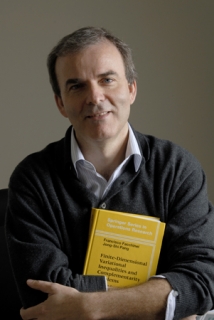
Francisco Facchinei is a Professor at Sapienza University of Rome, affiliated with the Department of Computer, Automatic and Management Engineering Antonio Ruberti within the College of Engineering. His research spans nonlinear and non-differentiable optimization, complementarity problems, variational inequalities, and game theory applications in telecommunications. His work focuses on developing algorithms for nonconvex optimization with ghost penalties, asynchronous distributed methods, and applications in healthcare and communications systems. Key Contributions: Foundational work in variational inequality theory, generalized Nash equilibrium problems, and optimization over dynamic networks. Recent Trends: Emphasis on asynchronous parallel algorithms, stochastic optimization, and non-invasive medical diagnostics via machine learning. He has held academic positions at Sapienza University since 1990, progressing from Ricercatore to Professore Ordinario. No scientific awards are explicitly mentioned in the provided texts.
Gilbert Babin is a Professor of Information Technologies at HEC Montréal, where he is affiliated with GRESI, ERPsim Lab, and Tech3Lab. He has been cited 1331 times according to Google Scholar, indicating significant scholarly impact in his field of research. His research interests span several key areas in information systems and business technology: Enterprise Resource Planning (ERP) systems Business simulation and serious games Cognitive aspects of information systems use Business intelligence and analytics Operations management education Professor Babin's work demonstrates a strong focus on the intersection of information technology and business processes, particularly through simulation-based approaches. His publication history shows an evolution from technical optimization problems (1996-2007) to applied business contexts (2010-2012), with his most recent work exploring the integration of neuroscientific approaches with enterprise systems. His research on ERP simulation games has been particularly influential, with his 2011 paper receiving 132 citations. His current research trajectory includes innovative cross-disciplinary work combining information systems with cognitive neuroscience, examining how brain-computer interfaces can enhance sustained attention in business contexts. This represents a cutting-edge direction that bridges traditional information systems research with emerging neurotechnologies.
Cosimo Solidoro is an Oceanographer and marine ecologist who currently serves as Director of the Oceanography department at OGS (Istituto Nazionale di Oceanografia e di Geofisica Sperimentale). He is also a Professor of 'Ocean Models and Data Analytic' at the University of Trieste, a member of the PhD school in Life Science (Trieste), and of the national PhD school on Earth Observations (Rome Sapienza). His extensive professional engagements include serving as president of the International Society of Ecological Modelling - European Chapter, Italian National Representative of IGBP program IMBER, member of the European Marine Board, and member of the executive board of the European consortium Euromarine. Professor Solidoro's research spans coastal areas, lagoons, and open sea ecosystems, focusing on the impacts of climate change, anthropogenic forcing, and natural phenomena on biodiversity and ecosystem functioning. His work integrates quantitative approaches to sustainability, complex system theory, and ecological-socio-economical systems. He has made significant contributions to developing ocean models and data analytics approaches, particularly applied to the Mediterranean Sea region. His research methodology combines advanced computational modeling with empirical data analysis, often taking an interdisciplinary approach that bridges physical, biological, and social dimensions of marine systems. His publication record shows a strong focus on Mediterranean marine ecosystems, with particular attention to the Venice Lagoon. Recent work (2022-2023) addresses climate change impacts including acidification, deoxygenation, and extreme weather events like Medicane Apollo. Earlier work established foundational models for lagoon ecosystems, mercury cycling, and phytoplankton dynamics. His research demonstrates a progression from developing basic hydrodynamic and ecological models toward increasingly integrated approaches that address sustainability challenges through coupled ecological-socio-economic frameworks. Professor Solidoro has received notable recognition including the Prigogine junior medal (2006) and co-recipient of Denni medals (2008). He serves on the editorial boards of Ecological Modelling, Ecological Informatics, Frontiers in Marine Science, and Bulletin of Oceanography, reflecting his standing in the marine science community. With over 200 research papers published, Professor Solidoro has successfully guided numerous students and postdocs who now hold research positions globally. His current involvement in major initiatives like Extended Partnership RETURN, National Center Future Biodiversity, INEST, and ITINERIS demonstrates continued research leadership. His work as a Lead Author for IPBES assessments highlights the policy relevance of his research. Professor Solidoro maintains an active international network through visiting positions at institutions including Berkeley, IIASA, DTU, and PML.
Nadia Pinardi is an Associate Professor of Oceanography in the Department of Physics and Astronomy at the University of Bologna, Italy, and a Founding Fellow at the CMCC Foundation (Euro-Mediterranean Center on Climate Change) in Bologna. Her primary contact is nadial.pinardi@cmcc.it, and she holds a Ph.D. in Applied Physics from Harvard University. Her research spans ocean numerical modeling, data assimilation for marine environments, marine biogeochemical modeling, and oil spill forecasting. Current emphases include uncertainty quantification in ocean forecasting systems, long-term Mediterranean Sea variability, sea level trends, and energetics of semi-enclosed seas. This work underpins operational oceanography advancements for regional climate adaptation. Recent publications demonstrate a cohesive focus on Mediterranean physical and biogeochemical processes, integrating tidal dynamics, sea level change, freshwater fluxes, and climate impacts through advanced numerical frameworks. Methodologies prominently feature the SHYFEM model for coastal dynamics, ensemble prediction systems, and high-performance computing implementations addressing policy-relevant environmental challenges. Her accolades include: European Geophysical Union (EGU) Fridtjof Nansen Medal for Oceanography (2007) Roger Revelle Unesco Medal (2008) Pinardi has coordinated Mediterranean operational oceanography development since the mid-1990s and currently co-chairs the Joint Committee for Oceanography and Marine Meteorology (JCOMM), a WMO-UNESCO-IOC initiative driving global meteo-marine services. Her leadership at CMCC integrates interdisciplinary teams advancing climate-ocean forecasting infrastructure.