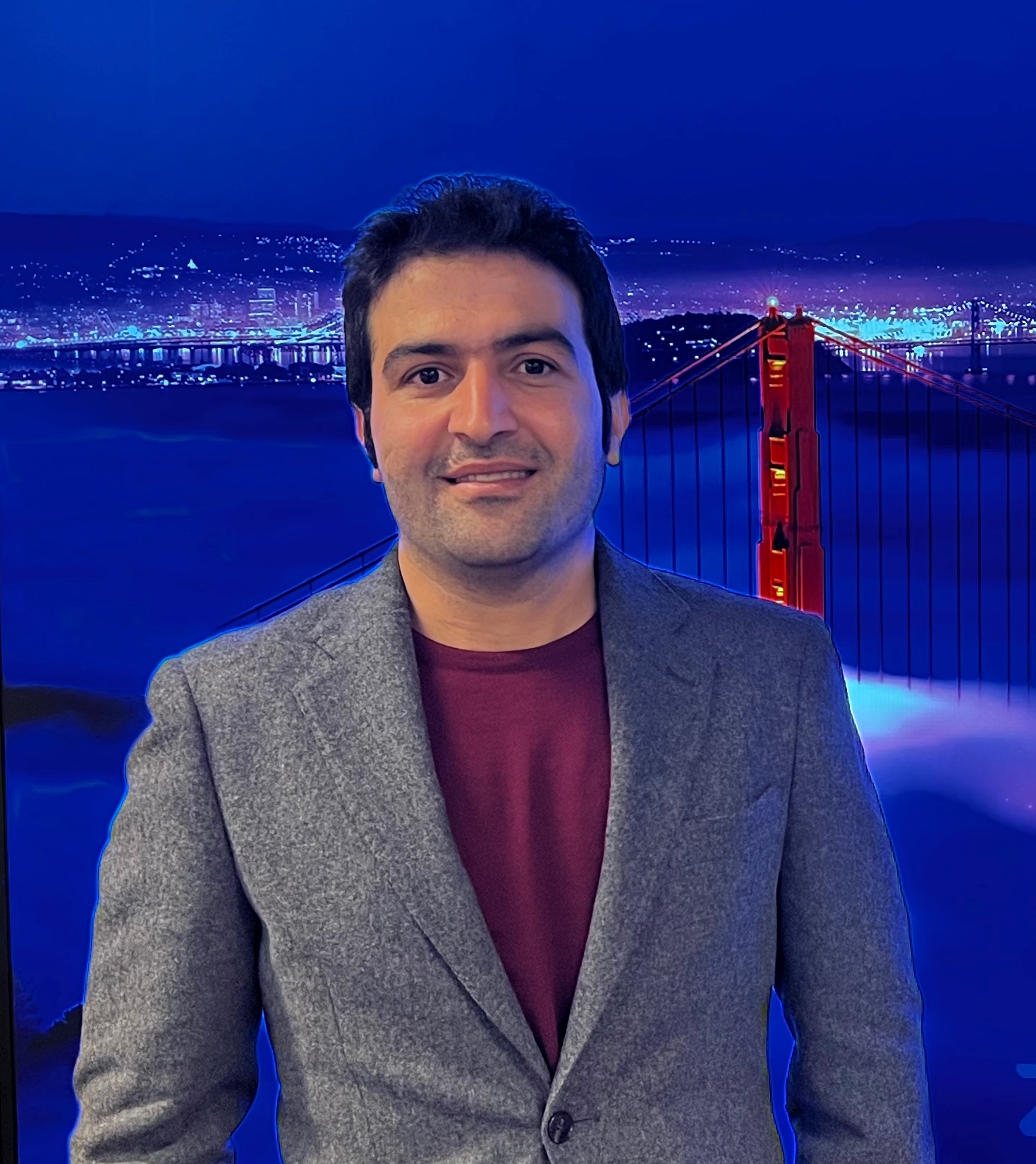
Ashkan Jahanbani Ghahfarokhi is an Associate Professor in Reservoir Engineering at NTNU’s Department of Geosciences since 2019. He leads the CEORS Gemini Centre (CO2 Enhanced Oil Recovery & Storage) and is a core member of the BRU21 Reservoir Management group. His research focuses on data-driven subsurface modeling, CO2 storage, and optimization of oil recovery processes. Education: PhD, NTNU (2015); MEng, University of Calgary (2009); MSc/BSc, Petroleum University of Technology, Iran (2006–2009). Roles: Head of Reservoir Engineering Group (2021–2022), Project Manager for NORHED II (2022), and NTNU’s Outstanding Academic Fellow (2022–2026). Research interests include CO2-EOR/Storage, machine learning applications, proxy modeling, and reservoir simulation. He has supervised 20+ students and published over 40 journal/conference papers. Awards include DNVA postdoc scholarship (2015–2017) and PoreLab postdoc (wettability studies). Teaching: Masters/PhD courses in reservoir fluids, simulation, and geomechanics. Guest editor for Energies (AI in Oil & Gas).
Curtis Hays Whitson is a Professor at the Institute of Geo Sciences, NTNU, affiliated with the Petroleum Technical Center. His research focuses on reservoir fluid characterization, CO2 sequestration, unconventional reservoirs, and enhanced oil recovery (EOR). He has advised numerous PhD students and contributed to over 100 peer-reviewed publications since 1980, including seminal works on PVT modeling, diffusion mechanisms, and shale gas optimization. His recent work emphasizes field-scale EOR optimization and CO2 injection in fractured systems. Whitson has supervised doctoral theses on topics like CO2-EOR in Iran’s Haft Kel field and gas-cycling benchmarking. His research integrates reservoir simulation, material balance analysis, and multiphase flow dynamics. Key research themes include: (1) CO2 injection in chalk and unconventional reservoirs, (2) diffusion-driven recovery mechanisms, (3) shale gas depletion performance, and (4) integrated field optimization. His articles span fluid property characterization, numerical modeling of transport phenomena, and production optimization strategies. Whitson collaborates widely with industry partners on projects involving experimental fluid analysis and reservoir-plant integration.
Curtis Hays Whitson is Professor at NTNU's Department of Geoscience, specializing in petroleum reservoir engineering and fluid phase behavior. His research encompasses PVT modeling of complex fluids, CO2 injection in fractured chalk, and unconventional resource development. Recent work advances compositional tracking for gas-condensate systems and hydrogen storage in depleted fields. With 40+ years of publications, he has contributed foundational methods in diffusion coefficient estimation, material balance for high-pressure reservoirs, and black-oil proxies for thermal recovery. Industry collaborations include benchmarking bottomhole pressure calculations and fluid heterogeneity analysis in tight formations.
Jon Kleppe is a Professor in Petroleum Engineering at the Norwegian University of Science and Technology (NTNU) since 1981. He has held leadership roles such as Center Director of SFI IO (2007-2015), Department Head for ~20 years, and Dean of Earth Sciences (1990-96). He has also served as a Visiting Professor at Stanford University (1988-1989) and a Visiting Researcher at Elf (1996-1997). Education: Ph.D. in Petroleum Engineering, Texas A&M University, 1974 M.Sc. in Mechanical Engineering, South Dakota School of Mines and Technology (SDSMT), 1971 B.Sc. in Mechanical Engineering, SDSMT, 1970 Research Interests: Kleppe's work focuses on Petroleum Engineering , Reservoir Simulation , Enhanced Oil Recovery (EOR) , CO2 Storage , and Fractured Reservoirs . His recent publications emphasize surfactant flooding, single-well chemical tracer tests, and geochemical interactions in carbonate reservoirs. Scientific Awards: Oilman of the Year 2014 (SPE Norway) Regional Distinguished Achievement Award for Petroleum Engineering Faculty 2015 NTNU's Internationalization Award 2015 Advising & Grants: He has supervised numerous doctoral students, including Mkinga Oras Joseph (2020), Cheng Xiaoqian (2019), and Jahanbani Ghahfarokhi Ashkan (2012). His research has involved collaboration with institutions like Stanford University and Elf, as well as industry projects in Saudi Arabia and Norway.
Ashkan Jahanbani Ghahfarokhi is an Associate Professor at the Norwegian University of Science and Technology (NTNU), Department of Geosciences (IGV), specializing in reservoir engineering. He leads the CEORS Gemini Centre, a strategic collaboration between NTNU and SINTEF on CO2 Enhanced Oil Recovery & Storage. His roles include Head of the Well and Reservoir Group (2021-2022), Project Manager for the NORHED II Program in Mozambique, and Guest Editor for the Energies journal's AI/ML in Oil & Gas Special Issue. Education: PhD (NTNU, 2015), MEng (University of Calgary, 2009), MSc/BSc (Petroleum University of Technology, Iran) Research focuses on subsurface reservoir modeling, CO2 storage, data-driven techniques, and production optimization. Key interests include: CO2-EOR/Storage system design Machine learning integration in reservoir simulation Wellbore-reservoir coupling dynamics Recent articles emphasize advanced numerical modeling of CO2 injection in depleted gas fields, AI-driven proxy models for reservoir optimization, and interfacial tension analysis for hydrogen storage. His work spans 40+ peer-reviewed papers and 20+ conference presentations. Scientific Awards: NTNU's Outstanding Academic Fellows Programme (2022-2026), DNVA Postdoctoral Scholarship (2015-2017) Supervised 20+ master’s students and 4 PhD candidates, including Jinjie Mao (CO2 storage optimization), Cuthbert Ng (data-driven reservoir modeling), and Behnam Tavagh Mohammadi (CO2 field storage modeling). Active in teaching reservoir simulation, CO2 storage engineering, and petroleum geoscience courses at NTNU.
Hassan Gholami is an Associate Professor at the University of Stavanger, affiliated with the Department of Safety, Economics, and Planning within the Faculty of Science and Technology. He also serves as a consultant at Multiconsult in the solar and smart grid division, contributing extensive expertise in renewable energy systems. His academic role emphasizes integrating solar energy into urban and regional planning, with a strong focus on education and student mentorship. His research interests lie at the intersection of solar energy and urban sustainability, particularly in building-integrated photovoltaics (BIPV), solar energy planning, and smart grid technologies. His work spans technical, economic, and environmental assessments of solar systems, with a special focus on optimizing energy performance in urban environments. He actively engages in feasibility studies, lifecycle cost analyses, and policy evaluations to advance the adoption of solar technologies. The recent body of his publications indicates a strong trend toward holistic, multi-criteria evaluations of solar energy deployment in cities. His work covers solar potential mapping, BIPV economic viability, climate impacts, and integration into building envelopes. He frequently analyzes both technical performance and financial feasibility, often using real-world case studies from Norway and Europe. His interdisciplinary approach combines engineering, economics, and urban design to promote sustainable energy transitions. Hassan Gholami has not received any explicitly mentioned scientific awards in the provided text. However, his prolific publication record in high-impact journals such as Solar Energy , Energies , and Energy Conversion and Management underscores his scholarly impact. He mentors master’s students in solar energy and smart grid technologies and contributes to various solar energy projects at UiS. While no specific grants are listed, his applied research and industry consultancy suggest active involvement in funded or collaborative initiatives. His dual role in academia and industry highlights his commitment to translating research into practical, scalable solutions. He is involved in several research and dissemination activities, including workshops at Nordic Edge Expo, public interviews, and collaborative book chapters. These efforts reflect his engagement with both technical and public audiences, promoting awareness and adoption of solar energy solutions in Norway and beyond.