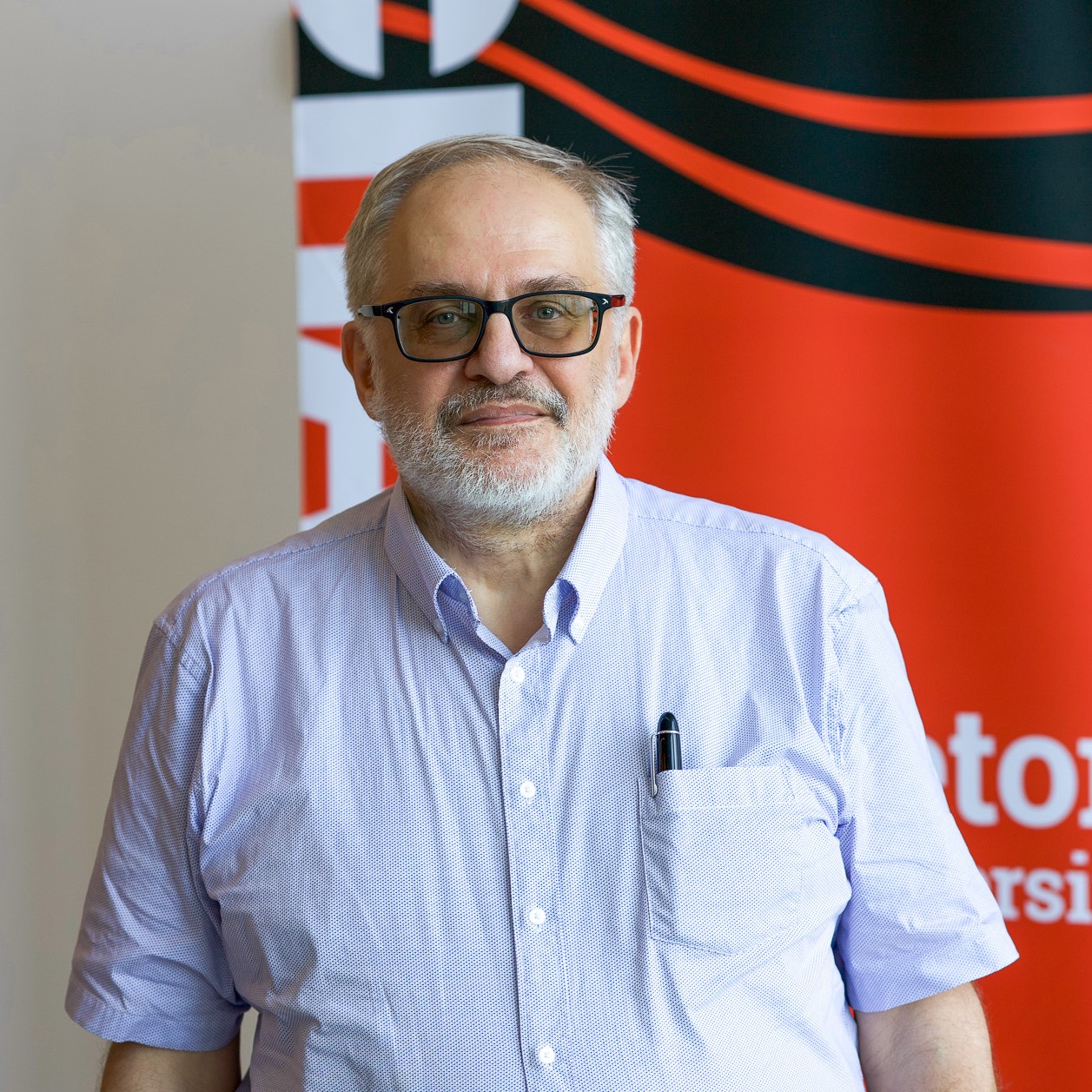
Ioannis Lambadaris is a Full Professor and Chancellor’s Professor at Carleton University's Department of Systems and Computer Engineering, Faculty of Engineering and Design. Holding a Ph.D. from the University of Maryland, he has contributed extensively to network performance analysis over 25+ years. Specializes in stochastic processes, cloud computing, and wireless edge systems Led Ericsson 5G Chair initiatives Supervised over 70 graduate students His research spans QoS control , VNF placement optimization , and IoT indoor localization , with over 170 publications. Recent work focuses on reinforcement learning and deep learning in network resource allocation. Scientific Recognition: Chancellor’s Professor Ericsson 5G Chair Contact: ioannis@sce.carleton.ca | Office: Mackenzie 4448, Ottawa, ON
Berend Jan van der Zwaag is an Assistant Professor at Universiteit Twente, affiliated with the Sensors and Smart Systems Research Centre. His work contributes to UN Sustainable Development Goals related to sustainable industry and innovation. He focuses on Artificial Intelligence, Cyber-physical systems, and Machine Learning applications in sensor networks and inertial measurement systems. Research interests include equine gait analysis using IMU sensors, machine health monitoring through ontology-based frameworks, and wireless sensor network design. Notable projects include the EquiMoves system for objective horse gait examination and an ontology framework for smart product-service systems in industrial IoT. Recent work emphasizes terrain classification for equine systems, gait event estimation, and speed estimation using body-mounted sensors. His publications span conferences like IEEE DCOSS-IoT and journals like Sensors and IEEE Internet of Things Journal. Accepting PhD Students Key collaborator: Prof. Paul Havinga (Twente) Research partnerships in Netherlands and international institutions
Aykut Fatih GÜVEN is an associate professor at Yalova University, specializing in renewable energy systems and optimization algorithms. His work focuses on sustainable energy integration in microgrids, hybrid systems, and electric vehicle (EV) infrastructure. He has conducted extensive research on metaheuristic optimization algorithms like the Artificial Rabbit Algorithm and Cheetah Optimization, applying them to energy storage, distributed generation, and grid stability challenges. Education: Yalova University (PhD implied via academic rank). Research interests include renewable energy optimization, smart grid technologies, and algorithm-driven solutions for energy efficiency. His studies often address real-world applications such as EV charging stations, hydrogen storage, and cost-effective hybrid systems for public facilities. Key trends in his articles include hybrid energy system design, algorithmic optimization for control systems, and sustainability assessments in regional energy projects. He has explored topics like protective relay coordination, fractional PID controllers, and the economic feasibility of off-grid solutions. His work emphasizes practical implementations, such as feasibility studies for hybrid systems in Turkish regions (e.g., Yalova, Mugla) and the integration of renewable energy into public hospitals and hotels.
Alaa Sheta is a tenured Professor of Computer Science at Southern Connecticut State University , New Haven, CT, USA. With over 180 refereed publications, three authored books, and extensive funded research, he is a globally recognized authority in machine learning, evolutionary computation, image processing, and robotics. Education B.E. Electronics & Communication Engineering, Cairo University, 1988 M.Sc. Electronics & Communication Engineering, Cairo University, 1994 Ph.D. Computer Science, George Mason University, USA, 1997 Research Interests Prof. Sheta’s research integrates machine learning , deep learning , and evolutionary algorithms to solve complex real-world problems. Core themes include image and signal processing for medical and industrial applications, autonomous robotics for navigation and inspection, big-data analytics for environmental and financial forecasting, and software reliability modeling using computational intelligence. His work frequently leverages meta-heuristic optimization techniques such as genetic algorithms, particle swarm optimization, and hybrid neuro-fuzzy systems. Publication Trends From 2015-2021, Prof. Sheta’s publications reveal a clear pivot toward deep learning and healthcare informatics , with multiple studies on obstructive sleep-apnea diagnosis using ECG and depth-sensor data, brain-tumor detection in MR images, and mobile-health applications. Earlier work emphasizes industrial process modeling , power-system optimization , and software effort estimation , reflecting sustained contributions across both theoretical algorithmic advances and high-impact interdisciplinary applications. Scientific Awards & Honors Best Poster Award, SGAI International Conference on Artificial Intelligence, Cambridge, UK, 2011 Senior Member, IEEE Vice-President, Arab Computer Society (2011) Associate Editor, International Journal of Advanced Computer Science and Applications (IJACSA) Associate Editor, International Journal of Computational Complexity and Intelligent Algorithms (IJCCIA) Advising & Grants Prof. Sheta has successfully supervised more than 30 master’s and Ph.D. students in the United States, United Kingdom, Jordan, and Syria. His research has been funded by the U.S. National Science Foundation , as well as agencies in Egypt, Saudi Arabia, and Jordan. He has also consulted for the Egyptian Ministry of Communication & IT (2002-2004) and UNDP Smart Schools project (2003). Labs, Workshops & Leadership He is the founder and chair of the Advanced Computation for Engineering Applications (ACEA) workshop series, held five times across Egypt, Jordan, and Saudi Arabia. He served as Program Chair of the Science and Information Conference 2013 in London and has held academic leadership roles such as Associate Dean (2008-2009) and Assistant Dean for Planning & Development (2006-2008) at Al-Balqa Applied University, Jordan.
Staniša Perić is an Associate Professor at the Department of Automation, Faculty of Electronic Engineering, University of Niš, Serbia. Elected to this position in 2023, he specializes in control systems and signal processing with 21 impact-factor journal publications to his name. Education: PhD in Systems Control, Faculty of Electronic Engineering, University of Niš (2016) Diploma in Automation, Faculty of Electronic Engineering, University of Niš (2009) Research Focus: Dr. Perić's work bridges Control Engineering and Signal Processing , with groundbreaking contributions in Sliding Mode Control for Automotive Systems and Advanced FIR Filter Design . His research integrates Orthogonal Endocrine Neural Networks for real-time control applications, particularly in Anti-lock Braking Systems (ABS), while developing ultra-selective multiplierless filters for hardware-efficient signal processing. Publication Analysis: His 11 representative publications (2010-2017) reveal a clear trajectory: early work focused on orthogonal function applications in antenna systems and filter design, evolving into neural network-enhanced sliding mode control for automotive safety systems. The 2015-2017 period shows intensive development of biologically inspired neural networks for dynamic system modeling and time-series forecasting. Research Engagement: National Research Projects: 2 International Research Projects: 4 Collaborative Environment: As a core member of the Department of Automation, Dr. Perić contributes to research groups specializing in intelligent control systems and advanced signal processing. His work directly supports the faculty's strategic focus on automotive electronics and embedded control solutions, with experimental validation conducted through university-industry partnerships in automotive safety systems.
Ramiro de Sousa Barbosa is a Coordinator Professor at the Instituto Superior de Engenharia do Porto (ISEP) within the Polytechnic Institute of Porto (IPP) , and a researcher at the Research Group on Engineering and Intelligent Computing for Innovation and Development (GECAD) in the Associated Laboratory for Intelligent Systems (LASI) . He holds a Ph.D. (2005) and M.Sc. (2000) in Electrical and Computer Engineering from the University of Porto . Research Interests: Fractional Calculus in Control Artificial Intelligence Evolutionary Algorithms Robotics Nonlinear Systems His work includes over 130 publications and active participation in R&D projects like LA/P/0104/2020 and TradeRES . He serves as a reviewer for journals including IEEE , Springer , and MDPI , and has edited 6 special journal issues. Article Trends: Recent publications focus on neural networks for robotics, fractional calculus in control systems, evolutionary algorithms for optimization, and smart energy systems. The 15 most recent works span 2025-2008, with keywords in Computer Science , Control Engineering , and Renewable Energy . Professional Roles: 2020-present: Coordinator Professor at ISEP 2010-2020: Adjunct Professor at ISEP 2004-present: Researcher at GECAD Projects: Currently leads research in Intelligent Systems Associate Laboratory and Smart Energy Systems , with past involvement in 8+ EU Horizon projects.
Manuel Jesus Lopez Sanchez is a tenured professor at the University of Cádiz, Spain, affiliated with the College of Engineering and the Department of Automatic Engineering, Electronics, Computer Architecture, and Networks. His work focuses on Systems Engineering and Automation, with expertise in Nonlinear Dynamics, Cyber-Physical Systems, Robust Control , and Advanced Process Control . He has developed control methodologies for chaotic systems, marine applications, and real-time simulation environments. Education: PhD in Systems Engineering (1999) - University of Cádiz PhD in Systems Engineering (1995) - University of Sevilla His research spans multiple domains including chaos control , marine automation , and real-time systems . Key contributions include H∞ controller designs for aircraft , adaptive ship stabilization systems , and open-source hard real-time environments . Article trends show sustained focus on robust control algorithms (7/15 articles), chaotic system stabilization (5/15 articles), and maritime automation (6/15 articles) since the 1990s. He has collaborated on numerous projects, including the development of the ControlAvH software for controller design and the EPESC real-time simulation system. His work integrates nonlinear control theory with practical hardware implementations , often through experimental validation using physical systems like chaotic circuits and marine vessels.
Mert Can is a Research Assistant at Istanbul Technical University in the Control and Automation Engineering department. His work spans interdisciplinary fields combining control theory with artificial intelligence. Doctorate in Control and Automation Engineering (2020) Master's in Control and Automation Engineering (2017) Bachelor's in Control and Automation Engineering (2012) His research focuses on: Optimizing variable-order fractional derivatives for adaptive control systems Applying AI to friction damper distribution in seismic protection Developing robust loss functions using fractional calculus Recent publications demonstrate expertise in quadcopter position control and graph neural networks for neuroimaging data fusion. Key trends include: Integration of AI with traditional control systems Advancements in fractional calculus applications Optimization methods for structural engineering No scientific awards are currently recorded.
Dr. Аlenka Milovanović is a Full Professor at the Department of Electrical Engineering, Faculty of Technical Sciences Čačak, University of Kragujevac. Her research focuses on Automatic Control , Electromagnetics , and Electrical Measurement , with over two decades of contributions to fields like PID control systems, magnetic material characterization, and educational technology integration. Affiliations: University of Kragujevac, Faculty of Technical Sciences Čačak Roles: Full Professor, Department of Electrical Engineering Her research interests span control systems , magnetic materials , and virtual instrumentation . Notable contributions include studies on nonlinear tank-level control, PID algorithms, and remote laboratory setups for electrical engineering education. She has authored/co-authored 7 books and over 50 peer-reviewed articles , with recent work focusing on applications in maritime engineering and e-learning platforms. Dr. Milovanović has actively participated in international conferences (e.g., ПЕС, UNITECH, KIMC) and contributed to projects like virtual instrumentation for magnetic flux measurement and energy efficiency testing. Her work emphasizes practical applications, such as improving control systems for marine boilers and developing educational tools for remote experimentation.
Professor Nejat Olgac is a distinguished faculty member in the Mechanical Engineering Department at the University of Connecticut's College of Engineering. He joined the UConn faculty in 1981 and continues to be an active researcher and educator. Dr. Olgac directs the Advanced Laboratory for Robotics, Automation and Manufacturing (ALARM) at UConn and has held guest professor positions at INRIA (France), Technical University of Munich, Harvard University, and Czech Technical University in Prague. Doctor of Science from Columbia University (1976) in Mechanical Engineering M.Sc. from Technical University of Istanbul, Turkey (1972, summa-cum-laude) in Mechanical Engineering Professor Olgac's research spans multiple domains within mechanical engineering and control systems, with particular emphasis on time-delayed systems and vibration control. His work bridges theoretical developments with practical applications across various industries. His research interests include time-delayed systems, vibration suppression techniques, nonlinear robust control of dynamic systems, and micromanipulation in cellular biology. A significant portion of his work focuses on developing mathematical paradigms for complex control problems, with direct applications in manufacturing, aerospace, and bioengineering. Analysis of Professor Olgac's recent publications (2019-2025) reveals a strong focus on advancing the Delayed Resonator concept and Cluster Treatment of Characteristic Roots (CTCR) methodology. His research has evolved toward addressing increasingly complex vibration control problems, particularly non-collocated systems and multi-frequency applications. The publications demonstrate a consistent trajectory of theoretical advancement coupled with experimental validation, showing strong connections between his mathematical frameworks and practical engineering solutions across multiple domains including manufacturing, aerospace, and bioengineering. UCONN Research Excellence Award (2015) ASME Distinguished Engineer Award of the Year, Hartford Chapter, CT (2015) Doctor Honoris Causa from Czech Technical University, Prague (2019) Professor Olgac's research has been consistently supported by major funding agencies including DoE, NSF, NIH, ONR, NOAA, and ARO, as well as industry partners such as GE, Pratt and Whitney, Sikorsky, and General Dynamics. His work has resulted in multiple patents, including three for the Delayed Resonator concept (1995, 1996, 1999) and one for optimized high-speed machining chatter (2011). He has served in numerous leadership roles including General Chair of IFAC Time Delay Systems Workshop (2012) and General Chairman of ASME Dynamic Systems and Controls Conference (2013). As director of the Advanced Laboratory for Robotics, Automation and Manufacturing (ALARM), Professor Olgac leads a research team that integrates theoretical control systems development with practical applications in robotics, manufacturing, and bioengineering. His laboratory serves as a hub for interdisciplinary research, connecting mechanical engineering principles with applications in cellular biology and advanced manufacturing processes.
Zhenyu Yang is an Associate Professor at Aalborg University's Department of Energy within The Faculty of Engineering and Science. He specializes in control theory, AI-driven automation, and industrial process control, with a focus on offshore energy and water treatment systems. He leads the Offshore Process Control and Cybernetics Research Group and chairs the Mission for Sustainable Fuels, Chemicals, and PtX. His work aligns with UN Sustainable Development Goals related to clean energy and environmental protection. Education: B.Sc., M.Sc., and Ph.D. in Control Theory from Shandong University and Beijing University of Aeronautics and Astronautics. Postdoctoral training at Delft University of Technology and Aalborg University. Completed pedagogic education for assistant professors and interdisciplinary leadership training. Research interests include fault-tolerant control systems, hybrid dynamical systems, AI for process automation, and water treatment technologies. He has supervised 6 PhD students, including M. Kashani. Notable awards include Teacher of the Year 2012 and ABB Best Application Award Finalist 2009. Key projects involve high-temperature heat pumps, offshore produced water treatment automation, and microplastics capture using hydrocyclones. He has authored 198 publications and actively participates in academic committees and international conferences. Collaborations span institutions globally, emphasizing sustainable energy solutions and advanced control systems.
Tooran Emami is a tenured full professor of Electrical Engineering in the Department of Electrical Engineering and Computing at the U.S. Coast Guard Academy (USCGA). She joined USCGA as a Tenure Track Assistant Professor in July 2011, advanced to Tenured Associate Professor in August 2017, and currently serves as a Tenured Professor since August 2023. Prior to USCGA, she was an adjunct faculty member at Wichita State University for three semesters. Ph.D., Electrical Engineering, Wichita State University M.S., Electrical Engineering, Wichita State University Dr. Emami's research focuses on control systems, with expertise in Proportional-Integral-Derivative (PID) controller design, robust control, time-delay systems, compensator design, analog and digital filter design, and hybrid fuel cell power plant design. Her work bridges theoretical control engineering with practical applications in energy systems, particularly fuel cells and renewable energy integration. She has made significant contributions to engineering pedagogy, developing innovative teaching methods for hybrid and virtual learning environments. Analysis of Dr. Emami's recent publications reveals a strong focus on PID controller design methodologies, particularly for systems with time delays. Her work increasingly integrates renewable energy systems, with numerous publications on hybrid fuel cell, solar, and battery systems. She maintains a dual focus on theoretical control systems and practical engineering education, with several publications addressing project-based learning approaches in electrical engineering education. Center for Advanced Study Summer Fellowship Award (2012) Spirit of The Bear Award (2016) Outstanding Doctoral Dissertation Award at Wichita State University Student Paper Award from Engineering Physics and Physics Division (2022) Multiple Best Paper and Student Paper Awards at ASEE conferences Dr. Emami serves as Lead Advisor for Electrical Engineering and Cyber Systems Majors and Advisor for Electrical Engineering Senior Capstone Projects. She has held numerous leadership positions including Interim Program Chair of Electrical Engineering, ASEE Electrical and Computer Engineering Division Program Chair, and Faculty Senate Vice President. Her service extends to conference organization, where she has served as Session Chair, Program Committee member, and Scientific Committee member at national and international conferences. She previously served as Ph.D. Student Dissertation Co-Adviser and Master Student Theses Co-Adviser at Wichita State University. Dr. Emami actively participates in professional organizations as a Senior Member of IEEE and member of IEEE Control System Society and American Society for Engineering Education. Her leadership roles in ASEE include serving as Electrical and Computer Engineering Division Vice Chair, Engineering Physics and Physics Division Program Chair, and Ocean Engineering Division Publication Chair. She has contributed to numerous conference committees and served as an advisor for Lockheed Martin Ethics in Engineering Case Competitions.
Ibrahim Eke serves as an Associate Professor in the Department of Electrical and Electronic Engineering within the Faculty of Engineering and Natural Sciences. His academic work centers on advancing power system stability and optimization through innovative computational methods, with primary affiliations spanning electrical engineering research and education. Professor Eke's research spans critical areas of electrical power engineering including economic load dispatch, load frequency control, voltage stability, and renewable energy integration. He specializes in developing heuristic optimization algorithms such as Electric Fish Optimization, Chaotic Particle Swarm, and Vortex Search to solve complex power system problems involving time delays, multi-area networks, and renewable integration challenges. His methodology consistently bridges theoretical algorithm development with practical power grid applications. Analysis of his 15 most recent publications (2020-2024) reveals three dominant research trajectories: (1) Mitigation of communication time delays in load frequency control using fractional-order PID controllers and neural networks, (2) Development of hybrid optimization techniques (Taguchi-Vortex, Chaotic PSO) for combined heat-power economic dispatch, and (3) Integration of electric vehicles and energy storage systems into frequency regulation frameworks. His work demonstrates increasing focus on renewable-heavy grid stability amid evolving power system architectures.
Piotr Derugo is a researcher at the Department of Electrical Machines, Drives and Measurements within the Faculty of Electrical Engineering at Wrocław University of Science and Technology. His work focuses on advanced control systems for electric drives, integrating fuzzy logic, neural networks, and Petri net methodologies. He maintains an active research program in adaptive control and optimization. Specializes in neuro-fuzzy PID controllers Investigates Petri net applications in drive control Develops low-computational cost fuzzy algorithms Researches torsional vibration damping techniques Recent publications demonstrate his expertise in disturbance observers, hybrid neural networks, and AI-driven control systems for electric drives. While no formal awards are highlighted in this profile, his contributions to nonlinear control systems and adaptive algorithms remain significant. Contact: piotr.derugo@pwr.edu.pl | Office hours: Tuesdays & Fridays 11.00-13.00
Tomasz Makowski is a Lecturer at the Department of Infotronics and Cybersecurity within the Faculty of Electrical and Computer Engineering at Cracow University of Technology. His work focuses on automation systems, control engineering, and cybersecurity, with active collaborations in robotics and IoT projects. Current affiliation: Cracow University of Technology Academic rank: Lecturer Research interests include: Automation systems and PLC programming 3D printing and Fusion 360 modeling Robotics and sensor networks Human-machine interfaces (HMI) and RFID technology Recent publications highlight applications in: Electromagnetic launcher control 3D printing integrations Smart greenhouse automation Experimental PID algorithm testing Mobile delivery robotics