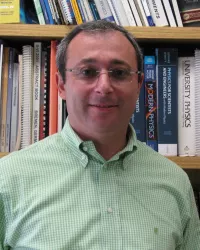
Oleg Shpyrko is a Professor and Department Chair in the Department of Physics at the University of California, San Diego (UCSD). He leads a research group focused on nanoscale structural dynamics using advanced x-ray scattering techniques. His work bridges hard and soft condensed matter systems, including magnetic materials, energy storage materials, and biophotonic nanostructures. Shpyrko earned his Ph.D. in Physics from Harvard University in 2004. His research leverages national facilities like the Advanced Photon Source (APS) and Linac Coherent Light Source (LCLS). Key areas include coherent x-ray imaging, domain dynamics in magnetic systems, and operando studies of battery materials. His research interests span: Coherent X-ray Scattering and Imaging Magnetic Domain Dynamics Nanostructured Materials Energy Storage (battery cathodes) Biophotonic Structures Phase Transitions Notable achievements include pioneering X-ray Photon Correlation Spectroscopy (XPCS) for antiferromagnetic domain studies and revealing dislocation dynamics in battery materials. His work has been featured in Nature , Science , and Physical Review Letters . Shpyrko has mentored over 15 graduate students and postdocs, many of whom have become faculty at top institutions. Awards include the NSF CAREER Award (2010), Hellman Fellowship (2009), and the Rosalind Franklin Young Investigator Award (2008). His group operates facilities including Dynamic Light Scattering labs, AFM/EFM microscopes, and collaborates with synchrotron and neutron sources globally.
Professor Kenneth S Schweizer is the G. Ronald and Margaret H. Morris Professor of Materials Science and Engineering, and holds concurrent professorships in Chemistry, Chemical and Biomolecular Engineering, and the Materials Research Laboratory at the University of Illinois at Urbana-Champaign (UIUC). He earned his B.S. (summa cum laude) from Drexel University and his Ph.D. in Physics from UIUC. His research focuses on statistical mechanics of soft materials, including polymers, colloids, and complex fluids, with emphasis on their thermodynamics, phase transitions, and nonlinear rheology. Key contributions include theories of glass transition dynamics, nanoparticle-polymer suspensions, and vitrimer networks. Schweizer has received prestigious awards such as the American Academy of Arts and Sciences membership (2021), APS Polymer Physics Prize (2008), and Hildebrand Award (2016). He has led major NSF-funded initiatives, including the Nanoscale Science and Engineering Center for Directed Assembly of Nanostructures. His work bridges fundamental theory and practical material design, addressing challenges in energy storage, biomaterials, and nanotechnology. Research interests span structural organization in soft materials, dynamic arrest phenomena, and the interplay between thermodynamics and relaxation processes. Recent studies explore ion transport in polymerized ionic liquids, activated dynamics in colloidal suspensions, and elastic properties of vitrimers. His theoretical frameworks, such as elastically collective activated dynamics and self-consistent hopping models, provide predictive tools for material innovation. Teaching and advising excellence is highlighted by UIUC awards including the 2022 Campus-wide Award for Excellence in Graduate Teaching. Schweizer’s labs and collaborations involve interdisciplinary teams addressing cutting-edge topics like biomolecular condensates and nanoconfined systems.
Nikolai Denkov is a Professor of Physical Chemistry at Sofia University's Faculty of Chemistry and Pharmacy, leading the Laboratory of Active Formulations and Materials since 2017. His administrative roles include Head of the Department of Chemical Engineering (2008–2015), Deputy Minister (2014–2016), and Minister of Education and Science of Bulgaria (2017). He holds a DSc from Sofia University (2007) and has authored over 160 peer-reviewed articles with an h-index of 45. Research focuses on colloid science, surfactant systems, and interfacial phenomena, including foam rheology, emulsion stability, and self-shaping of oil droplets. His studies bridge fundamental physics and industrial applications in cleaning agents, food technology, and pharmaceuticals. Key contributions include discovering antifoam mechanisms and self-emulsification processes. Recipient of the Solvay Prize (2019) and Bulgaria's highest scientific honor, 'Pythagoras' (2010) Supervised 12 PhD students and led 40+ industry-funded projects with companies like Unilever and BASF Active in international organizations: IACIS Council member, ERC panel chair, and ESA advisor His work emphasizes translational research, with patents in formulation technologies and over 7,300 citations. Current research explores smart materials and micro/nanostructured systems.
Prof. Dr. Nadine Buczek serves as Professor of Renewable Energies, Nanotechnology and Photonics at the Department of Applied Natural Sciences, Lübeck University of Applied Sciences (TH Lübeck), a position she has held since 2017. She leads the Energy Materials Laboratory and maintains active affiliations with the Climate and Environmental Protection Group, Materials for Storage and Renewable Energy Systems, and Photovoltaics Group. Her research centers on physical principles of renewable energy systems and photonics, with core expertise in solar technology, thermoelectrics, and nanoscale material engineering. She investigates spin wave phenomena in disordered magnetic materials and develops advanced fabrication techniques for silicon nanowires and superlattices using metal-assisted chemical etching, with applications in sustainable energy conversion and storage. Analysis of her 15 most recent publications (2012-2022) reveals consistent focus on condensed matter physics and nanomaterial engineering. Key trends include theoretical modeling of spin dynamics in alloys, structural characterization of etched semiconductor nanostructures, and optimization of nanofabrication processes for renewable energy applications. Her work bridges experimental nanotechnology with computational physics, primarily targeting semiconductor-based energy solutions. The Energy Materials Laboratory under her direction drives interdisciplinary research in photovoltaics and thermoelectric materials, collaborating closely with the Materials for Storage and Renewable Energy Systems group. Current projects emphasize scalable nanofabrication methods and fundamental studies of charge transport in nanostructured materials to advance next-generation renewable energy technologies.
Dr. Emanuele Marino is a Researcher in the Department of Physics and Chemistry at the University of Palermo , affiliated with the School of Basic and Applied Sciences . His work bridges quantum physics and nanotechnology, focusing on nanocrystal superparticles, photonic materials, and fluctuation-driven assembly processes. Current research areas include quantum dot lasing, Casimir effects, and 3D nanoparticle superlattices Teaches courses like Modern Physics Laboratory (2024, School of Basic and Applied Sciences) and Physics II (Polytechnic School) Recent publications highlight trends in: Tunable photonic properties via nanocrystal emulsion systems Quantum-excitonic coupling in heterostructures Critical Casimir forces for nanoparticle control Dynamic phase transformations in colloidal superlattices Microlaser fabrication and chirality engineering Based in the Emilio Segrè Physics and Chemistry Department , he conducts experimental and theoretical studies from nanoscale fabrication to quantum optical phenomena.
Professor Neil Cameron is the Monash Warwick Alliance Professor of Polymer Materials, splitting his time between Monash University's Department of Materials Science and Engineering (Australia) and the University of Warwick's School of Engineering (UK). His research focuses on polymeric biomaterials for applications in tissue engineering, regenerative medicine, and drug delivery. He holds a PhD in Polymer Chemistry and a BSc in Chemistry from the University of Strathclyde. Key research themes include: New Tools for Biology: Scaffolds for 3D cell culture, glycopolymers, and polypeptides. New Tools for Chemistry: Supported catalysts and mass spectrometry methods for polymer sequencing. Materials for Medicine: Drug delivery systems targeting the eye, nanomedicine, and biodegradable scaffolds. Synthetic Biology: Polymersome-based protocells and glycosylated nanoparticles. His projects span interdisciplinary collaborations, including the development of biodegradable ligament scaffolds, functionalized cellulose materials, and novel mass spectrometry techniques. He leads or co-investigates grants such as the SURE-Poly project on recyclable polymers and the NHMRC Equipment Grant for UV lamp adaptors. Labs/Teams: Active in Monash’s Materials Science group and collaborates with Warwick researchers. His lab specializes in biomaterials design, with a focus on scalable production and clinical applications.
Dr. Axel Lubk is a Group Leader at the Institute for Solid State Research (IFW Dresden) , specializing in advanced electron microscopy techniques for materials science. His research spans four key areas: (1) TEM method development (high-resolution imaging, tomography, holography, and in-situ techniques), (2) charge particle optics and scattering theory , (3) magnetic nanotextures (domain walls, skyrmions), and (4) plasmonics (mode hybridization in heterogeneous structures and semiconductor heterostructures). Dr. Lubk’s work focuses on three-dimensional magnetic texture analysis using electron holography and tomography, particularly in systems like skyrmion tubes , FeGe , and Cr2O3 thin films . He has pioneered techniques for vector-field electron tomography and phase retrieval under varying boundary conditions, advancing nanoscale magnetic imaging. His recent studies include plasmonic properties in AgAu nanosphere chains , thermoelectric multilayer systems , and topological insulators like NiRh2Sb and TaTMTe4 . Dr. Lubk has published extensively in high-impact journals such as Nature Communications and Advanced Materials , with a focus on TEM instrumentation and quantitative analysis . He frequently presents at international conferences like the International Microscopy Congress and European School of Magnetism , emphasizing applications in spintronics , quantum materials , and nanostructured systems . His contributions to holographic vector-field electron tomography and machine learning for spectrum-image data have set new standards in electron microscopy.
Igor L. Kuskovsky is a Professor & Chair in the Department of Physics at Queens College of the City University of New York (CUNY). He holds a Ph.D. in Applied Physics/Solid State (1998) and an M.S. in Materials Science and Engineering (1995), both from Columbia University. His research focuses on nanoscale materials, particularly type-II quantum dots and their applications in photonic devices, solar energy, and biomedicine. His work includes pioneering studies on the optical Aharonov-Bohm effect in ZnTe/ZnSe quantum dots and developing high-efficiency intermediate-band solar cells. He leads the Laboratory for Fundamental and Applied Nanoscale Physics (LAFANP), collaborating with institutions like Hunter College on bio-detection systems using quantum dots. Key research areas include excitonic phenomena, magnetooptical properties, and colloidal ZnO nanostructures. His team investigates quantum dot stacks, nanowire growth via CVD, and dielectric confinement effects. He teaches PHYS 225: Solid State Electronics and advises graduate students in experimental condensed matter physics. The group’s work bridges fundamental physics with applied nanotechnology, emphasizing interdisciplinary applications.
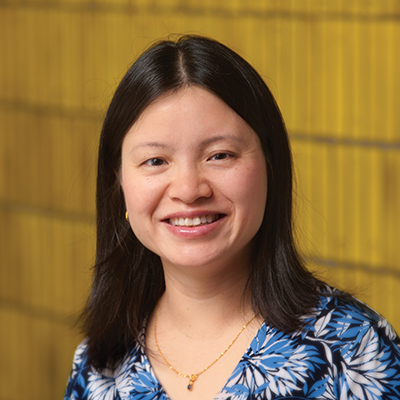
Shu Yang is the Joseph Bordogna Professor and Department Chair of Materials Science and Engineering at the University of Pennsylvania's School of Engineering and Applied Science. Her research spans multiple departments, with primary appointments in both Materials Science and Engineering and Chemical and Biomolecular Engineering. She directs the Yang Lab, which operates at the intersection of multi-materials synthesis, nano-/microfabrication, and device processing, backed by deep understanding of physical, mechanical and biological principles. Director, Center for Analyzing Evolved Structures as Optimized Products (AESOP) Principal Investigator, NSF NRT: Climate Action and Resilience for Extreme Urban Heat (CLIMATE-CARE) Member of the Engineering Research Visioning Alliance (ERVA) Professor Yang's research focuses on developing novel materials synthesis, assembly and eco-manufacturing of complex, multi-functional, nano- to macrostructured soft, sustainable materials and composites. Her lab addresses fundamental questions centered around surface/interface, actuation mechanisms, and structure-property relationships. Through directed assembly of oligomers, polymers, gels, colloids, liquid crystals, amphiphiles, and their composites with inorganic materials and biomolecules across nano- to macroscales, her team creates complex, multi-functional nano- and microstructures with unique surface, optical, and mechanical properties. Analysis of Professor Yang's recent publications reveals a strong trend toward environmentally responsive materials with applications in sustainability, water harvesting, carbon capture, and climate resilience. Her work increasingly integrates kirigami engineering principles with liquid crystal elastomers to create programmable, shape-morphing materials. The research shows a clear trajectory from fundamental materials science toward real-world applications addressing global challenges, particularly in climate action and sustainable infrastructure. Inaugural Nat Geo 33 Extraordinary Changemaker List 2022 Cozzarelli Prize from PNAS for Class III: Engineering and Applied Sciences Advanced Materials Hall of Fame collection recognition Multiple highly cited papers according to Web of Science Professor Yang's research group has secured significant funding for projects addressing climate change, sustainable materials, and advanced manufacturing. Her lab has developed numerous technologies with potential applications in coatings, adhesives, smart windows, displays, sensors, soft robotics, biomedical devices, dehumidifiers, and carbon-absorbing concrete. The Yang Lab maintains a strong mentoring record with numerous students and postdocs who have gone on to successful careers in academia and industry. Her group actively collaborates across disciplines, working with biologists, physicists, environmental scientists, and engineers to tackle complex challenges. The Yang Lab operates state-of-the-art facilities for materials synthesis, characterization, and fabrication. The lab is particularly known for its expertise in liquid crystal elastomers, kirigami engineering, and biomimetic materials. The group maintains strong industry partnerships and has filed multiple patents based on their research. Their facilities enable everything from molecular-scale synthesis to macro-scale manufacturing of functional materials, with particular strength in bridging these scales through innovative design principles.
Gaurav Arya is a Professor in the Thomas Lord Department of Mechanical Engineering and Materials Science at Duke University, with additional appointments in the Department of Chemistry and Biomedical Engineering. His research laboratory employs physics-based computational tools to investigate biological and soft-material systems at the molecular scale. Ph.D. from University of Notre Dame (2003) B.Tech. from Indian Institute of Technology Delhi (1998) Research focuses on: Molecular modeling and simulations Statistical mechanics DNA nanotechnology Viral DNA packaging Chromatin biophysics Polymer-nanoparticle composites Recent research trends emphasize AI-driven materials discovery and programmable DNA nanostructures. Key grants include: NSF DMREF: Architecting DNA nanodevices (2023-2027) DOE Mesoscale Self-Assembly (2020-2027) UC San Diego Ligand-Nanocrystal Interlayer Studies (2024-2027) Scientific contributions: Featured in 2025 Nature Communications on DNA superstructures 2022 Science Advances on DNA nanodevice reconfiguration 2021 PNAS on viral DNA packaging motors
Anand Yethiraj is a Professor and Canada Research Chair at the University of Guelph, specializing in soft matter physics and colloidal self-assembly. His research focuses on understanding structure, dynamics, and phase behavior in complex systems such as colloids, polymers, and liquid crystals using advanced techniques like fluorescence microscopy and NMR spectroscopy. Education: B.Sc. (Chemistry), St. Xavier's College, Bombay M.Sc., University of Houston Ph.D., Simon Fraser University Research Interests: Self-assembly in soft matter and nanostructures Colloidal phase transitions and external field control Macromolecular crowding effects in biological systems Electrohydrodynamics and microfluidic systems His work bridges fundamental physics with applications in materials science and biophysics. Recent Trends in Publications: Recent studies emphasize tunable colloids, field-responsive materials, and the interplay between confinement and dynamics in crowded environments. Articles often explore experimental techniques like NMR and confocal microscopy to probe structural and kinetic phenomena at microscopic scales. Awards: Canada Research Chair Grants & Advising: No explicit grants listed. Prospective students are encouraged to contact him directly, referencing his publications to align with his research directions. Labs/Teams: Research conducted in University of Guelph labs focused on soft matter and colloidal systems, though specific lab names are not specified in the provided texts.
Fang Lu serves as Staff Scientist at Brookhaven National Laboratory's Center for Functional Nanomaterials (2012-present) and Adjunct Professor at Stony Brook University (2021-present), focusing on nanomaterial synthesis for energy applications. Education Ph.D. in Condensed Matter Physics, Chinese Academy of Sciences, China Research Focus Dr. Lu pioneers shape/size-controllable nanoparticle synthesis (Au, Ag, Pd, Pt) and multi-component nanostructures using DNA-driven assembly. His work bridges structural characterization (SAXS/EM) with functional applications in electrocatalysis and plasmonics, targeting energy-conversion materials. Expertise spans particle surface modification, collective optical properties, and biomolecule functionalization. Publication Trends Recent publications (2023-2025) reveal evolution from fundamental synthesis toward applied energy systems: DNA-mediated chiral nanomaterials for sensing, facet-specific electrocatalysis (e.g., glycerol oxidation), and perovskite solar cell enhancements. Consistent themes include nanocrystal interface engineering and translating structural control into functional properties. Laboratory Context At Brookhaven's Center for Functional Nanomaterials, Dr. Lu utilizes state-of-the-art nanofabrication and characterization facilities within a multidisciplinary team advancing energy, quantum, and biological nanotechnology research.
Fernando A. Escobedo is a Professor in the Department of Chemical Engineering at Cornell University's College of Engineering, holding the Marjorie Hart Chair of Engineering since joining the faculty in 1998. His research pioneers computational methodologies for understanding entropy-driven self-assembly in complex soft matter systems, with applications spanning solar cells, battery electrodes, and advanced membranes. His educational background includes: B.S. in Chemical Engineering from Universidad de San Agustin, Peru (1986) M.S. in Chemical Engineering from University of Nebraska-Lincoln (1993) Ph.D. in Chemical Engineering from University of Wisconsin-Madison (1997) Professor Escobedo's work centers on molecular-level simulations of thermodynamic and kinetic properties, with particular emphasis on entropy's role in forming intermediate-ordered phases like liquid crystals and block copolymer mesophases. His group develops novel computational frameworks to establish structure-property relationships for nanoscale building blocks, enabling rational design of materials with tailored mechanical, optical, and transport properties. This research bridges statistical mechanics with practical engineering challenges in nanomaterials synthesis. Analysis of his 2023-2025 publications reveals three dominant trends: (1) machine learning integration for multiscale materials design, (2) entropy-controlled phase behavior in non-additive colloidal mixtures, and (3) molecular engineering of liquid crystalline oligomers for enhanced ion transport. Key advancements include heuristic rules for nanoparticle superlattice stability and diffusionless transition mechanisms in faceted colloids. His scientific recognition includes: Fellow, American Physical Society (2014) AIChE Computational Molecular Science & Engineering Impact Award (2012) Alfred P. Sloan Foundation Fellowship (2004) NSF CAREER Award (2001) Camille & Henry Dreyfus Foundation New Faculty Award (1999) College of Engineering Teaching Excellence Award (2003) Professor Escobedo has secured sustained funding through competitive grants including the NSF CAREER award and Sloan Fellowship, supporting his computational research group's high-impact publications in top journals. His mentorship focuses on training graduate students in advanced simulation techniques, with research outputs frequently appearing in Journal of Physical Chemistry and Macromolecules . While no dedicated lab name is specified, his work operates at the intersection of Cornell's Chemical Engineering department and nanomaterials research initiatives, emphasizing collaborative approaches to entropy-driven assembly problems.
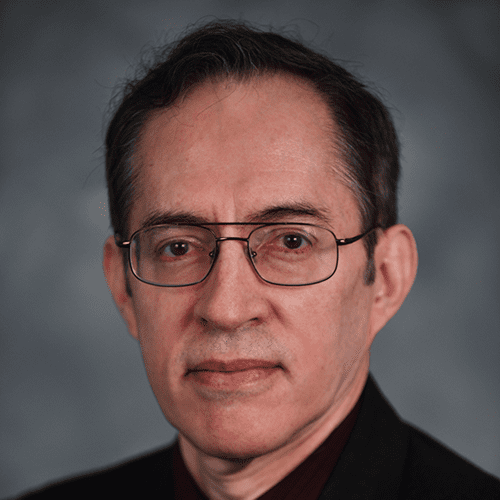
John F. DiTusa is a Professor of Physics and Dean of the School of Science at Indiana University. His research focuses on condensed matter physics, particularly in magnetic semiconductors, superconductivity, quantum criticality, and spintronics. He has extensive experience in crystal growth, electronic structure analysis, and experimental investigations of quantum materials. Ph.D. in Experimental Condensed Matter Physics from Cornell University (1992) B.A. in Physics with Honors from Oberlin College (1985) His work spans topics such as Dirac semimetals, chiral magnets, skyrmion lattices, and unconventional fermions. He has explored the interplay between magnetic order, structural transitions, and electronic transport in materials like MnSi, Sr 1−y Mn 1−z Sb 2 , and AuBe. The 15 most recent articles highlight his contributions to topological materials, quantum criticality, and spintronic systems. Keywords include Condensed Matter Physics , Quantum Transport , and Electronic Structure , with subfields like Dirac Semimetals , Chiral Magnets , and Magnetic Anisotropy . 2000 College of Basic Sciences Faculty Research Award 1998 Phi Kappa Phi Non-tenured Faculty Award 1997 NSF CAREER Award He has advised researchers across multiple institutions and collaborated on studies involving magnetic, thermodynamic, and transport properties of complex materials. His affiliations include the American Physical Society since 1988.
Zhen He (HE Zhen) is an Assistant Professor in the Department of Materials Science and Engineering at Southern University of Science and Technology (SUSTech). He obtained his B.A. in Materials Science from Northwestern Polytechnical University (2013) and Ph.D. in Inorganic Chemistry from University of Science and Technology of China (USTC, 2018). His research focuses on bioinspired nanostructures, advanced characterization techniques, and structure-property relationships in nanosystems. Biomimetic Nanodesign: Inspired by natural microstructures for functional nanomaterials Characterization Expertise: Synchrotron-based SAXS, AFM, and dynamic monitoring Structure-Property Analysis: Relating microscopic order to macroscopic material behavior He has published 28 papers in top journals including Acc. Chem. Res. , J. Am. Chem. Soc. , Angew. Chem. Int. Ed. , Adv. Mater. , and Small . His work has been supported by multiple National Natural Science Foundation of China projects, including both general and youth programs. Scientific Awards: Principal Investigator of NSFC Youth Program Principal Investigator of three NSFC General Projects Principal Investigator of two NSFC Youth Projects Dr. He collaborates with the Hefei National Laboratory for Physical Sciences at Microscale and works within SUSTech's College of Engineering. His current research explores nanowire self-assembly principles, precise control of nanofilms, and structure-property relationships in ordered nanosystems.