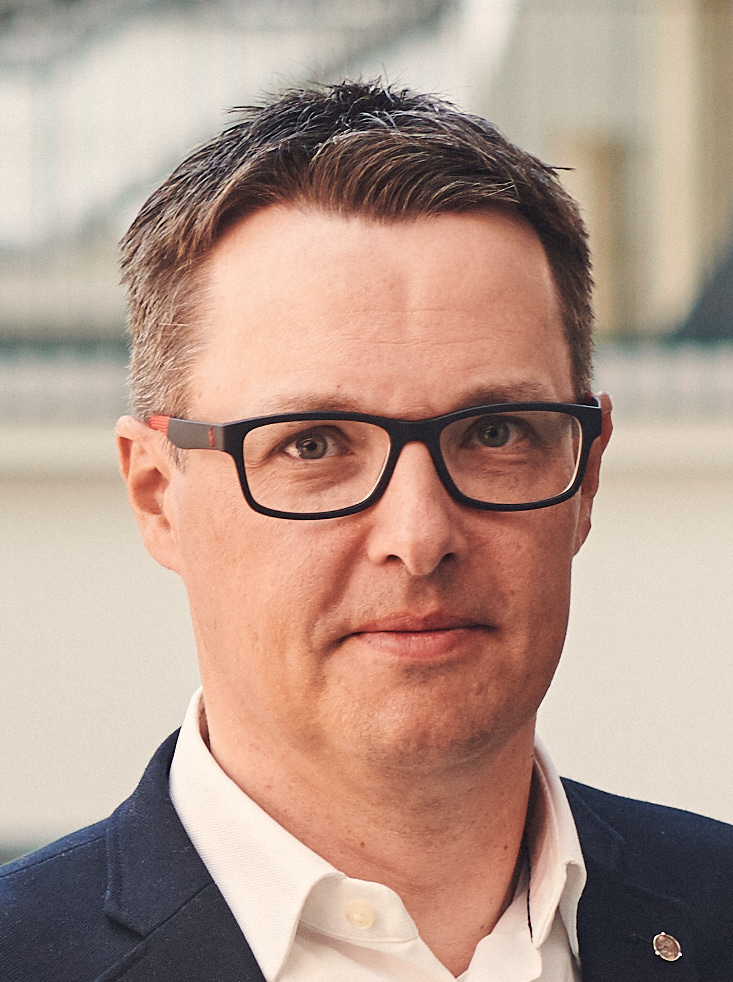
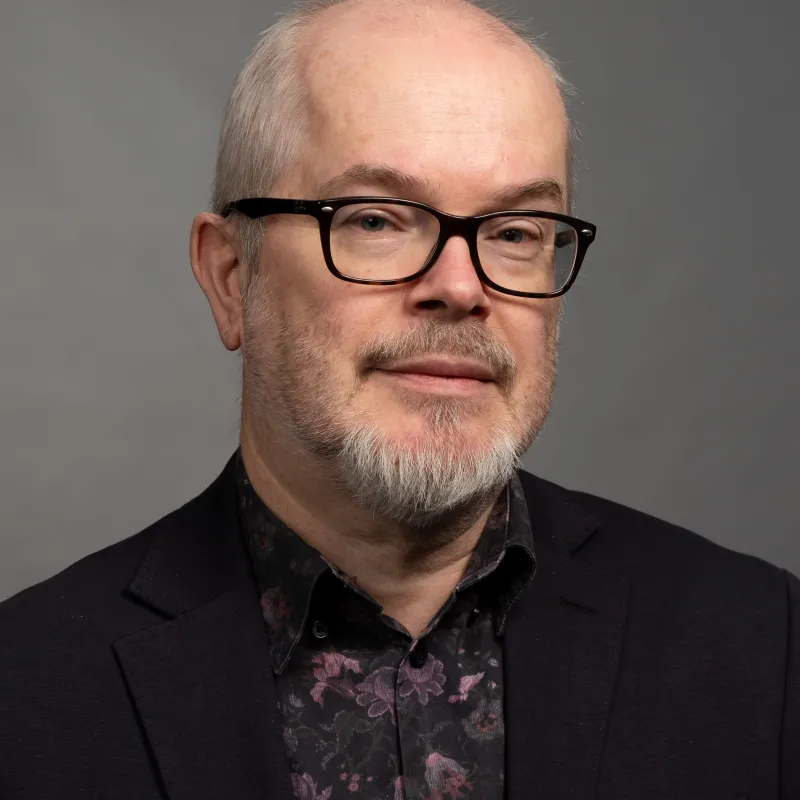
Kwantae Kim is an Assistant Professor at the Department of Electronics and Nanoengineering within Aalto University's School of Electrical Engineering . He leads the Tiny Systems and Circuits (TSirc) Group , focusing on power-efficient analog/mixed-signal ICs for biomedical and neuromorphic sensor systems. IEEE Senior Member (2025) Collaborates with institutions across Europe, Asia, and America Specializes in ultra-low-power AI-embedded IoT platforms His research emphasizes Tiny, Sensory, Intelligent, and Wireless IoT systems through: Development of energy-efficient IC architectures Democratizing access to advanced chip design Hardware-software co-design for edge computing Recent publications highlight innovations in: Spoken-language-understanding SoCs Temporal-sparsity-aware keyword spotting Open-source silicon frameworks Awards include: 2025 IEEE Senior Member 2023 Best Poster Award (AICAS) 2019 Samsung HumanTech Silver Award Research partnerships span: Prof. Tobi Delbruck (UZH/ETH Zurich) Prof. Hoi-Jun Yoo (KAIST) Prof. Shih-Chii Liu (UZH) Prof. Sohmyung Ha (NYU Abu Dhabi)
Dr. Juha Kärkkäinen is a University Lecturer and Principal Investigator at the Department of Computer Science, University of Helsinki, specializing in Algorithmic Bioinformatics. He supervises PhD students in the Doctoral Programme in Computer Science and actively contributes to research outputs and academic events. Institution: University of Helsinki Department: Department of Computer Science Rank: Lecturer His research focuses on string processing , data structures , and combinatorial pattern matching , with recent work on bijective Burrows-Wheeler transforms, LCP arrays, and efficient string indexing. Google Scholar lists publications spanning 2024 to 1999, highlighting his expertise in algorithm design and compression techniques . Notably, he has participated in and organized events like the International Workshop on Combinatorial Algorithms and delivered a keynote speech at the 1st Summer School on Bioinformatics Algorithms. While no explicit awards are detailed, his editorial roles in scientific collections and conferences underscore his academic influence.
Mikko Kurimo is a Full Professor at Aalto University's Department of Information and Communications Engineering, School of Electrical Engineering. He earned his M.Sc., Lic.Tech., and D.Sc.(Tech.) from Helsinki University of Technology (1992, 1994, 1997) and pioneered neural networks for automatic speech recognition (ASR) in his PhD thesis. After research roles at IDIAP (Swiss AI center) and visiting positions at University of Colorado, Edinburgh, SRI, ICSI, and Nitech, he leads Aalto's ASR group since 2000. His work focuses on unsupervised subword modeling for morphologically complex languages (Finnish, Estonian, Turkish, Arabic) and large speech foundation models. PhD in Neural ASR (Helsinki University of Technology, 1997) Research Scientist at IDIAP (Switzerland) Visiting Fellow at University of Colorado, Edinburgh, SRI, ICSI, Nitech Head of Aalto ASR Group (2000-present) His research spans deep learning for ASR, spoken language modeling , and low-resource language solutions . Recent work explores continued pre-training of self-supervised models, multimodal emotion recognition, and pronunciation assessment using LLMs. He led the winning team in the 2017 Multi-Genre Broadcast challenge and secured competitive funding in Tekes Challenge Finland and EC's H2020-ICT-2017. Key article trends include: Advancements in children's speech recognition and dysarthric speech processing Integration of generative AI for language learning feedback Specialization in low-resource Uralic languages (Finnish, Northern Sámi) Development of robust ASR systems for complex phonetic environments Scientific Awards ACM Multimedia 2023 Computational Paralinguistics Challenge Prize First place in MGB3 2017 Arabic ASR Challenge ISCA Best Student Paper Award (2011) Professeur Invité at Université de Saint-Etienne (2005-2006) Royal Society International Short Visit Fellowship (2004) Professor Kurimo leads the Speech Recognition Group at Aalto, collaborating with COIN (Centre of Excellence in Computational Inference) and AIRC (Adaptive Informatics Research Centre). His projects like CaptainA mobile app demonstrate practical applications of ASR in language education. He has supervised numerous publications with co-authors in domains spanning bandwidth extension, stuttering detection, and speech sound disorder assessment.
Jukka Manner is a Full Professor (tenured) of Networking Technology at Aalto University's Department of Communications and Networking (Comnet), School of Electrical Engineering. With a career spanning over two decades in internet technologies, he leads research in networking, wireless systems, and energy-efficient ICT solutions. Dr. Manner received his MSc (1999) and PhD (2004) degrees in computer science from the University of Helsinki. His academic journey has been marked by significant contributions to internet standardization through the IETF since 1999, where he served as co-chair of the NSIS working group. Professor Manner's research focuses on networking, software and distributed systems, with particular emphasis on wireless and mobile networks, transport protocols, energy efficient ICT and cyber security. His work bridges theoretical advancements with practical applications, addressing critical challenges in modern communication systems, sustainable networking practices, and security frameworks. His research group has made significant contributions to 5G technologies, UAV communications, and energy-efficient network design. His extensive publication record shows a clear evolution toward sustainability in networking technologies, with recent work focusing on energy efficiency in 5G systems, sustainable web technologies, and the environmental impact of digital infrastructure. The research demonstrates strong interdisciplinary connections between telecommunications engineering, computer science, and environmental science, with particular emphasis on reducing the carbon footprint of digital systems while maintaining performance. Cross of Merit, Signals (2014) Medal for Military Merits for contributions in national defence and C4 (2015) Professor Manner has supervised over 200 MSc theses and more than 20 doctoral dissertations, establishing himself as a dedicated mentor in the field. He has been principal investigator and project manager for over 15 national and international research projects, including serving as Academic Coordinator for the Finnish Future Internet research programme (2008-2012). His leadership extends to conference organization, having served as local co-chair of Sigcomm 2012 in Helsinki, and active participation as a peer reviewer and member of various Technical Program Committees. As an active contributor to internet standardization through the IETF, Professor Manner's work has practical impact on global networking technologies. His research group maintains strong connections with industry partners and participates in shaping future networking standards and practices, particularly in the areas of sustainable networking, 5G evolution, and security frameworks for emerging technologies.
Yu Xiao is an Associate Professor at the Department of Information and Communications Engineering, Aalto University, specializing in edge computing, extended reality (XR), wearable computing, and crowdsensing. Their research contributes to the UN Sustainable Development Goals, particularly in education and technology innovation. Active in mobile cloud computing and decentralized systems Principal Investigator in EU-funded projects (EMIL, TUTL) Expert in 5G networks, autonomous systems, and human activity recognition Yu Xiao's work spans interdisciplinary domains, including healthcare (cardiovascular resuscitation devices) and urban mobility (autonomous vehicle interactions). They have received multiple awards, including Best Paper Awards and Nokia Foundation Scholarships. Focus on low-latency communication and multiagent reinforcement learning Developed frameworks like FediLive for decentralized social networks Contributed to 128+ publications and software tools Recent collaborations include institutions like Pontificia Universidad Católica de Chile and participation in IEEE committees. Their research integrates blockchain for secure IoT communication and advanced AR applications.
Robert Piche is a Professor at the Computing Sciences Mathematics Research Centre, specializing in advanced signal processing, positioning systems, and sensor fusion. He holds a Doctor of Science (Technology) and Master of Science from the University of Waterloo, Canada (1986 and 1982, respectively). His research focuses on Kalman filters, Global Positioning Systems (GPS), particle filters, and indoor positioning technologies. He has contributed extensively to fields like satellite orbit prediction, non-line-of-sight (NLoS) positioning, and machine learning applications in biomechanics and robotics. Dr. Piche has authored over 230 publications and received recognition through an invitation/ranking in a 2014 competition. He actively participates in academic activities, including conference presentations and peer-review roles. His work bridges theoretical advancements and practical applications, with contributions to autonomous systems, sensor data analysis, and wearable technology. Collaborations span international institutions, reflecting his global impact in engineering and computer science disciplines.
Esa Rahtu is a Professor in the Department of Computer Science at Aalto University, Finland. His research focuses on computer vision, machine learning, and deep learning applications. He leads projects in image coding, neural networks, 3D reconstruction, object pose estimation, and anomaly detection. Rahtu has contributed to over 98 research outputs since 2017, with recent work emphasizing Gaussian splatting for SLAM, neural radiance fields, and hybrid video codecs for human-machine compatibility. His expertise spans visual-inertial odometry (e.g., ADVIO dataset), LiDAR-based place recognition, and manufacturing quality control systems. Key areas include: 3D scene reconstruction using Gaussian splatting techniques Deep learning models for anomaly detection in industrial processes Hybrid video codecs optimizing human perception and machine processing Multi-sensor fusion for robotic navigation and indoor mapping Notable datasets include ADVIO for visual-inertial odometry and FIORD for 3D reconstruction benchmarking. His research aligns with UN SDG 9 (Industry, Innovation & Infrastructure) and SDG 4 (Quality Education) through advancements in smart manufacturing and educational technology. Rahtu has received continuous research funding, including a grant period from April to June 2018. His work emphasizes practical applications, collaborating on real-world challenges like paper manufacturing quality control and smartphone-based 3D reconstruction.
Inigo Flores Ituarte is a Research Professor at Tampere University's Faculty of Engineering and Natural Sciences, affiliated with the Automation Technology and Mechanical Engineering department. He leads the Digital Design and Manufacturing (D2M) research lab, focusing on sustainable manufacturing and twin-transition strategies integrating digital and green technologies. His work emphasizes optimization-driven design, additive manufacturing innovations, and AI-driven expert systems to enhance energy efficiency and reduce environmental impacts. Key research pillars include: Pillar 1: Twin-transition in Engineering Design and Manufacturing Processes, addressing sustainable manufacturing and intelligent systems Pillar 2: Development of open D2M systems and Process-Structure-Property-Performance (PSPP) linkages in advanced materials His research explores multi-disciplinary optimization combining model-based simulations and data-driven techniques. Notable contributions include generative AI integration in CAD systems, cognitive manufacturing systems, and cost-effective process monitoring using CNN-based methods. Inigo's work emphasizes environmental sustainability, with a focus on reducing manufacturing's energy consumption (54% of global use) and CO2 emissions. He advocates for interconnected material systems, smart manufacturing processes, and AI-assisted decision-making to achieve cognitive intelligence in industrial operations. His D2M lab's overarching goal is to maximize product/process performance while improving cost-effectiveness and minimizing environmental footprints. Recent projects include railway bogie demonstrators via multi-material deposition and sensor systems leveraging IoT and ChatGPT integration.
Minna Palmroth is a Professor of Computational Space Physics at the University of Helsinki 's Faculty of Science , leading the Department of Physics 's Space Physics Research Group. She directs the Kestävän avaruustieteen ja -tekniikan huippuyksikön (Centre of Excellence in Sustainable Space Science and Technology) and serves as the principal investigator for the Vlasiator hybrid-Vlasov simulation framework.
Jarno Vanne is a Professor at the Department of Computing Sciences, Faculty of Information Technology and Communication Sciences at Tampere University. His research focuses on video coding standards, real-time systems, and hardware acceleration, particularly in the context of FPGA implementations and open-source tools. He leads projects involving VVC (Versatile Video Coding), V-PCC (Volumetric Video Coding), and HEVC (High Efficiency Video Coding), with an emphasis on efficiency, low latency, and machine learning integration. Key research interests include point cloud compression, saliency-guided encoding, parallelization schemes, and real-time video communication protocols. His work often addresses challenges in multi-party video streaming, embedded systems, and encryption mechanisms for privacy protection. He has contributed to open-source projects like the UVG dataset, Kvazaar encoder, and CiThruS simulation frameworks. Recent publications highlight advancements in VVC intra encoding optimizations, machine learning-driven partitioning schemes, and FPGA-accelerated solutions for edge computing. His research bridges theoretical video coding algorithms with practical implementations, aiming to improve compression efficiency while maintaining real-time performance.
Kari Lappalainen is an Assistant Professor in the Department of Electrical Engineering at Tampere University, affiliated with the Faculty of Information Technology and Communication Sciences. His research focuses on photovoltaic power systems, energy storage technologies, and renewable energy integration. He leads studies on photovoltaic module aging, parameter identification, and energy storage system optimization for power smoothing and ramp rate control. Key research interests include: Photovoltaic module diagnostics and performance analysis Energy storage system design for hybrid renewable plants Impact of environmental factors (e.g., temperature, cloud cover) on PV efficiency Advanced modeling techniques for photovoltaic systems Recent work emphasizes real-time monitoring of PV degradation via current-voltage curve analysis and optimization of energy storage configurations to mitigate power fluctuations. Over 50 peer-reviewed publications demonstrate sustained contributions to renewable energy systems research. Notably absent are awards or formal advisee listings, though collaboration with institutions like EU PVSEC and frequent conference participation indicate active academic engagement.
Prof. Vesa Välimäki is an Audio Signal Processing Professor at Aalto University's School of Electrical Engineering, leading the Audio Signal Processing Research Group within the Aalto Acoustics Lab. He also serves as Vice Dean for Research and Head of the Doctoral Programme at the university. His research focuses on digital signal processing, machine learning, and their applications in audio, acoustics, and music technology, particularly in artificial reverberation, audio filter design, and virtual analog modeling. He has pioneered techniques like velvet noise for reverberation synthesis and contributed to open-source tools like FLAMO. His academic accolades include IEEE, AES, and AAIA Fellowships, along with multiple best paper awards at venues like DAFx and ICASSP. He has advised numerous students, including recipients of prestigious awards like the Huawei Master's Thesis Award. Prof. Välimäki has held editorial roles at the Journal of the Audio Engineering Society and organized major conferences such as SMC-17. His work extends to applied projects like acoustic optimization for early childhood education facilities and immersive audio in virtual reality (e.g., the 'Space Walk' project). Key Projects: NordicSMC (Nordic University Hub for Sound and Music Computing), Aalto Acoustics Lab, FLAMO library Grants: NordForsk funding (2018–2023), Foundation for Aalto University Science and Technology His research spans both theoretical advancements (e.g., diffusion models for audio restoration) and practical implementations (e.g., real-time equalizers, headphone compensation systems). He collaborates internationally, contributing to acoustic measurement techniques and noise reduction strategies for diverse environments.
Heikki Handroos is a Full Professor of Mechanical Engineering at LUT University, leading the Laboratory of Intelligent Machines since 1993. He holds a DSc (Technology) from Tampere University of Technology and has served as Vice-Dean of the Faculty of Technology (2007-2009) and currently chairs the Collegiate Body of LUT University. His research focuses on mechatronics, robotics, control systems, and fluid power, with over 300 publications and 2,400+ citations. He has supervised 34 doctoral theses and 150+ MSc projects, managed R&D projects exceeding €20M, and co-founded four tech startups. His work spans industrial collaborations, digital twin applications, and innovative robotics for nuclear energy (e.g., DEMO reactor maintenance systems). He has held visiting professorships in the U.S., Japan, and Russia, and actively contributes to academic editorial roles and professional societies like ASME and IEEE.
Teemu Malmi is a Professor in the Department of Accounting at the School of Business, Aalto University, Finland. He has been an influential figure in management accounting research, particularly in management control systems and performance measurement. His academic qualifications include a Doctoral degree (1997), Licentiate degree (1994), and Master's degree (1990), all in Business and Economics from the Helsinki School of Economics. His research interests span management control, performance measurement, digitalization in finance, public sector accounting, and organizational behavior. His work often integrates empirical analysis with case studies, including a notable investigation into Nokia’s management control challenges. He has published extensively in top-tier journals and contributed to major handbooks in accounting and information systems. The recent trend in his publications (2020–2025) reflects a growing emphasis on digital transformation, blockchain, data analytics, and the evolving role of finance functions. His research increasingly bridges traditional accounting with technology and public policy, especially in healthcare financing and sustainability. Scientific Awards: “Thirst for knowledge” (“Tiedon Jano”) award by JOKO Executive Education Oy (2001) Teemu Malmi has supervised at least five theses and led externally funded research projects, including the SOTE/Kaks project (2015–2016) on social and healthcare services. He has been actively involved in academic service, such as serving on editorial boards, hosting international scholars, presenting keynote lectures, and participating in funding organization committees. His media appearances demonstrate his engagement in public discourse on welfare policy and regional financing in Finland. There is no indication of part-time status, retirement, or former staff designation; he remains an active academic.
Prof. Pia Fricker is an Associate Professor and Vice Head of the Department of Architecture at Aalto University's School of Arts, Design and Architecture in Finland. She holds the Professorship of Computational Methodologies in Landscape Architecture and Urbanism, directing the Urban Studies and Planning Programme. Her research integrates urban design, landscape architecture, and digital design culture, focusing on data-driven methods, immersive environments, and adaptive urban development. Collaborations include ETH Zurich, Singapore University of Technology and Design, and Hafencity University Hamburg. Key projects include the Metaversity and Future Smart Cities initiatives. Fricker has led over 80 publications and exhibitions globally, including at the Venice Biennale and National Design Centre Singapore. She is an editorial board member for the Journal of Digital Landscape Architecture and peer reviewer for multiple journals. Awards include the Digital Landscape Architecture Award (2018) and DLA Scientific Merit Award (2021). Her teaching emphasizes computational pedagogy and digital innovation in design education. Education: PhD in Architecture (ETH Zurich, 2021) Postgraduate in Didactics (ETH Zurich, 2011) MAS in Computer Aided Architectural Design (ETH Zurich, 2003) MSc Arch in Urban Design & Landscape Architecture (Technical University of Karlsruhe, 2001) Research Interests: Computational design, parametric modeling, mixed reality, climate-adaptive ecosystems, generative AI, and sustainable urban development. Her work bridges emerging technologies with ecological and urban challenges, emphasizing interdisciplinary collaboration. Grants & Projects: Metaversity (2023–2025, Principal Investigator) Future Smart Cities Sasakawa (2023–2024, Principal Investigator) ABRA (2020–2023, Project Member) Awards: DLA Awards (2018, 2021) DLA Review Committee Awards (2020–2022) Exhibition Recognitions (Venice Biennale, National Design Centre Singapore) Labs/Teams: Leads the Urban Studies and Planning Programme and collaborates with interdisciplinary teams on projects like the RAILCORRIDOR Singapore initiative. Active in digital twin development and AI-driven design tools.