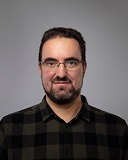
Nicolas Damgaard Frisch is an Instructor at the Department of Computer Science (DIKU), University of Copenhagen. He is affiliated with the Algorithms and Complexity (AC) section, which focuses on theoretical computer science and its practical applications in areas like machine learning and optimization. Research Interests : His work aligns with the AC section’s exploration of efficient computation, data structures, graph algorithms, and computational complexity. Labs & Centers : The AC section hosts the Basic Algorithms Research Copenhagen (BARC) center, supported by the VILLUM Foundation, and collaborates with the Danish Center for Big Data Analytics driven Innovation (DABAI). Contact : Reach Nicolas via email at nfri@di.ku.dk .
Dongyu Gao serves as an Instructor in the Machine Learning section at the Department of Computer Science (DIKU), University of Copenhagen. His position places him within one of Scandinavia's leading computer science departments, which hosts the SCIENCE AI Centre and maintains strong connections with both theoretical and applied machine learning research. Dr. Gao's research interests center around machine learning with applications spanning information retrieval, medical data analysis, remote sensing, sustainability, and biological data modeling. His work appears to bridge theoretical foundations with practical implementations, as evidenced by publications addressing quantum computing applications, environmentally sustainable AI practices, and advanced neural network architectures. The Machine Learning section at DIKU provides substantial computational resources including a powerful dedicated cluster and specialized initiatives like TreeSense for remote sensing applications. Analysis of recent publications associated with Dr. Gao reveals a diverse research portfolio spanning multiple cutting-edge AI domains. His work demonstrates particular strength in quantum machine learning applications, sustainable computing practices, and interpretable AI systems. The publications show a consistent pattern of interdisciplinary collaboration, connecting computer science with healthcare, environmental science, and quantum physics. Notably, several publications address the critical challenge of making AI systems more environmentally sustainable without sacrificing performance. The Machine Learning section operates within DIKU's broader research ecosystem, which includes strong connections to the SCIENCE AI Centre. This environment provides access to substantial computational resources and fosters collaboration across various AI subfields including natural language processing, computer vision, and theoretical machine learning. The department's location in Copenhagen positions it at the intersection of European AI research initiatives with strong connections to both academic and industry partners across the continent.
Nikolaj Hey Hinnerskov is a PhD Fellow in the Programming Languages and Theory of Computation (PLTC) section at the Department of Computer Science, University of Copenhagen. His research is embedded within DIKU's PLTC group, focusing on foundational and applied programming language systems. His core research spans: Programming Language Theory and Type Systems Compiler Design for Array-Based Languages Automatic Differentiation Techniques GPU-Accelerated Algorithm Development Rank-Polymorphic Function Inference Time Series Analysis Optimization Recent work demonstrates a strong convergence of programming language theory and high-performance computing, particularly in advancing compiler techniques for functional array languages like Futhark and optimizing scientific computations on GPUs. His publications address critical challenges in type inference, automatic differentiation, and parallel time-series decomposition. No scientific awards are documented in available sources. As a doctoral researcher, he operates under faculty supervision without independent advisees or grant leadership. His contributions align with DIKU's PLTC projects, including language design and performance optimization initiatives. He actively collaborates within the PLTC research ecosystem, contributing to GPU-based computational methods and programming language innovations alongside DIKU faculty and international researchers.
Max Bjørn Hofmann is an Instructor at the Department of Computer Science (DIKU) and Department of Mathematical Sciences at the University of Copenhagen , Denmark. He contributes to teaching and research within theoretical computer science. The Algorithms and Complexity (AC) section at DIKU, where he is affiliated, focuses on foundational research into computational efficiency, including data structures, graph algorithms, computational complexity, and algorithmic paradigms. Their work bridges mathematical theory with practical applications in machine learning and big data analytics. Contact details: Email: maho@di.ku.dk Email: mbh@math.ku.dk
Christian S Munk Jensen is an Instructor at the Department of Computer Science , University of Copenhagen. His work aligns with the Image Analysis, Computational Modelling, and Geometry section, which focuses on image analysis, computer vision, numerical optimization, and geometric statistics. Research Focus: The section contributes to theoretical analyses, algorithm development, and practical applications in science, industry, and society, including participation in the university’s SCIENCE AI Centre . Contact: Email csmj@di.ku.dk for direct communication.
Panagiotis Karras is a Professor at the Department of Computer Science , University of Copenhagen , with a faculty affiliate status at Aarhus University . His research focuses on robust and versatile methods for data access, mining, and representation. Education: MSc in Electrical and Computer Engineering from National Technical University of Athens , PhD in Computer Science from University of Hong Kong Research Interests: Spanning data management systems, graph algorithms, and privacy-preserving data publishing, his work addresses challenges in efficient query processing, influence propagation in networks, and semantic-aware data compression. Notable contributions include adaptive indexing techniques, graph alignment frameworks, and algorithms for fair stable marriage problems. Recent Publications (2024-2025): Focus on graph alignment, subgraph matching, and influence maximization, with applications to knowledge graphs, social networks, and time-series data analytics. Scientific Recognition: 2008 Young Scientist Award from the Hong Kong Institute of Science Keynote invitations at ACM SIGKDD and IEEE ICDE Professor Karras actively seeks motivated PhD students to collaborate on these research directions. His lab maintains a powerful compute cluster and modern facilities for data-intensive research.
Marcus Friis Klausen is a Lecturer at the Department of Computer Science , University of Copenhagen, affiliated with the Machine Learning section. His work intersects theoretical and applied machine learning across interdisciplinary domains. Research interests include: Quantum machine learning and hardware acceleration Explainable AI and model interpretability Clinical and healthcare applications of NLP Neuroscience-informed language modeling Environmentally sustainable AI practices Geometric and non-Euclidean deep learning Recent publications show trends in: Quantum computing applications for molecular simulations Medical imaging and clinical decision support Algorithmic fairness and ethical information retrieval Neural network optimization for energy efficiency Biological data modeling and remote sensing
Mathias Weirsøe Klitgaard is a Lecturer at the Department of Computer Science, University of Copenhagen. He is affiliated with the Image Analysis, Computational Modelling, and Geometry section, which conducts research spanning theoretical analyses, algorithm development, and practical applications in image processing, computer simulation, and geometric statistics. His work aligns with the section's focus on interdisciplinary research, bridging computational methods with real-world challenges in science and industry. The department provides access to advanced facilities, including a powerful compute cluster and modern research labs.
Lucas Alexander Kock is an Instructor at the Department of Computer Science , University of Copenhagen . His research spans Machine Learning and its applications in diverse domains including medical data analysis, quantum computing, and sustainable AI. Role: Lecturer in Machine Learning Affiliation: SCIENCE AI Centre, University of Copenhagen Research interests focus on: Quantum machine learning Neuroscience applications Cross-cultural AI systems Environmental sustainability in computing Medical informatics Deep learning explainability Recent publications demonstrate expertise in quantum computing applications , neural signal interpretation , and ethical AI frameworks . No formal awards or advisees are listed in available public data.
Oswin Krause is an Associate Professor at the Department of Computer Science , University of Copenhagen , specializing in Machine Learning . His research focuses on applying machine learning techniques to diverse domains including quantum computing, medical imaging, and astrophysics. Quantum dot array optimization and Coulomb diamond estimation Medical image analysis for clinical applications Evolutionary optimization algorithms and deep learning Neural networks for astronomical data interpretation Recent publications demonstrate a strong emphasis on quantum device calibration (2025), medical outcome prediction (2024), and algorithmic improvements in optimization (2022-2023). While no specific scientific awards are mentioned in the data, his work appears in journals like Physical Review Applied and Medical Image Analysis . Collaborations extend across physics, medicine, and computer science disciplines.
Jeppe Fræhr Linderød works as a Lecturer at the Department of Computer Science , University of Copenhagen. His research aligns with the department's Machine Learning section, focusing on theoretical foundations and applications in information retrieval, medical data analysis, remote sensing, and sustainability. He is part of the interdisciplinary SCIENCE AI Centre . His recent publications span diverse subfields including: Quantum machine learning and optical computing Explainable AI and feature attribution Large language models for emotion recognition Medical informatics applications Fairness in recommender systems Green/sustainable AI practices He contributes to the department's computational infrastructure, including access to a powerful compute cluster. His work often intersects with environmental and healthcare domains, particularly through projects like the TreeSense center for remote sensing applications.
David Rasmussen Lolck is a PhD Fellow at the University of Copenhagen's Department of Computer Science, specializing in the Algorithms and Complexity section. His research focuses on theoretical and applied aspects of computer science, particularly in algorithms, coding theory, and privacy-preserving data analysis. Current affiliation: Department of Computer Science (DIKU) , University of Copenhagen Research areas: Algorithms, complexity theory, differential privacy, and data management Recent publications address noise-robust coding and combinatorial clustering algorithms Contact: dalo@di.ku.dk | Phone: +45 3533 2122
Torben Ægidius Mogensen is an Associate Professor at the Department of Computer Science, University of Copenhagen, where he leads research in the Programming Languages and Theory of Computation section. His office is located at Universitetsparken 5, Copenhagen. His primary research focuses on: Automatic program analysis and transformation (especially partial evaluation and semi-inversion) Compiler technology for functional languages Domain-specific language design Reversible computing systems and languages Algorithms, complexity theory, and automata theory Applications in graphics and fractal generation His recent publications demonstrate a strong focus on reversible computation systems, including specialized programming languages like Hermes for encryption, reversible processor architectures, and functional programming extensions. His textbook publications on compiler design (2024) and programming language implementation (2022) indicate significant contributions to computer science education and foundational knowledge. He teaches courses on compilers, programming language technology, and game development, and maintains active research collaborations internationally. He is fluent in Danish and English, with working knowledge of German and Romanian.
Tobias Nordholm-Højskov is an Instructor at the Department of Computer Science , University of Copenhagen (DIKU). His research intersects machine learning with healthcare, sustainability, and quantum computing, focusing on theoretical foundations and applications in medical data analysis, climate-aware AI, and quantum systems. He is affiliated with the SCIENCE AI Centre and contributes to projects like QDarts (quantum dot array simulation) and TreeSense (remote sensing for environmental monitoring). His work spans diverse subfields, including Explainable AI for healthcare records Federated Learning in rare disease research Quantum-inspired neural networks Retrieval-Augmented Generation frameworks Environmental impact mitigation in AI
Jakob Nordström is a full-time Professor at the Department of Computer Science , University of Copenhagen , and holds a part-time affiliation with Lund University since 2020. His research lies at the intersection of theoretical computer science , proof complexity , and combinatorial optimization . His work focuses on SAT solving , Pseudo-Boolean optimization , and formal verification of algorithms. Recent research includes polynomial calculus lower bounds , dynamic programming certification , and MIP-based presolve techniques . Publications span journals like the Journal of the ACM and conferences including SAT and CADE . Scientific awards include the STOC '06 Best Student Paper Award and the Ackermann Award 2009 . He is a member of the Young Academy of Sweden (since 2018). Research funding comes from the Independent Research Fund Denmark and the Swedish Research Council . He has contributed to proof complexity , resolution trade-offs , and algebraic reasoning in combinatorial search. His work bridges theoretical lower bounds with practical Pseudo-Boolean solvers and certified algorithms .