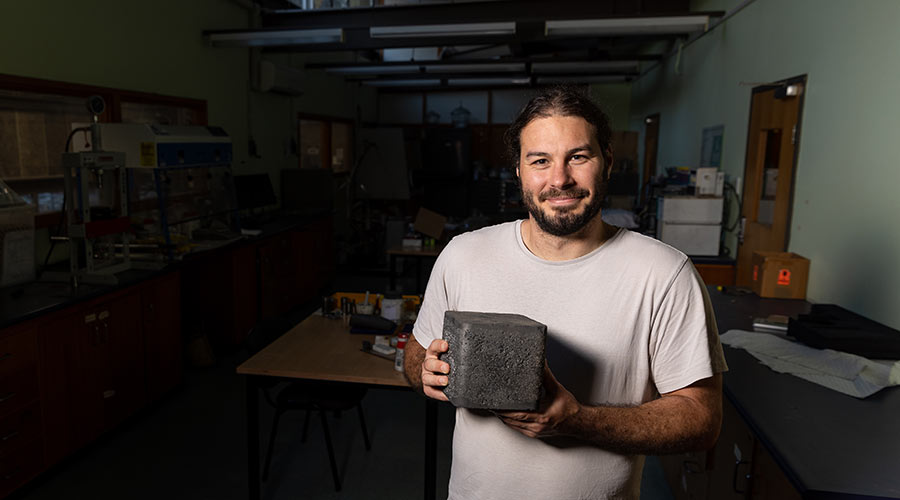
Dr Dylan Cuskelly is a Lecturer in the School of Engineering at the University of Newcastle, Australia. His research focuses on advanced materials development for energy storage and sustainable manufacturing, alongside STEM education innovation. He co-founded MGA Thermal, a company commercializing thermal energy storage materials derived from miscibility gap alloys (MGAs). Education: PhD in Mechanical Engineering (University of Newcastle, 2015) Bachelor of Engineering (Mechanical) (Hons) (University of Newcastle, 2009) Research Interests: Development of novel materials for energy storage applications Synthesis of MAX/MAB phase ceramics and metal alloys Economical material production processes Integration of renewable energy storage solutions STEM education pedagogy and curriculum design Grants & Awards: 2022: iSTEM Zero to Hero grant (Google Australia, $11,863) 2019: Optimisation of Thermal Energy Storage grant (MGA Thermal, $192,000) 2017: Excellence in Teaching and Learning Award (University of Newcastle) Collaborations: Active partnerships with industry (MGA Thermal, Sunburnt Space Co), academia (University of Melbourne), and international research networks. Labs/Teams: Leads the Advanced Materials Group at Newcastle, focusing on thermal energy storage materials and sustainable manufacturing processes.
Dr Leok Lee is a Lecturer in the School of Electrical and Mechanical Engineering at the University of Adelaide . He is also an active member of the Centre for Energy Technology , contributing to cutting-edge research in renewable energy systems. Research Interests: Renewable energy systems, with a focus on solar thermal energy and energy storage. System integration and optimisation of complex transient energy systems. Computational fluid dynamics (CFD) and experimental design for energy applications. Decarbonisation of heavy industry through clean energy technologies. His research spans from fundamental studies in heat transfer and fluid mechanics to applied engineering solutions for decarbonising industrial processes. He has led and contributed to projects funded by ARENA and HILT CRC, targeting the integration of concentrated solar thermal energy into industrial applications such as the Bayer Alumina process. Supervision & Mentorship: Dr Lee is eligible to supervise Masters and PhD students and actively mentors undergraduate, Masters, and PhD candidates. He encourages prospective students to contact him via email to discuss research opportunities. Contact: Email: leok.lee@adelaide.edu.au Location: Room 3, Engineering South, North Terrace Campus
Dr Sanjeev Gambhir is a Senior Research Fellow at the Intelligent Polymer Research Institute, University of Wollongong. With over 30 years of experience in chemistry, he leads bioinks synthesis and scale-up activities at TRICEP (Translational Research Initiative for Cellular Engineering and Printing) facility. His work bridges academic research with commercial translation, particularly in 3D bioprinting of living tissues. B.Sc. and M.Sc. in Organic Chemistry from Garhwal University Ph.D. in Organic Chemistry from Indian Institute of Petroleum Research focuses on 3D bioprinting technologies, graphene composites, conducting polymers, and hydrogel engineering. Key challenges addressed include biomaterial diversity limitations, bioprinted construct characterisation, and scalable bioink formulation. His work spans tissue engineering, regenerative medicine, and industrial applications. Major publications appear in Nature Communications , Journal of the American Chemical Society , and Advanced Materials . With 60+ peer-reviewed papers and an H-index of 28, his research on graphene composites and conducting hydrogels has significant citations in biomedical and materials science domains. Frater Award (Australian National Fabrication Facility, 2013) Active in mentoring junior staff and students, Gambhir collaborates with Inventia Life Science Pty Ltd and Professor Fiona Wood at the University of Western Australia. Current funding includes MRFF grants for intraoperative skin regeneration systems and translational projects through University of Wollongong infrastructure grants.
Dhammika Jayalath is an Associate Professor at Queensland University of Technology (QUT) in the School of Electrical Engineering & Robotics within the Faculty of Engineering. He has been with QUT since 2007, initially as a Senior Lecturer and later promoted to Associate Professor. Prior to joining QUT, he worked as a Senior Researcher at National ICT Australia Ltd and held a Fellowship at the Australian National University. His educational background includes a PhD in Wireless Communications from Monash University and a Graduate Certificate in Higher Education from QUT. He is a Senior Member of IEEE and active in multiple IEEE societies including Communications, Signal Processing, and Vehicular Technology. Research Interests: Dhammika's research focuses on Smart Systems with particular expertise in wireless communications and networking. His work spans Physical Layer Security, Massive MIMO Systems, Internet of Things, Optimum Resource Allocation, Cooperative communications, Cognitive radio, and Vehicular communications. He has made significant contributions to 5G New Radio, Chaotic Communications, Orthogonal Frequency Division Multiplexing (OFDM), and Space-Time Signal Processing. Publication Trends: His recent publications demonstrate a strong focus on 5G/6G networking technologies, physical layer security for IoT devices, and optimization of wireless communication systems. His work bridges theoretical communications theory with practical implementation challenges, particularly in vehicular networks, secure communications, and resource allocation for heterogeneous networks. The articles show increasing interdisciplinary work, combining machine learning techniques with traditional communications engineering approaches. Scientific Awards: 2007: Early Career Academic Recruitment and Development (ECARD) award from QUT 2009: Elevated to Senior Member Grade of IEEE 2000: IEEE travel grant Multiple scholarships during graduate studies at Monash University Supervision and Grants: Professor Jayalath has supervised numerous PhD students to completion with research topics including chaotic communication systems, resource allocation in heterogeneous networks, and vehicular communication systems. He has secured multiple research grants totaling over AU $300,000, including projects from ARC, QUT internal grants, and industry partnerships with Queensland Fire and Emergency Services. His current research includes physical layer security frameworks for IoT devices and optimization of massive MIMO systems for dense mobile networks. Laboratory and Team Work: He has been instrumental in establishing wireless communications research capabilities at QUT, including securing equipment grants for Software Defined Radio platforms. His work often involves interdisciplinary collaboration with researchers in signal processing, cybersecurity, and transportation systems.
Dr. Tracey Sletten is an Associate Professor (Research) in Psychology at Monash University's Turner Institute for Brain & Mental Health. She specializes in sleep and circadian rhythm research, particularly focusing on shift work impacts, fatigue management, and light-based interventions. Her work contributes to UN Sustainable Development Goals related to health and well-being. Dr. Sletten holds a PhD from the University of South Australia and has held postdoctoral roles at the University of Surrey and Harvard Medical School. She has led major projects on sleep interventions for shift workers, including the 'Zest' digital app and studies on Antarctic expeditioners' circadian rhythms. Education: PhD, University of South Australia (2000s) Postdoctoral Fellowships: University of Surrey (UK), University of Zurich (Switzerland), Harvard Medical School Research Interests: Impact of circadian misalignment on neurobehavioral performance Shift work disorder treatment and prevention Light's role in alertness and mental health Personalized sleep management strategies Key Projects: Principal Investigator for 'Optimising sleep, alertness and safety in shift work industries' (2024–2027) Chief Investigator in international task forces on sleep and youth mental health (2024–2029) Co-developer of the Zest app for shift worker sleep management Honors: 2023 Australian Research Council Industry Fellowship 2012 Australasian Sleep Association Helen Bearpark Scholarship 2005 European Union Marie Curie Fellowship Media & Outreach: Active in public engagement through podcasts (e.g., Talklink ), radio (ABC, BBC), and media features on shift work solutions.
Tara Zirakbash serves as a Lecturer at Murdoch University's School of Engineering and Energy, leveraging extensive cross-sector experience from consulting, government, and academia in hydrological analysis, urban water management, and GIS applications for sustainable engineering solutions. Her work directly addresses critical global challenges including water scarcity, climate change impacts, and water safety through interdisciplinary approaches. Her academic credentials include: Doctor of Philosophy in Environmental Engineering from Murdoch University, Western Australia Research focuses on environmental modelling optimisation, sustainable water systems, spatial/time series analysis, and uncertainty-informed planning. She champions systems thinking integrated with practical field applications and multi-stakeholder collaboration to develop innovative solutions for complex environmental challenges, emphasizing real-world relevance in all scholarly work. Scientific Awards: No scientific awards documented in source materials Advising and grants information is not specified in available documentation, though her teaching methodology emphasizes workshop-based learning connecting theoretical concepts to practical implementation. Professional networks reflect strong industry-academia linkages developed through diverse sector engagements. Laboratory facilities and research team structures are not described in the provided institutional profile.
Ali Karrech is a Professor at the University of Western Australia (UWA), affiliated with the School of Engineering and the Department of Civil, Environmental and Mining Engineering (CEME). He previously held roles as Senior Research Scientist at CSIRO (until 2012) and Assistant Professor at the Petroleum Institute of Abu Dhabi (2007–2009). His expertise spans materials science, geomechanics, mineral processing, and sustainable resource engineering. He serves as Graduate Research Coordinator in CEME and has led the Structures Laboratory (2015–2016). Education: He holds a Higher Doctorate (Habilitation) in Engineering Sciences from École Normale Supérieure Paris-Saclay (2014), a PhD in Structures and Materials from École des Ponts ParisTech (2008), and a Multidisciplinary Master's from Tunisia Polytechnic School (2001). Research Interests: Focus on computational geomechanics, resource engineering (surface mining, in-situ leaching), mineral processing (hydrometallurgy), waste repurposing, and thermal-hydraulic-mechanical-chemical coupling. His work aligns with UN Sustainable Development Goals related to education, energy, and the built environment. Awards: Recognitions include the School of Engineering Teaching Excellence Award (2021), Prize of Best Paper in Concrete Research (2021), and CEEC High Commendations (2023). His research has produced over 194 publications and 20 grants. Teaching: Coordinates units like Engineering Materials (ENSC1004), Finite Element Method (GENG5514), and Surface Mining (MINE4503). Engages in interdisciplinary projects, including the ARC Training Centre in Critical Resources and the FBI-CRC for Future Batteries.
Associate Professor Mariano Jr Reyes Ramirez serves as Senior Lecturer and Discipline Director of Industrial Design at the University of New South Wales School of Built Environment. With over 70 publications on design for sustainability and presentations at more than 30 international conferences, he has established himself as a thought leader in sustainable industrial design. Dr. Ramirez has contributed as a Visiting Academic to 24 universities across 10 countries including China, India, Korea, Mexico, and Brazil, and serves as a PhD Examiner in 5 Australian universities as well as in Sweden and Italy. His research concentrates on the environmental sustainability and social responsibility aspects of industrial design, with particular focus on promoting circular economy through waste minimisation and resource optimisation, enabling responsible consumption behaviours through product design, and leveraging industrial design innovation to tackle the United Nations Sustainable Development Goals. His work spans sustainable product development, product-service systems, design for a circular economy, and disaster risk reduction. Dr. Ramirez has secured significant research funding including Transport for NSW's $120,000 grant for enhancing public space safety, NSW Circular Challenge Program's $200,000 grant for hospital polypropylene waste recycling, and multiple international collaboration grants. His 15 most recent publications reveal a consistent focus on human-centered sustainable design approaches applied across diverse contexts from prison rehabilitation programs to water solutions in Jakarta slums and cultural heritage integration in electric vehicle design. Emerald Literati Network Award for Excellence 2007 for paper 'Sustainability in the education of industrial designers: the case for Australia' UNSW Built Environment Learning & Teaching Excellence Award, 2017 UNSW Built Environment Dean's Research Excellence Award, 2012 Multiple UNSW Built Environment Associate Dean Teaching Commendations (2007-2011) Dr. Ramirez actively supervises BID honours, MPhil and PhD students at UNSW while examining dissertations from multiple Australian and international universities. He serves on editorial boards for Sustainability (MDPI) and scientific review committees for several leading design and sustainability journals. His research supervision focuses on dematerialization of contemporary lifestyles, fostering sustainable behaviors through design, optimization of product lifetimes, sustainability integration in design education, and industrial design as a tool for achieving UN Sustainable Development Goals. As Regional Convenor for Oceania of the Learning Network on Sustainability since 2006 and Project Leader of the South-to-South initiative activating Australian-Latin American Cooperation through Design for Sustainability Education, Dr. Ramirez demonstrates significant leadership in building international research networks focused on sustainable design education and practice.
Hanyu Gu is a Senior Lecturer in the School of Mathematical and Physical Sciences at the University of Technology Sydney (UTS), part of the Faculty of Science. He holds a PhD in Power Engineering and Automation from Shanghai Jiao Tong University (1999) and has extensive industry experience in telecommunications, airline optimization, and mining. His research focuses on combinatorial optimization, decomposition methods, stochastic programming, and machine learning applications. Notable awards include second place in the 2020 ROADEF competition. He collaborates with institutions like the UTS Transportation Research Centre and has contributed to projects such as optimisation engines for airline management and underground mining algorithms. Current research explores hybrid algorithms, Bayesian optimisation, and scheduling under uncertainty. Education: Bachelor in Industrial Automation, Shanghai Jiao Tong University (1994) Master in Control Theory and Application, Shanghai Jiao Tong University (1997) PhD in Power Engineering and Automation, Shanghai Jiao Tong University (1999) Industry Experience: ZTE (1999–2001): Senior Wireless Communication Engineer CTI, Melbourne (2007–2011): Airline Management Optimisation Researcher NICTA (2011–2013): Underground Mining Optimisation Researcher Grants: ARC Linkage Project LP0883855 (2008–2012): Developed optimisation tools for transportation crewing, valued at $840,000. Research interests span decomposition methods for large-scale problems (e.g., airline scheduling), stochastic programming for resource sharing, and hybridisation of mathematical programming with constraint programming. Recent work includes Bayesian optimisation for knapsack problems and relax-and-solve algorithms for project scheduling. His articles frequently address optimisation in logistics, healthcare, and transportation, emphasizing practical industry applications and algorithmic innovation. Awards: Second place in the ROADEF 2020 competition for maintenance planning solutions. Advising & Grants: Supervises Masters and PhD students in operations research and optimisation. Collaborates with Ausgrid, UGL, and ANC on optimisation projects (e.g., employee training timetabling, logistics). Active in the Optimisation Group of UTS Transportation Research Centre, he bridges academic research with real-world challenges in scheduling, logistics, and resource management. Ongoing efforts include advancing metaheuristics and integrating machine learning with traditional optimisation techniques.
Associate Professor John Pye leads research in high-temperature solar-thermal systems and industrial decarbonisation at the Australian National University's School of Engineering. He holds a BE/BSc (University of Melbourne) and a PhD (University of New South Wales) focused on solar thermal modelling. His work bridges engineering innovation and sustainability, with a focus on green steel production, CSP technologies, and hydrogen applications. As a Visiting Scholar at Sandia National Laboratories, he advanced solar thermal testing methodologies. Educations: Bachelor of Engineering (Mech.) and Bachelor of Science (University of Melbourne, 1997) PhD in System Modelling of Compact Linear Fresnel Reflectors (UNSW, 2008) His research interests include solar thermal energy systems, concentrated solar power (CSP), and hydrogen-based industrial processes. Notable contributions include system-level optimisation of CSP plants, techno-economic analysis of green steel production, and solar-thermal beneficiation of iron ore. His work often integrates AI for optimisation and free/open-source engineering software. Recent publications focus on solar thermal applications in steelmaking, particle-based CSP systems, and hydrogen plasma metallurgy. Projects include the Gen3 Liquids Pathway for CSP and solar-driven thermochemical processes. Collaborations span industry and academia, addressing decarbonisation challenges in steel production and energy storage. Supervises research in solar thermal engineering and low-carbon technologies, contributing to Australia's role in zero-emissions commodity production. Active in policy submissions related to green energy and manufacturing frameworks.
Professor Axel Schulz is a Professor of Management Accounting at the La Trobe Business School, La Trobe University. He previously held professorial roles at Monash University, Melbourne University, and the University of New South Wales (UNSW). His research focuses on behavioral accounting, particularly the design of Management Control Systems and the impact of Performance Measurement Systems on organizational performance. Schulz has contributed to leading journals such as the Journal of Accounting Research and Accounting, Organizations and Society. He currently serves on the editorial board of The Journal of International Accounting Research. Education: Bachelor of Commerce (Honours), UNSW Master of Commerce (Honours), UNSW PhD, UNSW Chartered Accountant (CA) Research Interests: Behavioral aspects of Management Control Systems Incentive system design and performance evaluation Decoding effort measurement in accounting contexts Impact of technology on behavioral accounting experiments Recent Research Trends: Recent work emphasizes experimental methods to explore effort dynamics, collaborative team behavior under performance metrics, and causal inference in strategic performance tools. His 2025 articles highlight advancements in measuring effort intensity and leveraging new technologies for behavioral research. Grants: Quantum Enhanced Optimisation for Energy Efficient Data Centres (Critical Technologies Challenge Program) Hybrid Entrepreneurship and Job Creation in a Covid World Labs/Teams: No specific lab/team affiliations explicitly mentioned in the text.
Dan Steinberg is a senior research scientist and team leader of the Decisions & Statistical Learning team at CSIRO Data61 in Canberra, Australia. His expertise lies in probabilistic machine learning, variational inference, Bayesian deep learning, causal inference, and their application to domains spanning synthetic biology, geospatial analytics, and algorithmic fairness. Education PhD in Computer Vision / Machine Learning (2013) – University of Sydney, Australian Centre for Field Robotics Bachelor of Engineering (Mechatronics, First-Class Honours) – University of Sydney (2008) Bachelor of Commerce (Finance) – University of Sydney (2008) Research Interests Steinberg’s core research agenda revolves around building scalable probabilistic models that can learn efficiently from limited or noisy data and provide principled uncertainty estimates. Key themes include: Variational Inference & Bayesian Deep Learning: developing lightweight yet powerful algorithms for approximate posterior inference in complex models (e.g., Aboleth, Revrand). Active Learning & Experimental Design: creating methods that decide which experiments or measurements will maximise information gain, with recent focus on in-silico protein engineering via Variational Search Distributions (VSD). Causal Inference: leveraging machine-learning tools to perform robust observational causal studies for evidence-based policy, including work on youth well-being and academic outcomes. Algorithmic Fairness: translating normative notions of equity into quantifiable objectives for regression-based decision systems. Large-scale Spatial Analytics: Landshark—an open-source TensorFlow toolkit for supervised learning on massive geospatial raster datasets. Notable Software & Tools Aboleth: A minimal-overhead TensorFlow framework for Bayesian deep learning. Landshark: Command-line tools for large-scale spatial inference. Revrand: Scalable Bayesian generalised linear models with non-conjugate likelihoods. libcluster: Extensible C++ library for hierarchical Bayesian clustering. Scientific Awards Oral Presentation Award – ICML 2025 Workshop on Scaling up Intervention Models (SIMS) Oral Presentation Award – NeurIPS 2024 Workshop on Bayesian Decision-making and Uncertainty (BDU) Oral Presentation Award – NeurIPS 2023 Workshop on Adaptive Experimental Design and Active Learning Spotlight Paper Award – NeurIPS 2014 (Extended and Unscented Gaussian Processes) Research Team & Collaborations As Team Leader – Decisions & Statistical Learning at CSIRO Data61, Steinberg directs a multi-disciplinary group that partners with government agencies (e.g., Jobs and Skills Australia, Australian Institute of Health and Welfare) and industry to deploy machine-learning solutions at scale. He has previously held roles as Principal Researcher at Gradient Institute (2019-2023), Senior Research Engineer at CSIRO Data61 (2016-2019), Researcher at NICTA (2013-2016), and Research Associate at the University of Sydney (2012-2013).
Aaron Bere is a Senior Lecturer and Course Director in the Department of Information Technology at Torrens University Australia. He leads undergraduate programs in Software Engineering (AI), IT, and cloud computing. His research focuses on digital transformation and the application of Information and Communication Technologies (ICTs) in education, emphasizing how these technologies can enhance learning experiences and pedagogical practices. Education: Master's in Information Technology, Cape Peninsula University of Technology PhD in Information Technology, RMIT University Higher Education and Global Change, University of the Western Cape Research Interests: Bere explores mobile learning, cloud computing, and AI applications in education. His work examines the integration of digital tools like mobile instant messaging (e.g., WhatsApp) and learning management systems (LMS) to create dynamic educational environments. Key themes include technology adoption frameworks, learning analytics, and the impact of ICTs on educational outcomes. Article Trends: His publications analyze technology adoption barriers, mobile learning effectiveness, and cloud infrastructure security. Recent work addresses federated learning in cloud security and learning analytics adoption in higher education. Labs/Teams: Bere is affiliated with the Design and Creative Technology Centre for Artificial Intelligence Research and Optimisation (AIRO) at Torrens University. His collaborations span global institutions, focusing on ICT integration and educational technology innovation.
John Betts is a Senior Lecturer in the Department of Data Science & AI at Monash University's Faculty of Information Technology. He serves as Course Director for the Bachelor of Information Technology and previously held roles as Chief Examiner and Lecturer for multiple IT units. His research focuses on computational modelling, optimization, simulation, and data science, with applications in societal polarization, healthcare, and retail inventory systems. Education: Doctor of Philosophy (Operations Research), Monash University (2003) Graduate Diploma in Statistics/Operations Research, RMIT University (1996) Postgraduate Diploma in Mathematics and Mathematics Education, University of Melbourne (1992) Diploma in Education, Monash University (1984) Bachelor of Arts, Monash University (1983) Research Interests: Dr. Betts explores computational methods to address variability in complex systems, including agent-based modeling for societal polarization, optimization in healthcare (e.g., prostate brachytherapy), and simulation-driven decision-making in retail and transportation. His work contributes to UN SDGs related to education and sustainable cities. Projects: Leading the Optimising multi-item retail inventories project (2021–2026) focusing on inventory optimization algorithms. Contributing to the Biofocussed Prostate Cancer RadioTherapy (BiRT) project (2017–2021), developing personalized radiation therapy plans. Investigating Societal Polarization dynamics via agent-based models and hate crime measurement frameworks. Advising & Grants: Dr. Betts has secured $2.5M+ in research funding, including ARC grants for retail optimization and prostate cancer treatment planning. He advises on interdisciplinary projects spanning computer science, healthcare, and social sciences. Labs/Teams: Collaborates with Monash’s Data Science Institute and the Australian Research Data Commons, contributing to the Temporal Networks Security group and Health Informatics initiatives.
Dr. Emily Saurman is a Senior Lecturer in Rural and Remote Public Health at the Rural Health (Dubbo/Orange) campus of the Sydney School of Public Health, Faculty of Medicine and Health, University of Sydney. Her work focuses on improving healthcare access and delivery in rural and remote communities across Australia. Dr. Saurman holds a PhD from the University of Sydney, an MPH from the University of Wollongong, an MA in Applied Ethics from the University of Wollongong, and a BA in Philosophy/Medical Ethics from Randolph-Macon Woman's College. Dr. Saurman's research spans several interconnected domains within rural and remote health. Her primary focus is on improving access to health services in underserved communities, with particular emphasis on digital health solutions and telehealth innovations. She has pioneered work in rural mental health emergency care through videoconferencing technology, which has significantly transformed how mental health services are delivered in remote areas. Her research also extends to palliative care models, school-based health services, Indigenous health research ethics, and the impact of climate change on rural mental health. She employs primarily qualitative research methodologies with a strong emphasis on translational research that directly informs health service improvements. Dr. Saurman's recent publications demonstrate a clear trajectory toward hybrid virtual care models, particularly the Virtual Rural Generalist Service, which aims to improve health access and outcomes in rural and remote communities. Her work increasingly integrates economic evaluations with clinical outcomes to demonstrate the value of innovative service delivery models. There's also a growing emphasis on Indigenous health research ethics and reconciliation in her more recent publications, reflecting a commitment to culturally safe research practices. Optimising digital solutions to improve access to comprehensive Primary Health Care services in remote Indigenous communities (2022) A systems-approach to enhancing community-based medication review (2021) Evaluation of the Virtual Rural Generalist Service VRGS as an effective, 'COVID-19 resilient' model of care (2021) Her teaching focuses on research and evaluation methods, qualitative evaluation methodologies, and research and evaluation ethics, contributing to research capacity building in rural health contexts.