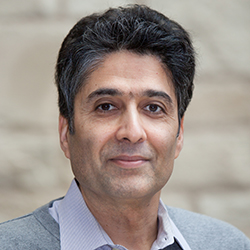
Steffen Bondorf is a Professor of Distributed and Networked Systems in the Faculty of Computer Science at Ruhr University Bochum, Germany. His research focuses on performance modeling and analysis of deterministic networking, particularly using network calculus to provide rigorous performance guarantees for networked systems. Dr. Bondorf received his B.Sc., M.Sc., and Dr.-Ing. (Ph.D.) in Computer Science from TU Kaiserslautern (TUK), where he was part of the distributed computer systems lab. He was the first student to enroll in a B.Sc. program at TUK before finishing secondary education. After graduation, he held positions as postdoctoral researcher, lecturer and Carl-Zeiss Fellow at TUK, research fellow at the National University of Singapore, and visiting researcher at the University of Toronto. From fall 2018 to fall 2019, he was funded by an ERCIM Alain-Bensoussan fellowship at NTNU Trondheim, Norway, and spent time at INRIA Paris. His research interests include network calculus, deterministic networking, performance modeling, computer networks, distributed systems, and P2P overlays. Dr. Bondorf's work has significantly advanced the field of network calculus, particularly in developing methods for analyzing FIFO feedforward networks, multicast flows, and P2P overlay structures. His recent research has integrated machine learning techniques with network calculus to improve analysis accuracy and efficiency, creating hybrid approaches that leverage the strengths of both methodologies. Dr. Bondorf was appointed as assistant professor at Ruhr University Bochum on October 1, 2019, becoming the university's first hire in the joint tenure-track program for the promotion of young scientists. Since December 1, 2021, he has been a tenured full professor at RUB. Carl-Zeiss Fellow ERCIM Alain-Bensoussan fellowship At RUB, Dr. Bondorf teaches Advanced Topics in Networking, Distributed Systems, Deterministic Network Calculus, and Seminar Distributed and Networked Systems. His research group develops tools and methodologies for deterministic network analysis with applications in industrial networking, real-time systems, and time-sensitive communications. His work bridges theoretical networking principles with practical implementations, contributing to the advancement of deterministic networking standards and protocols.