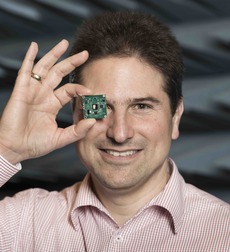
Tomas Palacios is a Professor of Electrical Engineering at the Massachusetts Institute of Technology (MIT) , where he directs the Center for Graphene Devices and 2D Systems and leads the Microsystems Technology Laboratories (MTL). His research focuses on pushing the boundaries of microelectronics through novel semiconductor materials and device architectures, including Gallium Nitride (GaN) and 2D materials like graphene and molybdenum disulfide (MoS2). Professor, MIT Electrical Engineering and Computer Science Director, MIT Center for Graphene Devices and 2D Systems Clarence J. LeBel Professor, MIT Faculty Director, Northeast Microelectronics Internship Program (NMIP) Research Interests span multiple cutting-edge domains: High-frequency electronics (>300 GHz) for 6G and quantum applications High-voltage power devices (600V–10kV) for energy conversion Post-silicon logic devices using 2D materials High-temperature electronics (e.g., Venus rover applications) Distributed neural networks on large-area 2D materials Graphene-based biosensors and chemical detection systems Scientific Contributions include: Double recipient of the IEEE George Smith Award for groundbreaking GaN transistor work Co-invented first MoS2 electronic circuits Developed world’s first Wi-Fi-to-electricity conversion antenna Led MIT’s Microsystems Technology Laboratories since 2021 Advising Philosophy emphasizes cross-layer expertise, with students gaining experience from materials synthesis to system-level prototyping. His lab has incubated startups like Vertical Horizons , focused on GaN power devices for AI and EVs.
Dr. Khurram Aziz is a Senior Instructor in the Faculty of Computer Science at Dalhousie University , Halifax, Canada. He is actively engaged in teaching and research, with a focus on optical networks, data center interconnects, and network performance modeling. Education: PhD in Electrical Engineering, Vienna University of Technology, Austria (2008) MSc in Electrical Engineering, National University of Singapore (2003) BSc (Hons) in Electrical Engineering, University of Engineering and Technology, Lahore, Pakistan (1998) His research interests include optical packet and burst switched networks , optical interconnects for data centers , analytical modeling and simulation , and network routing and switching . He has contributed extensively to the design and performance evaluation of scalable optical switches and hybrid switching systems. The recent publications reflect a strong trend in data center optical networks , focusing on performance, blocking probability, signal degradation, and architectural classification. His work bridges theoretical modeling with practical simulation frameworks, such as CloudNetSim++ in OMNeT++, contributing to cloud and high-capacity network research. Dr. Aziz has no listed scientific awards in the provided text. He teaches several core computer science courses including CSCI 2141: Intro to Database Systems , CSCI 3171: Network Computing , CSCI 3132: Object Orientation and Generic Programming , and CSCI 3120: Operating Systems . There is no mention of graduate student supervision or external research grants. He has co-authored book chapters in major handbooks on data centers and switched systems. Dr. Aziz has not listed any formal lab or research team affiliations in the provided content.
Matteo Cagnoni is a Researcher at the Department of Electronics and Telecommunications (DET) of Politecnico di Torino . His research focuses on Density Functional Theory , Quantum Chemistry , and Thermoelectric Materials for Solar Cells . He is actively involved in the European Union’s MIRACLE project , developing photonic meta-concrete for radiative cooling solutions. Research Interests: Development of cement-based radiative coolers for solar cell thermal management Computational discovery of intermediate-band solar cell materials Electronic properties of semiconductors and insulators Teaching: Electronic transport in crystalline and organic semiconductors Advanced experimental physics Scientific Contributions: Matteo has published extensively on radiative cooling, perovskite/silicon tandem solar cells, and thermoelectric materials. His work spans journals like Nature Communications , Advanced Functional Materials , and Progress in Photovoltaics , with a focus on simulation engineering , photonic devices , and energy-efficient materials . Labs & Collaborations: He works within the Microwave and Optoelectronics Group (MOG) at DET, collaborating with international institutions on EU-funded projects.
Michele Zorzi is a Professor of Telecommunications at the School of Engineering, University of Padova, Italy, where he has held a faculty position since 2003. He leads the SIGNET (Signal processing and Networking) Research Group, focusing on cutting-edge wireless networking challenges including mmWave communications and underwater networks. His extensive publication record exceeds 600 papers in top-tier journals and conferences, reflecting significant contributions to the field through both theoretical and experimental work. He received his Laurea Degree (1990) and Ph.D. (1994) in Electrical Engineering from the University of Padova. Prior academic appointments include Politecnico di Milano (1993-1996), University of California San Diego (1995-1998), and University of Ferrara (1998-2003), where he progressed from Associate Professor to full Professor. His educational trajectory demonstrates deep roots in Italian academia with international exposure. Professor Zorzi's research spans wireless communications and networking, with current emphases on mmWave networking for vehicular systems, underwater acoustic/optical communications, non-terrestrial networks, and AI-driven networking solutions. His group conducts experimental validations including at-sea trials for underwater systems and testbeds for vehicular networks. Key projects include PRATA for predictive QoS in autonomous driving and IoT-based environmental monitoring of the Venice Lagoon, demonstrating practical applications of theoretical work. Analysis of his 2022-2025 publications reveals strong trends in applying artificial intelligence to networking challenges across diverse environments. There is significant emphasis on vehicular networks (predictive QoS, teleoperated driving), underwater systems (acoustic/optical communications, AUV swarms), and satellite networks (Starlink integration, NTN security). Experimental validation in real-world scenarios like the Venice Lagoon monitoring project and underwater sea trials characterizes his applied research approach. His scientific accolades include: IEEE Fellow (2007) IEEE Communications Society Best Tutorial Paper Award (2008, 2019) Stephen O. Rice Best Paper Award (2018) Multiple best paper awards at IEEE conferences (2005-2020) As principal investigator for numerous European and US research projects plus 20+ industry-funded initiatives, Professor Zorzi has mentored over 35 PhD students and post-docs. Graduates now hold prominent positions at institutions including Stanford, UCSD, CTTC, and Huawei. His SIGNET group maintains active international collaborations and contributes to open-source networking tools via GitHub, demonstrating commitment to community engagement. The SIGNET Research Group, housed within the Department of Information Engineering, operates specialized experimental facilities for mmWave and underwater communications. Current initiatives include AI-based predictive QoS frameworks for vehicular networks, underwater optical communication systems using ultraviolet light, and large-scale IoT deployments for environmental monitoring. The group's GitHub presence indicates strong open-science practices, while recent sea trials confirm hands-on experimental capabilities beyond theoretical work.
Ranjan Singh is a Professor at the Division of Physics, Nanyang Technological University (NTU) Singapore, specializing in terahertz photonics and metamaterials. He holds an elected fellowship from OPTICA (OSA) for pioneering work in ultrafast terahertz photonics, active metamaterials, and sensors. His research focuses on hybrid THz-electronic-photonic technologies for 6G communications, topological photonics, spintronics, quantum materials, and high-Tc superconductors. Education: B.Eng. in Telecommunications (Bangalore University, 2001); M.Tech in Photonics (Cochin University, 2004); Ph.D. in Photonics (Oklahoma State University, 2009). Postdoctoral research at Los Alamos National Laboratory (2009–2013). Research emphasizes on-chip THz topological photonics for next-gen communication systems, with notable achievements including a $7M grant for TERACOMM (on-chip THz topological photonics). His work integrates AI-driven beamforming, reconfigurable metasurfaces, and phase-change materials for adaptive THz systems. Key awards include the 2020 Web of Science 'Top 1% Highly Cited Researcher' distinction. His lab, TeraX Labs (founded 2013), develops cutting-edge technologies like THz brain-computer interfaces, quantum emitters, and spintronic sensors. Over $12M in competitive grants has fueled innovations in THz integrated circuits, tunable optical coatings, and ultra-sensitive biosensors. Advancing 6G/XG wireless, Singh's team designs topological beamformers, intelligent reflecting surfaces (IRS), and terahertz metamaterials for multi-link systems. His work bridges theoretical physics and applied engineering, with a focus on energy-efficient, reconfigurable photonic systems.
Prof Christina Lim is a Professor at the Department of Electrical and Electronic Engineering, University of Melbourne, Australia. She serves as the Associate Dean of Research for the Faculty of Engineering and Information Technology (FEIT) and manages the Tucker Lab. Previously, she held roles as Research Group Leader of the Electronics and Photonics System group and Deputy Head of Department (Teaching and Operations) Education: PhD and Bachelors from University of Melbourne Research Interests: Radio-over-Fibre, Optical Wireless Communications, Microwave Photonics, Augmented Reality Displays, Reservoir Computing, Optical Crosshaul Networks Recent publications demonstrate expertise in optical waveguide design for AR, underwater optical wireless communications, photonic switching, and network optimization. Her projects focus on next-generation wireless infrastructure, including Photonics Computing Enabled Ultra-Broadband Wireless Communications (2024-2027, $598k ARC grant) and Additive Manufacturing of Optical Elements (2025). She has secured significant funding, including ARC Discovery Projects and Future Fellowships. Scientific Honors IEEE Fellow (2022) Optica Fellow (2018) ARC Future Fellow (2009-2013) ARC Australian Research Fellow (2004-2008) Professional Service Vice-President of Conferences, IEEE Photonics Society Deputy Editor, IEEE/Optica Journal of Lightwave Technology ARC College of Experts (2014-2016)
Professor Goran Mashanovich is a leading academic in silicon photonics at the University of Southampton's Optoelectronics Research Centre (ORC) , Faculty of Engineering and Physical Sciences. With a Dipl. Ing. and MSc from the University of Belgrade and a PhD from the University of Surrey, he serves as head of the ORC's Mid-IR silicon photonics group. His expertise spans passive and active photonic devices in silicon and germanium for communication and sensing systems. Education: Dipl. Ing. in Optoelectronics, University of Belgrade MSc in Optoelectronics, University of Belgrade PhD in Silicon Photonics, University of Surrey MSc in Innovative Teaching, University of Surrey His research focuses on Silicon Photonics , Photonics Integrated Circuits , and Sensor Development , particularly in mid-infrared applications. His recent publications demonstrate advancements in waveguide engineering, perovskite integration, and nonlinear optical effects optimization through computational methods. As Principal Investigator on grants exceeding £20 million from EPSRC and industry partners, his collaborative projects include MISSION (mid-infrared healthcare sensors), CORNERSTONE 2.5 , and PIXEurope . He also contributes to global education initiatives as a visiting professor at the University of Belgrade's Faculty of Electrical Engineering.
Sridhar R. Tayur is the Ford Distinguished Research Chair and University Professor of Operations Management at Carnegie Mellon University’s Tepper School of Business. He holds a Ph.D. in Operations Research from Cornell University and a B.Tech. in Mechanical Engineering from IIT Madras. His research focuses on quantum computing applications in operations research, healthcare systems optimization, and supply chain management. He has held visiting roles at MIT, Stanford, and Cornell, and founded companies like SmartOps and OrganJet. His recent work spans quantum-inspired optimization algorithms, healthcare decision support systems, and fair resource allocation policies. He has contributed to over 110 publications, including high-impact papers in Management Science , Operations Research , and IEEE Transactions . Awards include INFORMS Fellow and NAE membership. He teaches courses in quantum integer programming, healthcare operations, and service management at the Tepper School. Education: Ph.D. (Cornell), B.Tech. (IIT Madras) Research Labs: Quantum Technology Group, OrganJet Key Awards: INFORMS Fellow, NAE Member, MSOM Distinguished Fellow Teaching: MBA Operations Management, PhD Quantum Optimization, Healthcare Systems His interdisciplinary work bridges quantum computing, healthcare policy, and logistics, supported by collaborations with industry and government institutions.
Professor Peter F. Driessen is a faculty member in the Department of Electrical and Computer Engineering at the University of Victoria, with a cross-appointment in the School of Music. He holds a BSc and PhD from the University of Victoria and is a Professional Engineer (PEng). His research focuses on communication systems, signal processing, control, and interdisciplinary projects in computer music and wireless technologies. Key areas include audio/video signal processing, radio propagation, sound recording, and multimedia systems. He leads the University of Victoria Propagation Laboratory, which explores radio wave propagation and Amateur radio integration with engineering education. His work spans theoretical research and applied projects like ECOSat satellite systems, software-defined radio (SDR), and innovative musical instruments such as the Radio Drum. He supervises undergraduate and graduate projects in these domains through ELEC 499 courses. Notable contributions include the APEGBC Editorial Board Award for Best Paper (2002) and patents in wireless networking and signal processing. His teaching includes courses in signal analysis and electromagnetics, and he collaborates on interdisciplinary programs like the Music/Computer Science degree. Education: BSc in Electrical Engineering, University of Victoria PhD in Electrical Engineering, University of Victoria Research Interests: Audio and video signal processing for music and media Software-defined radio and Amateur radio technologies Satellite communication and ground station development Gesture-based interfaces and musical instrument design Error mitigation in streaming audio/video Optical and microwave-photonic systems Labs & Collaborations: Propagation Laboratory (radio wave research) UVic Experimental Radio Group (Amateur radio club) UVic Satellite Design Team (ECOSat projects) UVic Centre for Aerospace Research Grants & Awards: APEGBC Editorial Board Award (2002) Multiple US patents in wireless systems and signal processing
Andrea C. Ferrari is a Professor of Nanotechnology at the Department of Engineering, University of Cambridge, UK. He holds multiple leadership roles, including Director of the Cambridge Graphene Centre and EPSRC Centre for Doctoral Training in Graphene Technology, and serves as Science and Technology Officer for the EU Graphene Flagship. Education: PhD, University of Cambridge (2001) Laurea in Nuclear Engineering, Politecnico di Milano (1997) Ferrari’s research focuses on graphene, 2D materials, and their applications in nanotechnology, photonics, optoelectronics, and Raman spectroscopy. His work bridges fundamental studies and industrial translation, emphasizing scalable synthesis and characterization techniques. His publications span over 390 peer-reviewed articles, including groundbreaking studies on graphene photonics, quantum emitters, and advanced optoelectronic devices. These works are highly cited, with an H-index of 115 and over 116,000 total citations. Scientific Awards: IMR-Lee Hsun Lecture Award (2018) Nanosmat Award (2017) Knight Officer of the Order of the Star of Italy (2017) ERC Synergy Grant (2013) EU-40 Materials Prize (2011) Royal Society Wolfson Research Merit Award (2010) ERC Starting Grant (2008) Philip Leverhulme Prize (2005) Ferrari has secured over £60M in research funding, including leadership roles in the EU Graphene Flagship and the EU Quantum Technology Flagship. He is a Fellow of the Optical Society, Materials Research Society, Institute of Physics, and American Physical Society.
Professor Nicole Metje is a Professor of Infrastructure Monitoring at the Department of Civil Engineering, University of Birmingham, and Director of the National Buried Infrastructure Facility. She also serves as Co-director of the Institute of Quantum Technology. Her research focuses on quantum sensing, geotechnical engineering, and infrastructure monitoring, with a particular emphasis on buried infrastructure detection and sustainable urban development. Education: PhD in Civil Engineering (University of Birmingham, 2001); Dipl.-Ing. in Civil Engineering (Hannover University, Germany, 1998). Key roles and affiliations include membership in EPSRC Infrastructure Strategic Advisory Team, Chartered Institution of Civil Engineering Surveyors, and international advisory boards for Hong Kong Polytechnic University. She has authored/co-authored over 50 journal papers and a textbook on tunnel construction. Research areas include quantum sensor applications for buried asset detection, geophysical soil properties, and sensor development for infrastructure monitoring. She leads projects such as UKCRIC National Buried Infrastructure Facility and Quantum Technology Hub in Sensors and Metrology. Awards and fellowships include FICE, FCInstCES, CEng, FHEA, and multiple committee memberships in national/international bodies. Teaching includes MSc courses on underground construction and geotechnical engineering. She supervises doctoral research on quantum sensors, soil-structure interactions, and sustainable infrastructure.
Prof. Dr.-Ing. Thomas Zwick is a full professor and director of the Institute of High Frequency Engineering and Electronics (IHE) at the Karlsruhe Institute of Technology (KIT). He holds a Dipl.-Ing. (M.S.E.E.) and Dr.-Ing. (Ph.D.E.E.) from the University of Karlsruhe. His career includes roles at IBM Research (2001–2004), Siemens AG (2004–2007 managing automotive radar teams), and KIT since 2007. He leads research in high-frequency technologies, antennas, radar systems, and wireless communications. Research interests include radio wave propagation, antenna design, automotive radar architectures, and millimeter-wave systems. He has authored/co-authored over 400 papers, 20 patents, and received IEEE Fellow status (2018), honorary doctorate from Budapest University (2022), and membership in the Heidelberg Academy and acatech. His work emphasizes integrating sensing and communication systems, 3D-printed RF components, and high-frequency measurement techniques. Teaching focuses on high-frequency engineering, electronic circuits, and radar systems. He oversees the IHE’s laboratories, including the Microwave Engineering Lab and Student Innovation Lab. Recent work explores sub-THz communication, RIS-aided ISAC systems, and beamforming for reduced EMF exposure in urban scenarios.
Romain Fleury is an Associate Professor at the Laboratory of Wave Engineering (LWE) , part of the École Polytechnique Fédérale de Lausanne (EPFL) School of Engineering and Institute of Electrical and Micro Engineering (IEL) . He earned a Ph.D. in Electrical and Computer Engineering from the University of Texas at Austin in 2015 under Andrea Alù, followed by a Marie-Curie Postdoctoral Fellowship at ESPCI Paris-Tech and CNRS Langevin Institute (2016). His research explores wave physics and engineering , focusing on topological insulators , nonreciprocal wave propagation , and time-modulated metamaterials . He has co-authored over 70 peer-reviewed articles in journals like Science , Nature , and Physical Review series, with recent work on topological acoustics , active metamaterials , and wave-based analog computing . Dr. Fleury received the Eccellenza Grant (2021) from the Swiss National Science Foundation and an ERC Starting Grant (2022) . He co-founded Minwave , a startup selling miniaturized microwave devices patented by his lab, which has garnered awards such as ESA-BIC CH , FIT , and Venture Kick . He has served as Technical Program Committee Chair for Eucap 2019 and on the Editorial Board of the New Journal of Physics . Recognized for teaching excellence with the STI Polysphere Award (2019) and IEL Best Teacher Award , he teaches courses including Electromagnetics , Antennas , and Advanced Photonics . His work bridges fundamental wave physics with applied technologies , emphasizing topological effects , nonlinear systems , and metamaterials . Collaborations span institutions such as ESPCI Paris , University of Texas at Austin , and University of Vienna , with applications in acoustic imaging , 5G antennas , and optical signal processing . His recent publications highlight ultrafast anti-lasing , reconfigurable metasurfaces , and disorder-assisted photonic crystals , reflecting a career dedicated to advancing wave engineering through topological and nonreciprocal designs .
Oussama Damen is a Professor at the University of Waterloo's Department of Electrical and Computer Engineering. His research focuses on advanced wireless communication systems, particularly in MIMO (Multiple-Input Multiple-Output) systems, signal processing, and machine learning applications in telecommunications. He is actively involved in developing innovative solutions for beamforming, hybrid precoding, and distributed decoding in massive MIMO and millimeter-wave networks. Damen's work also extends to optical fiber communication, federated learning in wireless systems, and optimization of resource allocation in next-generation networks like 5G/6G. His research interests include wireless communication theory, antenna system design, channel modeling, and algorithm development for improving spectral and energy efficiency. He has contributed extensively to the theoretical foundations of MIMO detection, lattice reduction techniques, and statistical signal processing methods. Notable trends in his publications emphasize bridging theoretical performance limits with practical implementations, particularly in scenarios involving channel impairments, limited backhaul capacity, and multi-core fiber transmission. His work often addresses fairness and optimization in distributed systems, including federated learning frameworks and hybrid beamforming architectures. No scientific awards or grants are explicitly mentioned in the provided information. Damen has advised no listed students, and no specific lab affiliations are noted.
Govind P. Agrawal is a Professor of Optics and Physics at the University of Rochester. He holds concurrent positions as a Fellow of the IEEE and the Optical Society of America (OSA). His research focuses on theoretical optics, nonlinear optics, laser physics, and semiconductor lasers, with notable contributions to fiber optics and optical communications. Education: Agrawal earned his MS (1971) and PhD (1974) from the Indian Institute of Technology, New Delhi. He has held prior positions at École Polytechnique (Paris), City University of New York, and AT&T Bell Laboratories before joining the University of Rochester in 1989. Research Interests: Agrawal's work explores quantum electronics, soliton dynamics, Raman scattering, and temporal reflection phenomena. He has authored seminal books such as Nonlinear Fiber Optics and Semiconductor Lasers , and published over 300 journal articles. His recent studies emphasize spatiotemporal dispersion, multimode fiber optics, and integrated photonics systems. Editorial Roles: He served as Topical Editor for Journal of the Optical Society of America B (1993–1998) and currently contributes to editorial boards for optics journals and book series. Awards: Honored as a Fellow of the IEEE and OSA for his transformative contributions to optics and photonics. Key Contributions: Pioneered theories on graded-index fiber amplifiers, temporal reflection in nonlinear media, and soliton-based technologies. His research bridges fundamental optics with practical applications in telecommunications and photonics systems.