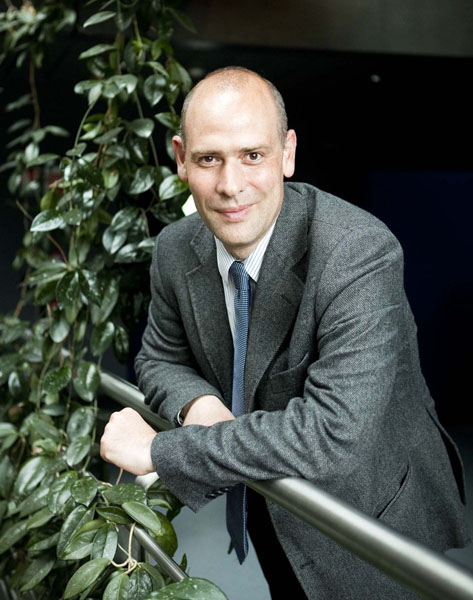
Paolo Samorì is a full-time Professor at the Université de Strasbourg , where he serves as Director of the Nanochemistry Laboratory and Emeritus Director of the Institut de Science et d'Ingénierie Supramoléculaires (ISIS) . He is affiliated with multiple prestigious academies, including the German National Academy of Science and Engineering (ACATECH) , Royal Society of Chemistry (FRSC) , and European Academy of Sciences (EURASC) . Education: Laurea (MSc) in Industrial Chemistry (University of Bologna, 1995), PhD in Chemistry (Humboldt University Berlin, 2000, summa cum laude). His research focuses on Nanochemistry , 2D materials , and supramolecular systems at interfaces , with applications in organic electronics , optoelectronics , and sensing . He pioneered methods for scanning probe microscopies and photoresponsive nanodevices , including graphene-based systems and diarylethene molecular switches. His scientific awards include the ERC Advanced Grant (2019) , Blaise Pascal Medal (2018) , and Catalán-Sabatier Prize (2017) , among 20+ honors. He has trained over 130 students and researchers , including 34 professors now active globally.
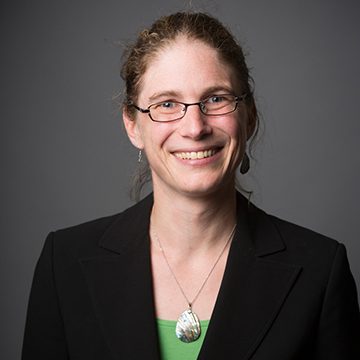
Lara A. Estroff is a Full Professor and the current Chair of the Department of Materials Science and Engineering at Cornell University's College of Engineering. She has been a faculty member since 2005 and served as Director of Graduate Studies from 2015 to 2019. Her academic leadership and research excellence position her at the forefront of bio-inspired materials and biomineralization research. Her educational background includes a B.A. in Chemistry from Swarthmore College (1997) and a Ph.D. in Chemistry from Yale University (2003), followed by an NIH-funded postdoctoral fellowship at Harvard University in the lab of Prof. George M. Whitesides. Dr. Estroff's research centers on the fundamental mechanisms of crystal growth, biomineralization, and pathological mineralization. She investigates how organisms control mineral formation and applies these principles to engineer synthetic materials with complex structures and functionalities. Her work spans biomaterials, tissue engineering, and energy materials—particularly hybrid organic-inorganic perovskites for photovoltaics. She employs advanced characterization techniques and has pioneered in situ methods to monitor crystallization dynamics. Her recent publications reveal a strong trend toward interdisciplinary research, integrating materials science with cancer biology, immunology, and machine learning. The articles emphasize bio-inspired synthesis, mineral-tissue interactions, and the development of functional crystalline materials for medical and energy applications. Faculty Early CAREER Award, National Science Foundation (2009) Fiona Ip Li '78 and Donald Li '75 Excellence in Teaching Award, Cornell College of Engineering (2007) Marilyn Emmons Williams Award, Cornell Undergraduate Research Board (2009) Keynote Speaker, Gordon Research Seminar on Biomineralization (2012) Lawrence Berkeley National Lab Affiliate (2013) Dr. Estroff leads a major DOE-funded project titled “Formulation Engineering of Energy Materials via Multiscale Learning Spirals,” a $3 million, three-year initiative using machine learning to optimize perovskite synthesis for solar cells. She has advised numerous graduate students and postdoctoral researchers, and her lab is known for fostering collaborative, cross-disciplinary research. She has also contributed to educational initiatives at Cornell, particularly in undergraduate research and materials education. Her research group operates at the intersection of chemistry, engineering, and biology, focusing on high-resolution characterization of biominerals, in situ crystal growth studies, and the design of in vitro models for cell-mineral interactions. The lab actively collaborates with institutions including Lawrence Livermore National Laboratory, National Renewable Energy Laboratory, and Johns Hopkins University.
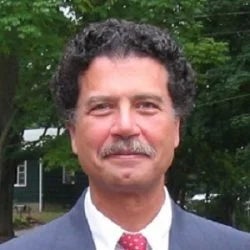
Hamouda Ghonem is a Professor in the Department of Mechanical, Industrial and Systems Engineering at the University of Rhode Island . He established the Mechanics of Materials Research Laboratory (MMRL) in 1981, focusing on experimental and computational studies of deformation and damage in advanced engineering materials under extreme conditions. Education: Ph.D., Mechanical Engineering, McGill University (1978) M.S., Mechanical Engineering, McGill University (1976) B.Sc., Nuclear Engineering, University of Alexandria (1969) Research Interests span high-temperature deformation of metallic alloys, creep-fatigue-environment interactions, dislocation-precipitate interactions, grain boundary mechanics, and ultrafine grain manufacturing. His work quantifies microstructural effects on material failure and develops predictive models for damage evolution in aerospace and nuclear materials. Scientific Awards include: Fellow of ASME Sabbatical appointments at European universities and aerospace research centers Laboratory Facilities at MMRL include: MTS servohydraulic testing machines Creep and high-strain rate (Split Hopkinson Bar, gas gun) systems Computational modeling with Abaqus, MATLAB, and in-house codes Microstructural analysis via SEM and optical microscopy Vacuum and high-temperature (-196°C to 1200°C) testing environments
Bryan K. Clark is an Associate Professor in the Department of Physics at the University of Illinois, with his office located in the Engineering Sciences Building. He leads the Clark Research Group, which works at the intersection of quantum information, condensed matter physics, machine learning, and computing. Clark's research spans four main areas: Quantum Computing , where his group develops quantum algorithms and collaborates with experimentalists on superconducting qubit systems; Quantum Many-Body Physics , where he applies computational methods to understand emergent behavior in strongly correlated systems; Algorithms for the Quantum Many-Body Problem , where his group has pioneered techniques like Neural Network Backflow (NNBF) that represent state-of-the-art accuracy for simulating fermions and frustrated magnetism; and Machine Learning for Experiment , where his group develops techniques to analyze experimental data like scanning transmission electron microscopy images. His publication record demonstrates consistent innovation in bridging theoretical quantum information science with practical applications. Recent work focuses on neural network approaches to quantum simulation, quantum error correction/mitigation, and novel qubit architectures like the Floquet Fluxonium Molecule. His research shows a clear trajectory from fundamental questions about the quantum-classical boundary to practical implementations in quantum hardware. Clark actively mentors graduate students, with recent thesis defenses by Faisal Alam, Matt Thibodeau, Chad Germany, James Allen, and Abid. His group has secured significant funding from the NSF and IBM's IIDAI institute to support research in quantum computing and machine learning applications for nano-photonics manufacturing and error mitigation. The Clark Research Group maintains strong connections with experimental teams, particularly in superconducting qubit development and materials characterization. They've developed computational tools like QOSY (Quantum Operators from SYmmetry) that are publicly available on GitHub and have gained recognition in the quantum information community.
Sarah Köster is a Full Professor at the University of Göttingen’s Institute for Cellular and Molecular Physiology of the Brain. She earned her PhD from the University of Göttingen under Prof. Stephan Herminghaus and completed postdoctoral research at Harvard University with Prof. David Weitz. Her career includes appointments as Junior Professor (2008-2011), Associate Professor (2011-2017), and Full Professor (since 2017). Research focuses on cellular biophysics, particularly cytoskeletal mechanics and intermediate filament dynamics. Key investigations include keratin plasticity, vimentin network mechanics, cytoskeletal crosstalk, and DNA organization during cell division. Her publications demonstrate expertise in nanoscale biomechanics, utilizing techniques like nanoindentation, X-ray diffraction, and advanced microscopy to probe cellular structures. Recent work emphasizes multiscale mechanical properties of cytoskeletal networks and their functional implications.
Renaud BACHELOT is a full Professor of Physics at the University of Technology of Troyes (UTT) since 1996. He leads the Light, Nanomaterials, and Nanotechnologies (L2n) laboratory and directs the Graduate School 'Nano-optics & Nanophotonics'. He holds adjunct professorships at the University of Paris-Saclay (LuMIn Lab) and Shanghai University (1000-talents Grant). His research focuses on nano-optics, plasmonics, and hybrid nanoplasmonics, with expertise in photopolymerization and plasmon-driven chemical processes. Education: PhD and graduate studies at Université Paris-Cité and ESPCI Paris Research Interests: BACHELOT’s work spans nanoscale light-matter interactions, including plasmonic nanostructures, photopolymerization-based fabrication, and applications in optical sensing and quantum photonics. His lab employs advanced techniques like near-field scanning optical microscopy (NSOM) and two-photon polymerization. Grants & Projects: ANR-PIA3 STRONG-NANO (2023-2026) ANR ADVANSPEC (2022-2025) International collaborations with NTU Singapore and Argonne National Lab Labs & Teams: Directs L2n (CNRS-UMR 7076) and collaborates across interdisciplinary platforms like InSyTE and LIST3N. His team develops novel hybrid materials and nanophotonic devices.
Prof. Dr. Uwe Hartmann is a faculty member and Chair Holder at Saarland University, affiliated with the Institute of Experimental Physics within the Faculty of Natural Sciences and Technology. His research group specializes in nanostructure research and nanotechnology, with a strong focus on instrumentation, nanofabrication, and quantum systems. He is based in Building C6.3, Saarbrücken, Germany. His research interests lie at the intersection of physics and engineering, particularly in nanotechnology , scanning probe microscopy , quantum device characterization , and nanofabrication . His work spans fundamental investigations of nanostructures to applied developments in microsystem technology and industrial nanomanufacturing. He has contributed significantly to cleanroom technologies, surface physics, and the transition from micro- to nanoscale systems. The recent publications highlight a strong thematic focus on enabling technologies for nanoscale science, including instrumentation (e.g., atomic force microscopy), fabrication methods, and analysis of quantum and metallic nanostructures. The research demonstrates a consistent trajectory toward understanding and manipulating matter at the nanoscale for both scientific and industrial applications. Scientific Awards: No awards explicitly mentioned in the provided text. Prof. Hartmann actively supervises doctoral and diploma students, indicating a strong commitment to academic mentoring. His group includes PhD students and scientific staff, suggesting ongoing research projects and potential grant funding, although specific grants are not listed. He has led a long-standing research group with technical staff supporting experimental work, indicating a well-established laboratory infrastructure focused on experimental physics and nanotechnology development. Laboratory and Team: The working group includes scientific staff (e.g., Dr. Haibin Gao), PhD and diploma students, and technical staff (electronics engineers, mechanics, workshop heads), forming a multidisciplinary team capable of both theoretical and hands-on experimental research in nanotechnology. The presence of a dedicated workshop and technical personnel underscores the practical, device-oriented nature of the research.
Cesare Franchini is a full Professor at the University of Vienna's Faculty of Physics, leading the Computational Materials Physics research group. His work focuses on theoretical understanding and computational modeling of quantum materials using first principles methods, particularly VASP. He maintains an active research program with numerous postdocs, PhD students, and collaborations across multiple institutions including the University of Bologna. Professor Franchini's research centers on quantum materials with many interacting degrees of freedom (lattice, spin, and electron orbital) that enable novel electronic and magnetic phases. His specific interests include metal-insulator transitions, polaron physics (electron-phonon interactions), non-collinear spin orderings, topological Dirac/Weyl phases, multiferroism, and superconductivity. He has increasingly incorporated machine learning data-driven tools and diagrammatic Monte Carlo techniques into his computational approaches. Analysis of his recent publications (2024-2025) reveals a strong focus on polaron physics across multiple material systems, with significant work on hematite, titanium dioxide, and quantum paraelectrics like KTaO3. His research increasingly integrates machine learning with traditional first-principles methods, particularly for studying hydrogen diffusion, surface science phenomena, and electronic structure calculations. There's also substantial work on single-atom catalysis and the application of advanced computational techniques to understand fundamental charge transport mechanisms in energy materials. Professor Franchini actively supervises numerous PhD students and postdocs, including Andrea Angeletti, Viktor Birschitzky, Lorenzo Celiberti, and several others working on diverse aspects of computational materials physics. He leads or participates in major research projects including TACO (Taming Complexity in Materials Modeling), DCAFM (Doctoral College Advanced Functional Materials), and the recently launched Spin-orbit entangled anharmonic polarons project. His group maintains strong collaborations with experimentalists at Charles University, Technical University of Vienna, and other international institutions.
Daniel Vanmaekelbergh is a Professor in the Department of Chemistry at Utrecht University, where he leads research in the Condensed Matter and Interfaces group within the Debye Institute for Nanomaterials Science. His academic career spans over two decades with continuous contributions to nanomaterials science and semiconductor physics. Professor Vanmaekelbergh's research focuses on the fundamental properties of semiconductor nanocrystals, quantum dots, and artificial electronic lattices. His work bridges theoretical and experimental approaches to investigate electron transport, quantum confinement effects, and the optical properties of nanoscale materials. He has made significant contributions to understanding the formation mechanisms of nanocrystal superlattices, the electronic structure of artificial honeycomb lattices, and the dynamics of excitons in confined systems. His research group, known as the Vanmaekelbergh Lab, employs advanced techniques including scanning tunneling spectroscopy, electron microscopy, and optical spectroscopy to probe nanoscale phenomena. Analysis of his recent publications reveals a strong emphasis on the physics of quantum-confined systems, particularly in lead chalcogenide and cadmium selenide nanocrystals. His work explores the relationship between nanocrystal structure and electronic properties, with applications in optoelectronics and quantum technologies. Recent research has focused on oriented attachment processes, artificial quantum systems with fractal geometries, and the fundamental limits of light-matter interactions in nanoscale materials. Professor Vanmaekelbergh has established a productive research program with numerous collaborations across the Netherlands and internationally. His work has been published consistently in high-impact journals including Nature Physics, Nano Letters, and ACS Nano, demonstrating the significance of his contributions to the field of nanomaterials science.
Xiaoqing Pan is a Professor and Henry Samueli Endowed Chair in Engineering at the University of California, Irvine, with dual appointments in the Department of Materials Science and Engineering and the Department of Physics and Astronomy. He serves as Director of the Irvine Materials Research Institute (IMRI) and the Center for Complex and Active Materials (NSF MRSEC). A renowned electron microscopy expert, Pan has developed advanced transmission electron microscopy (TEM) techniques for atomic-scale material characterization. Ph.D., Universität des Saarlandes, Germany (1991) His research focuses on atomic-scale structure-property relationships in oxide heterostructures, ferroelectrics, nanocatalysts, and 2D functional materials. Pan leads development of novel 4D-STEM and momentum-resolved vibrational electron microscopy methods to study single-atom catalysts and complex oxides. With over 400 high-impact publications in Nature , Science , and Nature Materials , his work has been recognized by major fellowships and awards from the American Ceramic Society, American Physical Society, and National Science Foundation. Pan's recent work includes: Atomic-scale analysis of grain boundary phonon anisotropy Advances in FeSe/SrTiO 3 interface electron-phonon coupling Plastic waste upcycling through carbon intermediate interception Control of metal-support interactions in photocatalysts Strain engineering in high-entropy oxide films His laboratory at UCI represents the forefront of materials characterization technology development.
Prof. Dr. Soeren Lienkamp is an Assistant Professor at the Institute of Anatomy , Faculty of Medicine , University of Zurich . His work bridges digital education and genetic research , focusing on enhancing medical teaching through innovative formats. Research Interests : Genetics, developmental biology, kidney disease modeling, CRISPR applications, digital medical education, and advanced microscopy. Methodologies : Combines Xenopus tropicalis models, deep learning , and bioengineering to study genetic kidney disorders and improve diagnostic tools. Publication Trends : His recent articles highlight predictable genome editing , 3D imaging technologies , and mechanistic insights into kidney and eye development. Earlier works focus on ciliary function , Wnt signaling , and metabolic stress in renal cells.
Michael Vershinin is an Assistant Professor of Physics and Astronomy at the University of Utah, specializing in molecular motors and biophysics. He is also affiliated with the Biological Chemistry Program and leads a lab focused on understanding how molecular motors like kinesin and dynein drive intracellular transport and viral assembly. He earned his B.S. from Cooper Union College and Ph.D. from the University of Illinois, Urbana-Champaign. His research interests include: Molecular motor function and regulation Single-molecule biophysics Microtubule-based transport Viral particle assembly (especially SARS-CoV-2 and HIV) Optical trapping and fluorescence microscopy His lab uses in vitro reconstitution and optical trapping to dissect the biophysical properties of motor proteins and their regulation. He collaborates across disciplines, integrating biochemistry, molecular biology, physics, and computational modeling to explore how complex biological behaviors emerge from simpler components. His publications span a wide range of topics, from the structural stability of SARS-CoV-2 virus-like particles to the mechanical behavior of kinesin and dynein motors. A recurring theme is the use of quantitative biophysical tools to understand how motor proteins navigate complex cytoskeletal environments and how viruses hijack these systems for transport. He currently advises no listed students in the provided text and has not received any explicitly listed awards. His lab is located at the University of Utah and can be reached at vershinin@physics.utah.edu .
Jeff S Abramson is a Professor of Physiology in the David Geffen School of Medicine at the University of California Los Angeles (UCLA). His research focuses on the structural and functional characterization of membrane transport proteins, particularly sugar transporters and mitochondrial channels. He maintains an active laboratory investigating the molecular mechanisms of cellular transport processes. Dr. Abramson's primary research interests center on membrane transport proteins, with particular emphasis on sugar symporters and voltage-dependent anion channels (VDACs). His work combines structural biology, biophysics, and biochemistry to understand the molecular mechanisms of transport, including conformational changes during transport cycles, substrate recognition, and regulation by membrane potential. His research has significant implications for understanding metabolic disorders, mitochondrial function, and potential therapeutic targets. Analysis of Dr. Abramson's publication record reveals a consistent focus on membrane protein structure-function relationships over the past two decades. His work demonstrates expertise in X-ray crystallography, cryo-electron microscopy, and functional assays to characterize transport proteins. Recent publications show increasing emphasis on mitochondrial biology, particularly VDAC structure and function, while maintaining his longstanding interest in sugar transport mechanisms. His research bridges fundamental biophysical principles with potential biomedical applications in metabolic diseases. Dr. Abramson has been awarded multiple NIH grants supporting his research, including the R35GM135175 grant titled 'Deciphering molecular details of cellular sugar transport and their roles in disease' (2020-2024), R01GM124783 'Functional and structural studies of unique pathogenic transporters involved in glycobiology' (2017-2021), and R01GM078844 'Structural and functional characterization of sugar transporters in health and disease' (2006-2020). As Principal Investigator, Dr. Abramson has mentored numerous graduate students and postdoctoral researchers. His laboratory has made significant contributions to understanding the structure-function relationships of membrane transport proteins through collaborations with researchers across multiple disciplines. The lab utilizes advanced techniques including X-ray crystallography, cryo-EM, electrophysiology, and computational modeling to address fundamental questions about membrane protein mechanisms. Dr. Abramson's laboratory is part of UCLA's broader research ecosystem focused on structural biology and membrane protein research. His work intersects with several research centers at UCLA including those focused on metabolic diseases and structural biology. The lab maintains active collaborations with researchers specializing in biophysics, computational modeling, and disease mechanisms to translate basic findings into potential biomedical applications.
François Peeters is a Full Professor of Physics at the University of Antwerp, Belgium, holding the position since 2000 (with Dutch title 'gewoon hoogleraar' since 2003). He previously served as Research Director (FWO-VI) at the University of Antwerp (1996-1999), Research Leader (NFWO) (1992-1996), and Senior Research Assistant (NFWO) (1988-1992), establishing a distinguished academic career spanning over three decades. His educational background includes a Ph.D. in Physics from the University of Antwerp (1982), followed by a Habilitation (Hoger aggregaat) from the same institution (1987), and a postdoctoral fellowship at Bell Laboratories in Murray Hill, New Jersey (1982-1983). His academic journey also featured research periods at prestigious institutions including the High Magnetic Field Laboratory in Grenoble, University of California Berkeley, Oxford University, and several Brazilian and Australian universities. Peeters' research focuses on theoretical condensed matter physics , specializing in the electronic, optical, and magnetic properties of nanostructured systems. His work encompasses semiconductors , superconductors , graphene , and hybrid quantum systems , with particular emphasis on strong correlations in both classical (colloids, dusty plasma) and quantum (quantum dots) environments. His theoretical frameworks bridge fundamental quantum mechanics with practical nanotechnology applications, driving innovations in spintronics and quantum device design. Analysis of his publication record reveals a clear evolution from foundational work on polaron physics and quantum Hall systems in the 1980s-1990s toward contemporary research on graphene, topological materials, and programmable quantum nanodevices. His most cited works demonstrate consistent leadership in mesoscopic physics, with recent publications showing increased focus on spin-dependent transport phenomena and two-dimensional material systems. His scientific recognition includes: Fellowship in the American Physical Society (2005) APS Outstanding Referee award (2008) Doctor Honoris Causa from University of Szeged, Hungary (2009) Peeters has supervised 26 completed PhD theses and currently leads the Condensed Matter Theory research group comprising 3 ZAP researchers, 16 PhD students, and 8 postdocs. His grant portfolio includes coordination of an EU Marie Curie Training site on 'Electrons on helium', participation in multiple EU projects, COST actions, and ESF networks, demonstrating sustained success in securing competitive international funding. The Condensed Matter Theory group maintains extensive international collaborations, evidenced by Peeters' research visits to over 10 institutions worldwide and regular hosting of 3-4 international visitors at postdoc or professorial levels. The group's output of over 770 refereed publications with 12,000+ citations reflects its position at the forefront of theoretical condensed matter physics research.
Jean Provost is a Full Professor in the Department of Engineering Physics at Polytechnique Montréal , with affiliations to the Montreal Heart Institute , IVADO , and the Institute of Biomedical Engineering . His research focuses on ultrasound imaging , cardiac and cerebral vascular imaging , and superresolution image reconstruction using machine learning and optimization . Based on 96 publications, his work emphasizes ultrasound localization microscopy , neural network applications , and microvascular hemodynamics . Education : Ph.D. (Columbia University), MPhil (Columbia University), M.Sc.A. (École Polytechnique Montréal), Engineering Degree (École Centrale Paris), License (Université Paris XI), B.Eng. (École Polytechnique Montréal) Research trends from 15 recent articles include: 3D and dynamic ultrasound localization microscopy for microvascular mapping Deep learning for image reconstruction and neural network pruning Machine learning-driven aberration correction and superresolution imaging Acoustoelectric and cavitation-based imaging techniques Applications in cardiac diagnostics and dementia detection Supervision includes 2 Ph.D. and 8 Master's theses completed at Polytechnique Montréal (2023), covering topics like optical ultrasound detection , microbubble modulation , and spatiotemporal sampling .