
Paul Prucnal is a Professor of Electrical and Computer Engineering at Princeton University, affiliated with the Princeton Materials Institute (PMI). He leads the Lightwave Communications Research Lab, focusing on ultrafast optical techniques for communication networks and neuromorphic photonics. His research spans optical security, CDMA networks, nonlinear signal processing, and photonic neurons. Education: Ph.D., Columbia University (1979) M.Phil., Columbia University (1978) M.S., Electrical Engineering, Columbia University (1976) A.B., Bowdoin College, summa cum laude (1974) Research Interests: Optical Network Security (eavesdropping/jamming countermeasures) Optical CDMA for broadband networks Silicon photonic neuromorphic computing RF interference cancellation in wireless systems Photonic spiking neurons mimicking biological organisms Awards: National Academy of Inventors Fellow (2017) 10+ teaching awards including Princeton's President's Award (2015) OSA/IEEE Fellowships (1992, 1997) Labs/Teams: Leads the Lightwave Communications Lab, collaborating with government/industry partners. Lab alumni like Prof. Bhavin Shastri have achieved international recognition. Grants/Publications: Over 350 journal papers, 22 U.S. patents. Authored/co-authored Neuromorphic Photonics (2017) and edited Optical Code Division Multiple Access (2019). Current projects include photonic tensor processors and real-time RF signal processing.
جستوجوی استاد و پژوهشگر
استاد راهنما، استاد دانشگاه یا پژوهشگر مناسب برای مسیر پژوهشیتان را پیدا کنید و با او ارتباط بگیرید.
نمایش ۱-۱۱ از ۱۱ استاد راهنما
اطلاعات این پروفایلها از صفحات عمومی دانشگاهها جمعآوری شده و ممکن است بهروز نباشد.
Saleh A. Alshebeili is a Professor in the Department of Electrical Engineering at King Saud University's College of Engineering, Riyadh, Saudi Arabia. With over 139 publications spanning from 1991 to 2024, his research demonstrates significant contributions across multiple engineering disciplines. His academic profile shows consistent collaboration with Saudi research institutions and international partners, particularly in communications and signal processing fields. Dr. Alshebeili's research interests span wireless communications, optical networks, radar systems, and biomedical signal processing. His work bridges theoretical signal processing with practical applications in 5G/6G communications, IoT security systems, and healthcare monitoring. The interdisciplinary nature of his research connects electrical engineering with computer science, particularly through machine learning applications for signal analysis and system optimization. His publications demonstrate expertise in both traditional signal processing techniques and emerging AI-driven approaches to engineering problems. Analysis of his recent publications (2021-2024) reveals a strong focus on next-generation communication technologies including 6G systems, optical wavelength conversion, and OAM-SDM communication. Simultaneously, he maintains active research in biomedical applications, particularly EEG signal processing for seizure detection and biometric authentication using physiological signals. His work consistently appears in top IEEE journals including IEEE Access, IEEE Transactions on Wireless Communications, and IEEE Journal of Biomedical and Health Informatics, reflecting the high quality and relevance of his research. Dr. Alshebeili has established extensive collaborations with researchers across King Saud University, particularly with Fathi E. Abd El-Samie (29 co-authored papers), Turky N. Alotaiby (22 papers), and Amr Ragheb (21 papers). These long-term collaborations suggest leadership in research groups focusing on communications systems and biomedical signal processing. His work spans theoretical development, simulation, and experimental validation, as evidenced by publications with 'Experimental Investigation' and 'Experimental Demonstration' in their titles.
Professor Richard Syms, FREng, is a Professor in the Department of Electrical and Electronic Engineering at Imperial College London's Faculty of Engineering. His research focuses on interdisciplinary fields including metamaterials, medical imaging, MEMS/NEMS, and advanced signal processing. He is affiliated with both the Department of Electrical and Electronic Engineering and the Optical and Semiconductor Devices group. His research interests span a wide range of topics, including optical physics, communications technologies, and medical device development. Notable contributions include innovations in magnetic resonance imaging (MRI), microelectromechanical systems (MEMS), and acoustic filter design. His work often integrates engineering principles with biomedical applications, such as developing catheter-based MRI systems and advanced imaging techniques for cancer diagnostics. Professor Syms has authored numerous publications in high-impact journals, with recent work emphasizing metamaterial-based communication systems, NEMS actuators, and sustainable healthcare technologies. His research has been recognized through prestigious awards, including his fellowship in the Royal Academy of Engineering (FREng). His academic contributions also include advancements in microfabrication techniques, parametric amplification of magneto-inductive waves, and the design of high-performance filters for acoustic and electromagnetic applications. He collaborates widely across disciplines to address challenges in medical imaging, energy-efficient systems, and smart materials.
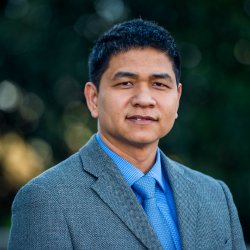
Hung Viet Nguyenمشاهده پروفایل
پژوهشگر ارشد
Hung Viet Nguyen is a Research Fellow at the 5G Innovation Centre, University of Surrey, UK, within the Institute for Communication Systems. He holds a PhD in Electronics and Electrical Engineering from the University of Southampton (2013), an MEng in Telecommunications from Asian Institute of Technology (2002), and a BEng in Electronics & Telecommunications from Hanoi University of Science and Technology (1999). His research focuses on quantum communications, including quantum error correction, quantum algorithms, and quantum key distribution (QKD), alongside classical domains like cooperative communications, channel coding, and network coding. He has contributed to EU-funded projects such as CONCERTO and OPTIMIX, and his work bridges quantum and classical information systems. Key research areas include: - Quantum error correction codes and topological codes (e.g., surface codes, color codes) - Quantum network coding and quantum channel capacities - Network-coding aided cooperative communications - Applications in 5G-NR and future wireless systems Publications highlight advancements in QKD protocols over free-space optics, quantum turbo codes for memory channels, and quantum-assisted routing optimization. His work on classical-to-quantum coding isomers and Pareto-optimal routing algorithms underscores interdisciplinary innovation. Nguyen’s contributions also extend to MIMO systems, antenna optimization, and energy-efficient ad hoc networks. Labs/Teams: Active member of the 5G Innovation Centre and collaborator with the School of Electronics & Computer Science, University of Southampton.
Michael B. Rahaim is a Researcher at Boston University , specializing in Optical Wireless Communication (OWC), Visible Light Communication (VLC), and Hybrid RF/VLC Networks . His work focuses on interference mitigation , dynamic field-of-view (FOV) receivers , and integration with 5G systems . He has developed open-source tools like the gr-owc toolkit for optical wireless research and extended ns-3 network simulator for VLC. His collaborations include researchers such as Thomas D. C. Little , Hany Elgala , and Abdallah Khreishah . His scientific contributions span MAC protocol design , outage probability analysis , and low-cost IoT communication systems . He has not been explicitly associated with teaching or administrative roles in the provided records.

Paul R. Prucnal is a Professor of Electrical and Computer Engineering at Princeton University and an Associated Faculty member in the Princeton Materials Institute (PMI). He directs the Lightwave Communications Research Laboratory, where he leads cutting-edge research in photonics, optical communications, and neuromorphic computing. Education: Ph.D., Columbia University, 1979 M.Phil., Columbia University, 1978 M.S., Electrical Engineering, Columbia University, 1976 A.B., Math and Physics, Bowdoin College, summa cum laude, 1974 Professor Prucnal's research focuses on ultrafast optical techniques with applications to communication networks and signal processing. His group investigates several key areas including physical (optical) layer network security, optical code division multiple access (CDMA), nonlinear optical signal processing for ultrafast networks, optical cancellation of RF interference, and the development of photonic neurons that operate a billion times faster than biological neurons. His work bridges the gap between photonics device physics and neural networks, pioneering the field of neuromorphic photonics. His recent publications reveal a strong trend toward neuromorphic photonics and brain-inspired optical computing. The research spans from fundamental optical physics to practical applications in secure communications and ultrafast signal processing, with emphasis on photonic neural networks, optical encryption techniques, silicon photonics implementations, and optical systems that emulate biological neural functions. Scientific Awards: National Academy of Inventors Fellow (2017) The President's Award for Distinguished Teaching, Princeton University (2015) Lifetime Achievement Award for Excellence in Teaching, Engineering Council, Princeton University (2015) School of Engineering and Applied Science Distinguished Teaching Award, Princeton University (2009) Fellow of the OSA (1997) Fellow of the IEEE (1992) Rudolf Kingslake Medal and Prize, SPIE (1990) Professor Prucnal has mentored numerous graduate students including Eric Blow, Eli Doris, Thomas Ferreira de Lima, Yusuf Jimoh, Hyuma Umeda, Yuxin Wang, Ben Wu, Lei Xu, and Jiawei Zhang. His research has been supported through collaborations with government and industrial research laboratories, focusing on next-generation optical signal processing, computing, and communications systems. His lab has produced significant innovations including graphene-based laser neurons and optical implementations of biological neural processing. The Lightwave Communications Research Laboratory offers students opportunities to work on innovative projects at the intersection of photonics, communications, and neural computing. Current research includes developing photonic neurons for machine learning applications, optical security techniques for fiber networks, and neuromorphic photonic systems that emulate visual, auditory, and motor functions found in biological organisms.

Goran Lj. Djordjevic is a Professor at the Department of Electronics, Faculty of Electronic Engineering, University of Nis, Serbia. Appointed full professor in 2009 after progressive promotions from assistant professor (1999) to associate professor (2004), he represents a cornerstone of the institution where he completed all academic degrees. His three-decade career exemplifies deep institutional commitment and scholarly excellence in electronic engineering. His academic foundation was built entirely at the University of Nis: Diploma Engineer in Electronics (1989) Master of Science in Electronics (1994) Doctor of Philosophy in Electronics (1998) Professor Djordjevic's research forms three interconnected pillars: Networks-on-Chip (NoC) innovation with breakthroughs in deflection routing and port allocation; UWB localization systems solving multipath challenges in complex indoor environments through multi-algorithm fusion; and error control coding for storage systems with applications in optical media. His work consistently bridges theoretical rigor and practical implementation, evidenced by 22 impact-factor journal publications spanning VLSI design, wireless communications, and parallel computing. Analysis of his publication timeline reveals strategic evolution: recent work (2021-2022) focuses on real-world NoC optimization and robust indoor positioning, mid-career research (2015-2005) established CDMA bus architectures and fault-tolerance frameworks, while foundational contributions (2001, 1996) in constraint coding and task scheduling underpin his later breakthroughs. This trajectory demonstrates exceptional continuity in advancing communication reliability across hardware and software domains. Scientific recognition includes: No formal awards documented in source materials Regarding academic mentorship, while specific students aren't listed, his sustained research output implies active graduate supervision. Project funding shows zero current national grants, though international collaborations remain unspecified. His 22 impact-factor publications across IEEE, Elsevier, and Springer journals demonstrate consistent productivity through completed research initiatives, with recent work indicating ongoing laboratory activity in wireless and NoC domains.
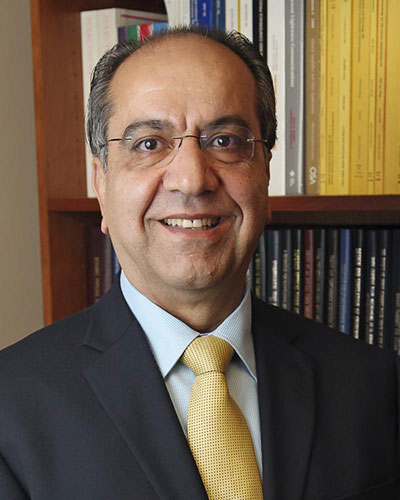
- Optical fiber communications
- Broadband communications
- Photonic generation of millimeter waves
- +۷ مورد دیگر
Mehdi Shadaram is a Professor in the Department of Electrical and Computer Engineering at the University of Texas at San Antonio (UTSA), where he holds the Janey and Dolph Briscoe Distinguished Professorship. He has served in leadership roles including Founding Director of the Center for Excellence in Engineering Research and Education (CEERE) and Interim Dean of Engineering (2013-2014). Ph.D., Electrical Engineering, University of Oklahoma (1984) His research spans optical fiber communications , photonic millimeter-wave generation , wireless networks , and engineering education . Recent work focuses on radio-over-fiber systems , probe beam deflection imaging , and cognitive radio networks . Funded by organizations like NASA and NSF, he has secured over $10M in grants. Key awards include the 2017 UTSA President’s Distinguished Achievement Award, 2009 UTSA College of Engineering Research Award, and NASA’s 1993 monetary award. He leads the UTSA Fiber Optic Research Laboratory, equipped with advanced photonics tools.
Michel Kulhandjian is a researcher specializing in Wireless Communication and Machine Learning applications. His work spans NOMA Systems , RF Fingerprinting , and Drone-Assisted Sensing across academic institutions. Key collaborations with Carleton University , Carleton University , and University of Ottawa researchers Active in 5G/6G technologies and IoT Security since 2018 His recent articles focus on: 2024 : Pedestrian detection, drone-based tree health monitoring, and industrial IoT security 2025 : AI-powered agricultural robotics Scientific contributions include: Code design for OTFS-NOMA systems Low-complexity detection algorithms 3D CNN frameworks for signal analysis RF Fingerprinting under impaired channels
Dr. José Manuel Villadangos Carrizo serves as an Associate Professor in the Department of Electronics at the University of Alcalá, Spain, actively contributing to the GEINTRA research group (Electronic Engineering Applied to Intelligent Spaces and Transport). He obtained his PhD from the University of Alcalá in 2013 with a dissertation on wide-coverage ultrasonic local positioning systems using encoding techniques, supervised by Dr. Jesús Ureña Ureña and Dr. Juan Jesús García Domínguez. His research centers on indoor/outdoor positioning technologies utilizing ultrasonic, infrared, and BLE systems, with specialized focus on non-intrusive elderly monitoring, dementia care, and behavioral pattern analysis. He develops sensor fusion algorithms, high-rate acquisition systems, and hardware architectures for real-world applications in smart environments. Analysis of his 2021-2025 publications reveals a strong trajectory toward healthcare-integrated positioning systems, particularly improving data availability through multi-sensor fusion (e.g., infrared-ultrasonic combinations) and extending tracking capabilities from indoor to outdoor environments for vulnerable populations. No scientific awards are documented in the provided materials. While his research output indicates significant project involvement, specific details regarding student advising or research grants remain unavailable in the source information. He maintains active research leadership within GEINTRA, which develops electronic engineering solutions for intelligent transportation and ambient-assisted living systems.
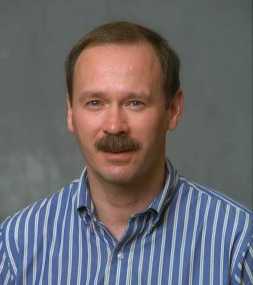
James S. Lehnert is a Professor at the School of Electrical and Computer Engineering , Purdue University, where he has been since 1984. He holds a B.S., M.S., and Ph.D. from the University of Illinois at Urbana-Champaign (1978, 1981, 1984). His research focuses on spectrum management , CDMA systems , channel estimation , and spread spectrum communications . He has led projects for DARPA, NSF, and the Air Force Office of Scientific Research, collaborating with institutions like the University of Michigan and Ohio State University. He has authored numerous articles in top journals like IEEE Transactions on Communications and IEEE Journal on Selected Areas in Communications . His awards include the IEEE MILCOM Lifetime Achievement Award (2009) and recognition as a Highly Cited Researcher (2000-2010). He is also a Fellow of the IEEE for contributions to spread-spectrum communications. Dr. Lehnert has advised over 30 graduate students, many of whom now hold prominent roles in academia and industry. He teaches advanced courses such as ECE544: Digital Communications and ECE639: Error Control Coding . His research group operates the Spread Spectrum and Satellite Communications Research Laboratory (S3CRL).