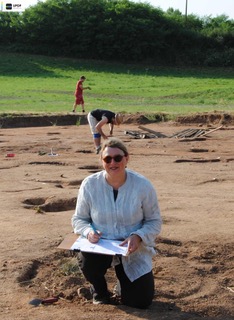
Sophie Krausz is a Professor of European Protohistory at the University of Paris 1 Panthéon Sorbonne, School of Art History and Archaeology of the Sorbonne, specializing in Iron Age archaeology and Gallic societies. Previously, she served as a Lecturer at Bordeaux Montaigne University (2005–2021) and Director of Éditions Ausonius (2018–2021). Her academic journey includes a PhD (1992) and Habilitation (2014) from Paris 1-Panthéon Sorbonne. Her research focuses on fortifications, state emergence, and political systems in prehistoric and protohistoric Europe, with fieldwork spanning 91 excavations since 1986. Notable projects include Châteaumeillant, Vix, and Mont Beuvray. She leads the CNRS International Research Network NEMESIS, studying European Iron Age societies. Key contributions include over 70 published books and 121 invited lectures. Awards include the Chevalier de l'Ordre des Arts et des Lettres (2014) and Chevalier de l'Ordre national du Mérite (2017). She oversees archaeological sites, integrates paleoenvironmental studies, and collaborates on interdisciplinary projects like the GENETIX genetic study of Iron Age populations.
John Creighton is a Professor in the Department of Archaeology at the University of Reading, specializing in Roman archaeology and Iron Age studies. His research focuses on Romanization processes, numismatic analysis, geophysical survey techniques, and urban development in Roman and pre-Roman contexts. He has conducted fieldwork in Britain, France, and Germany, contributing significantly to understanding Roman Britain and Gallic-Roman transitions. Creighton's notable works include the book Britannia: The Creation of a Roman Province (2006) and co-authored studies on Silchester Roman town mapping. He has collaborated with institutions like Bibracte European Archaeology Centre and led projects such as the Silchester Mapping Project (2005-10). His research bridges archaeological methodology and historical analysis, with recent work emphasizing interdisciplinary approaches to Roman economic systems and undergraduate research pedagogy. His publications span peer-reviewed articles in journals like Britannia and European Journal of Archaeology , as well as edited volumes on Roman and Iron Age topics. Collaborations include work with the Institute for Archaeologists on accessibility initiatives for disabled archaeologists.
Helmholtz Centre Berlin for Materials and EnergyGermany
Dr. Martin Schönfelder is a prominent researcher at the Leibniz Centre for Archaeology (LEIZA) in Mainz, Germany, specializing in European Iron Age studies with a focus on the La Tène period (5th–1st century BC) and Celtic cultures. His work spans cultural contacts, social practices, urbanization, and palaeoenvironmental research, with extensive fieldwork and publications addressing mobility, migration, and synchronization of chronological systems across Central Europe. Research Focus : Celtic migrations and La Tène cultural spread Chronological synchronization of Iron Age cultures (La Tène, Jastorf, Przeworsk) Analysis of oppida and open agglomerations Material culture studies (gold torcs, bronze jugs, horse tack) Elite representation and religious symbolism Publications & Projects : He has co-edited international volumes on open settlements and proto-urbanization, led DFG-funded projects like 'Mobilität und Migration in der Eisenzeit', and contributed to debates on the Gundestrup Cauldron and Spearbutts in Irish Iron Age . Recent work examines developmental dynamics post-2nd century BC and artifact-based evidence for cultural memory. Academic Roles : Member of AFEAF since 2005 Associated with UMR 6298 ARTeHIS (Dijon) Curator of RGZM permanent exhibition (since 2020) Editorial leadership in Archäologisches Korrespondenzblatt (2003–2020)
PhDr. Jiří Militký, Ph.D. is a researcher at the Center for Medieval Studies, Czech Academy of Sciences, specializing in Celtic and ancient numismatics, coin finds, and the numismatics of the High Middle Ages. He teaches externally at Charles University's Faculty of Arts in Prague and Masaryk University's Faculty of Arts in Brno, where he offers courses on ancient and Celtic numismatics. His work bridges numismatics and archaeology, focusing on the historical significance of coin finds in Central Europe. 2002-2010: Ph.D., Faculty of Arts, Charles University, Prague, Institute for Prehistory and Early History 2005: PhDr., Faculty of Arts, Charles University, Prague, Institute for Prehistory and Early History 1987-1992: Mgr., Faculty of Arts, Charles University, Prague, Institute for Prehistory and Early History 1994: Archaeological expedition in Drama, Bulgaria (University of Saarbrücken) 2008: Study stay in Vienna, Austria (Prähistorische Kommision) Jiří Militký's research focuses on the intersection of numismatics and archaeology, particularly examining Celtic and ancient coin finds in the Czech Republic and Central Europe. His work analyzes how coin circulation patterns reflect broader historical, economic, and cultural developments from antiquity through the Middle Ages. He investigates the role of coinage in trade networks, the significance of specific coin types in archaeological contexts, and the connections between Central European regions and the wider Mediterranean world. His recent publications reveal a continued focus on Celtic coinage, Roman and Byzantine coin finds in Bohemia, and medieval monetary systems. Militký's work demonstrates increasing interdisciplinary approaches, combining numismatic analysis with archaeological context and historical documentation. His research shows particular attention to regional variations in coin circulation and the significance of hoard finds for understanding economic patterns in Central Europe. Jiří Militký has participated in numerous research projects funded by the Czech Science Foundation (GA ČR), including studies on Roman and Byzantine coin finds in Bohemia, Celtic coinage at Czech oppida, and mobility of raw materials in the La Tène period. His collaborative work spans multiple institutions across Central Europe, reflecting the international nature of numismatic research. As a member of editorial boards for numismatic journals including Numismatický sborník, Numismatické listy, and Anály Náprstkova muzea, Militký contributes significantly to the scholarly infrastructure of his field. His research is conducted within the framework of the Center for Medieval Studies and in collaboration with the National Museum in Prague and other archaeological institutions across the Czech Republic.
Philippe Barral is a Professor of Celtic archaeology at the University of Franche-Comté (UMR 6249 Chrono-environment). He served as Director of the Maison des Sciences de l'Homme et de l'Environnement CN Ledoux (2015–2022) and was a member of the CNRS National Committee for Ancient and Medieval Worlds (2016–2021). Since 2006, he chairs the Association for the Study of the Iron Age and sits on editorial boards for Gallia and the Revue Archéologique de l’Est . His research investigates socio-cultural transformations during the late Iron Age and early Roman period in Northern Gaul and Celtic Europe. Key themes include the evolution of community sanctuaries, urbanization processes, territorial dynamics, and Mediterranean-Celtic cultural-economic interactions. He employs interdisciplinary methodologies integrating archaeology, spatial analysis, and environmental studies to explore ritual practices, settlement hierarchies, and economic networks. Barral's publications reveal consistent engagement with Iron Age-Roman transition, ceramic analysis, and ritual landscapes. Recent works emphasize integrated approaches to urbanism, public architecture, and ethnopolitical identities, reflecting methodological innovation and broad chronological scope. He mentors graduate students (e.g., Emmanuel Hamon, Charles Vuillermin) and leads excavations at major sites, including Alesia, Bibracte, Autun, and Mandeure. His projects involve multinational teams focusing on oppida, sanctuaries, and rural settlements, supported by institutions like the CNRS and regional archaeological services.
Josep Burch i Rius is a full Professor in Archaeology at the University of Girona since 1999. He holds a PhD in History since 1996 and has led archaeological research projects at sites including the Iberian oppida of Sant Sebastià de la Guarda and Sant Julià de Ramis, the Roman villas of Pla de Palol and Casa del Racó, and the Catalan Institute for Research in Cultural Heritage. Director of the Institute of Cultural Heritage (University of Girona), 2004–2007 Technical Director of the Catalan Institute for Research in Cultural Heritage, 2007–2013 Director of the Roses Chair of Archaeology and Archaeological Heritage, 2018–2021 Research Focus: Archaeology and cultural heritage, with emphasis on Iberian and Roman settlements, ancient pottery, and historical preservation. His work bridges theoretical and applied archaeology, integrating fieldwork with institutional leadership.
Dr. Miles Russell is a Senior Lecturer in Prehistoric and Roman Archaeology at Bournemouth University's Department of Archaeology and Anthropology. With a career spanning over 30 years, he specializes in Neolithic monumental architecture, Iron Age-Roman transitions, and archaeothanatology. His fieldwork spans the UK, Germany, Sicily, and Russia. PhD in Neolithic Architecture (2000, UCL) Director of the Durotriges Project Author of 15 books, including Piltdown Man: Case Closed and Arthur and the Kings of Britain Research Trends from his 15 most recent articles (2020-2025) focus on: Late Iron Age funerary practices and identity Roman provincial sculpture and political symbolism Archaeothanatology and mortuary analysis Geophysical surveys of ancient settlements Interdisciplinary approaches using 3D scanning Reassessing historical narratives in archaeology Scientific Awards : Fellow of the Society of Antiquaries of London (2006). Outreach : Regular media contributor to BBC's Digging for Britain , Time Team , and The One Show , with over 50 TV/radio appearances (2003-2022).
Leibniz Institute for Jewish History and CultureGermany
Prof. Dr. Roland Schwab is an Adjunct Professor at the Faculty of Mathematics and Natural Sciences of the Eberhard Karls University of Tübingen and serves as Research Associate and Head of the Laboratory for Archaeometry at the Leibniz Centre for Archaeology in Mainz. With a PhD in Archaeometry from TU Bergakademie Freiberg (2004) and habilitation in Scientific Archaeology from Tübingen (2015), he has established himself as a leading expert in ancient metallurgy and materials science for cultural heritage. His research focuses on archaeometry, with particular expertise in ancient metallurgy spanning Bronze and Iron Age Europe. Schwab's work extensively examines metal recycling practices, non-destructive analysis techniques, and the technological aspects of ancient metalworking. His investigations cover a wide range of artifacts including Celtic metalwork, Roman bronze statues, and gold objects from various periods, revealing sophisticated manufacturing techniques and resource management strategies employed by ancient societies. Analysis of his recent publications (2023-2025) shows a continued focus on material composition studies, metal recycling in antiquity, and non-destructive analytical methods. His work spans multiple chronological periods from the Early Eneolithic to the Roman era, with particular emphasis on Central Europe, the Rhineland, and the Alpine regions. The publications demonstrate his interdisciplinary approach combining scientific analysis with archaeological context to understand ancient technological practices. Professor Schwab has made significant contributions to understanding metal resource management in ancient societies, particularly through his studies of copper alloys from Celtic oppida like Manching and Martberg. His research has revealed sophisticated recycling practices and technological adaptations that challenge previous assumptions about ancient metallurgical knowledge. As Head of the Laboratory for Archaeometry at the Leibniz Centre for Archaeology, Schwab leads a team conducting cutting-edge research on cultural heritage materials. His leadership extends to major collaborative projects like 'CELTIC GOLD' investigating fine metalwork in the Western La Tène culture, demonstrating his continued influence in advancing archaeometric methodologies and interpretations.