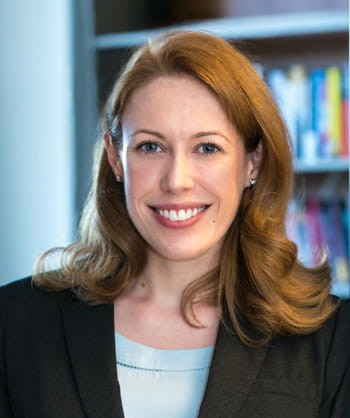
Lindsey O'Rourke is an Associate Professor of Political Science at Boston College's Morrissey College of Arts and Sciences. Her research examines U.S. foreign policy, international security, and covert regime change operations. Her work analyzes the causes, conduct, and consequences of U.S.-orchestrated covert interventions during the Cold War, gender dynamics in terrorism, and the strategic implications of regime change. Her book 'Covert Regime Change: America's Secret Cold War' received significant scholarly recognition. She teaches courses on U.S. foreign policy since 1945, the World Wars, and foreign-imposed regime change. Publications demonstrate three interconnected research streams: 50% on covert operations and regime change, 30% on gender dimensions of political violence, and 20% on contemporary security challenges. Her work combines historical analysis with contemporary policy implications.
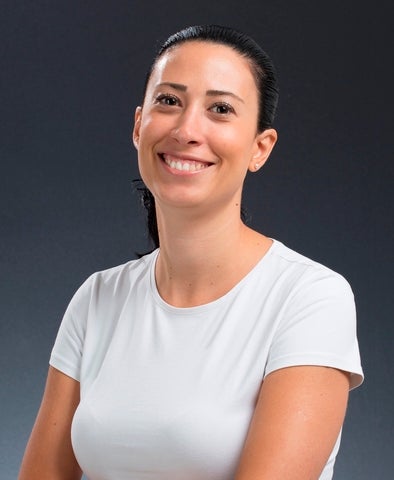
Sibel Alumur Alev is an Associate Professor and Associate Chair of Graduate Studies at the University of Waterloo. Her research focuses on logistics network design, hub location optimization, and sustainable transportation systems. She actively contributes to the fields of operations research and supply chain management, with a strong emphasis on addressing uncertainty in network design and strategic infrastructure planning. Her work spans applications in autonomous mobility systems, electric vehicle charging infrastructure, healthcare logistics, and pandemic response. She has published extensively on hub-and-spoke network models, reverse logistics for environmental sustainability, and multi-period resource allocation strategies. Notable areas of interest include the integration of stochastic and robust optimization methodologies into real-world logistics challenges. Dr. Alev’s research also bridges academic and industrial needs, addressing practical problems such as optimal testing center locations during pandemics and strategic freight hub expansions. Her contributions have been featured in peer-reviewed journals and conference proceedings, reflecting her commitment to advancing both theoretical and applied aspects of logistics and operations research.
Dr. Adnan Rajib is an Assistant Professor of Civil Engineering at The University of Texas at Arlington, leading the H2I Lab (Hydrology & Hydroinformatics Innovation Lab). His research focuses on large-scale hydrology, water quality modeling, and integrating artificial intelligence with remote sensing data to address climate change impacts on water resources. He actively advises doctoral, master's, and undergraduate students in projects related to flood resilience, wildfire hydrology, and nature-based solutions. Dr. Rajib has secured significant grants from NASA, NSF, and USDA, totaling over $4 million, including a major NASA initiative to predict wildfire effects on freshwater supplies and a DOE-funded Coastal Bend Climate Resilience Center. His work spans collaborations with international organizations like the United Nations University and The Nature Conservancy. Key contributions include global studies on floodplain alterations, wetland-mediated nitrate reductions, and the development of cyberinfrastructure tools for open science. He serves on the editorial board of environmental journals and professional committees, including the American Society of Civil Engineers' Wetland Hydrology Technical Committee. His teaching emphasizes advanced topics in civil engineering and research mentorship, with courses like 'Topics in Civil Engineering' and dissertation advisement. Dr. Rajib's lab integrates cutting-edge hydroinformatics to advance climate resilience strategies for vulnerable communities.
Jann Spiess is an Associate Professor of Operations, Information & Technology at Stanford University's Graduate School of Business and holds a courtesy appointment as Associate Professor of Economics in the School of Humanities and Sciences. He is also a Center Fellow at the Stanford Institute for Economic Policy Research and a Faculty Affiliate of the Golub Capital Social Impact Lab. PhD in Economics (Harvard University, 2018) AM in Economics (Harvard University, 2015) MPP in Public Policy (Harvard University, 2013) MASt in Mathematics (University of Cambridge, 2011) BSc in Mathematics (Technical University of Munich, 2010) Jann's research integrates machine learning with econometric methods to advance causal inference and data-driven decision-making . He explores high-dimensional and robust causal inference, synthetic control methods, and algorithmic fairness, while addressing challenges in human-AI collaboration and policy design. His publications span econometrics, behavioral economics, and data science, focusing on experimental design, robust statistical techniques, and applications of machine learning to public policy. Key themes include replicable inferences from big data, human-AI interaction, and ethical algorithmic design. Philip F. Maritz Faculty Scholar, 2021–22 David A. Wells Prize for best dissertation, Harvard Economics, 2018 Restud Tour, 2018 Jann's work bridges microeconometric methods , statistical decision theory , and mechanism design to enhance analytical frameworks for data-driven policy. He has contributed to robust inference in panel data and synthetic control methods, alongside studies on nudges for vaccination and financial aid renewals. As Faculty Affiliate at the Golub Capital Social Impact Lab, Jann collaborates on projects applying data science to social policy challenges, merging technical rigor with societal impact.
Shuaishuai Wang is a Lecturer in Digital Media and Culture at the University of Manchester, specializing in platform studies, critical algorithm studies, and queer media. His research explores queer communities' digital presence across platforms like Douyin, TikTok, and Blued, with a focus on algorithmic governance, data-driven social media operations, and geopolitical-economic contexts. He holds a PhD in Media Studies from the University of Amsterdam and previously served as Assistant Professor at Xi’an Jiaotong-Liverpool University and Lecturer at the University of Amsterdam. Shuaishuai leads two university-funded projects: 'Douyin Data Economies' (100,000 CNY) and 'Algorithmic Configurations of Sexuality' (30,000 Euros). His work appears in journals like Big Data & Society , Television & New Media , and Social Media + Society , and he contributes to media outlets including The Conversation and Sixth Tone. His research interests emphasize the interplay between algorithms, queer identities, and platform economies. Recent studies analyze Douyin's shift to e-commerce, LGBTQ+ visibility challenges in algorithmic systems, and the political dimensions of TikTok. He has also examined business models of LGBTQ platforms and the impact of censorship on digital queer spaces. Key grants include projects investigating data economies and algorithmic configurations of sexuality, reflecting his commitment to understanding technology's societal implications. Collaborations span global institutions, with notable work on misinformation, playful political performances, and transgressive digital cultures.
Pardis Pishdad is an Associate Professor and Graduate Program Director in the School of Building Construction at Georgia Institute of Technology’s College of Design. She directs the Smart Built Environment Eco-System (Smart Bees) Laboratory, focusing on integrating cyber-physical systems, digital twins, and innovative project delivery methods (e.g., IPD, Flash Tracking) for sustainable built environments. Her research bridges technology adoption, trust-building in construction contracts, and supply chain optimization. Education: PhD, Environmental Design and Planning (Virginia Tech) Master’s Degrees: Civil Engineering (Virginia Tech), Design Studies in Project Management (Harvard), Architecture (University of Tehran) Bachelor’s in Architectural Engineering (Azad University of Shiraz) Research Interests: Her work emphasizes sustainable construction practices using IoT, BIM, and blockchain. Key areas include lifecycle cost analysis, lean construction, and smart building technologies. She explores trust dynamics and collaboration in construction projects through game theory and process optimization. Recognition: 2018 ENR Top 20 Under 40 Professionals 2016 CII National Outstanding Researcher Award 2020-2022 Georgia Tech Provost Teaching Learning Fellow Advisory Roles: Academic Advisor for CII’s Supply Chain Management Community, Vice Chair of BuildingSMART’s BIM Forum 5D Taskforce. Formerly advised the Construction Management Association of America’s Board (2016–2018). Industry Collaboration: Partnerships with Turner Construction, GDOT, and VDOT. Research on Flash Tracking and blockchain has been integrated into industry practices. Labs & Teams: The Smart Bees Lab pioneers cyber-physical systems for smart buildings, exploring AI-driven solutions and sustainable construction frameworks.
Dr. Joseph Moore is an Assistant Professor in the Department of Mechanical Engineering at Johns Hopkins University (JHU), serving as Director of the Agile and Intelligent Robotics (AIRO) Laboratory. He is affiliated with the Laboratory for Computational Sensing and Robotics (LCSR), the Institute for Assured Autonomy (IAA), and holds a Bridging Faculty appointment in the Research and Exploratory Development Department (REDD) at JHU/APL. His research focuses on computational control, machine learning, and robotics to enable agile systems operating in complex environments. Dr. Moore previously served as Robotics Group Chief Scientist at JHU/APL, leading projects on hybrid unmanned aerial-aquatic vehicles and aerobatic fixed-wing systems. He has secured funding as Principal Investigator (PI) for ONR, DARPA, and ARL programs, particularly in post-stall maneuvering control and multi-robot coordination. His work emphasizes robust control strategies for autonomous systems in constrained environments. Research interests include aerial robotics, optimization, and learning-based control. Notable contributions involve NMPC-based systems, UAV navigation, and adaptive control for uncertain environments. His recent articles highlight advancements in swarm coordination, morphing-wing UAVs, and PAC-NMPC frameworks. Dr. Moore advises students such as Mark Gonzales and Adam Polevoy. Key grants include ONR/DARPA-funded projects on post-stall flight control and Army-funded multi-robot coordination efforts. His lab (AIRO) and collaborations (LCSR, IAA) drive applied and theoretical robotics research.
Prof. Iris F.A. Vis is a Professor of Industrial Engineering at the University of Groningen's Faculty of Economics and Business. She specializes in logistics and operations management, focusing on optimizing processes through quantitative and qualitative methods. Her work intersects logistics with sectors like healthcare, education, and energy. She leads major projects such as SMiLES (sustainable mobility-logistics integration) and designs logistics solutions for personalized learning systems in schools. She has advised over a dozen PhD students and collaborates with industry partners globally. Awards include Fellowship in the Netherlands Academy of Engineering. Education: M.Sc. Mathematics (Leiden University), PhD in Operations Management (Erasmus University Rotterdam) Roles: Captain of Science for Topsector Logistics, Member of multiple national advisory boards Research interests span sustainable transportation networks, port optimization, healthcare logistics, and educational logistics. Key projects include LNG supply chain design, offshore wind farm maintenance planning, and synchromodal transport networks. Over 45 peer-reviewed publications and 18 media engagements highlight her impactful contributions. Teaching includes courses on supply chain network design, technology-enabled innovation, and operations management at all academic levels. She advises on industrial partnerships and digital transformation initiatives in the Northern Netherlands region.
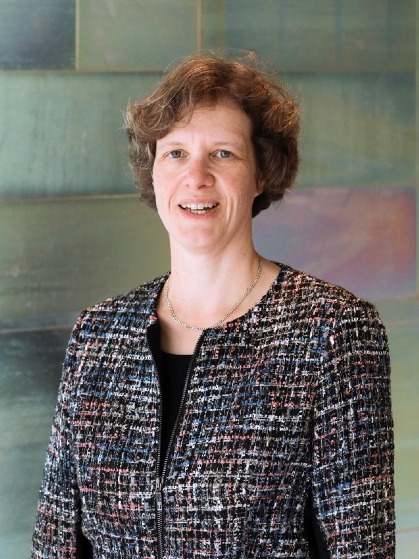
Dr. Karen Dennis is a Senior Lecturer in Operations Management at the University of Surrey Business School. She holds a PhD in Business Studies from Oxford Brookes University, an MSc in Information Systems & Technology from City University London, and a BSc in Industrial Engineering from the University of the West Indies. Her career spans small business development with the Jamaican Government, renewable energy policy work with the UK Government, and academia since 2016. Education: BSc Industrial Engineering, University of the West Indies MSc Information Systems & Technology, City University London PhD Business Studies, Oxford Brookes University Her research focuses on Value Creation and Performance Management , with a notable publication examining management strategies in independent hotels. Despite no listed scientific awards, her work bridges academic and policy domains. She advises no current students but has contributed to government policy and business support programs. Her role at Surrey includes teaching and research in operations management.
Mesut Baran is a Professor in the Department of Electrical and Computer Engineering at North Carolina State University. He focuses on applying computer, control, and system analysis techniques to power system operation and planning, particularly in smart power distribution systems and distributed energy resource integration. His research emphasizes grid resilience, renewable energy integration, and advanced grid technologies. Education: Ph.D. in Electrical Engineering, University of California, Berkeley (1988) Master's in Electrical Engineering, Middle East Technical University, Turkey (1981) Bachelor's in Electrical Engineering, Middle East Technical University, Turkey (1979) Research interests include power electronics, smart grid technologies, distributed energy resource management, and grid resilience. His recent work addresses challenges in EV charging impacts, fault tolerance, and microgrid coordination. Baran has contributed to IEEE standards and received prestigious awards, including the IEEE Fellow designation (2010) and the William F. Lane Outstanding Teaching Award (2017). Publications highlight advancements in distribution system state estimation, fault mitigation, and microgrid management. Collaborations with industry (e.g., Strata Solar) and federal grants ($3.1M DOE award) underscore his applied research impact. He teaches foundational courses like ECE200 and advises on FREEDM Systems Center projects.
Zeljko Pantic is an Associate Professor in the Department of Electrical and Computer Engineering at North Carolina State University. He holds a Ph.D. from NC State (2013) and B.S./M.S. degrees from the University of Belgrade (1998/2007). Before joining NC State in 2019, he served as an Assistant Professor and Associate Director of the Electric Vehicle and Roadway Research Facility at Utah State University. He is actively involved in editorial roles for IEEE Transactions on Transportation Electrification and serves on the IEEE IAS Transportation Systems Committee. Education: Ph.D., Electrical Engineering, North Carolina State University (2013) M.S., Electrical Engineering, University of Belgrade (2007) B.S., Electrical Engineering, University of Belgrade (1998) Research: Dr. Pantic specializes in electrified transportation systems, wireless power transfer (WPT), power converter design, and DC microgrid technologies. His work addresses challenges in EV charging infrastructure, magnetic circuit optimization, and energy conversion principles for transportation electrification. Recent projects include autonomous wireless charging systems for UAVs, marine DC microgrids, and road-embedded DWPT solutions. Awards & Recognition: 2019 IEEE JESTPE Second Prize Paper Award 2017 Outstanding Teacher of the Year (USU) 2012 NC State Mentored Teaching Assistantship Award Advisees & Grants: While specific student names are not listed, Dr. Pantic has advised graduate students on projects spanning WPT systems, EV infrastructure, and battery management. His work has been supported by grants focusing on dynamic charging, magnetic materials, and autonomous observatory nodes. Labs & Facilities: He leads research at NC State's Electric Vehicle and Roadway facility, focusing on roadway-integrated wireless charging and high-power WPT systems. Collaborations include ocean observatory development and autonomous system integration.
Carles Pont Sorribes is an Associate Professor and Vice-Dean at the Faculty of Communication at Universitat Pompeu Fabra (UPF), where he also directs the Journalism Degree program. He serves as Academic Director of the Master in Political and Institutional Communication at UPF Barcelona School of Management. His academic journey includes a Ph.D. in Social Communication, a Master's in Social Communication, and a Bachelor's in Journalism and Education Sciences. Education: Ph.D. in Social Communication Master's in Social Communication Bachelor's in Journalism and Education Sciences His research focuses on political communication, public opinion, risk/crisis communication, and journalism. Key themes include the Catalan sovereignty process's international media coverage, digital news credibility, and media engagement strategies. Recent work explores AI's role in journalism training and the impact of disinformation on senior populations. Publications highlight trends in crisis communication (e.g., Ebola and Germanwings disasters), the framing of Catalan independence in global media, and the evolution of Twitter as an emergency communication tool. His books include El impacto del engagement y el futuro de la empresa periodística (2022) and Risk and News (2020). Dr. Pont Sorribes has no listed scientific awards but contributes to academic-industry collaboration through his roles in educational programs. His work emphasizes media sustainability and audience loyalty, with proposals for operational frameworks in journalism.
Dr. Navid Izady is a Reader in Operations & Supply Chain at Bayes Business School, part of City St George's, University of London. His academic career includes a PhD from Lancaster University Management School (2010), and prior roles at the University of Southampton. He specializes in stochastic modelling for healthcare and manufacturing operations, collaborating with hospitals and healthcare organizations on sponsored research and consultancy projects. Dr. Izady holds qualifications in Industrial Engineering from Sharif University of Technology (BSc and MSc) and a PhD in Management Science. He teaches operations management, stochastic modelling, healthcare modelling, and decision analysis across BSc, MSc, and MBA programs. His research focuses on optimizing healthcare logistics, patient flow management, and resource allocation in hospitals. He has developed frameworks for managing pandemic and non-pandemic demand, reconfiguring inpatient services, and optimizing staffing and patient admission/discharge processes. His work bridges theoretical stochastic models with practical healthcare challenges, emphasizing operational efficiency and resilience. Notable contributions include studies on inpatient bed pressure reduction, sample pooling techniques for pandemic testing, and queueing theory applications in emergency departments and specialty clinics. His publications highlight innovations in healthcare operations management and simulation methods. Dr. Izady's expertise includes operations research, simulation, statistics, and stochastic processes. He supports industry partnerships and has supervised numerous research students, contributing to both academic and applied knowledge in healthcare and manufacturing systems.
Don B. Russell is a distinguished Professor of Electrical & Computer Engineering at Texas A&M University, holding the Harry E. Bovay, Jr. Chair and Regents Professor title. He is a member of the National Academy of Engineering and a Fellow of multiple professional organizations. His research focuses on power system automation, protection, and real-time diagnostics, with a strong emphasis on waveform analytics for fault detection and wildfire mitigation. Russell leads the internationally recognized Power System Automation Laboratory, supported by sponsors like the National Science Foundation and Texas A&M's Energy Resources Program. Educational Background: Ph.D., Electrical Engineering, University of Oklahoma (1975) M.E., Electrical Engineering, Texas A&M University (1971) B.S., Electrical Engineering, Texas A&M University (1970) Research Interests: Power system protection and control Incipient failure detection via waveform analysis Forensic engineering and wildfire prevention Engineering ethics and professionalism Smart grid technologies and automation Awards and Honors: IEEE Millennium Medal (2000) R&D 100 Award (Digital Feeder Monitor) Outstanding Engineering Achievement Award (NSPE) 6 Distinguished Achievement Award (Texas A&M) Grants and Sponsors: The lab collaborates with TXU Energy, NSF, ONR, and industry partners to advance power system reliability and safety. His work has led to commercialized technologies like high-impedance fault detection relays. Labs and Teams: The Power System Automation Lab specializes in real-time data capture and fault analysis, with global recognition for reducing wildfire risks and improving distribution network resilience.
Professor Jo Braithwaite is a faculty member at the LSE Law School, specializing in international commercial finance law with a focus on derivatives markets and financial infrastructure. She joined LSE in 2008 and holds a PhD from the University of London, an LLM from the University of Pennsylvania (as a Thouron Scholar), and a BA(Hons) from the University of Oxford. Her research explores legal frameworks in global financial markets, particularly regarding central counterparties (CCPs), default management, and standard form contracts. Her notable achievements include the 2022 Inner Temple Main Book Prize for The Financial Courts , which examines judicial roles in financial markets. She has also received Modern Law Review Scholarship and multiple LSE teaching awards. Her work bridges legal theory and practice, addressing challenges like crisis management, regulatory compliance, and market resilience. Professor Braithwaite teaches financial, banking, and commercial law while supervising PhD students. Her external activities include contributions to academic journals and policy discussions on financial market infrastructure. She practices in the Cheng Kin Ku Building and can be reached at J.P.Braithwaite@lse.ac.uk.