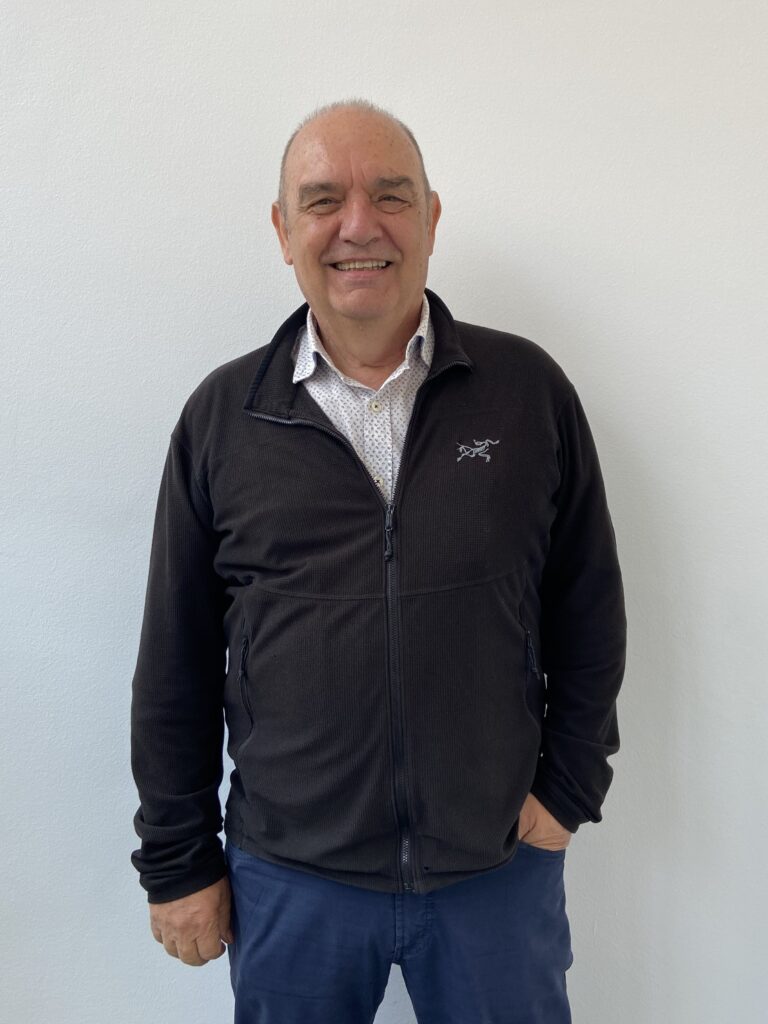
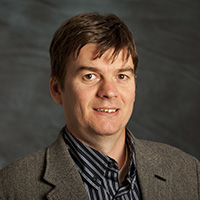
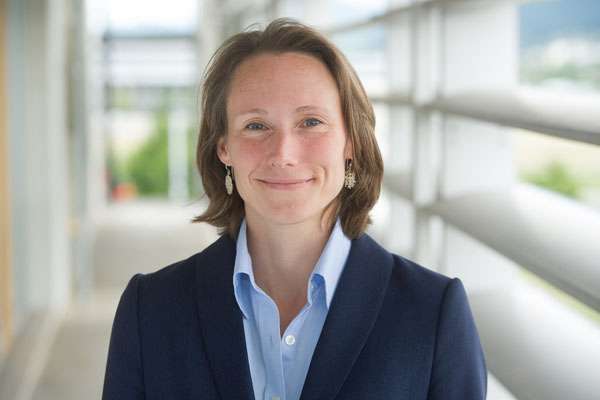
Josep Casanovas is a Full Professor at the Statistics and Operations Research Department of the Technical University of Catalonia (UPC), affiliated with the Barcelona School of Informatics. He previously served as head of inLab FIB (2012-2020) and as dean (1998-2004) and vice-rector (2006-2011) of UPC, leading strategic initiatives in university governance and ICT policies. His research focuses on Modelling and Simulation , Internet and Information Systems , and Urban Mobility . He has led projects for the European Union, including C-ROADS Spain, REMEDiAL, and ECHORD++, addressing intelligent transport, software automation, and robotic innovation. Recent publications highlight his work on agent-based simulation for urban health, deep learning applications in traffic and energy savings, and wildfire management tools . He co-directs LogiSim and coordinates the Severo Ochoa Research Excellence Program at the Barcelona Supercomputing Center (BSC-CNS).
Dr. Ian Bayley is a Senior Lecturer in Computer Science at the School of Engineering, Computing and Mathematics, Oxford Brookes University. He serves as Subject Coordinator for MSc courses in Computing Science, Advanced Computer Science, and Computer Science for Cyber Security. His research focuses on cybersecurity, secure programming, software engineering, and design patterns, with collaborations on topics like LLM evaluation, exploratory testing for machine learning, and agent-oriented programming for microservices. He is affiliated with the Cloud Computing and Cybersecurity Group (CCC) and the Artificial Intelligence, Data Analysis and Systems (AIDAS) Institute. Teaching responsibilities include modules such as Secure Programming (undergraduate/postgraduate) and Professional Programming Practice for first-year undergraduates. He actively supervises cybersecurity projects and students, including Debalina Ghosh (LLM evaluation) and Kieren Stanton (authentication in vehicular networks). Research interests span cybersecurity patterns, software design composability, formal methods for web services, and agent-oriented approaches to microservices. Recent work explores LLM evaluation via scenario-based meta-information and testing challenges in machine learning applications. He co-leads research on design pattern composition and algebraic specifications. Publications span journals like Journal of Systems and Software and IEEE Transactions on Software Engineering , addressing topics from cybersecurity patterns to formal verification of web services. His teaching and research emphasize practical software engineering principles and cutting-edge cybersecurity practices.
Emil Prodan is a Full Professor of Physics at Yeshiva University, where he has been faculty since 2007. He holds office at the Beren campus in Stanton Hall and teaches both introductory and advanced physics courses. His educational background includes: PhD in Theoretical Physics from Rice University (2003) MS in Theoretical Physics from University of Houston (1999) MS and BS in Theoretical/Mathematical Physics from University of Bucharest (1996, 1995) Dr. Prodan conducts research at the intersection of mathematical physics and condensed matter systems, specializing in operator theory, spectral analysis, and quantum field formalism. His work combines rigorous mathematical frameworks with computational approaches to investigate topological phenomena in quantum materials. He has received significant recognition including the 2016 Keck Foundation Award for research on topological phonon edge modes and the 2011 NSF CAREER Award for studying disorder effects in topological insulators. His publications focus on theoretical frameworks for complex quantum systems.
Martijn van der Steen is a Lecturer at the University of Groningen, affiliated with the Faculty of Economics and Business, Department of Accounting. He focuses on organizational behavior, management accounting, and social identity dynamics within institutional frameworks. His research explores topics such as identity regulation, climate change responses, and healthcare policy reforms, often employing case studies in diverse sectors like banking, cooperatives, and healthcare. Key research interests include professional identity development, regulatory responsiveness, and the interplay between organizational structures and social values. He has contributed to understanding how formal rules interact with informal practices in complex organizations, with a particular focus on legitimacy narratives and performance measurement systems. Van der Steen has been recognized for academic contributions, including the Credit Union Research Prize (2021) and multiple highly commended paper awards. His work bridges theoretical frameworks from organizational theory, management accounting, and social identity studies, often addressing real-world challenges such as climate change mitigation and healthcare reform. He supervises PhD candidates exploring topics like identity development in healthcare workers and auditors' adaptation to AI. Engaged in editorial and peer-review activities, he actively contributes to journals like Management Accounting Research and Long Range Planning .
Florian Lücker is a Reader (equivalent to Associate Professor) in Supply Chain Management at Bayes Business School, City, University of London, where he also serves as Course Director for the M.Sc. International Business. He holds a PhD from the École polytechnique fédérale de Lausanne (EPFL), Switzerland, and has held visiting roles at the Kellogg School of Management. His research focuses on supply chain resilience, risk management, and finance, with a particular emphasis on mitigating disruptions through inventory, pricing flexibility, and collaborative strategies. His work has been supported by grants and presented globally. Dr. Lücker’s research interests include supply chain risk mitigation, multi-stage supply chain design, and digital financing solutions. He has contributed to high-impact journals such as Production and Operations Management and European Journal of Operational Research , with recent articles addressing anticipatory orders, disruption ripple effects, and product lifecycle management. He currently serves as an academic director for the UK Industrial Excellence Award and reviews for leading journals including International Journal of Production Research and Decision Sciences . His publications span resilience-efficiency trade-offs, pharmaceutical supply chain strategies, and mathematical physics (earlier work). Grants and industry collaborations have enabled his empirical studies on supplier behavior in digital financing. No formal awards are listed, but his role in the Industrial Excellence Award highlights his industry engagement. He advises no listed students but contributes to academic leadership through editorial roles and course direction.
Darrell Edwards is an Assistant Professor of Practice in Supply Chain Management at the University of Tennessee, Knoxville’s Haslam College of Business . With over three decades of global operations and supply chain experience, his expertise spans consumer product industries, business coaching, team building, and process innovation. He previously served as Senior Vice President and COO at La-Z-Boy Incorporated, overseeing operations for over 9,000 employees in its Branded Business division. Education: Doctorate (D.B.A.) in Business Administration, Fox School of Business, Temple University (2017) M.G.M. in Global Management, Thunderbird School of Global Management (2009) M.B.A. in Business Administration, University of Tennessee, Knoxville (2003) M.S.M. in Management, Troy State University (1995) B.S. (degree unspecified), Athens State College (1990) Research & Leadership: Edwards focuses on operational excellence and strategic supply chain innovation. He has been a board member for Dovetail Brands since 2023 and frequently speaks at national business forums. His work has earned multiple safety and operational awards, including five consecutive Safety Culture Awards from 2017 to 2021. Awards Overview: National Safety Council Awards (2017–2021) Gartner Power of the Profession Semi-Finalist (2018–2019) Industry Week Best Plants Winner (2010) Grants & Advising: No formal grants or academic advising roles explicitly stated in the provided text. His professional contributions focus on industry leadership and executive coaching. Labs/Teams: Oversees La-Z-Boy’s global supply chain operations and collaborates with Dovetail Brands’ strategic initiatives through his board role.
Marcus ANG Teck Meng is an Associate Professor of Operations Management (Education) at the Lee Kong Chian School of Business, Singapore Management University. He is also the Academic Director and Track Coordinator of the International Trading Institute (ITI). His academic journey began at the National University of Singapore, where he earned dual B.Sc. degrees in Mathematics, followed by an S.M. in High Performance Computing and a Ph.D. in 2008. Ph.D., National University of Singapore, 2008 S.M., High Performance Computing for Engineering Systems, Singapore-MIT Alliance under NUS, 2003 B.Sc. (Hon), Mathematics, National University of Singapore, 2002 B.Sc., Mathematics, National University of Singapore, 2001 His research focuses on the theoretical and applied aspects of operations management, particularly in inventory management , stochastic models , and robust optimization . His work bridges mathematical rigor with real-world applications in supply chains, healthcare, and e-commerce. He has made significant contributions to warehouse storage optimization, hospital resource planning, and online retail fulfillment under uncertainty. The recent articles reflect a strong trend in applying robust optimization and stochastic modeling to logistics and service operations. His research spans domains such as healthcare analytics, e-commerce fulfillment, and inventory systems. Keywords like operations research , supply chain management , and data analytics dominate, with sub-fields including appointment scheduling, risk measures, and warehouse layout optimization. His teaching excellence has been widely recognized: Winner, SMU Undergraduate Excellent Teacher Award (2020) Winner, SMU Undergraduate Innovative Teacher Award (2018) Nominee, SMU Undergraduate Innovative Teacher Award (2021, 2022) Multiple appearances on SMU Dean’s Teaching Honour List (Undergraduate and Postgraduate) MPA Research Fellow (AY2019–2023) Dean’s List, NUS Department of Mathematics (AY1998–2001) He leads the International Trading Institute (ITI) and has been involved in pedagogical innovation through TEL grant-funded projects such as Inn or Out and Pricing Boss . While no formal list of advisees is provided, his role as Academic Director and course coordinator suggests active mentorship and supervision of students in operations and analytics. He has no known lab or research team explicitly mentioned, but his case studies and projects indicate strong industry engagement and applied research leadership.
Dr. Alberto Bueno is a Junior Professor in the Department of Political Science and Public Administration at the Faculty of Political Science and Sociology, University of Granada, Spain, a position he has held since 2023. He concurrently serves as a lecturer at the University of Leipzig, Germany, teaching on the political system of Germany and European politics since 2020. His academic affiliations also include prior teaching roles at the Universities of Jaén and Pablo de Olavide in Spain. University: University of Granada School: Faculty of Political Science and Sociology Department: Department of Political Science and Public Administration Academic Rank: Assistant Professor Alberto Bueno's research focuses on security and defense policy, particularly in Spain, Germany, and the European Union, as well as civil-military relations in Spain and Latin America and strategic culture. His teaching includes political systems in Europe and North America, public administration, policy analysis (especially security and defense policy), and strategic foresight and scenario analyses. His recent publications, from 2020 to 2024, reflect a strong thematic consistency, exploring defense diplomacy, the militarization of emergencies, NATO, European strategic culture, and the rise of right-wing movements in Europe and Latin America. These works appear in journals such as Armed Forces & Society , Communication & Society , and European Politics and Society , indicating a focus on both empirical political science and security studies. Spanish Association of Political Science and Public Administration (AECPA) Institute for Peace and Conflict Studies, University of Granada (IPAZ) UTSYN - Norwegian Centre for Security and Resilience Dr. Bueno has contributed expert commentary to major media outlets such as CNN, El País, Agenda Pública, and Radio France International, demonstrating his role as a public intellectual. He completed his doctorate at the University of Granada in 2021, supported by a doctoral fellowship from the Spanish Ministry of Education and Science. No information is available regarding formal advisees or scientific awards.
Marcus Hilbrich is a Professor in Computer Science with extensive academic experience across multiple institutions. His primary affiliation is Chemnitz University of Technology, where he held roles including Assistant Professor, Acting Professor of Software Engineering, and Research Assistant. He also served as Scientific Coordinator at Humboldt University of Berlin (SFB 1404 FONDA) from 2022–2024. Education: He earned a Doctor of Engineering (Dr.-Ing.) from Dresden University of Technology in 2015, focusing on job/user-centric monitoring in distributed environments. His diploma thesis (2008) explored performance analysis of parallel simulations using the SUN Niagara II architecture. Research Interests: Hilbrich specializes in distributed systems, software engineering, cloud computing, and workflow management. He investigates microservices architecture, resilience engineering, and scalable monitoring techniques. His work bridges theoretical foundations (e.g., formal methods for workflows) with practical applications in HPC and data analysis. Publications: He has authored/co-authored over 15 peer-reviewed articles, including key contributions on ßMACH software management guidance, validity constraints in data workflows, and microservices design patterns. His research often addresses interdisciplinary challenges in computational systems and software lifecycle management. Projects: Active involvement in third-party funded projects like SFC (Cloud Computing for Secure Financial Transactions), ECOUSS (parallel simulations), and WisNetGrid (knowledge networks in grids). His work often integrates performance analysis and system scalability. Labs/Teams: Central to his work is the SFB 1404 FONDA collaborative research center, focusing on foundational aspects of distributed heterogeneous environments.
Gudmund Grov is an Associate Professor in Digital Security at the Department of Informatics, Faculty of Mathematics and Natural Sciences, University of Oslo. His research focuses on cybersecurity, with emphasis on anomaly detection, explainable AI, and security modeling. He is actively contributing to advancements in autonomous cyber defense and machine learning applications in security operations. His research interests span Digital Security , Network Anomaly Detection , Explainable AI (XAI) , Machine Learning for Cyber Defense , Security Modeling , and Risk Modeling in Enterprise Architecture . His work integrates formal reasoning with practical modeling to enhance system security and interpretability. The recent publications reflect a strong trend towards intelligent and interpretable cybersecurity systems, combining deep learning with formal methods to detect and explain network threats. His work bridges the gap between theoretical modeling and real-world security applications, particularly in autonomous defense and labeled dataset generation for APTs. No scientific awards were mentioned in the provided text. Gudmund Grov collaborates extensively with researchers in cybersecurity and formal methods. While specific grants and advising roles are not detailed, his co-authorship on multiple projects indicates active research supervision and collaboration. He is involved in developing frameworks for labeled data generation, contextual anomaly detection, and explainable alerts in SOC environments. There is no explicit information about labs or research teams, but his work suggests involvement in cybersecurity research groups at the University of Oslo focusing on AI-driven security and formal verification.
Benjamin J. Sacks is a policy researcher at the RAND Corporation and Professor of Political Geography at the RAND School of Public Policy. He is actively engaged in national security research, focusing on geopolitical competition, polar regions, defense acquisition, and emergency preparedness. His work informs high-level policy discussions with the U.S. Department of Defense, UK Cabinet Office, and the U.S. Joint Chiefs of Staff. His research interests center on political geography and its application to national security policy , particularly in contested spaces such as the Arctic, Antarctic, and South China Sea. He also explores military acquisition , climate-related conflict , information warfare , and Truth Decay . His interdisciplinary approach integrates historical and geographical perspectives to generate novel policy insights. The recent publications authored by Sacks reflect a strong trend in geopolitical analysis , defense policy reform , and climate-security linkages . His work spans strategic assessments of Arctic and Antarctic governance, military procurement challenges (e.g., KC-46A), and climate-driven instability in U.S. Central Command. These articles demonstrate consistent engagement with high-impact policy domains, blending empirical analysis with forward-looking recommendations. Scientific Awards and Honors: Permanent Elected Fellow of the Royal Geographical Society Fellow of the American Geographical Society 2009 National Beinecke Scholar Advising and Grants: While no formal advisees are listed, Sacks collaborates with higher education institutions to encourage humanities doctorates to pursue policy careers. His research is supported through RAND’s institutional funding and likely external grants tied to defense and security research. He has led or contributed to numerous studies for U.S. and allied defense agencies, suggesting significant grant and contract involvement. Labs and Research Teams: Sacks works within RAND’s national security research portfolio, contributing to interdisciplinary teams focused on defense strategy, polar security, and geopolitical competition. He participates in expert conferences and tabletop exercises, such as those assessing Antarctic governance risks, indicating active collaboration in specialized research groups.
Christopher W. Fowler, D.O., is an Assistant Professor in the Department of Emergency Medicine at the University of Arkansas for Medical Sciences (UAMS) College of Medicine. He practices clinically at UAMS Medical Center in Little Rock, Arkansas, serving adult patients with acute and emergency medical conditions. His academic and clinical work is centered within the Department of Emergency Medicine, a key division of the UAMS College of Medicine dedicated to emergency care, trauma response, and medical training. Specialty: Emergency Medicine Practice Location: UAMS Medical Center, Little Rock, AR Patient Population: Adults Language: English Dr. Fowler's research interests are inferred from his departmental affiliation and likely include emergency medicine, acute care, trauma management, patient safety, and medical education. While no specific publications are listed, his role as a faculty physician suggests involvement in teaching, clinical research, and resident supervision within emergency medicine. No scientific awards or honors are listed in the available information. As a faculty member in a clinical department, Dr. Fowler likely participates in medical student and resident education, clinical mentorship, and departmental initiatives. While no formal advisees are listed, his role as Assistant Professor implies engagement in academic supervision and training. There is no mention of external grants or funded research projects. He is affiliated with the clinical and academic operations of the Department of Emergency Medicine at UAMS, contributing to patient care, medical education, and emergency healthcare delivery in Arkansas.
Prof. Dr. Anke Weidlich serves as Professor of Control and Integration of Grids at the Institute for Sustainable Technologies (INATECH) of the University of Freiburg, leading research on holistic sustainable energy systems that balance economic, social, and ecological dimensions. Her work addresses the critical interplay between electricity markets, grid infrastructure, and cross-sectoral energy coordination. Her research spans: Sustainable Energy Transformation: Pathways and infrastructure requirements for transitioning to renewable-based systems Electricity Markets & System Integration: Coordination of technologies across markets for efficient energy delivery Flexibility Modeling: Quantifying and harnessing flexibility needs amid rising renewable penetration Network Analysis: European grid dynamics in future energy scenarios Multi-energy Systems: Synergies between electricity, heat, and mobility sectors Current projects include GrECCo (Grid-Sensitive Energy Community Coordination), Formal Modeling of Flexibility in Multi-Scale Multimodal Energy Systems, CO2Map (electricity CO2 intensity tracking), and ASSUME (agent-based market simulation). These initiatives demonstrate her focus on practical solutions for energy system integration and decarbonization. Her contributions have been recognized through: SAP Top Talent Program high-potential designation BMBF Career Promotion Programme fellowship DAAD research scholarship for US collaboration Heinrich Böll Foundation academic support Freiburg–Penn State Virtual Classroom Award Prof. Weidlich teaches Energy System Operations, Optimization for Energy Systems, Forecasting for Energy Systems, Energy System Modeling with Python, and Sustainable Energy Systems courses, preparing next-generation energy specialists through technical and systems-thinking approaches.
António Raposo is a faculty member at Universidade Lusófona, affiliated with the Faculty of Health Sciences and the Department of Nutrition and Food Sciences. He holds a PhD and has established a robust research profile in nutrition, food science, public health, and sustainability. His work spans multiple continents, with collaborations in Brazil, Saudi Arabia, and Ecuador, reflecting a global perspective on food and health challenges. PhD in Food Safety and Risk Management (2013) Extensive research in nutrition, food behavior, and sustainable food systems Active publication record in peer-reviewed journals His research interests are centered on improving public health through better nutrition and sustainable food practices. Key areas include gut microbiota, plant-based diets, celiac disease, food waste reduction, and food security. He investigates how dietary patterns influence health outcomes, particularly among vulnerable populations such as university students, low-income communities, and individuals with chronic conditions. The analysis of his recent publications reveals a strong trend toward interdisciplinary research that bridges nutrition, environmental sustainability, and behavioral science. His work frequently employs systematic reviews, meta-analyses, and cross-sectional studies to assess dietary behaviors, food safety practices, and the health impacts of functional foods. There is a clear emphasis on translating research into practical interventions for healthier and more sustainable food systems. While no formal scientific awards are listed in the provided text, his prolific output and leadership in thematic reviews suggest recognition within the academic community. He has contributed to consensus documents, such as the Ibero-American consensus on low- and no-calorie sweeteners, indicating expert status. António Raposo has likely supervised or co-supervised students, given his extensive research output and doctoral degree, though specific names are not listed. His work often involves large datasets (e.g., NHANES) and international collaborations, suggesting involvement in grant-funded projects. He has explored topics ranging from vending machine nutrition to jellyfish as a sustainable food source, demonstrating innovative and applied research directions. He is associated with research initiatives focused on food safety, allergen management, and sustainable food services. His work on hygiene assessment systems, food spoilage, and HACCP implementation indicates engagement with food industry standards and public health policy. The development of tools for evaluating green restaurants and food waste in food services further highlights his commitment to operational sustainability in real-world settings.
Assoc. Prof. Dr. Taylan Maral is the Head of New Media and Communications at the Faculty of Economics, Administrative and Social Sciences, Istanbul Gelişim University. His research focuses on media framing, political communication, digital transformation in education, and social media impact analysis. He has contributed to academic journals analyzing conflict reporting in Palestinian-Israeli contexts, social media strategies of political parties, and crisis communication during disasters. Education: No formal education details provided in the source text. Research Interests: Media framing analysis, political journalism, digital media's role in education, and communication strategies in crisis management. His most recent work includes a groundbreaking article on Palestinian-Israeli conflict framing in Turkish newspapers, featured in the Journal of Communication and Diplomacy . He also explores social media's role in political campaigns and pandemic-driven educational adaptations. Maral's work bridges theoretical communication studies with real-world political and societal challenges. Grants & Projects: Not explicitly mentioned in the provided texts. Labs/Teams: Associated with university labs like Applied Digital Communication Workshop and Radio and Television Studio facilities.