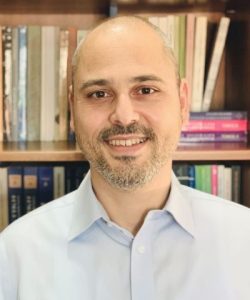
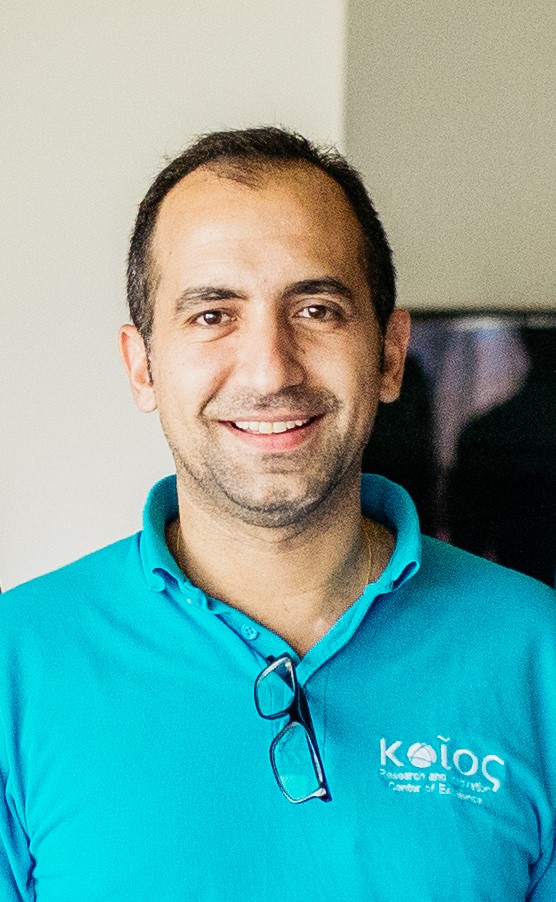
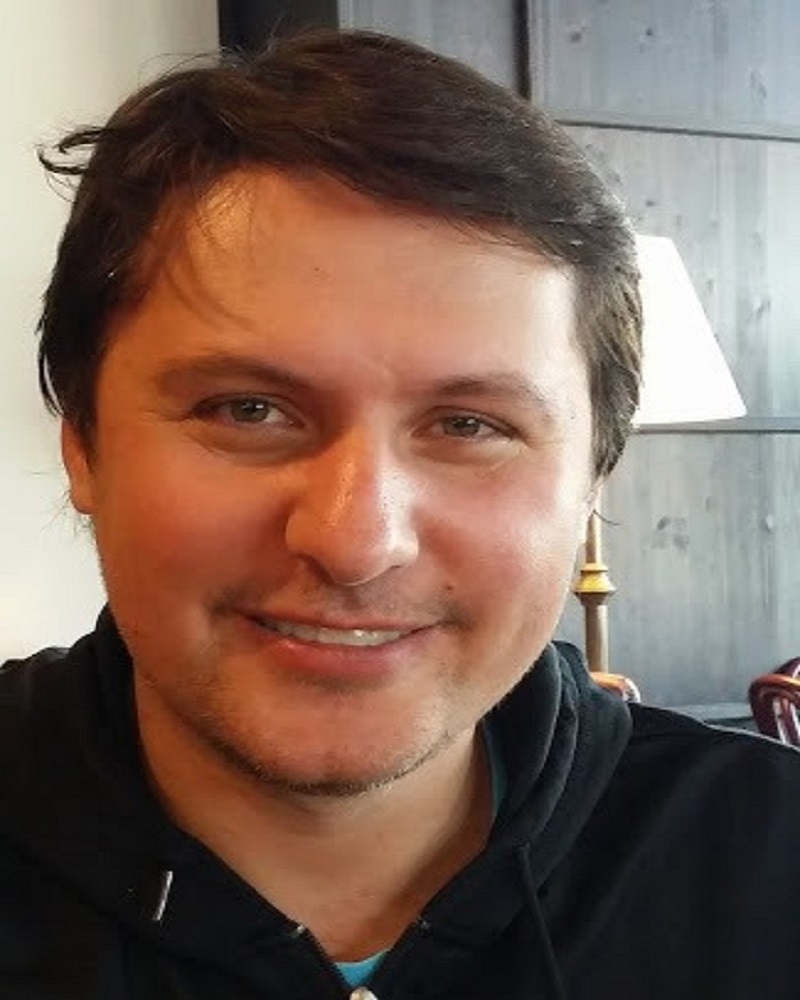
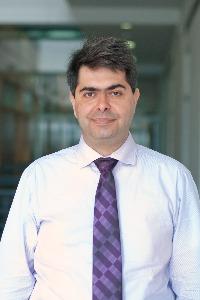
Stelios Timotheou is an Associate Professor at the Department of Electrical and Computer Engineering and faculty member at the KIOS Research and Innovation Center of Excellence, University of Cyprus. He holds a Dipl-Ing from National Technical University of Athens, and MSc/PhD from Imperial College London. His research focuses on developing real-time distributed methodologies using mathematical optimization, machine learning, and computational intelligence to enhance efficiency in critical infrastructure systems. Research interests center on data-driven decision making for urban mobility management, traffic control systems, and energy optimization. Key areas include: Intelligent UAV-based sensing for traffic monitoring Cooperative control algorithms for multi-agent systems Optimization of renewable energy integration Robust infrastructure protection strategies Recent publications demonstrate strong focus on traffic state estimation (76%), energy system optimization (16%), and UAV applications (8%). Awarded the Cyprus Research Award (2017) and ERC Consolidator Grant for URANUS project. Secured multiple research grants focusing on real-time control systems.
Panayiotis Kolios is an Assistant Professor at the Department of Computer Science, University of Cyprus (UCY). Previously, he served as a Research Assistant Professor at the KIOS Research and Innovation Centre of Excellence (2013–2024) and a Visiting Lecturer at UCY. He holds a BEng and PhD in Telecommunications Engineering from King’s College London (2008 and 2012, respectively). His research focuses on networked intelligent systems, emergency management using AI and UAV technologies, and cyber-physical systems. Education: BEng in Telecommunications Engineering, King’s College London, 2008 PhD in Telecommunications Engineering, King’s College London, 2012 Research Interests: His work centers on autonomous systems, intelligent transportation, and emergency management. Key areas include AI-driven disaster response, UAV-based surveillance, and algorithmic optimization for critical infrastructure. He develops solutions for real-time situational awareness and decision-support in emergencies. Recent work trends show a focus on multi-UAV coordination, disaster management platforms (like AIDERS), and AI applications in emergency response. His team’s 2023 win in the Cooperative Aerial Robots Inspection Challenge highlights advancements in UAV inspection algorithms. Scientific Awards: First Prize in Cooperative Aerial Robots Inspection Challenge (CDC 2023) Grants and Advising: He has secured over €40 million in EU and industrial grants, leading projects like PREDICATE, SWIFTERS, and AIDERS. His team advises on emergency response strategies and has trained first responders through EU-funded programs such as the Exchange of Experts training. Labs and Teams: He leads the Security and Emergency Response Group at KIOS CoE and established the Cyprus Civil Defence Aerial Observation Unit. His team collaborates with institutions like the Cyprus Police and Fire Service to operationalize UAV technologies in disaster scenarios.
Christos Nicolaides is an Assistant Professor at the Department of Business and Public Administration within the School of Economics and Management at the University of Cyprus (UCY), holding a secondary appointment as a Digital Fellow at MIT's Initiative on the Digital Economy. Previously, he spent three years as a James McDonnell Foundation-funded Postdoctoral Fellow at MIT Sloan School of Management. His educational background includes a PhD in Engineering from Massachusetts Institute of Technology (2014), SM from MIT (2011), MSc in Applied Mathematics from Imperial College London (2009), and BSc in Physics from University of Thessaloniki (2008). Nicolaides' research applies mathematical, statistical, and computational tools to large-scale empirical questions in social influence mediated by digital technologies. His work spans Data Science , Machine Learning , Social Networks , and Computational Social Science , with significant contributions to understanding human mobility patterns, disease transmission dynamics, and social contagion effects. His research has established novel methodologies for analyzing complex network structures in mobility data and social interactions. Analysis of his 15 most recent publications reveals a consistent focus on applying network science to real-world problems, particularly in pandemic response (12 publications), human mobility analytics (9 publications), and social contagion dynamics (7 publications). His work demonstrates increasing interdisciplinary integration, combining computer science, epidemiology, and organizational behavior since 2020. Marie S. Curie Fellow Two Highly Cited Papers by Web of Science (2017, 2020) Best Paper Award by Risk Analysis Society (2019) Professor of The Week by Poets & Quants (2020) As principal institutional investigator, Nicolaides has secured over €1 million in research funding from the European Commission, industry partners, Cyprus Innovation and Research Foundation, and Cyprus Ministry of Health. His current teaching includes Social Networks and Entrepreneurship, Introduction to Operations Management, and Quantitative Methods in Management. Media coverage of his work spans major outlets including The New York Times, CNN, Nature, and Science, with significant impact on public health policy discussions during the COVID-19 pandemic.
Michael Sirivianos is an Associate Professor at the Cyprus University of Technology (CUT), where he serves as Dean of the School of Engineering and Technology. He holds a PhD in Computer Science from Duke University (2010) and leads research in cybersecurity, disinformation detection, and social media analysis. He coordinates multiple EU-funded projects including ReCRED (Horizon 2020) and ENCASE (Marie Curie RISE), securing over €3M in research funding. Research Focus His work spans: Cybersafety : Detection of cyberbullying, hate speech, and inappropriate content targeting children Trust Systems : Device-centric authentication and blockchain applications Disinformation Analysis : Graph-based detection of fake news and state-sponsored manipulation Scalable Systems : Distributed databases and network infrastructure Achievements & Recognition Best Paper Award (2019) for work on state-sponsored disinformation Distinguished Paper (2018) for fringe web community analysis Spotlight Session recognition (2020) for child protection research Featured in NYT, Washington Post, and Wired for YouTube content analysis Leadership Co-directs the Network Systems Research Lab, serves on the Board of CYENS Centre of Excellence, and coordinates the Fact-check Cyprus Centre against Disinformation.
Angelos Georghiou is an Associate Professor of Operations Management at the Department of Business and Public Administration, University of Cyprus. He previously held academic positions as Assistant Professor at McGill University (2016–2019), Post-Doctoral Researcher at MIT (2012–2013), and Postdoctoral Researcher at ETH Zurich (2013–2016). His work bridges computational methods in stochastic and robust optimization with applications in healthcare, energy systems, and operations management. Ph.D. in Operations Research, Imperial College London (2012) M.Sci. in Mathematics, Imperial College London (2008) His research focuses on stochastic optimization , robust optimization , and decision rules , addressing challenges in healthcare analytics , energy-efficient control systems , and machine learning integration . Recent publications in Management Science and Operations Research highlight his contributions to decision-dependent information discovery and computational frameworks. Key trends in his 15 most recent articles include: Advancing robust optimization techniques for multistage problems Applications in healthcare (psychiatric risk prediction) and energy systems Integration of machine learning with stochastic programming Development of tractable algorithms for complex decision environments Scientific Awards : Esdras-Minville Best Student Paper Award (2023) He serves on editorial boards of Operations Research Letters (Area Editor) and Management Science , and collaborates with institutions like MIT, ETH Zurich, and McGill University. His work with undergraduate students includes a 2021 paper in SIAM Undergraduate Research Online .
Professor Angelika Kokkinaki is Dean of the School of Business and MBA Director at the University of Nicosia. With a PhD in Computer Science from the University of Louisiana at Lafayette (1995), a M.Sc. from Northeastern University (1991), and a Diploma from Patras University (1987), her academic credentials are rooted in Information Systems and Computer Science. PhD in Computer Science (1995), University of Louisiana at Lafayette M.Sc. in Computer Science (1991), Northeastern University Diploma in Computer Engineering and Informatics (1987), University of Patras Her research spans e-business, e-government, e-learning, and smart city technologies, focusing on semantic search engines, distributed systems, and circular economy applications. Recent work emphasizes Smart Cities through projects like OpenDCO, CRISIS, and DEVOPS. Key article trends include smart city resilience, AI applications in education, e-learning adoption, marine sensor networks, and open data workforce development. Her scholarly output aligns with 6 UN Sustainable Development Goals , particularly in education, sustainability, and urban innovation. Scientific Awards : Innovation award by the Republic of Cyprus (for quality management system) She leads over 30 EU/national projects and contributes to the Center of Equality, Diversity, and Inclusion (CEDI) and OECD policy monitoring. Her work integrates Petri Net modeling , software agent systems, and 100+ publications in information systems.
Christodoulou Chris is a Professor at the Department of Computer Science, University of Cyprus. He joined in 2005 and holds a Visiting Research Fellowship at Birkbeck College, University of London. His educational background includes a BEng in Electronic Engineering from Queen Mary and Westfield College (1991), a PhD in Neural Networks from King's College London (1997), and a BA in German from Birkbeck College (2008). His research focuses on Computational Neuroscience, Neural Networks, and Machine Learning, with specific interests in neural coding, self-control modeling, computational neuronal modeling, multi-agent reinforcement learning, and practical machine learning applications. Recent publications (2013-2025) demonstrate interdisciplinary approaches combining neuroscience, computer science, and optimization techniques, with emerging emphasis on protein structure prediction and biomedical applications. Scientific awards include: Best Paper Award, ICSR 2015 Best Paper Award, MODELS 2008 Doctoral Symposium He leads the Computational Intelligence and Neuroscience (CIN) research group and has secured funding from European projects (SocioCoast, CYberSafety, TAMIT). He mentors students through Google Summer of Code and collaborates internationally.
Assoc. Prof. Dr. Adnan Acan is a faculty member in the Department of Computer Engineering at Eastern Mediterranean University (EMU). He holds a PhD from Middle East Technical University, specializing in Electrical Engineering. His academic roles include teaching and supervising numerous graduate students in areas such as optimization algorithms, computer vision, and biomedical signal processing. Education: PhD, Electrical Engineering, Middle East Technical University (1992) MS, Electrical Engineering, Middle East Technical University (1985) BS, Electrical Engineering, Middle East Technical University (1983) Research Interests: His research focuses on optimization algorithms, machine learning, pattern recognition, and biomedical applications. Notable areas include metaheuristic algorithms (e.g., particle filters, great deluge), multi-agent systems, and ECG/heartbeat classification. He has contributed to advancements in computational intelligence, evolutionary algorithms, and medical diagnostics. Advising & Students: He has supervised over 30 graduate students, including PhDs such as JAMSHID TAMOUK (2021) and ZAHRA GOLRIZ KHATAMI (2019), and master’s students like MILAD ROSTAMPOUR (2023). His work spans applications in robotics, face recognition, and numerical optimization. Labs & Collaboration: His teaching and research involve courses in artificial intelligence, algorithms, and computer engineering. He actively contributes to academic service, including roles as a session chair and reviewer in conferences. His lab focuses on developing innovative solutions to complex computational and biomedical challenges.
Professor HADJINICOLAS GEORGE holds a faculty position at the University of Cyprus, Department of Business Administration and Public Administration under the School of Economics and Management. His research focuses on production-marketing interface, international manufacturing systems, and product positioning methods. He earned a Ph.D. in Business Administration (Operations Management) from the University of Southern California in 1993, preceded by MS degrees in Statistics (1990) and Computer Engineering (1989), and a BS in Electrical Engineering (Cum Laude, 1988). His research interests emphasize optimizing production systems through interdisciplinary approaches, integrating marketing and operational decisions. Key themes include cost reduction in serial production systems, resource allocation for service quality, and strategic product positioning using advanced analytics like self-organizing maps. His publication trends reflect sustained contributions to operations management and decision sciences, with notable work on journal evaluation metrics and production-marketing interface challenges. Over two decades, his research has addressed both theoretical frameworks (e.g., asymptotic distribution analysis) and practical applications (e.g., hotel service optimization). He has advised numerous studies on manufacturing systems and marketing strategies, though specific student names are not listed here. His work bridges engineering and business disciplines, addressing global operational challenges through quantitative methodologies.
Michalis Michaelides is an Assistant Professor at the Department of Electrical Engineering, Computer Engineering and Informatics at the Cyprus University of Technology , where he has held a tenure-track position since 2012. He holds a PhD in Electrical Engineering from the University of Cyprus (2009), and earlier degrees from Purdue University (MSEE, 1998; BSEE, 1997). His research focuses on communication systems, wireless sensor networks, environmental monitoring, and computational intelligence applications in maritime logistics and smart infrastructure. He received the Elsevier Building and Environment Journal Best Paper Award in 2014. His work spans smart port operations , IoT integration , and data-driven environmental modeling . Recent publications address berth allocation optimization, vessel arrival prediction, CO2-based virus transmission risk analysis, and AI-driven maritime terminal management. His interdisciplinary approach combines signal processing, optimization algorithms, and sensor networks to solve challenges in transportation, environmental sustainability, and public health. Education: PhD in Electrical Engineering, University of Cyprus (2009) MSEE, Purdue University (1998) BSEE, Purdue University (1997) Awards: Elsevier Building and Environment Journal Best Paper Award (2014) His research group collaborates on projects like intelligent irrigation systems and coastal eutrophication analysis , leveraging computational intelligence for real-world applications. Ongoing work emphasizes port efficiency, sensor network reliability, and decision support systems for maritime logistics.
Panos K. Chrysanthis is a Professor of Computer Science at the University of Pittsburgh and an adjunct Professor at Carnegie-Mellon University and the University of Cyprus. He holds a BS in Physics with a Computer Science concentration from the University of Athens, Greece, and MS and PhD degrees in Computer and Information Sciences from the University of Massachusetts Amherst. He has been affiliated with the University of Pittsburgh since 1991, serving as Director of the Advanced Data Management Technologies (ADMT) Lab. His research focuses on database systems, mobile and pervasive data management, distributed computing, and real-time systems, with recent emphasis on data streams and energy-efficient data management for IoT and sensor networks. Chrysanthis has authored over 100 peer-reviewed publications, including a book on transaction processing and consistency in distributed databases. He has received the NSF CAREER Award (1995) and the University of Pittsburgh's Provost Award for Excellence in Mentoring (2015). He has held editorial roles at the VLDB Journal, IEEE TKDE, and DAPD, and has organized major conferences like ICDE and MDM. His work bridges theoretical database research with practical applications in urban informatics, healthcare, and sustainability. Chrysanthis has advised numerous students, contributed to grants focused on big data and healthcare analytics, and co-developed tools like the ADMT Lab's experimental platforms for urban mobility and congestion. He is a Senior Member of IEEE and an ACM Distinguished Scientist.
Rigas-Filippos Soldatos serves as a Visiting Assistant Professor in the Department of Psychiatry at the Medical School of the National and Kapodistrian University of Athens, where he currently holds an Academic Fellow position in Neuropsychiatry at Aeginitio Hospital's First Neurological Clinic since May 2021. His academic career includes prior roles as an Academic Fellow in Psychiatry at the university's First Psychiatric Clinic (2014-2020) and a Research Fellow in Neuropsychiatry at the University of Melbourne's Melbourne Neuropsychiatry Centre (2019-2020) under a Greek-Australian Research Fellowship. His educational credentials feature a Doctoral degree (2014) from the National and Kapodistrian University of Athens' 1st Department of Pathological Anatomy with thesis 'Molecular study of meningiomas', a Medical degree (2005) from the same institution's Medical School, and a Bachelor of Science in Biomedical Science (1999) from King's College London. Soldatos specializes in advanced psychiatric research focusing on first-episode psychosis , schizophrenia spectrum disorders , and exposome-environment interactions . His work integrates machine learning methodologies to develop predictive models for symptom remission while examining socioeconomic and familial influences on disease progression. He actively contributes to the Athens first-episode psychosis research study , advancing early intervention frameworks through longitudinal clinical investigations. Analysis of his publication record reveals a concentrated research trajectory on computational psychiatry applications, with recent work emphasizing exposome scoring systems in schizophrenia and pandemic-related caregiver impacts in neurocognitive disorders. His methodological approach bridges clinical psychiatry with data science to address critical gaps in psychosis management and functional outcomes. As a core collaborator in the Athens first-episode psychosis research initiative, Soldatos operates within multidisciplinary teams at Aeginitio Hospital while maintaining international research connections established during his fellowship at the Melbourne Neuropsychiatry Centre.
Antonis Savva serves as a Researcher at the KIOS Research and Innovation Center of Excellence, University of Cyprus, a role he has held since March 2020 focusing on computer vision applications for drone systems. His academic background includes: MEng in Electronics and Systems from the School of Electrical and Computer Engineering, National Technical University of Athens (2014) MSc in Management of Organizations and Entrepreneurship from the same institution (2018) PhD in medical data analysis from the School of Electrical and Computer Engineering, National Technical University of Athens (2019) Dr. Savva specializes in signal processing and computer vision with dual applications in medical imaging and autonomous systems. His doctoral work pioneered algorithms for aligning pre/post-operative CT scans in bone augmentation procedures, reconstructing panoramic jaw views, and quantifying dynamic brain region associations via fMRI analysis in both healthy and pathological states. Current research extends these methodologies to drone technology, emphasizing real-time visual data processing and pattern recognition for aerial applications. He operates within the KIOS Research and Innovation Center of Excellence, a specialized hub for intelligent systems and networks at the University of Cyprus driving cross-disciplinary innovation in computational methodologies.
Dr. Daniele D’Alvia is a Visiting Fellow of Financial Services and Transactions Law at the University of Central Lancashire (UCLan) Cyprus. He holds a PhD in International Economic Law and Financial Regulation from Birkbeck College, University of London (2014–2019), alongside advanced qualifications in Commercial Law, Corporate Finance, and Banking from institutions such as Queen Mary University of London and Sorbonne School of Law. His academic career includes roles as a Course Leader for courses in Comparative Law, Business Law, and M&A at institutions like Birkbeck College and Bayes Business School, City University of London. Dr. D’Alvia’s research focuses on SPACs, Banking and Finance Law, Cross-border Insolvency, and Critical Financial Law . He has authored or co-authored multiple books and peer-reviewed articles, including International Insolvency and Finance Law (2022) and Mergers, Acquisitions, and International Financial Regulation (2021) . His work explores legal frameworks for financial innovation and systemic risk management. He has held affiliations with prestigious institutions such as the European Banking Institute (Frankfurt) and the Institute of Advanced Legal Studies (IALS, London). His research grants include a 2020–2021 project on COVID-19 Legal-Economic Responses with Harvard University, examining insolvency regimes across 70+ jurisdictions. He is also a mentor for the European Bank for Reconstruction and Development (EBRD) on insolvency law reforms. Awarded the Colin B. Picker Prize (2017) and the Ronnie Warrington Scholarship (2014), Dr. D’Alvia is a member of professional bodies such as the European Corporate Governance Institute and the Society of Legal Scholars. His teaching and advisory roles span institutions in Cyprus, the UK, Italy, and the US. Key publications highlight his expertise in SPACs, Islamic finance, and financial regulation. He has delivered keynote lectures at venues like the City University of New York and the Institute for New Economic Thinking, addressing topics like Risk in Islamic vs. Western Finance and SPACs in the Post-COVID Era .
Marios Theodosiou is an Associate Professor in the Department of Business Administration and Public Administration at the University of Cyprus, affiliated with the School of Economics and Management. His research focuses on international marketing strategy, business performance in global markets, export strategies, and dynamic capabilities. He has contributed to top-tier journals such as the Journal of the Academy of Marketing Science and the Journal of International Marketing, and serves on editorial boards of the Journal of International Business Studies and Industrial Marketing Management. He has held roles including Assistant Professor, Lecturer, and Visiting Lecturer, with extensive teaching experience in international business and marketing management. Research interests include standardization vs. adaptation in international marketing, the interplay between marketing strategy and performance, and the role of innovative partnerships in achieving Sustainable Development Goals. His work bridges theoretical insights with practical applications in global markets. Despite his prolific output, no scientific awards are explicitly mentioned in the profile. Advising and grant details are not detailed here, though his research collaborations likely involve international partnerships. No lab affiliations or teams are specified, though his editorial roles suggest active engagement in academic networks.