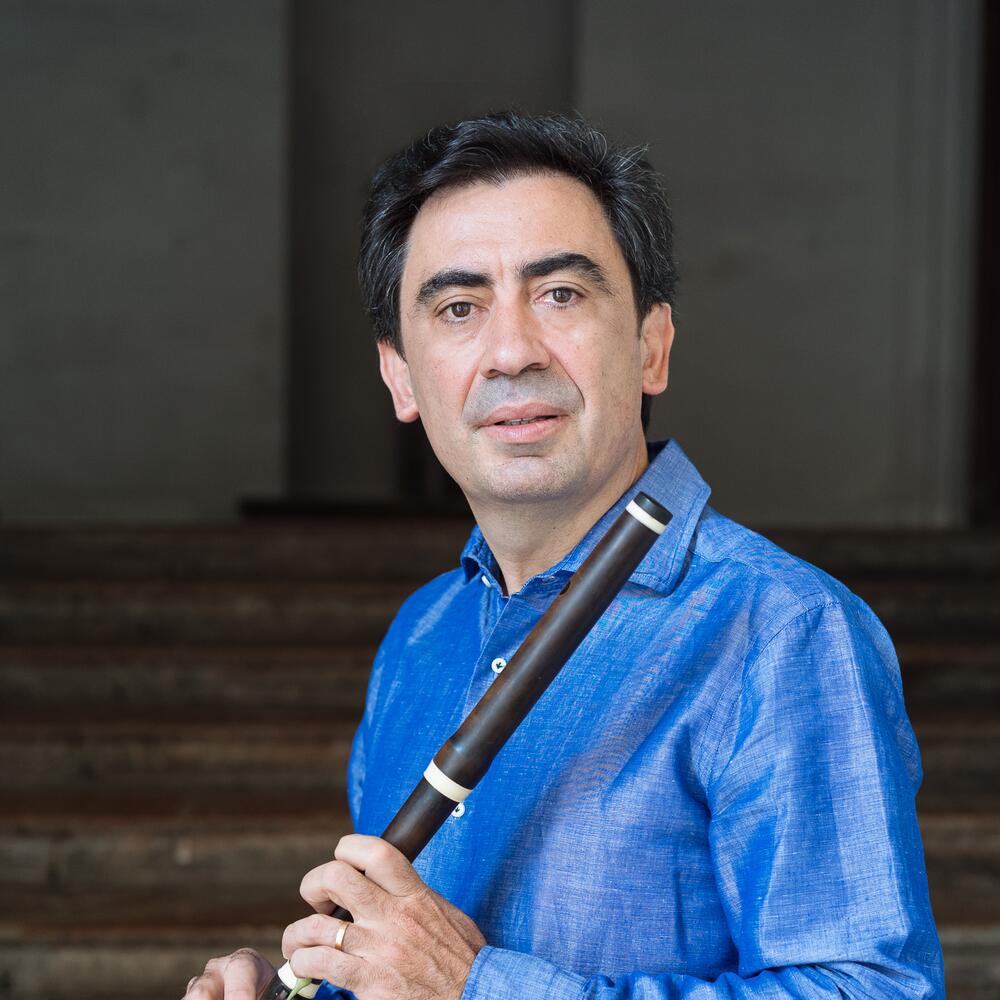
Marcello Gatti serves as Professor of Historical Flute at Mozarteum University Salzburg's Department of Wind & Percussion Instruments. An internationally recognized performer specializing in Renaissance through Romantic repertoire on period instruments, he maintains an active dual career in both academia and performance. His research focuses on historical performance practice across multiple musical eras, with particular expertise in traverso technique and interpretation. Gatti's scholarly work manifests primarily through his extensive discography and collaborations with leading period-instrument ensembles including Europa Galante, Accademia Bizantina, and Ensemble Aurora. The 15 most recent recordings demonstrate his evolving expertise across musical periods: Renaissance : Chamber works like 'Le Parler et le Silence' showcase his mastery of early flute consort repertoire Baroque : Major projects including Lully/Charpentier's 'Idylle sur la Paix' and Monteverdi's 'Vespro' Classical : Mozart opera collaborations and Schubert sacred works Romantic : Verdi, Moniuszko and Mendelssohn-Schumann symphonic projects His performance methodology consistently emphasizes historically informed techniques while maintaining artistic expressivity, particularly noted for 'sensitive cantabile' phrasing across diverse repertoire. Professor Gatti maintains significant teaching commitments beyond his Mozarteum position, regularly instructing at the Accademia Musicale Chigiana in Siena and the Fondazione Italiana Musica Antica in Urbino. His performance career includes over 80 documented productions with specialized ensembles including Ensemble Zefiro, Europa Galante, Amsterdam Baroque Orchestra, and L'Orfeo Baroque Orchestra.
Michael Mautner is a composer, conductor, and author currently teaching Project Oriented Composition at the Mozarteum University in the Department of Composition & Music Theory. He has held significant positions including composer, music dramaturge, and musical director at the Rabenhof Theater in Vienna since 2002, academic editor at the Hermann Publishing Group since 2005, and music curator of the Konzett Gallery Vienna since 2013. His educational background includes: Salzburg Music High School, Matura 1978 1978-1984: University of Salzburg (musicology, art history, philosophy) 1979-1985: Mozarteum University (composition with Gerhard Wimberger, conducting with Bernhard Conz, Mladen Basic, and Michael Gielen) Summer courses with Witold Lutoslawski, Henri Dutilleux, and Hans Werner Henze Mautner's creative work focuses on contemporary composition with particular emphasis on multimedia music theater and the interfaces of perception between visual art and music. He maintains what he describes as 'stylistic ambivalence,' working with both tonal harmony and dissonant sharpness without preference for either approach. His work aims to be immediately accessible despite its complexity and uncompromising nature, while still exploring new artistic spaces and contents. He is particularly known for his COM.MEDIA project based on Dante Alighieri and his collaboration with artist Kurt Hofstetter on 'supersymmetric composition technique.' His recent compositions demonstrate a strong trend toward interdisciplinary work at the intersection of visual art and music, with many pieces created specifically for gallery or museum contexts in collaboration with visual artists, especially Franz West. There's also a notable focus on adapting literary and historical texts into musical form, with works based on Dante, Arthur Schnitzler, and Austrian political history. Technologically, his work increasingly incorporates electronic elements and novel compositional techniques like the supersymmetric approach. Mautner has received numerous awards for his work: Staatsstipendium für Komposition (1985) Prix du Centre Acanthes (1982) Silver Bear at the Berlin Festival in the youth film/music category for 'Tunnelkind' (1990) 1st prize in the Mozart composition competition of the City of Vienna/Austro Mechana (1991) Förderungspreis des Landes Salzburg (1994) Mautner has supervised numerous composition students throughout his career, particularly during his tenure as Head of the 'Applied Composition' course at the Mozarteum University from 1994-2005 and his current role teaching Project Oriented Composition since 2015. His work has been supported by significant commissions from prestigious organizations including the Mozarteum Foundation, European Parliament, Gesellschaft der Musikfreunde Wien, ORF, Museum Moderner Kunst Wien, École Nationale Supérieure des Beaux-Arts Paris, Kunsthaus Bregenz, Wiener Festwochen, Rabenhof Theater, and the City of Salzburg. He collaborates extensively with various ensembles and institutions, most notably the Merlin Ensemble Wien and the Konzett Gallery Vienna where he directs the KonzettKonzeptKonzert series. His current work includes the 'Supersymmetric Music' project with Kurt Hofstetter, which generates musical sequences through rotations of the space-time axis of a dot matrix corresponding to tones and durations, representing a novel approach to composition that moves beyond conventional patterns.
Andrew Snow serves as a Senior Lecturer for Applied Piano Skills in the Department of Composition & Music Theory at Mozarteum University Salzburg, integrating performance expertise with pedagogical instruction. His academic foundation includes: Linz Bruckner Conservatory: piano studies under Horst Matthäus, music theory and counterpoint with Helmut Schiff; earned state teaching qualification for piano (IGP) University Mozarteum Salzburg: advanced piano training with Schneider-Cuvey, school composition under Ernst Ludwig Leitner, teacher training for music education (completed with distinction), and polyaesthetics with Wolfgang Roscher Artistic practice defines his career trajectory across performance and composition. As a pianist, he specializes in collaborative settings spanning opera excerpts, operettas, musicals, and jazz repertoire, while his compositional output spans choral works, film scores, ballets, and church music. This dual focus creates a unique synergy between theoretical frameworks and practical execution in music education. Professional recognition includes: Composition Prize of the Province of Upper Austria He maintains active performance affiliations with ensembles including the Salonensemble Potpourri, Jeunesse Orchestra Linz, Salzburg Virgil Schola, and Salzburg Belcanto Choir, alongside teaching positions at Stiftsgymnasium Wilhering and A. Stiftergymnasium Linz.
Dorothée Oberlinger is an internationally renowned recorder player, ensemble leader, conductor, and Professor of Recorder at the Mozarteum University Salzburg since 2004. She has revolutionized the recorder's artistic profile through groundbreaking work in early and contemporary music, founding Ensemble 1700 and directing major festivals including Arolsen Baroque Festival (since 2009) and Potsdam Sanssouci Music Festival (since 2018). Her educational background includes studies in: Cologne Amsterdam Milan Professor Oberlinger's research centers on reviving historical performance practices while expanding the recorder's repertoire into new music. Her work emphasizes original sound concepts in rediscoveries of rare Baroque operas and instrumental works, demonstrating the recorder's versatility beyond traditional perceptions. This scholarly-artistic approach has reestablished the instrument on world stages through innovative concert formats and critically acclaimed recordings. Her distinguished accolades include: Grand Cultural Prize of the Sparkassen-Kulturstiftung Rheinland (2025) Opus Klassik (2020, Instrumentalist of the Year) Echo Klassik Diapason d'Or ICMA Award Telemann Prize of the City of Magdeburg Federal Cross of Merit, First Class As an educator, Oberlinger has mentored generations of musicians through her professorship at Mozarteum University, where she headed the Institute for Early Music (2008-2018), developing its international profile. Her pedagogical philosophy combines technical mastery with creative exploration, inspiring students through unconventional concepts that bridge historical authenticity and contemporary expression. She directs Ensemble 1700 as its artistic leader and conductor, producing award-winning opera stagings and recordings. Since 2024, she has expanded her influence as Artist in Residence at Knechtsteden Early Music Festival, creating top-tier productions that showcase both historical repertoires and new commissions for the recorder.