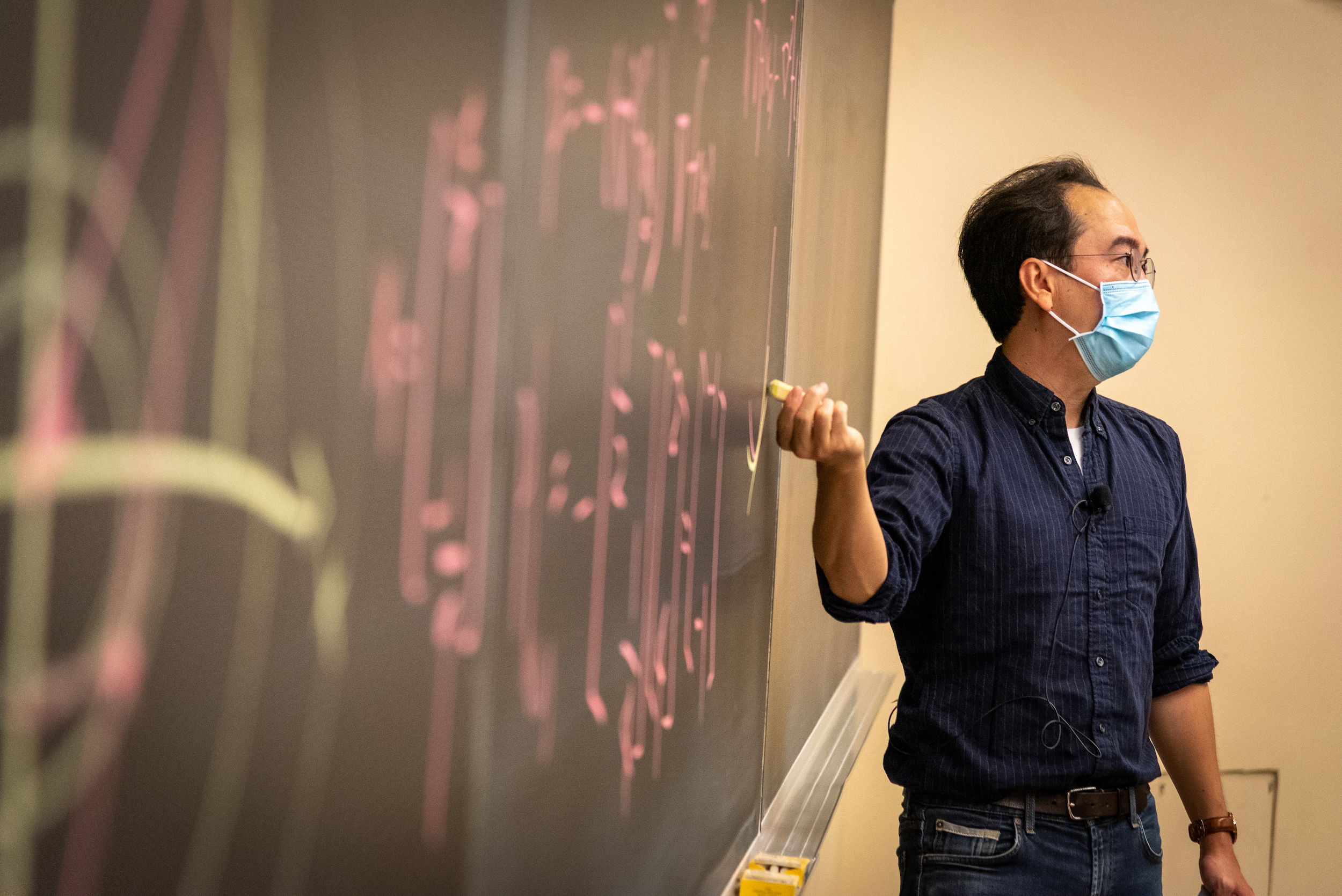
Dr. Balaraman Ravindran is a Professor and Head of the Department of Data Science and Artificial Intelligence (DSAI) at IIT Madras. He also leads the Robert Bosch Centre for Data Science & Artificial Intelligence (RBCDSAI) and the Centre for Responsible AI (CeRAI). His research focuses on reinforcement learning, geometric deep learning, and ethical AI deployment. Education includes a PhD from the University of Massachusetts Amherst (2004) and MSc from the Indian Institute of Science, Bangalore (1996). He holds prestigious fellowships from AAAI and INAE, and is an ACM Distinguished Member. Key contributions include work on class imbalance learning (e.g., TODUS algorithm) and applications in healthcare, transportation, and social networks. He has advised over 20 students and secured grants from Google, TCS Research, and others. Labs/Teams: Heads RBCDSAI and CeRAI, collaborates with TCS Research and Google.
Shimon Whiteson is Professor of Computer Science at the University of Oxford, leading the Whiteson Research Lab focused on reinforcement learning, multi-agent systems, and deep learning. His research develops algorithms for efficient learning in complex environments. Current work explores meta-reinforcement learning frameworks that enable agents to rapidly adapt to new tasks, with applications in autonomous driving simulation and robotics. Recent innovations include novel methods for offline reinforcement learning, multi-agent coordination, and morphology-aware control. Publications demonstrate advances in: Meta-RL algorithm design for few-shot adaptation Multi-agent reinforcement learning environments and benchmarks Imitation learning in autonomous driving Bayesian methods for sample-efficient learning Research outputs include widely used benchmarks and tools including JaxMARL for accelerated multi-agent RL research. Current doctoral supervision focuses on temporal abstraction in RL, multi-agent coordination, and reinforcement learning theory.
Aarti Singh is a Professor in the Machine Learning Department at Carnegie Mellon University and Director of the NSF AI Institute for Societal Decision Making. She leads research at the intersection of machine learning, statistics, and decision making, with applications to scientific and societal domains. Her work focuses on designing principled interactive algorithms for learning and decision making under uncertainty. Education: Ph.D. in Electrical Engineering, University of Wisconsin-Madison (2008) M.S. in Electrical Engineering, University of Wisconsin-Madison (2003) B.E. in Electronics and Communication Engineering, University of Delhi (2001) Research Interests: Professor Singh's research centers on developing interactive machine learning algorithms that go beyond finding input-output associations to make higher-level decisions about the most informative data and actions. Her work spans autonomous decision making, including active sampling, stochastic optimization, bandits, and reinforcement learning that are statistically optimal, computationally tractable, and robust. She also investigates human factors in decision making, designing algorithms that model and leverage human feedback while accounting for bias, memory effects, and calibration. Her research has applications in material science, cosmology, and peer review systems. Research Trends: Professor Singh's recent publications demonstrate a strong focus on reinforcement learning, particularly in developing more efficient and robust algorithms for decision making under uncertainty. Her work bridges theoretical foundations with practical applications, spanning from fundamental algorithm development to real-world implementation in scientific domains. There's a clear trajectory toward integrating human factors into decision-making algorithms, with significant contributions to peer review systems and preference learning. Scientific Awards: NSF Career Award United States Air Force Young Investigator Award A. Nico Habermann Faculty Chair Award Harold A. Peterson Best Dissertation Award Multiple paper awards Advising and Grants: Professor Singh has advised numerous PhD and master's students, many of whom have gone on to faculty positions or research roles at leading institutions. Her research is supported by prestigious grants from ONR, Simons Foundation, AFRL, ARL, and NSF. She serves as General Chair (2025) and Program Chair (2020) for the International Conference on Machine Learning (ICML) and has held leadership roles in multiple professional organizations. Research Team: Professor Singh leads a vibrant research group within the Machine Learning Department at CMU, with current PhD students working on topics including reinforcement learning, human-AI collaboration, and decision making under uncertainty. She also directs the NSF AI Institute for Societal Decision Making, which brings together researchers from multiple disciplines to develop AI systems that support human decision making in societal contexts.
Sicun Gao is an Associate Professor in the Computer Science and Engineering department at the University of California, San Diego. His research focuses on practical algorithms for NP-hard search and optimization problems in computational systems, emphasizing combinatorial perspectives in numerical and statistical contexts to achieve reliable autonomy. Research Interests: Automated reasoning, Hamilton-Jacobi reachability, safe reinforcement learning, control barrier functions, and optimization in cyber-physical systems. Teaching: Courses on AI search, optimization, and graduate research seminars. The 15 most recent publications highlight advancements in safe AI control, motion planning, and policy optimization, often integrating neural networks with formal verification. Awards include the IEEE Power & Energy Society Technical Committee Prize Paper Award and the IROS RoboCup Best Paper Award. He advises PhD students working on AI-driven control and robotics, with alumni placed at institutions like Seoul National University, Amazon, and Apple. Grants include NSF Career, Air Force Young Investigator, and DARPA Assured Autonomy funding. His lab develops tools like dReal for automated reasoning in nonlinear theories over the reals.
Osbert Bastani is an Associate Professor at the Department of Computer and Information Science, University of Pennsylvania, leading the trustml@Penn research group. He is affiliated with the ASSET , PRECISE , and PRiML centers, and the PLClub research group. His research focuses on Trustworthy Neurosymbolic Systems , Synthesizing Neurosymbolic Programs , and Machine Learning for Programmer Productivity , with applications in verification, fairness, and human-AI collaboration. He received the NSF CAREER Award in 2023. His recent publications (2024-2025) emphasize AI Safety , LLM Robustness , and Algorithmic Fairness , including work on adversarial robustness, conformal prediction, and program synthesis. Students he has advised include Sagnik Anupam, Stephen Mell, Jason Ma, Shuo Li, and others. Awards: NSF CAREER Award (2023)
Bo Dai is an Assistant Professor at the School of Computational Science and Engineering, Georgia Institute of Technology, and a Staff Research Scientist at Google DeepMind. His research focuses on Agent AI, Generative Models, and Representation Learning, aiming to create decision-making agents through world modeling. He holds a Ph.D. from Georgia Tech (2013–2018) and previously worked at Google Brain. Dai has authored numerous influential papers in top conferences like NeurIPS, ICML, and ICLR, and received the AISTATS Best Paper Award (2016). Education: Ph.D., School of Computational Science and Engineering, Georgia Tech (2013–2018) Research Interests: Reinforcement Learning and Representation Learning for decision-making agents Generative Models and their integration with Agent AI Provable and scalable algorithms for real-world applications His work bridges theory and practice, emphasizing spectral representations and provable guarantees in complex systems. Key Article Trends: His recent work emphasizes scalable spectral methods for multi-agent systems, diffusion policies, and representation-based techniques in reinforcement learning. He also explores LLM alignment and sim-to-real transfer learning. Awards: AISTATS Best Paper Award (2016) NeurIPS Workshop Best Paper (2017) Ross Fellowship (2011–2012) Advising & Grants: Supervises 6 current Ph.D. and M.S. students. Active in organizing workshops on reinforcement learning and serves as an Area Chair for top conferences. Labs & Software: Leads development of Representation-based Reinforcement Learning and Repr-Control toolboxes for nonlinear control and stochastic systems.
Alexander Schwing is an Associate Professor in the Department of Electrical and Computer Engineering and Computer Science at the University of Illinois at Urbana-Champaign, affiliated with the Coordinated Science Laboratory. His research focuses on machine learning and computer vision with applications in 3D scene understanding, generative modeling, and multi-agent systems. Education: Diploma in Electrical Engineering and Information Technology, Technical University of Munich (TUM) PhD in Computer Science, ETH Zurich Postdoctoral Fellow, University of Toronto Research Interests: Structured prediction in deep learning Generative adversarial networks and stability Multi-modal vision-language models 3D scene reconstruction from single images Embodied agent collaboration Semantic segmentation with temporal coherence Recent Publications: Highlight trends in neural rendering, video object segmentation, and reinforcement learning with applications to 3D modeling and multi-agent systems. Notable innovations include SAIL-VOS dataset for amodal segmentation and NeRFDeformer for single-view scene transformation. Scientific Awards: NSF CAREER Award, 3M and Amazon research awards, multiple student recognition awards, ETH Zurich PhD medal, and best paper at Intelligent Tutoring Systems 2014. Teaching: Offers graduate courses in Pattern Recognition (ECE 544) and Machine Learning (CS 446/ECE 449). Previously taught at University of Toronto and ETH Zurich. Labs & Collaborations: Leads research at Coordinated Science Laboratory (UIUC) with collaborations across University of Toronto, ETH Zurich, and industry partners like Samsung SAIT and Amazon.
Caglar Gulcehre is a Tenure Track Assistant Professor at École Polytechnique Fédérale de Lausanne (EPFL) and Principal Investigator of the CLAIRE (Caglar Gulcehre Laboratory of Artificial Intelligence Research) lab. Previously, he worked as a Staff Research Scientist at Google DeepMind, Microsoft Research, and IBM Research. His research focuses on reinforcement learning , foundation models , LLM alignment , and sequence modeling . Current Position : Assistant Professor, EPFL Lab : CLAIRE Lab Previous Roles : Staff Research Scientist at DeepMind, MSR, IBM Research His work spans reinforcement learning , deep learning , and neural architecture design , with a focus on safety , trustworthy AI , and real-world applications . He has published in top venues including Nature , NeurIPS , ICML , and JMLR . Scientific contributions include: Best paper award at NeurIPS Nonconvex Optimization workshop Honorable mention for best paper at ICML 2019 Co-organizer of seven workshops at NeurIPS, ICML, and ICLR He supervises PhD students in areas related to AI for algorithm discovery , neural architectures , and foundation models , including: Skander Moalla Justin Samuel Deschenaux Liangze Jiang Xiuying Wei Yitao Xu
Raman Arora is an Associate Professor in the Department of Computer Science at Johns Hopkins University, with affiliations to the Mathematical Institute for Data Science (MINDS), the Center for Language and Speech Processing (CLSP), and the Institute for Data-Intensive Engineering and Science (IDIES). His research spans theoretical and practical aspects of machine learning, focusing on robustness, privacy, representation learning, and optimization. Research Interests: Machine Learning Theory Representation Learning (e.g., Deep CCA, Multi-view Learning) Privacy-Preserving Machine Learning (Differential Privacy) Robustness in Deep Learning Online and Reinforcement Learning Stochastic Optimization Algorithms His recent publications, primarily in top-tier venues like NeurIPS, ICML, and ICLR, demonstrate a strong focus on the theoretical foundations of adversarial robustness, multi-task learning, offline reinforcement learning, and differentially private optimization. His work often bridges theory and practice, with applications in speech, language, and data-intensive systems. Scientific Awards and Honors: NSF CAREER Award (2020) ICML Test-of-Time Award Finalist (2023) for Deep CCA Member, Institute for Advanced Study (2019–2020) Visiting Scientist, Simons Institute (2019, 2020, 2022) Advising and Grants: Raman Arora has advised numerous PhD and master’s students, many of whom are now researchers at leading tech companies like Google, Meta, and Microsoft. His research is supported by significant grants from the NSF (including CAREER, BIGDATA, TRIPODS, and CRCNS awards), DARPA, and other agencies, focusing on foundational aspects of machine learning such as inductive biases, privacy, robustness, and computational neuroscience. Laboratory and Research Group: He leads a dynamic research group at Johns Hopkins, comprising current PhD students and postdoctoral researchers working on the intersection of theory and applications in machine learning. The group is actively involved in projects related to adversarial robustness, meta-learning, offline reinforcement learning, and private optimization.
Tzu-Mao Li is an Assistant Professor in the Department of Computer Science and Engineering (CSE) at the University of California, San Diego (UCSD), affiliated with the Center for Visual Computing. His research focuses on differentiable graphics algorithms, combining classical visual computing with modern machine learning techniques. He holds a Ph.D. from MIT CSAIL under Frédo Durand and a postdoc at MIT and UC Berkeley with Jonathan Ragan-Kelley. His work spans rendering, programming languages for graphics, Monte Carlo methods, and inverse problems. Education: B.S. and M.S. from National Taiwan University (2011-2013), advised by Yung-Yu Chuang. Ph.D. from MIT CSAIL (Computer Graphics Group), advised by Frédo Durand. Postdoctoral research at MIT and UC Berkeley with Jonathan Ragan-Kelley. Research Interests: Differentiable rendering, Monte Carlo integration, programming language design for visual computing, physical simulation, adversarial machine learning, and applications in computer vision and robotics. Key areas include rendering algorithms (path tracing, bidirectional methods), optimization techniques (MCMC, gradient-based), and neural representations (SDFs, neural fields). Publications focus on advancing rendering algorithms, differentiable systems, and applications in inverse problems. Notable contributions include edge sampling for differentiable rendering, warped-area sampling, and diffusion models for BSDF sampling. Awards: ACM SIGGRAPH 2020 Outstanding Doctoral Dissertation Award, multiple Best Paper Awards at SIGGRAPH, and oral presentations at ICCV. Teaching: Courses include CSE 167 (Computer Graphics), CSE 168 (Rendering), and CSE 272 (Advanced Image Synthesis), emphasizing physically-based methods and programming.
Jenna Wiens is an Associate Professor of Computer Science and Engineering at the University of Michigan's College of Engineering. She serves as Associate Director of the Artificial Intelligence Lab and co-Director of AI & Digital Health Innovation. Leading the MLD3 research group, her work focuses on machine learning and AI applications for healthcare data. PhD from MIT (2014) under John Guttag NSF CAREER Award recipient (2016) Humboldt Foundation Carl Friedrich von Siemens Award (2024) Her research addresses four key technical thrusts: Time-series analysis for predicting clinical outcomes Robust machine learning against spurious correlations Decision-making with causal inference and offline reinforcement learning Human-AI collaboration frameworks Notable methodological contributions include the FIDDLE preprocessing pipeline for clinical time-series data, foundational work on survival analysis, and novel approaches to model selection in healthcare reinforcement learning. Her work has led to real-world AI deployments in infection prevention and patient risk stratification. Scientific honors include: Forbes 30 Under 30 (2015) MIT Tech Review 35 Innovators Under 35 (2017) Sloan Research Fellowship in Computer Science (2020) Sarah Goddard Power Award (2023) Wiens collaborates with clinicians across disciplines, emphasizing clinician-in-the-loop AI systems and ethical implementation in healthcare workflows.
Gauri Joshi is an Associate Professor in the Electrical and Computer Engineering (ECE) department at Carnegie Mellon University, with affiliate appointments in the Machine Learning Department and Robotics Institute. Her work focuses on system-aware algorithms for distributed machine learning, combining optimization, probability, and coding theory to address communication and computational constraints in edge networks. MIT Ph.D. in EECS (2016) IIT Bombay B.Tech/M.Tech in Electrical Engineering (2010) Research themes include federated learning with communication efficiency, erasure coding for non-linear computations, and reinforcement learning for heterogeneous queueing systems. She leads the Optimization, Probability and Learning (OPAL) lab , affiliated with the Parallel Data Lab (PDL), CyLab, and FLAME Center. Recent publications highlight advances in: federated fine-tuning with low-rank adaptation, robust PCA for model aggregation, privacy-preserving prediction mechanisms, and adaptive reinforcement learning for job dispatching systems. Her group has received 15+ paper awards across SIGMETRICS, MobiHoc, and NeurIPS workshops. Scientific recognition includes: IEEE Goldsmith Lecturer (2025), MIT Technology Review '35 Innovators Under 35' (2022), ONR Young Investigator Award (2023), NSF CAREER (2021), and ACM SIGMETRICS Best Paper (2020). She has advised 20+ graduate students, many now at tech giants like Google, Apple, and Meta. Service contributions span program co-chair roles (MLSys 2025), associate editorships (IEEE/ACM Transactions on Networking), and workshop organization (ICML, NeurIPS). Her NSF AI-EDGE Institute leadership (2021-present) drives next-generation intelligent edge networks for robotics and aerospace applications.
Hao Liu is an incoming Assistant Professor of Machine Learning at Carnegie Mellon University and currently works as a research scientist at Google DeepMind. Previously, he completed his Ph.D. in Computer Science at UC Berkeley under the supervision of Pieter Abbeel. He also spent two years part-time at Google as part of the Google Brain team. His educational background includes: Ph.D. in Computer Science from UC Berkeley Hao Liu's research focuses on solving intelligence through deep learning, neural networks, and innovative learning objectives. His work spans multiple areas including large language models, reinforcement learning, world models, and attention mechanisms for long context processing. He has made significant contributions to making transformer models more efficient and capable of handling extremely long sequences through techniques like Ring Attention and Blockwise Transformers. His recent publications demonstrate a strong focus on extending the capabilities of language and vision models, particularly in handling long sequences and multimodal data. Key themes include attention optimization, tokenization efficiency, and alignment techniques. His work bridges theoretical advances with practical implementations for real-world AI systems, with multiple papers at top conferences including NeurIPS, ICML, and ICLR, often receiving spotlight or oral presentations. Hao is actively involved in open-source AI research, having contributed to projects like Koala and OpenLLaMa, which aim to make advanced language models more accessible to the research community. His work on RingAttention has been implemented as a Python package available on GitHub, demonstrating his commitment to practical implementations and community sharing.
Stephen Redmond is an Associate Professor at the School of Electrical and Electronic Engineering at University College Dublin (UCD), where he leads the Biomedical Sensors and Signals Research Group. He completed his Bachelor of Electronic Engineering at UCD in 2002, followed by a PhD in biosignal processing in 2006 on at-home sleep staging. After spending 10 years at the University of New South Wales in Sydney, he returned to UCD in 2018. His educational background includes: BE Electronic Engineering, University College Dublin (2002) PhD Biosignal Processing, University College Dublin (2006) Redmond's research focuses on the intersection of signal processing, pattern recognition, and novel sensing hardware to enable longitudinal health monitoring in home environments. His group has developed expertise in wearable sensor systems for human movement analysis, robust physiological signal measurement in unsupervised settings, tactile physiology and sensing, and the application of deep neural networks for medical image segmentation and robotic manipulation. His work bridges biomedical engineering with practical applications in healthcare and robotics. His recent publications demonstrate a strong trend toward integrating tactile sensing with machine learning for robotic applications, particularly in slip detection and dexterous manipulation. His research spans multiple disciplines including biomedical engineering, robotics, computer vision, and artificial intelligence, with a particular emphasis on practical applications that bridge the gap between laboratory research and real-world implementation. His notable recognition includes: Science Foundation Ireland President of Ireland Future Research Leaders Award for his project on tactile sensing As a research leader, Redmond mentors multiple doctoral students and postdoctoral researchers, securing significant research funding to support his team's work in tactile sensing and robotic manipulation. His research group has established strong industry connections, notably through the co-founding of Contactile, a tactile sensor company. The group maintains active collaborations with both academic and industry partners to translate research into practical applications. The Biomedical Sensors and Signals Research Group operates a well-equipped laboratory featuring advanced robotics platforms including a UR5e six-axis arm, Physik Instrumente Hexapods, ATI force/torque sensors, multiple 3D printers, and specialized tactile sensing equipment including Contactile Dev Kits and Meta Digit tactile sensors. This infrastructure supports their research in tactile physiology, sensor development, and intelligent robotic manipulation.
Eric V. Mazumdar is an Assistant Professor at the California Institute of Technology (Caltech), jointly appointed in the departments of Computing and Mathematical Sciences and Economics. He holds a B.S. from MIT (2015) and a Ph.D. from UC Berkeley (2021), co-advised by Michael Jordan and Shankar Sastry. His research bridges machine learning and economics, focusing on deploying algorithms into societal systems through theoretical and practical lenses. Key areas include strategic classification, multi-agent reinforcement learning, and distributionally robust optimization, with applications in healthcare, online markets, and intelligent infrastructure. Education: B.S., Electrical Engineering and Computer Science, Massachusetts Institute of Technology, 2015 Ph.D., Electrical Engineering and Computer Science, University of California, Berkeley, 2021 Research Interests: Mazumdar’s work emphasizes understanding learning algorithms in strategic environments, including min-max optimization, game theory, and multi-agent systems. He explores how algorithms interact with human and algorithmic agents in dynamic systems, with practical applications in healthcare delivery, e-commerce, and autonomous systems testing. Awards: NSF CAREER Award (2023) Simons Institute Research Fellowship in Learning in Games Grants & Funding: Supported by NSF, DARPA, Amazon, and other organizations. His NSF CAREER grant focuses on strategic interactions in societal-scale systems. Teaching: Courses include Networks: Structure & Economics (CMS/CS/EE/IDS 144) and Topics in Learning and Games (CMS/Ec 248). At UC Berkeley, he contributed to courses like Data, Inference, and Decisions (DS 102). Students & Postdocs: Current students: Lauren Conger, Tinashe Handina, Yizhou Zhang Postdocs: Zaiwei Chen, Laixi Shi, Kishan Panaganti (co-advised with Adam Wierman)