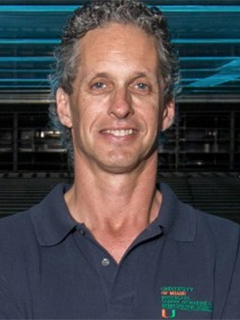
Brian K Haus is a Professor in the Department of Ocean Sciences at the University of Miami's Rosenstiel School of Marine, Atmospheric, and Earth Science. His research focuses on hurricane dynamics, air-sea interactions, and coastal protection technologies through advanced experimental and numerical modeling approaches. Institution: University of Miami School: Rosenstiel School of Marine, Atmospheric, and Earth Science Department: Ocean Sciences As director of the Alfred C. Glassell Jr. SUSTAIN Laboratory, he investigates: Wind-wave-storm surge interactions Extreme weather condition modeling Oceanographic instrument design Coastal barrier systems The laboratory enables 3D visualization of hurricane forces up to Category 5 strength (155mph/69mps) and serves as a platform for: Scientific instrument testing Material development for marine environments Commercial imaging applications His research has attracted significant grant funding including the $6.74 million coastal protection experiment involving student researchers.
Prof. Dr. Şeniz Ertuğrul is a faculty member at the College of Engineering , İzmir University of Economics , Department of Mechatronics Engineering. She previously held academic positions at Istanbul Technical University (ITU) from 1998–2018, progressing from Dr. Öğr. Üyesi to Professor. Her career includes visiting researcher roles at University of Michigan (2002) and University of Malta (2024). PhD in Mechanical Engineering (1996), Wichita State University MSc in Robotics Engineering (1992), Istanbul Technical University BSc in Mechanical Engineering (1988), Istanbul Technical University Her research focuses on system dynamics and control , particularly in humanoid robotics , marine vessel control , fuzzy logic , neural networks , and intelligent systems . She has published over 15 articles in journals like Applied Soft Computing and Ocean Engineering , with recurring themes in robot manipulators , collision avoidance algorithms , and adaptive control . Her work has been cited in studies on autonomous maritime navigation , driver modeling , and industrial optimization . She has received 14 scientific awards , including TÜBİTAK-National Instruments Third Place (2015) and WSU Mechanical Engineering Project First Prize (1993). Her 18+ advisees have explored topics like humanoid robot trajectory planning , ship motion control , and smart actuator design . Current projects include Series Elastic Actuator Development (2023–2024) and Humanoid Robot Cognitive Modeling (2021–2023).
Guy Plantier is a Teacher-researcher affiliated with the Institute of Acoustics at Le Mans University . His work bridges optical engineering and acoustic sensing, with a focus on developing advanced instrumentation for seismic and environmental monitoring. Research Interests Opto-acoustics and laser ultrasonics Self-mixing interferometry Machine learning for sensor data analysis High-resolution optical displacement sensors Monitoring of geohazards in harsh environments Scientific Production Trends Plantier's recent publications emphasize optical sensor development for geophysical applications, particularly seismic monitoring in extreme environments (volcanoes, ocean floors). His work also explores interdisciplinary applications of machine learning in agricultural data analysis (dairy cow behavior tracking). Collaborations Collaborates with researchers across France (Paris, Bordeaux, Martinique) Participates in instrumental park projects and measurement platform development
Mehr U Nisa is an Assistant Professor in the Department of Physics & Astronomy at Michigan State University, where she joined the faculty in 2023 after completing a postdoctoral position at the same institution from 2019-2023. She is an experimental particle astrophysicist working at the intersection of particle physics and high-energy astrophysics, with significant contributions to neutrino and gamma-ray astronomy. Michigan State University (2023-present): Assistant Professor Michigan State University (2019-2023): Postdoctoral Researcher University of Rochester (2018): Ph.D. in Physics and Astronomy LUMS (2012): B.S. in Physics Dr. Nisa's research focuses on multimessenger astronomy, particularly using observations of high-energy photons (TeV gamma rays) and neutrinos to investigate cosmic-ray accelerators and dark matter. Her work spans both neutrino astronomy and very-high-energy gamma-ray observations, with an emphasis on constraining beyond-the-standard-model physics. She leads research projects that involve enhancing sensitivity to point-source and extended-source neutrino searches, cross-correlating gamma-ray data with neutrinos, and using machine learning to improve directional reconstruction of neutrino events. Her extensive publication record in high-energy astrophysics reveals strong trends in multimessenger astronomy, with particular emphasis on neutrino point-source searches, gamma-ray source identification, and dark matter constraints. Her recent work shows increasing focus on machine learning applications in neutrino astronomy and the development of next-generation neutrino telescopes like P-ONE. Dr. Nisa is actively involved in multiple major international collaborations, including the IceCube Neutrino Observatory, the High Altitude Water Cherenkov (HAWC) Gamma-ray Experiment, the Southern Wide-field Gamma-ray Observatory (SWGO), and the Pacific Ocean Neutrino Experiment (P-ONE). She maintains a strong commitment to mentoring students, particularly women and under-represented minorities in physics, and encourages interested students to reach out for guidance on navigating research careers. Her laboratory work primarily involves data analysis from neutrino and gamma-ray observatories, with computational research focusing on improving detection algorithms and developing new analysis techniques for multimessenger astronomy.
Eric D'Asaro is a Senior Principal Oceanographer and Professor of Oceanography at the Applied Physics Laboratory, University of Washington (APL-UW). He is affiliated with the Ocean Physics department and has made significant contributions to the field of physical oceanography over his extensive career. Dr. D'Asaro earned his B.A. and M.S. in Physics from Harvard University in 1976, followed by a Ph.D. in Oceanography from MIT/WHOI in 1980. His educational background provided the foundation for his innovative research at the intersection of fluid mechanics, oceanography, and engineering. Dr. D'Asaro's research spans a wide number of environments from upper ocean mixed layers to nearshore coastal fronts to fjords to deep convection. Starting from a core interest in turbulence and internal waves, his work has expanded to include new aspects of small-scale oceanography, including submesoscale processes, and the role of all of these mixing processes in controlling biochemical processes in the ocean. For the past 30 years, his experimental work has focused on exploiting the unique capabilities of "Lagrangian Floats," a class of instruments that try to accurately follow the three dimensional motion of water parcels particularly in regions of strong mixing. By measuring big signals, like hurricanes or major blooms, it is easier to unravel the underlying processes because the signal to noise is high. His work bridges fluid mechanics, oceanography, and engineering, making significant contributions to our understanding of ocean mixing processes and their role in global climate systems. His research has important implications for climate modeling, carbon cycling, and predicting the behavior of extreme weather events like hurricanes. Wave Measurements at Ocean Weather Station PAPA Air-Sea Momentum Flux in Tropical Cyclones Salinity Processes in the Upper Ocean Regional Study (SPURS) Lateral Mixing Autonomous Lagrangian Floats for Oxygen Minimum Zone Biogeochemistry Hurricane Lagrangian Floats North Atlantic Bloom EXPORTS: Export Processes in the Ocean from RemoTe Sensing Lagrangian Submesoscale Experiment (LASER) Dr. D'Asaro's laboratory and research team focus on developing and deploying innovative instrumentation for oceanographic measurements, particularly Lagrangian floats that can accurately follow water parcels. His work has resulted in numerous publications spanning from 2000 to the present, with a particularly high output in recent years (2023-2025).
Wilco Hazeleger serves as Rector Magnificus of Utrecht University since 26 March 2025 and professor of Climate System Science. As rector, he oversees research, education, and student affairs at Utrecht University, with a mission to make the institution open and accessible to society through interdisciplinary connections and societal collaboration. Previously, he served as dean of the Faculty of Geosciences from July 1, 2019 to March 1, 2025, where he championed diversity, inclusivity, and sustainability-focused research. Current Position: Rector Magnificus of Utrecht University (2025-present) Academic Appointment: Professor of Climate System Science Previous Leadership: Dean of Faculty of Geosciences (2019-2025) Former Roles: Director of Netherlands eScience Center (2014-2019), Professor of Climate Dynamics at Wageningen University Education: PhD in Physical Oceanography from Utrecht University (1999) Hazeleger's research spans climate modeling, oceanography, and the application of data science to climate challenges. He pioneered narrative approaches to climate change based on vulnerability mapping, enabling better understanding of future weather extremes. His work connects climate science with societal applications, particularly through digital twin technology for Earth system modeling. His research trajectory demonstrates a clear evolution from fundamental climate science toward integrated approaches combining AI, data science, and climate modeling. Recent publications focus on digital twins of Earth, climate risk assessment through event-based storylines, and applications of machine learning to climate prediction. His work on EC-Earth, a climate model based on ECMWF's weather model, has been instrumental in IPCC assessment reports. Climate System Science: Focus on interactions within Earth's climate system Digital Earth Twins: Development of integrated simulation frameworks Climate Risk Assessment: Innovative approaches using narrative/storyline methods AI Applications: Machine learning for climate prediction and analysis Hazeleger is deeply committed to open science principles, advocating for open data, software, and knowledge sharing. He co-founded the AI Lab Sustainability, facilitating collaboration between sustainability researchers, computer scientists, and external stakeholders. His leadership extends to implementing the MERIT promotion policy at the Faculty of Geosciences, which values research, education, leadership, impact, and team spirit equally. As a key contributor to the European 'Destination Earth' program, Hazeleger bridges fundamental climate research with practical applications for addressing climate change challenges. His interdisciplinary approach connects climate science with social sciences, computer science, and policy development, positioning him at the forefront of next-generation climate research infrastructure.
apl. Prof. Dr. habil. Bernhard Schulz is an Associate Professor for Petrology at the Chair of Mineral Deposits and Petrology, Institute of Mineralogy, Faculty of Geosciences, Geotechnology and Mining at Freiberg University of Mining and Technology (TU Bergakademie Freiberg) in Germany. He has held this position since 2005, following previous academic roles at the Universities of Würzburg, Erlangen-Nuremberg, and earlier appointments as a lecturer and research fellow. His scholarly work spans metamorphic petrology, geochronology, and mineral deposit studies with particular expertise in electron microprobe monazite dating and SEM-based automated mineralogy techniques. Professor Schulz's research focuses on metamorphic rocks and petrochronology, employing methods including geothermobarometry, EPMA-Th-U-Pb-monazite dating, microstructure analysis, and geochemistry to reconstruct geodynamic processes and mineral deposit formation. His work covers regions including the Eastern Alps, Saxony, Armorican Massif, and South America. He also investigates ores and processed ores using SEM-based automated mineralogy methods (MLA) for characterizing metal ores, technical mineral processing, and recycling processes. His analytical expertise includes SEM automated mineralogy with MLA and EPMA electron probe microanalysis for silicates and Th-U-Pb-CHIME dating of monazite. Analysis of his recent publications reveals strong trends in metamorphic petrology, geochronology (particularly monazite dating), ore deposit geology, and SEM-based mineralogy applications. His work spans diverse geological settings from the Variscan orogeny in Europe to Precambrian terranes in Africa and South America. The research demonstrates consistent methodological innovation, particularly in electron microprobe techniques for dating and characterizing metamorphic events and ore formation processes across different geological timescales. Hermann-Credner-Preis 1990 der Deutschen Geologischen Gesellschaft (1990) Korrespondent der Geologischen Bundesanstalt in Wien (2001) Ernennung zum Professor apl. an der Universität Erlangen-Nürnberg (2003) Professor Schulz has served on multiple review committees including the Scientific Priority Program (SPP) 1144 'From Mantle to Ocean: Energy, Material and Life Cycles at Spreading Axes' and SPP 1158 'Antarctica Research' (both Deutsche Forschungsgemeinschaft). He has received research fellowships from the German Research Foundation (DFG) and maintains active international collaborations, particularly with institutions in France, Switzerland, Austria, and the United States. His current research involves extensive fieldwork in metamorphic terranes across Europe, Africa, and South America, with a strong emphasis on methodological development in geochronology and mineral characterization. Professor Schulz works within the Institute of Mineralogy at Freiberg University, where he leads research on metamorphic petrology and mineral deposits. His team utilizes state-of-the-art analytical facilities including a Quanta 600 FEG SEM for automated mineralogy and a JEOL electron microprobe for EPMA analysis. He collaborates closely with Dr. Joachim Krause at the Helmholtz Institute Freiberg for Resource Technology, sharing access to advanced JEOL-JXA-8530-FEG instrumentation. His research group maintains strong connections with international laboratories including Géosciences Rennes and Université Paris Jussieu in France.
Dr. Eleni Anagnostou is a leading researcher in paleoceanography and marine biogeochemistry at the Helmholtz Centre for Ocean Research Kiel (GEOMAR) , where she has served as a group leader since 2024. Her work bridges climate dynamics, carbon cycle evolution, and geochemical proxy development, with a focus on past climate reconstructions. Ph.D., Chemical Oceanography, Rutgers University (2011) M.Sc., Environmental Science, Rutgers University (2005) B.Sc., Chemical Engineering, National Technical University of Athens (2003) Her research explores the relationship between atmospheric CO 2 , climate sensitivity, and ocean chemistry across geological periods such as the Paleogene and Neogene. She specializes in boron isotopes and trace elements as proxies for seawater pH and CO 2 levels, with applications to understanding tipping points in Earth’s climate history. The HighBorG project (ERC Consolidator Grant) and multiple DFG-funded initiatives underscore her leadership in reconstructing climate-carbon interactions during high-CO 2 intervals. Her recent publications emphasize methodological innovations in boron isotope analysis, ultra-high-resolution coral-based climate records, and modeling of past climate variability. Scientific Awards : ERC Consolidator Grant (2024-2029) for HighBorG DFG Project Funding (467590255, 468679331, 546924479) She has mentored numerous postdoctoral researchers and students, including Dr. Karlos Kochhann, Dr. Ray Zammit, and Luisa Meiritz, while collaborating on multidisciplinary efforts like the PAGES workshop series on foraminiferal boron isotopes.
Eric Pardyjak is a Professor in the Mechanical Engineering department at the University of Utah , with an Adjunct Professor appointment in Atmospheric Sciences . His career spans over two decades at the University of Utah, where he was promoted from Assistant Professor (2001-2007) to Associate Professor (2007-2013) before attaining his current Professor status since 2013. He holds a PhD in Mechanical Engineering from Arizona State University (2001), following MS (1996) and BS (1994) degrees from University of Wisconsin-Madison and Michigan State University respectively. Research Focus: Atmospheric boundary layer dynamics, turbulence interactions with hydrometeors, cold fog formation in complex terrain, and urban/subsurface flow modeling Key Projects: Principal investigator for CFACT (Cold Fog Amongst Complex Terrain) and FATIMA (Fog And Turbulence Interactions in Marine Atmosphere) field campaigns Instrumentation Development: Co-developer of the Differential Emissivity Imaging Disdrometer (DEID) for real-time snowflake density measurements Scientific Contributions: His work has established critical relationships between surface thermal heterogeneity and secondary circulations, developed novel canopy wind models (QES-ROC), and improved hydrometeor fall speed parameterizations. Current research explores fog shadows around Sable Island and scalar transport in vegetative canopies. Awards: Mechanical Engineering Professor of the Year (2023) Researcher of the Year (2022) ASME Fellow (2017) Fulbright Scholar (2016) Teaching: Advises graduate students in Mechanical Engineering through PhD Dissertation and Masters Thesis supervision. Teaches TFES Lab courses focusing on thermal-fluid systems.
John Horel is a Professor in the Department of Atmospheric Sciences at the University of Utah, where he has served since 1986, progressing from Assistant Professor (1986-1990) to Associate Professor (1990-1996) and Professor (1996-present). He has held significant administrative roles including Director of Undergraduate Studies and Department Chair. His research focuses on observation and analysis of weather and climate processes in mountainous regions, with particular emphasis on fire weather applications, flash flooding, Great Salt Lake dynamics, and air quality. His group developed extensive instrumentation infrastructure across northern Utah and led numerous research field campaigns. ORCID: 0000-0002-2328-5008 Research Group: Mountain Meteorology Group Key Projects: MesoWest, MEOP (Mobile Environmental Observing Platform), UUNET, Great Salt Lake Research, Alaska Fire and Fuels System, Great Lakes Fire and Fuel System Horel's research led to the creation of Synoptic Data, a Public Benefit Corporation where he serves as a Director. The company provides expanded access to environmental data for public safety, government operations, and research. His group maintains real-time research tools available at https://horel.chpc.utah.edu/ . His teaching includes ATMOS 1020 (Climate Change), ATMOS 3000 (Professional Development), ATMOS 3200 (Mountain Weather and Climate), ATMOS 5340 (Environmental Programming and Statistics), and other advanced courses. Recent teaching activities show he regularly instructs Thesis Research courses for MS and PhD students. Horel has secured substantial research funding, with current grants including the Great Salt Lake Evaporation Modeling Program (2024-2026), U.S.-Canada Center on Climate-Resilient Western Interconnected Grid (2023-2028), and multiple fire and fuels system projects across Alaska and the Great Lakes region.
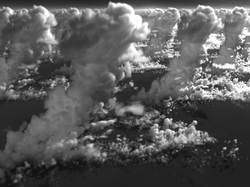
Steven Krueger is a Professor at the University of Utah, where he leads the Clouds, Turbulence, and Fire Weather Research Group . His research focuses on atmospheric processes including cloud systems dynamics, turbulence, boundary layer interactions, and fire weather modeling. Krueger employs advanced numerical techniques like Large Eddy Simulation (LES) and cloud-resolving models to study convection, cloud physics, and climate feedback mechanisms. Research Interests: Krueger's work spans cloud modeling (from stratocumulus to cumulonimbus), convective cold pools, stratocumulus entrainment, and wildfire-atmosphere interactions. Key methodologies include LES benchmarks (e.g., GigaLES), super-parameterized climate models (SP-CAM), and observational data analysis from field campaigns like KWAJEX. Publication Trends: His recent articles (2007–2012) emphasize cloud microphysics, turbulence parameterization, fire weather simulations, and Arctic climate feedbacks. Work demonstrates consistent application of high-resolution modeling to quantify convection dynamics, aerosol impacts, and precipitation processes across diverse climates. Group Leadership: Krueger directs a team studying cloud physics, fire weather, and convective analysis. Current projects include developing tools to quantify cloud responses to climate states and improving wildfire spread models through turbulence analysis.
Aradhna Tripati is a Professor at the University of California, Los Angeles with joint appointments in the Institute of the Environment and Sustainability, the Department of Atmospheric and Oceanic Sciences, the Department of Earth, Planetary, and Space Sciences, the Institute for Geophysics and Planetary Physics, and the California Nanosystems Institute. She serves as the faculty director and founder of the Center for Developing Leadership in Science (CDLS) at UCLA. Dr. Tripati received her B.S. in Geological Sciences from California State University, Los Angeles in 1996, where she received the Aaron Waters Award for Outstanding Senior. She earned her Ph.D. in Earth Sciences at UC Santa Cruz in 2002, where she was a Gates Millennium Scholar, an Ocean Drilling Program Fellow, and a UC Regents' Fellow. Following her Ph.D., she was a research fellow at the University of Cambridge, holding the Thomas Nevile Fellowship in Natural Sciences, a Comer Abrupt Climate Change Fellowship, a National Environmental Research Council Fellowship, and a Marshall Sherfield Fellowship. She also served as a visiting scientist at the California Institute of Technology for several years before joining UCLA as an assistant professor in 2009, receiving tenure in 2014. Dr. Tripati's research focuses on climate change, the history and dynamics of changing Earth systems including climate, ice sheets, oceans, the water cycle, and carbon dioxide levels. She specializes in tool development and clumped isotope geochemistry, using the chemistry of natural compounds as well as models to understand how the Earth works. Her work addresses pressing questions pertaining to climate change, earth systems history, geochemistry, geobiology, and sedimentary geology. She also integrates geochemical data with field-based observations, sedimentologic and micropaleontologic data, and models. Her interdisciplinary approach spans multiple fields, connecting geological records with modern climate science to understand past and present environmental changes. Dr. Tripati's extensive publication record, with 66 publications including 12 in Nature journals, Science, or PNAS, demonstrates her significant contributions to paleoclimatology and geochemistry. Her recent work shows a continued focus on clumped isotope thermometry, with applications to understanding past climate conditions, hydrological cycles, and Earth system processes. Her research spans various time periods from the Miocene to the Holocene, examining climate dynamics across different spatial scales from local lake systems to global ocean circulation patterns. A notable trend in her recent publications is the increasing integration of community engagement and environmental justice perspectives with traditional geochemical research. Presidential Early Career Award in Science and Engineering from President Obama NSF CAREER award (NSF's most prestigious award for early career faculty) Bromery Award for Minorities from the Geological Society of America Hellman Fellow National Academy of Sciences Kavli Fellow E.O. Wilson Award for Outstanding Science on climate change Chair International D'Excellence in Stable Isotopes by IUEM Vasa Cube Awardee for UCLA's Fiat Lux Freshman Seminar program UCLA Career Development Award Dr. Tripati has mentored over 130 postdoctoral fellows, researchers, PhD students, Master's students, undergraduates, high school teachers, and high school students. Her commitment to education extends beyond traditional academic mentoring, as she has developed numerous outreach programs to promote diversity in STEM fields. She has secured substantial research funding, including the NSF CAREER award which supported her work from 2014-2018, and has established world-renowned laboratories for clumped isotope geochemistry. Her research program is highly collaborative, involving partnerships with institutions worldwide and interdisciplinary teams addressing complex environmental questions. Dr. Tripati directs the UCLA Geochemistry Facility, which houses specialized equipment for clumped isotope measurements including Thermo Finnigan MAT 253 and Nu Perspective IS mass spectrometers. Her 'Tripati Lab' (also known as the Climate & Biogeochemistry Group or Climate & Carbon Cycle Group) focuses on using the chemistry of natural compounds to understand Earth systems. The lab has established a strong reputation in clumped isotope geochemistry and maintains active collaborations with researchers globally. The lab follows a 'Star Wars naming convention' for its instruments, reflecting the team's enthusiasm for both science and pop culture. Dr. Tripati has also founded the Center for Developing Leadership in Science (CDLS), which aims to develop leadership skills in science students while promoting diversity and inclusion in environmental science and geoscience.
Dr. Julie Herniman is a Principal Enterprise Fellow at the University of Southampton within the School of Chemistry. She specializes in mass spectrometry, focusing on the development of analytical methods for biomolecules and polymer characterization. Education: BSc from Plymouth University MSc from Cardiff University (School of Ocean and Earth Sciences) Research Interests: Chromatography-mass spectrometry Supercritical fluid chromatography-mass spectrometry High-resolution mass spectrometry Open access mass spectrometry Her work emphasizes improving MS techniques for oligonucleotide analysis and supporting interdisciplinary research through advanced analytical infrastructure. Recent Publications: Highlight applications of SFC-MS in polymer science, natural product synthesis, and protein modification, alongside method development for high-resolution MS. Laboratory Role: She maintains and develops the university's open access mass spectrometry facility, serving researchers and students across Chemistry.
Nicolas Cowan is an Associate Professor at the McGill Space Institute within the Department of Earth & Planetary Sciences at McGill University. Previously, he served as a CIERA Postdoc from 2010 to 2014 before becoming an Assistant Professor and eventually advancing to his current position as Associate Professor. His academic work spans multiple space-related research areas through the Trottier Space Institute. Dr. Cowan's research focuses on the atmospheres of extrasolar planets using space telescopes and novel remote sensing methods. His primary goal is to empirically measure atmospheric reflectiveness (clouds), infrared opacity (greenhouse gases), and heat transport (winds) on exoplanets - factors that determine planetary climate including Earth's. He frequently constructs temperature and surface maps of exoplanets through a technique he refers to as "exo-cartography." His research spans astrobiology, exoplanetary atmospheres, and the formation and evolution of stars and planets. Analysis of Dr. Cowan's recent publications reveals a consistent focus on characterizing exoplanetary systems through observational astronomy and theoretical modeling. His work bridges astronomy, planetary science, and climate science, with particular attention to atmospheric properties, planetary habitability, and observational techniques for studying distant worlds. The publications demonstrate expertise in data analysis from space telescopes and development of methods to interpret complex exoplanet observations. Dr. Cowan teaches EPSC 186: Astrobiology, which covers the study of life throughout the universe, including the search for habitable worlds, formation and evolution of stars and planets, astronomical and geological factors impacting planetary habitability, and the evolution of life on Earth. The course is cross-listed with PHYS 186 and is not open to students who have taken or are taking EPSC 182, ANAT 182, or PHYS 186.
Samuel Barton is a postdoctoral researcher affiliated with the University of Oxford , specifically within the Department of Earth Sciences and the Oxford Martin School Programme on Monitoring Ocean Ecosystems . His work focuses on marine phytoplankton dynamics and electrochemical sensing technologies to improve ocean monitoring. Samuel’s research investigates how phytoplankton respond to warming and how this affects oceanic carbon cycling . He is developing a novel electrochemical sensing technique for autonomous marine observations. This addresses the lack of detailed spatial and temporal data on phytoplankton community shifts due to climate change. Current projects involve fluoro-electrochemical microscopy for distinguishing phytoplankton cell types and Coulter Counter applications in calcification studies. His work emphasizes the importance of granular observational data for understanding marine ecosystem services.