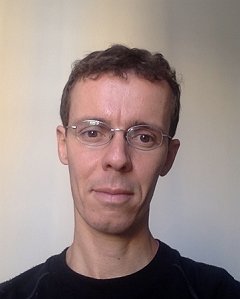
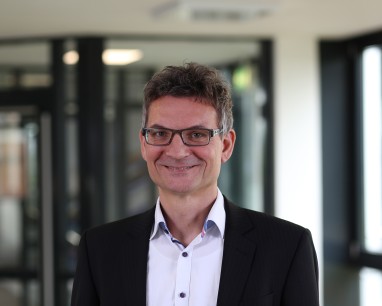
Prof. Ulrich Büker is a faculty member at TH OWL since 2022, leading the Intelligent Systems research group at inIT (Institute for Industrial Information Technology). He became deputy head of inIT in 2024 and Vice Dean of Department 5 in 2025. His work bridges academic research and industrial applications in intelligent systems. Education : Diploma in Computer Science (University of Paderborn), Doctorate and Habilitation in Electrical Engineering and Information Technology (University of Paderborn). Research Interests include: Application-oriented artificial intelligence for automation and mobility systems. Autonomous driving with focus on scenario generation and vision-based control. Computer vision for robotics and industrial applications. Embedded systems in battery electric vehicles. Article Trends demonstrate expertise in autonomous systems, computer vision, and industrial applications, spanning from foundational 2000s work on hybrid object models to recent LLM-driven autonomous driving scenario generation . Key sub-fields include neural networks, image processing, and vehicle energy management. Professional Contributions include: Industrial leadership roles at Aptiv , Delphi , and Hella . Membership in German Informatics Society (GI) and German Society for Pattern Recognition (DAGM) . Patents in image segmentation (DE000010250781, EP000001416441).
Sylvie Coste-Marquis is a Lecturer at the Institute of Technology of Lens, part of the University of Artois. Her research focuses on knowledge representation, argumentation frameworks, and computational logic, particularly in artificial intelligence applications. PhD in Computer Science (1994) from Henri Poincaré University of Nancy Co-supervised three PhD theses on argumentation systems, QBF, and speech recognition Administrative roles: Vice-President for Digital Affairs (2016-), Project Manager (2012-2016), and Head of IT Department (2010-2013) Her work explores abstract argumentation, belief revision, and quantified Boolean formulae, with recent contributions to enforcing extensions via optimization and translating argumentation frameworks. She actively participates in program committees for top-tier conferences like IJCAI and COMMA. She has contributed to ANR projects on multi-agent argumentation, configurable product recommendation, and preference handling in combinatorial domains. Her teaching includes modules on computer systems, object-oriented design, and AI, with recognized innovations in educational methods.
Ella Peltonen is an Assistant Professor at the M3S research unit, University of Oulu, Finland. She joined the Ubicomp Oulu research centre and 6Genesis research programme in November 2018. Prior to this position, she was a postdoctoral researcher at the Insight Centre for Data Analytics in Cork, Ireland. She completed her PhD in the Nodes group at the University of Helsinki, Finland, working on the Carat project of collaborative energy diagnostics for mobile devices. Her educational background includes: PhD in Computer Science, University of Helsinki, Finland (Carat project on collaborative energy diagnostics) Ella Peltonen's research focuses on ubiquitous computing, large-scale data analysis, and applied machine learning. Her work particularly emphasizes everyday sensing and mobile and wearable devices. She aims to apply machine learning algorithms to large, complex data in real-time systems, with a focus on distributed machine learning and data analysis of smart devices. Her research spans various applications including energy consumption monitoring of mobile devices, wearable technology for measuring physiological signals, and exploring future sensing technologies. Peltonen has expressed interest in how future devices might sense human states, become smarter, and provide greater benefits, potentially through innovations like augmented reality glasses or subcutaneous chips. Analysis of her recent publications shows a strong focus on edge computing, vehicular networks, and sustainable computing systems. Her work bridges the gap between theoretical machine learning approaches and practical applications in transportation, healthcare, and environmental monitoring. Many of her papers address challenges in distributed systems, real-time data processing, and privacy-preserving techniques for edge intelligence. Her notable scientific awards include: Nominated to the list of 10 Rising Stars in Networking and Communications by N2 Women 2017 Selected as one of 50 Finnish Researchers by the Finnish Union of University Researchers and Teachers Nokia Scholarship 2015 and 2016 Jorma Ollila Grant 2018 Young Teacher of the Year 2012 Young Researcher of the Year 2015 Peltonen is actively involved in teaching and mentoring, with a teaching philosophy focused on supporting students' independent learning rather than lecturing from above. She enjoys guiding small groups where she can discuss topics together with students and get to know them personally. As a researcher, she describes herself as precise, detail-oriented, and committed to verifying the correctness of her work carefully. She values the combination of mathematical work with experimental work and creativity in technology, noting that research tasks are diverse and can apply different types of methodology. She is part of international research collaborations with several major universities worldwide, as required by Finnish Academy funding. Peltonen is also an advocate for diversity in technology fields, noting that technology is used by all kinds of people from various backgrounds, yet the producers of technology lack diversity. She has highlighted the importance of encouraging more women to pursue technology careers from an early age.
António Ismael Freitas Vaz serves as Associate Professor with Habilitation at the School of Engineering, University of Minho, and holds a Senior Researcher position at the ALGORITMI Research Centre. As a core member of the SEOR (Systems Engineering and Operations Research) R&D Group, he directs research in mathematical optimization methodologies with applications spanning energy systems, additive manufacturing, and biomedical engineering. His institutional profile includes verified metrics: h-index 17, 1,505 citations, and 41 publications including 34 in Q1/Q2 journals. His research program centers on developing advanced optimization frameworks including multi-objective, derivative-free, and semi-infinite programming techniques. Key application domains feature renewable energy integration (demand-response co-optimization, cost-effectiveness analysis), 5-axis 3D printing (curved layer path planning, build orientation optimization), and medical diagnostics (automated tumor detection in wireless capsule endoscopy). Methodological innovations focus on particle swarm optimization, DC programming, and gradient descent complexity for complex constrained problems. Analysis of his 15 most recent publications (2018-2022) reveals three dominant research thrusts: energy systems optimization (33% of output), additive manufacturing (33%), and medical imaging (13%), with foundational optimization theory comprising the remainder. This distribution demonstrates strategic application of core methodologies to high-impact engineering challenges, particularly in sustainable energy transition and advanced manufacturing. The consistent publication in top-tier venues like Renewable and Sustainable Energy Reviews and Applied Energy underscores disciplinary influence. Scientific Awards: No specific awards, fellowships, or medals were documented in the provided profile information. Regarding academic advising, the source material contains no listings of PhD or Master's students supervised. The funding section explicitly indicates zero recorded projects ("Fundings (0)"), suggesting either institutional management of grants outside individual reporting or incomplete profile documentation. His h-index and publication volume imply significant research leadership despite absent grant details. As an integral contributor to the SEOR R&D Group at ALGORITMI, Vaz participates in a cross-disciplinary research ecosystem focused on operational research applications. The group maintains industry partnerships in energy, manufacturing, and healthcare sectors, facilitating translation of optimization algorithms into practical solutions for industrial partners and public administration through the Centre's thematic lines.
Alexandra Silva is a Professor of Computer Science at Cornell University with prior affiliations as a Royal Society Wolfson Fellow and Professor of Algebra, Semantics, and Computation at University College London . She leads a research group focusing on the modular development of specification languages and algorithms for models of computation, emphasizing coalgebra as a unifying mathematical framework. Research Interests Her work spans foundational and applied areas in theoretical computer science, including: Coalgebraic methods for formal verification Automata theory and learning algorithms Probabilistic programming and semantics Programming language design (e.g., NetKAT, Kleene Algebra with Tests) Concurrency theory and distributed systems Algebraic structures in computation Recent publications address network verification (StacKAT), symbolic automata learning, probabilistic regular expressions, and outcome logic for correctness/incorrectness reasoning. She is actively involved in organizing academic events like OPLSS 2025 and co-authoring foundational works in Formal Aspects of Computing and Theoretical Computer Science . Scientific Awards Distinguished Paper Award (ACM SIGPLAN POPL, 2020) Best Paper Award (RTA, 2015) She teaches courses on Kleene Algebra with Tests (KAT) and verification at summer schools like Marktoberdorf 2025 , and her research includes collaborations on probabilistic network verification (ProbNV) and stochastic system modeling.
Hristina Kostadinova is an Assistant Professor in the Department of Informatics at New Bulgarian University. She previously held positions as a Chief Assistant at NBU (2016-present) and Honorary Assistant roles at both NBU and American University in Bulgaria (2013-2015). Her educational background includes a PhD, Master's, and Bachelor's degree in Informatics from South-West University 'Neofit Rilski'. Her research focuses on three primary domains: E-learning systems : Development of adaptive courses, gamified training, and automated assessment tools Programming education : Innovative teaching methods for Java and other languages Educational technology : Implementation of Moodle-based solutions and conceptual mapping techniques Recent publications demonstrate strong emphasis on automated test generation, adaptive learning frameworks, and gamification in programming education for diverse audiences including children and vocational students. Her work consistently integrates pedagogical theories with technical implementations. No scientific awards are mentioned in available documentation. Current courses taught include Java programming and related technical subjects. No information is available regarding research grants, student advising, or laboratory affiliations.
Prof. Dr. Patric Eichelberger is a Professor and Head of the Bern Movement Lab at the Bern University of Applied Sciences, School of Health Professions, Department of Physiotherapy. He leads the Foot Biomechanics and Technology Research Group, focusing on quantitative assessment of human movement and biomechanics in injury prevention and rehabilitation. His work bridges clinical practice with technological innovation, particularly in foot biomechanics and orthopedic technology applications. Dr. Eichelberger's research interests center on movement biomechanics of the lower extremity, with special emphasis on foot biomechanics, movement analysis techniques, and biomechanics applications in injury prevention and rehabilitation. His work explores how current technologies can be applied to transfer objective assessment of movement biomechanics from laboratory settings into clinical routine. Specific areas of investigation include footwear and orthoses for running-related injuries, the relationship between running biomechanics and injury, and the development of innovative measurement techniques for dynamic postural stability. His recent publication trends show a strong focus on clinical biomechanics applications, with particular emphasis on ankle and foot biomechanics, movement analysis in injury contexts, and innovative measurement techniques. His work frequently appears in journals related to biomechanics, physiotherapy, orthopedics, and sports medicine, demonstrating interdisciplinary collaboration across these fields. The research consistently applies quantitative methods to address clinically relevant questions in movement science. Prof. Eichelberger actively supervises master's thesis projects through the Bern Movement Lab and teaches across multiple health profession programs. His teaching portfolio includes Quantitative Research Methods and Applied Statistics, Movement Biomechanics, Gait Analysis, and Biomechanical Models. He is also involved in the Center Health Technologies as Co-Head and serves on the Committee for 'Human Digital Transformation' at BFH. His laboratory infrastructure includes the Bern Movement Lab, Bern Mobility Centre, and Bern Pain & Stress Lab, which provide comprehensive facilities for biomechanical assessment, movement analysis, and clinical testing. Through partnerships with institutions like Ortho-Team AG, Praxisklinik Rennbahn AG, and Bern University Hospital, his research maintains strong clinical relevance while advancing methodological approaches in movement science.
Shachar Itzhaky is an Associate Professor in the Department of Computer Science at Technion - Israel Institute of Technology, Haifa. His research spans multiple areas of programming languages, formal methods, and software engineering, with a focus on making program development and verification more accessible and efficient. He has served on program committees for numerous prestigious conferences including PLDI, POPL, SPLASH, and ICFP. Dr. Itzhaky's research interests center around program synthesis, automated reasoning, and formal verification. His work in program synthesis explores techniques for automatically generating programs from high-level specifications, with applications in end-user programming and software development. In automated reasoning, he has made significant contributions to e-graph based reasoning, invariant inference, and property-directed verification. His research in formal methods focuses on practical applications for program verification, particularly for data structures and security properties. An analysis of his recent publications reveals a strong focus on leveraging advanced formal techniques for practical program understanding and generation. His work consistently bridges theoretical foundations with practical applications, particularly in program synthesis, verification, and end-user programming tools. The trend shows increasing integration of machine learning techniques with traditional formal methods, as well as expanding applications to security and privacy domains. ACM SIGPLAN John C. Reynolds Doctoral Dissertation Award Dr. Itzhaky has been actively involved in the programming languages research community, serving on numerous program committees and contributing to the advancement of formal methods and program synthesis. His work has practical implications for software development tools, security analysis, and end-user programming environments. While specific grant information isn't detailed in the provided text, his extensive publication record in top-tier venues suggests successful funding for his research endeavors. His work on projects like Object Spreadsheets and Lifty demonstrates a commitment to creating practical tools that address real-world programming challenges. Dr. Itzhaky's research is conducted within the vibrant programming languages and formal methods group at Technion's Computer Science department. His work intersects with multiple research threads including program synthesis, verification, and security, suggesting collaboration across these areas within the department. His tools like EPR-based Verification, PDR∀, and VeriCon represent significant technical contributions that likely form the basis of ongoing research projects with students and collaborators.
Laura Dietz is a tenured Associate Professor in the Department of Computer Science at the University of New Hampshire, where she leads the TREMA lab. Her academic journey began with a PhD from the Max Planck Institute for Informatics in Saarbruecken, Germany (2011), followed by postdoctoral positions at the University of Massachusetts Amherst (2010-2015) and University of Mannheim (2015-2016). Her educational background includes PhD studies at both the Max Planck Institute for Informatics (2007-2011) under Prof. Gerhard Weikum and Prof. Tobias Scheffer, and earlier research at Humboldt University in Berlin. She has built a distinguished career bridging theoretical computer science with practical applications in information retrieval and machine learning. Dietz's research primarily focuses on the intersection of information retrieval, natural language processing, and knowledge graphs, with a parallel research initiative in watershed data science. She is particularly known for her work on entity-aspect linking, complex answer retrieval, and the vision of automatic Wikipedia construction. Her approach integrates fine-grained knowledge annotations with text understanding to create comprehensive information systems that go beyond traditional 10-blue-links search paradigms. In watershed data science, she applies similar machine learning techniques to environmental data streams, focusing on solute transport analysis during storm events. Her recent publications reveal a strong trend toward fine-grained semantic understanding, particularly in entity-oriented search tasks. She has pioneered methods for entity-aspect linking that significantly improve retrieval accuracy by capturing different contexts in which entities appear. Her work increasingly integrates knowledge graphs with neural architectures, showing sophisticated understanding of how to leverage both structured and unstructured information for better search experiences. Best paper award at JCDL 2018 for work on entity-aspect linking NSF CAREER Award (2019-2023) for "Utilizing Fine-grained Knowledge Annotations in Text Understanding and Retrieval" OSSI Award 2013 from UMass ICB3 for open-source hardware/software Dietz actively mentors PhD and Masters students through the TREMA lab, with current research focusing on entity ranking, topic extraction, conversational search, and watershed forecasting. Her grant portfolio includes the NSF CAREER award and funding from the Northeast Big Data Innovation Hub for forecasting salinity in rivers during storm events. She has also coordinated the TREC Complex Answer Retrieval track (2017-2019), creating important benchmarks for the IR community. The TREMA lab (Text Retrieval, Entity Modeling, and Applications) serves as the hub for Dietz's research activities, bringing together students and collaborators to work on cutting-edge problems in information access. The lab's work spans both theoretical contributions to information retrieval and practical applications in domains ranging from environmental science to scientific publication analysis.
Fernando Magno Quintão Pereira is an Associate Professor at the Federal University of Minas Gerais (UFMG), Brazil, specializing in compiler design and program analysis. His academic journey began with a Ph.D. from UCLA in 2008 under Jens Palsberg's supervision, establishing his foundation in compiler research. His research focuses on compilers , with core expertise in code generation , compiler optimizations , and static program analyses . Recent work explores quantum compilation, binary analysis, and security-aware compilation techniques. His publications reveal consistent contributions to major conferences including PLDI, CGO, and SPLASH, with emphasis on practical optimization frameworks and theoretical compiler advancements. Analysis of his 15 most recent publications (2020-2026) shows dominant themes in binary optimization (e.g., AnghaBench), security-aware compilation (e.g., Memory-Safe Elimination of Side Channels), and emerging architecture support (e.g., Quantum Computing Compilation). His work bridges theoretical compiler principles with real-world systems challenges. He actively contributes to the academic community through: Program committees for PLDI (2020-2025), CGO (2021-2026), and SPLASH conferences Leadership roles including CGO Finance Chair (2026) and PLDI Diversity & Inclusion Co-Chair (2023-2024) Organizing JENSFEST 2024 and serving on multiple conference steering committees Pereira maintains an active research group evidenced by continuous publication output and conference leadership, with his personal website ( homepages.dcc.ufmg.br/~fernando/ ) serving as a hub for his academic activities.
Kate Tully is an Associate Professor at the University of Maryland in the Department of Plant Science and Landscape Architecture, affiliated with the College of Agriculture and Natural Resources. She leads the Agroecology Lab and co-founded the non-profit Farm the District in Washington, DC. PhD in Ecology, University of Virginia (2011) MS in Ecology, University of Virginia (2007) BA in English, Spanish, and Biology, Kenyon College (2004) Kate’s research focuses on the intersection of agriculture and ecology, particularly managing agroecosystems under climate change. Her work addresses sea-level rise and saltwater intrusion , climate-smart agricultural practices , cover crops for ecosystem services , and urban farming for food security . She investigates sustainable strategies in regions with limited land, water, and input access, such as East Africa and coastal zones. Her publications span salinization impacts , soil nutrient dynamics , cover crop modeling , and climate change adaptation . Notable collaborations include studies on coastal agricultural resilience and agroecosystem carbon cycling , funded by USDA, NSF, and other agencies. Research Impact Fellow (2024-2025) US Fulbright Scholar (2023-2024) Dean’s Grantsmanship Award (2021, 2024) Earth Institute Postdoctoral Fellowship (2011-2014) Kate co-developed a multi-university cover crops course and teaches Global Food Systems , Agroecology , and Independent Study in Agroecology . Her lab collaborates with farmers and interdisciplinary teams to test sustainable technologies in field settings.
Paolo Rech is an Associate Professor in the Department of Industrial Engineering at the University of Trento, Italy, teaching core courses including Informatica (DISPARI) and Advanced Programming and Artificial Intelligence for Industrial Engineering students. His research spans hardware-software reliability under radiation exposure with emphasis on real-world applications. His primary research domains feature: Reliability Engineering : Pioneering fault-tolerance methodologies for radiation-prone environments Radiation Effects : Quantifying neutron/gamma impacts on GPUs, TPUs, and quantum devices Computer Architecture : Designing hardened RISC-V systems and post-CMOS accelerators AI Reliability : Developing fault-aware neural networks for safety-critical deployment Quantum Vulnerability : Characterizing error mechanisms in quantum circuits Analysis of his 15 most recent publications reveals a dominant focus on radiation-hardened computing systems, with 83% of works addressing neutron-induced faults in GPUs/TPUs and quantum devices. His methodology consistently integrates neutron beam experiments, fault injection frameworks, and architectural hardening techniques across space, medical, and autonomous systems applications. Scientific Awards: None documented in available sources. His teaching directly feeds into research supervision, with course content on C++ programming, object-oriented design, and quantum computing foundations forming the basis for student projects in fault-tolerant system development. Current grants likely support neutron irradiation testing and quantum reliability initiatives given publication patterns, though specific funding details aren't publicly itemized. He operates within University of Trento's engineering research ecosystem, collaborating with teams specializing in radiation testing and quantum computing through projects like ARCHYTAS and Trikarenos, though no dedicated lab name is specified in source materials.
Dr. Thilini Bhagya serves as a Lecturer at Lincoln University's School of Landscape Architecture since 2025, affiliated with the Centre for Geospatial and Computing Technologies. Her academic foundation includes a PhD in Computer Science from Massey University and a BSc (Hons) in Computing and Information Systems from Sabaragamuwa University of Sri Lanka. Her educational background comprises: PhD in Computer Science, Massey University, New Zealand BSc (Hons) in Computing and Information Systems, Sabaragamuwa University of Sri Lanka, Sri Lanka Dr. Bhagya's research centers on Software Engineering and Machine Learning , with pioneering work integrating explainability into ML techniques for enhanced transparency in software development. She advances methodologies in Data Analytics and Information Systems , focusing on practical applications across domains. Her 8 publications (2014-2019) reveal a consistent focus on applying software engineering to legal informatics, particularly through collaboration modeling for court workflows and service-oriented computing. Key contributions include Sri Lankan context-specific legal frameworks, the reproducible GHTraffic dataset, and innovative lightweight web-service testing approaches. No scientific awards are documented in available records. She actively supervises Masters/PhD research and industry projects, offering long-term mentoring as indicated in her availability statement. Specific grant details remain undisclosed in source materials. Her institutional affiliation is limited to the Centre for Geospatial and Computing Technologies, with no additional labs or research teams specified.
Prof. Dr.-Ing. Steffen Helke serves as a full Professor in the Department of Electrical Engineering & Information Technology at University of Applied Sciences Südwestfalen. His academic roles include Senate membership, evaluation officer for the department, program coordinator for Media Informatics, and spokesperson for the GI Specialist Group Automotive Software Engineering. Current affiliations span committee work in electrical engineering bachelor programs and leadership in safety-critical software research. His research focuses on functional software security , safety-critical system verification , and model-based quality assurance . Key areas include information flow control languages, automotive software security, hierarchical statechart validation, and requirements delta analysis for efficient development estimation. Methodologies emphasize formal verification, static analysis, and tool-supported refactoring to ensure robustness in embedded systems. Teaching encompasses advanced courses in Software Engineering, IT Security, Ethical Hacking, and Competitive Programming. Thesis supervision occurs in research areas like NLP-based requirements analysis, refactorings for security languages (Jif), and model checking for Statecharts. Industrial collaborations facilitate project/bachelor theses with real-world security applications. Research trends from publications show consistent focus on bridging formal methods with industrial software development. Dominant disciplines include Software Engineering (72% of works) and Formal Verification (58%), with emerging subfields like NLP-assisted requirements engineering (2019) and automotive security frameworks. Keyword analysis reveals sustained emphasis on verification (100% of works), security (80%), and automotive applications (40%). Administrative contributions include leadership in the combined Electrical Engineering bachelor program and active participation in university governance through department councils. Tools developed in his research (e.g., Delta Analyzer, R2BC) are integrated into curricula using ReqView, Matlab/Simulink, and Enterprise Architect for systematic requirement engineering and UML modeling.
Yves Ledru is a Professor at UFR IM2AG of Université Grenoble Alpes (formerly Université Joseph Fourier), where he also serves as Deputy Director. He is a member of the Laboratoire d'Informatique de Grenoble (LIG) and heads the VASCO research team. Additionally, he serves on the bureau of the GDR GPL national research group of the CNRS. Professor Ledru's research focuses on Software Engineering and Formal Methods. His primary interests include Specification and Modeling, Software Architecture, Testing, and the application of formal specification languages such as JML, VDM, and Z Notation. His team has developed several tools including RoZ (for integrating UML and Z specifications), B4MSecure, Tobias (for combinatorial testing), and ParTraP. His recent research projects include ANR Philae (2018-2022), ANR MODMED (2015-2019), and NExTRegio project of IRT Railenium (2015-2019). Professor Ledru has been actively involved in the academic community, serving on program committees for numerous conferences including Crisis 2024, MEDI 2023, and RSSRail 2023. He was a member of the steering committee of the ASE conference from 1997 to 2013, serving as chair from 2001 to 2007. His publication record shows a consistent focus on bridging formal methods with practical software engineering applications, particularly in specification languages and testing methodologies. He has supervised twelve PhD students to completion and currently supervises Alexandre Monnier. His former administrative responsibilities include leading the ISLE research cluster of the Rhône-Alpes Region (2007-2011) and serving as scientific responsible for the ARC6: Technologies de l'Information et de la Communication (2011-2017).