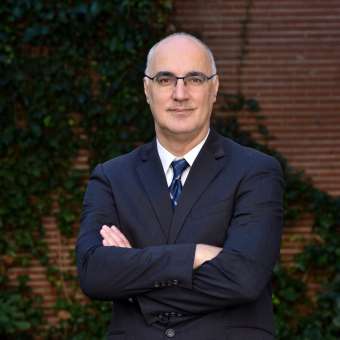
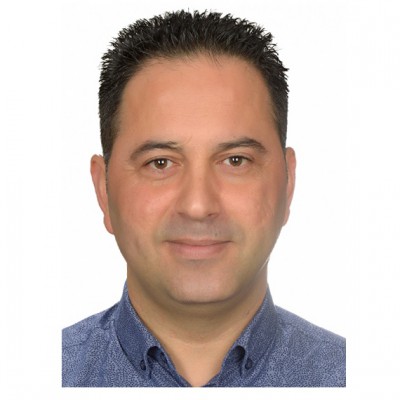
Professor Okan Topçu is a faculty member in the Department of Computer Engineering at Middle East Technical University, Northern Cyprus Campus (METU NCC), where he serves as Head of the Academic Board of Engineering and Natural Sciences. He holds a Ph.D. and M.S. from Middle East Technical University (Ankara, Turkey, 2007 and 1999 respectively). Education: Ph.D. & M.S. in Computer Engineering from METU Ankara Research Focus: Modeling and simulation, agent-based systems, distributed simulation, cybersecurity, and model-driven engineering
Professor Üner Çolak is affiliated with the Energy Institute at Istanbul Technical University, focusing on nuclear engineering, computational fluid dynamics, and renewable energy systems. His work spans reactor simulation, droplet dynamics, and energy optimization algorithms. Nuclear Reactor Engineering Computational Fluid Dynamics Renewable Energy Systems High-Temperature Reactors Droplet Dynamics Energy Optimization Algorithms Recent research includes validating AGREE HTR code with PROTEUS experiments (2025), developing pelican optimization algorithms for load dispatch (2024), and numerical studies on droplet interactions (2023). His projects address pebble-bed reactor dynamics, hydrogen technologies, and export-oriented localization strategies for nuclear plants. Scientific recognition includes the TÜBA TEÇEP Award (2015). Current projects involve pebble flow dynamics hydrogen production low-quality heat source utilization TRIGA reactor diffuser optimization
Prof. Dr. Tolga Ovatman is a faculty member at the Department of Computer Engineering, Istanbul Technical University , where he has been serving as Head of Department since 2024. His academic career spans roles from Research Assistant (2004-2012) to Associate Professor (2019-2023) and full Professor (2023-present). He previously held administrative roles such as Vice Dean (2018-2022) and Deputy Head of Department (2016-2018). PhD in Computer Engineering (2005-2011) MS in Computer Engineering (2003-2005) BSc from Hacettepe University (1999-2003) His research focuses on model checking , replicated state machines , cloud computing , and object-oriented software . Recent work addresses computation offloading in 6G networks , collaborative text editing data structures , and energy-efficient environmental monitoring systems . Key projects led include Design of a Multiplexed State Machine Storage System for Edge Computing (2022-2024) and Microservice Compatible Symphony Infrastructure Research (2020). He has supervised numerous theses on topics ranging from collaborative text editing to AI applications in watershed management . Publications span IEEE Transactions , Springer , and conferences like CSCE and CLOSER .
Prof. Dr. Raif Bayır is a Turkish academic at Karabük University's College of Engineering, Department of Mechatronics Engineering. With a career spanning 2000-2024, he has held continuous full-time faculty positions from Assistant Professor to Professor. His research focuses on Robotics, Hybrid/Electric Vehicles, and Artificial Intelligence. Doctorate: Gazi University (2005) - Electronics & Computer Education Postgraduate: Gazi University (1998) - Electronics & Computer Education Undergraduate: Gazi University (1995) - Electronics & Computer Education His work integrates Artificial Intelligence techniques into Electric Vehicle systems, Robotics, and Agricultural Engineering applications. Recent publications emphasize Deep Learning for Mask Detection, Real-Time Battery Monitoring, and Autonomous Navigation Systems. Scientific awards include: 2017 METU Line-Following Robot 1st Prize 2016 TÜBİTAK Domestic Product Award 2015 TÜBİTAK Electromobil Best Design Prize He has advised over 20 graduate theses on topics spanning Electric Vehicle Components, Beehive Monitoring Systems, and Intelligent Control Applications. His research teams have developed multiple TÜBİTAK-supported projects including Automotive Test Stands and Battery Management Systems.
Prof. Dr. Murat Hacıömeroğlu is a faculty member in the Department of Computer Engineering at Başkent University, primarily involved in the Artificial Intelligence Engineering Program . He holds a PhD in Computer Science from the University of East Anglia (2010), alongside a Master's (2006) and BSc (2002) in Computer Engineering from Başkent University. PhD: University of East Anglia, Computer Science (2010) MSc: Başkent University, Computer Engineering (2006) BSc: Başkent University, Computer Engineering (2002) His research and teaching focus on foundational and applied aspects of Computer Science , particularly Database Systems , Object-Oriented Programming , and Software Engineering . He contributes to the field of Artificial Intelligence Engineering through educational leadership and curriculum development. His academic work emphasizes Engineering Education and the theoretical underpinnings of modern computing systems. He teaches key courses such as Introduction to Computer Engineering , Object-Oriented Programming , and Database Systems , reflecting his expertise in core engineering disciplines and data management.
Prof. Dr. Mahmut Bayazıt is a Professor of Management Sciences at Özyeğin University's Faculty of Business Administration since September 2024, and Acting Director of the Graduate School of Business Administration since January 2025. Previously, he served at Sabancı University for 17 years and Koç University for 4 years. Bachelor's: Psychology, Boğaziçi University (1995) Master's: Industrial and Organizational Psychology, Baruch College (1998) PhD: Organizational Behavior, Cornell University (2003) His research focuses on leadership dynamics , gender disparities in management , work-family conflict mitigation , and strategic HRM systems . He explores how gender stereotypes influence leadership perceptions and the impact of flexible work arrangements on organizational outcomes. Recent publications show trends in gender-based leadership research , cross-cultural psychology , and work-family conflict . His work appears in journals like Journal of Applied Psychology , Asian Journal of Social Psychology , and Human Resource Management . 2005 Kanter Award for Excellence in Work-Family Research (Top 20 Finalist) Bayazıt's career includes visiting positions at Cornell University (2010-2011) and University of British Columbia (2016-2017). He has supervised numerous students and contributed to major handbooks in industrial-organizational psychology.
Ayşem Başar is an Assistant Professor at Yeditepe University Faculty of Architecture , Department of Industrial Design. With a PhD in Industrial Product Design from Istanbul Technical University (2013), a Master’s from Marmara University Institute of Fine Arts (2005), and an undergraduate degree in Industrial Design from Marmara University (1998), she specializes in sustainable design , design management , and cultural context in product development . Her work integrates repurposing , urban furniture sustainability , and Covid-19 design responses . Education PhD (2013): Istanbul Technical University, Institute of Sciences, Industrial Product Design Master’s (2005): Marmara University, Institute of Fine Arts, Industrial Product Design Undergraduate (1998): Marmara University, Faculty of Fine Arts, Industrial Product Design Her research focuses on design for sustainability , user-centered product development , and circular economy principles . She has led projects like "DHL Express Şehir İçi Elektrikli Kargo Aracı Tasarımı" (2023) and "Daima Taze (DAT) – Smart System Design for Temperature-Sensitive Products" (2021-2023). Her publications address environmental sustainability awareness and culture-oriented product development . Notable scientific awards include the IF Design Talent Award (2020) and Yeditepe University’s Academic Success Award (2014, 2015). She has advised master’s students like Melis (2022) and Ozan (2023) on topics ranging from bike rental systems to smart city mobility .
Bertan Badur is a Professor at Boğaziçi University, where he teaches courses such as MIS 132 - Object Oriented Programming , MIS 331 - Data Mining , and CSE 551 - Computational Methods . His research focuses on Data Mining, Agent-Based Modeling, and Machine Learning. Undergraduate: Boğaziçi University, Chemical Engineering M.A.: Boğaziçi University, Economics Ph.D.: Boğaziçi University, Economics His work spans interdisciplinary applications, including predictive analytics in e-commerce , game theory for market share dynamics , and agent-based simulations for migration and social behavior . He has contributed to fields like IT risk modeling , social media analysis for education , and IoT research trends . Recent publications highlight trends in deep learning for customer lifetime value prediction , Nash equilibrium in economic competition , and spatiotemporal crime risk modeling . His academic career bridges computational methods with socio-economic challenges.
Kerem Ciddi is an Assistant Professor in the Department of Industrial Engineering at Dumlupınar University in Kütahya, Turkey. He holds a PhD in Industrial Engineering from Gazi University and has held visiting academic roles at institutions such as Clausthal University of Technology (Germany), Rensselaer Polytechnic Institute (USA), and several universities across Europe. His research focuses on supply chain management, logistics optimization, and operations research with a particular emphasis on mathematical modeling and sustainability. Education: Bachelor of Industrial Engineering, Gazi University (1994–1998) Doctor of Industrial Engineering, Gazi University (2005–2011) Research Interests: Dr. Ciddi’s work integrates mathematical modeling, optimization techniques, and statistical analysis to address challenges in supply chain logistics, reverse logistics systems, energy efficiency, and decision-making under uncertainty. His areas include: Quantitative models for sustainable supply chain networks Multi-objective optimization in industrial systems Neural networks and regression analysis for energy systems Fuzzy logic applications in decision support systems Publications & Awards: He has contributed over 10 peer-reviewed articles and conference papers, including studies on neural network-based heat transfer modeling and TÜBİTAK-funded research on compressed air systems. His 2017 TÜBİTAK Postdoctoral Fellowship supported his work at Rensselaer Polytechnic Institute. Teaching & Service: He has taught courses in operations research, supply chain management, and mathematical modeling at both undergraduate and graduate levels. His professional affiliations include the Turkish Union of Chambers of Mechanical Engineers (TMMOB).
Prof. Dr. Murat Paşa Uysal is a distinguished academic at Başkent University's Management Information Systems Program. With a PhD in Educational Technology from Gazi University (2008) and advanced degrees in Computer Engineering and Operations Research, he specializes in Machine Learning, Enterprise Architecture, and Sustainable Development. His work bridges Software Engineering with Healthcare and Energy Management systems. Education: PhD (2008), Gazi University, Educational Technology (Computer and Educational Technologies Education) Master's Degree (2002), Çankaya University, Computer Engineering Associate Degree (2007 & 1999), US Army Logistics University & Ege University Bachelor's Degree (1991), Turkish Military Academy, Electrical and Electronics Engineering His research spans Machine Learning project management, Healthcare IT integration, and sustainable energy systems. Recent publications in Turkish Journal of Engineering (2025) and IEEE Engineering Management Review (2024) highlight his focus on methodological frameworks for AI-driven systems. Conference contributions at COMPSAC and ICIIIE further emphasize his leadership in multidisciplinary approaches. Projects and Leadership: Yürütücü, 2024: "Veri Tabanı Yönetim Sistemleri, Bilgisayar Programlama, Makine Öğrenmesi ve Proje Yönetimi Derslerinin Yeterliğe Dayalı Tasarım ve Değerlendirme Modelleri" Yürütücü, 2023: "Başkent Üniversitesi Ankara Hastanesi Yapay Zeka Uygulama Yol Haritası ve Kurumsal Mimarisi" International Experience: Includes affiliations with Rochester Institute of Technology (Postdoctoral, 2024) and US Army Logistics University (Pre-Doctoral, 2007). He has also taught courses in Python, Database Systems, and Artificial Intelligence.
Talip Tolga Sarı is a Research Assistant at the Department of Computer Engineering , Istanbul Technical University , where he has been affiliated since 2019. He holds a PhD in Computer Engineering (2021), a Master's in Computer Engineering (2018), and dual Bachelor's degrees in Computer Engineering and Electronics & Communication Engineering (2015). Education PhD in Computer Engineering, Istanbul Technical University (2021) Master's in Computer Engineering (2018) Bachelor's in Computer Engineering (2015) Bachelor's in Electronics & Communication Engineering (2015) Research interests span Computer Networks , Wireless Communication , and Unmanned Aerial Vehicles (UAVs) , with a focus on semantic communication , UWB localization , and topology control for resilient networks. His recent publications address UAV swarm coordination , smart campus frameworks , and assisted localization systems , reflecting interdisciplinary applications of computer science in real-world problems. Key trends in his 15 most recent articles include decentralized UAV networks, semantic communication architectures, and UWB-based indoor positioning. His work combines machine learning, cross-layer routing, and software-defined networking paradigms, with citations spanning Computer Science , Robotics , and Network Security . Awards : Highest Performance Award, Istanbul Technical University (2025)
Osman Darcan is an Associate Professor at Bogazici University in Istanbul, Turkey, with a verified institutional email osman.darcan@boun.edu.tr. His academic career spans over two decades with consistent research output in computational fields. Education Background: Undergraduate: Boğazici University, Computer Engineering Masters: Boğaziçi University, Computer Engineering Ph.D.: Boğaziçi University, Industrial Engineering His research focuses on practical applications of computational techniques across multiple domains. Darcan's work in Programming Techniques emphasizes object-oriented development frameworks and visualization tools for educational purposes. His Simulation research includes distributed systems and load balancing algorithms, while Artificial Intelligence applications target data mining for student profiling and e-commerce. The E-Learning strand features innovative tools for linear programming, geometric problem-solving, and programming education, demonstrating a strong commitment to pedagogical innovation through technology. Publication trends (2000-2012) reveal an evolution from foundational work in distributed simulation (2000-2006) toward applied data mining in education and e-commerce (2009-2012). His research consistently bridges theoretical computer science with practical educational and business applications, particularly in cluster analysis for student performance and agent-based modeling for market simulations. No scientific awards were documented in the source material. While specific advising records and grant details weren't provided, Darcan's publication pattern indicates supervision of students in data mining and simulation projects. His international conference presence (IBIMA, PICMET, World Conference on E-Learning) suggests active participation in global academic networks. The absence of lab/team mentions implies independent or small-group research operations focused on software tool development.
Sümeyye KAYNAK serves as an Assistant Professor in the Department of Computer Engineering at Sakarya University's Faculty of Computer and Information Sciences. Her academic profile demonstrates interdisciplinary expertise bridging computer science with environmental sustainability and educational technology through computational modeling and data-driven solutions. Her educational foundation includes: Doctorate (2019) from Sakarya University Institute of Science/Computer and Information Engineering with thesis on solar energy potential modeling using 3D data Master's degree (2014) from same institution focusing on AI-based student counseling infrastructure Bachelor's degree (2012) in Computer Engineering from Sakarya University Faculty of Engineering Dr. KAYNAK's research integrates advanced computational methodologies across multiple domains. Her primary focus areas include Artificial Intelligence applications for resource allocation in cloud manufacturing (utilizing genetic algorithms and AHP), Environmental Informatics for flood modeling and hydrological analysis, and Sustainable Energy systems through solar potential estimation tools. Recent work demonstrates significant expansion into geospatial web components for earth science agencies and digital twin frameworks for urban infrastructure resilience, reflecting growing emphasis on climate change adaptation technologies. Publication analysis from 2012-2025 reveals a clear research evolution: early work (2012-2018) concentrated on educational AI systems and solar energy tools, while current output (2023-2025) prioritizes environmental applications with city-scale flood impact modeling, hydroinformatics, and open data frameworks. This trajectory shows increasing sophistication in real-time data analytics and cross-domain integration, particularly between manufacturing systems and environmental monitoring. No scientific awards were documented in the source materials. Regarding academic mentoring, the available documentation contains no references to graduate student supervision or grant-funded research projects. No laboratory affiliations or research team leadership roles were specified in the provided information.
Assoc. Prof. Dr. Neslihan Zabcı is an Associate Professor of Clinical Psychology at Yeditepe University, Faculty of Arts and Sciences, Department of Psychology . She concurrently serves as Doctoral Lecturer in the Clinical Psychology Master’s Program, where she teaches advanced psychopathology, group supervision, and trauma psychology. Previously, she was Doctoral Lecturer at Maltepe University (2012) in the Department of Clinical Psychology. Education 2004–2011 PhD, Psychology – Istanbul University, Institute of Social Sciences (Dissertation: Impulsive functioning characteristics of children in the latency period and the contribution of projective tests ) 2000–2004 MA, Psychology – Istanbul University, Institute of Social Sciences (Thesis: Evaluation of personality traits of children with ADHD using the Rorschach Test ) 1989–1994 BA, Guidance & Psychological Counseling (English) – Boğaziçi University, Faculty of Education Research Interests Her scholarly work is anchored in clinical child and adolescent psychopathology , psychoanalytically-oriented psychotherapy , and projective assessment . She investigates the inner worlds of children and adolescents through Rorschach, TAT, CAT, Sceno-Test and Fairy-Tale Test , exploring themes such as ADHD, depression, trauma, narcissism, learning disabilities, obesity-related psychopathology, and the impact of parental containment functions . Cross-cultural validation of projective instruments and the interface between psychoanalysis and developmental psychopathology constitute additional foci. Publications & Scholarly Output Assoc. Prof. Zabcı has authored or co-authored 26 scientific books (including Latans Dönemi Projektif Testler , Psikanalitik Terapiler , and Çocukluk Çağı Travmasının Yansımaları ) and over 60 peer-reviewed articles . Recent works center on scale development (e.g., Child Depressive Symptoms Scale, Parental Containing Function Scale), normative studies for Turkish Rorschach samples across age groups, and pandemic-related child and teacher mental health . Scientific & Professional Memberships International Psychoanalytic Association (IPA) European Federation for Psychoanalytic Psychotherapy (EFPP) International Society of the Rorschach and Projective Methods (ISR) Réseau International de Recherche: Méthodes Projectives et Psychanalyse Founding member, Turkish Rorschach & Projective Tests Association (Board Member) Founding member, Istanbul Child & Adolescent Psychoanalytic Psychotherapy Association Teaching, Supervision & Thesis Advising At both undergraduate and graduate levels, she delivers courses on Child Psychopathology, Trauma Psychology, Family Systems, Advanced Psychopathology, Group Supervision and Dynamic Psychotherapies . She has supervised 15 master’s theses and 1 doctoral dissertation , covering topics such as selective mutism, sleep-training impacts on attachment, sexual abuse, and learning disabilities. She also conducts clinical group supervision in external counseling centers. Laboratories, Projects & Grants Assoc. Prof. Zabcı leads or co-investigates projects funded by Turkish Higher Education Institutions, including “Duygu Salıncağı” (a pilot intervention for incarcerated mothers with infants) and “Okuldayız Üsküdar” (community mental-health outreach). Her lab environment emphasizes projective test norming, psychodiagnostic tool development, and psychoanalytic case formulation .
Tuna Tuğcu is a Professor in the Department of Computer Engineering at Bogazici University's Faculty of Engineering. He also serves as Advisor to the Rector. He is a faculty member of the Computer Networks Research Lab (NetLab) and participates in the Telecommunications and Informatics Technologies Research Center (TETAM) at Kandilli Campus. His educational background includes a PhD in Computer Engineering from Bogazici University (2001), followed by a post-doctoral position at Georgia Institute of Technology's Broadband and Wireless Networking Lab (18 months), and a visiting professorship at Georgia Institute of Technology - Savannah Campus (2 years). Professor Tuğcu's research focuses primarily on wireless networks with emphasis on Cognitive Radio and 5G Networks, as well as Molecular Communications and NanoNetworking. His work spans both theoretical and practical aspects, including the development of emulators for molecular communication systems. His research group has created several educational tools including emulators for Communication via Diffusion, Calcium Signaling, Neuromuscular Junctions, and Protrusions. His publication record shows a clear progression from foundational work in Cognitive Radio Networks architecture to more recent work on Radio Environment Maps, social cognitive radio, and optimized sensor networks. The research demonstrates consistent focus on spectrum utilization challenges and innovative approaches to molecular-scale communications. Best Paper Award at The Sixth Advanced International Conference on Telecommunications (AICT) 2010 Professor Tuğcu has supervised numerous students who have contributed to research projects and developed educational emulators. He teaches courses including Introduction to Computing (CmpE150), Introduction to Object Oriented Programming (CmpE160), Operating Systems (CMPE322), Broadband Wireless Networks (CmpE567), and NanoNetworking (CMPE59G). His research group is actively seeking new members for projects on NanoNetworking, 5G/CloudRAN, and Next-Generation Private Industrial Communications Networks, including a joint TÜBİTAK-2244 project with SIEMENS.