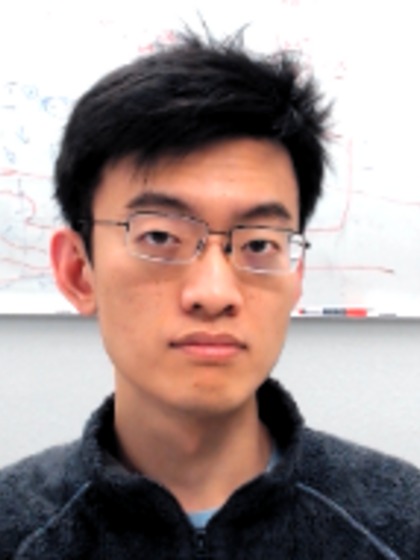
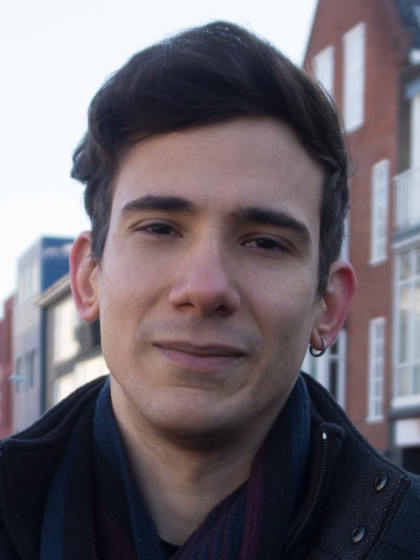
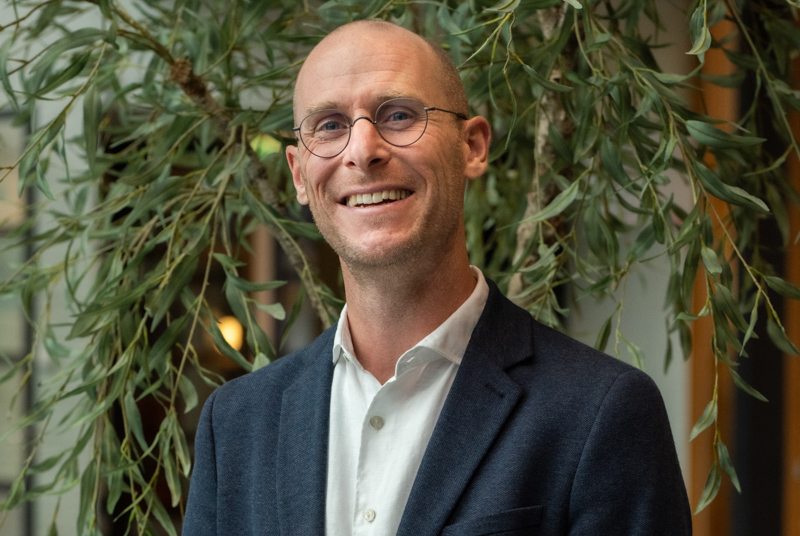
Kailai Li is a tenure-track Assistant Professor at the University of Groningen's Bernoulli Institute, where he leads the Agile Sensing and Intelligence Group (ASIG). His research develops novel methods for robotic perception, including continuous-time state estimation, sensor fusion, and visual navigation. Recent publications focus on Gaussian process representations for motion estimation and multi-robot collaboration using vision-language models. Dr. Li's lab maintains open-source projects like LiLi-OM (LiDAR-inertial odometry) and SFUISE (UWB-inertial fusion). Collaborations include Linköping University and industry partners. Current projects investigate trustworthy perception for autonomous systems under uncertainty and efficient representations for high-dimensional state estimation.
Atze van der Ploeg is an Assistant Professor at the Vrije Universiteit Amsterdam's Faculty of Science, within the Theoretical Computer Science department. He is also affiliated with the Network Institute. His research focuses on interdisciplinary topics at the intersection of computer science and computational biology, with expertise in algorithm design, bioinformatics tools, and programming languages. He holds an MSc and a PhD, though specific academic details about his degrees are not provided in the text. His teaching responsibilities include courses such as Introduction to Programming (PYTHON), Object-Oriented and Functional Programming, and Systems Programming Project. These courses reflect his commitment to foundational programming skills and advanced software development practices. Key research interests include developing tools for bioinformatics (e.g., the PRALINE alignment toolkit), functional reactive programming, and visualization systems. His work emphasizes practical, principled approaches to solving complex computational problems. Though no specific grants or awards are listed, his publications span topics like type-safe dynamic typing, modular language implementation, and algorithm optimization, showcasing contributions to both theoretical and applied computer science.
Luiz Bonino is an Associate Professor at Leiden University Medical Center and an International Technology Advisor at GO FAIR International Support and Coordination Office. He holds a PhD in Computer Science from the University of Twente (2011), specializing in semantic service provisioning. His research focuses on ontology engineering, semantic interoperability, and FAIR data principles, with applications in healthcare and distributed data systems. Key research interests include ontology development, cybersecurity in data systems, service-oriented computing, and the implementation of FAIR (Findable, Accessible, Interoperable, Reusable) principles across domains. He contributes to initiatives like the Personal Health Train architecture and the FAIR Data Point framework, emphasizing distributed data platforms and metadata standards. Recent publications highlight work on large language models for ontology creation, interoperability challenges in healthcare data, and methodological frameworks for FAIRification. Bonino has organized conferences like the 2024 FOIS workshop and contributed to datasets such as the FAIRDataTeam/FAIRDataPoint project. He actively promotes FAIR principles through workshops and collaborative projects.
Vinod Nigade is a Visiting Professor in the Department of Computer Science at Vrije Universiteit Amsterdam (VU). His research focuses on edge computing, deep learning systems, and network security. He holds a PhD in Computer Science from VU, defended in 2023 with his thesis Latency-Critical Inference Serving for Deep Learning . Key research areas include: Dynamic edge networks and latency-optimized inference systems IoT communication protocols and battery-free device synchronization Neural intrusion detection in programmable networks Distributed deep learning architectures Collaborations span academia-industry projects involving real-time systems, network programmability, and cybersecurity. His work addresses challenges in timely video analytics, service-level objectives in edge computing, and scalable exploit detection in distributed environments. Publications emphasize practical solutions for latency-critical applications, with contributions to ACM, IEEE, and other top venues. Current research trends include accelerating IoT discovery protocols and enhancing network security through AI-driven systems.
Bouali is a Lecturer in Computer Science at the University of Twente, affiliated with the Datamanagement & Biometrics (DMB) research group. They contribute to the bachelor programs of Technical Computer Science (TCS), Business Information Technology (BIT), and CreaTe, as well as the master program in Computer Science. Bouali's research focuses on Natural Language Processing (NLP) and semantic parsing, with expertise spanning Artificial Intelligence, User-Centered Design, Object-Oriented Programming, Usability Evaluation, and Virtual Reality. Teaching: Courses in TCS, BIT, CreaTe, and Computer Science master programs. Affiliation: Faculty of Electrical Engineering, Mathematics and Computer Science (EEMCS), Computer Science (EEMCS-CS), DMB group. Their work integrates Artificial Intelligence and Usability Evaluation, emphasizing practical applications in education and software design. Contact details include the email address n.bouali@utwente.nl and availability via Microsoft Teams.
Marcello Bonsangue is a full Professor of Systems Modelling and Analysis at the Leiden Institute of Advanced Computer Science (LIACS), Leiden University. He holds additional roles as Scientific Director of LIACS, coordinator for international students, and member of the LIACS management team and Scientific Council. His research focuses on formal methods, coalgebra, automata theory, and program semantics. He has led numerous EU-funded projects including ECoPro (2014-2018) and CoRE (2010-2015). Education: BSc from University of Milano, PhD from Free University of Amsterdam (1996). Memberships include IFIP WG 1.3, IEEE Benelux Embedded Systems Chapter, and editorial roles for journals like Frontiers in ICT and Open Computer Science. He advises multiple PhD candidates and collaborates with institutions like CWI Amsterdam and East China Normal University.
Daniel Feitosa is an Assistant Professor in the Faculty of Science and Engineering at the University of Groningen, affiliated with the Software Engineering and Architecture (SEARCH) group led by Prof. Paris Avgeriou. His research focuses on software quality, technical debt management, automation in software projects, and energy efficiency in AI/ML systems. He holds a Ph.D. in Computer Science from the University of Groningen and has extensive experience in both academia and industry. Research Interests: Automation of software processes and technical debt management Source code analysis and mining software repositories Energy efficiency in AI/ML applications Software architecture and design patterns Teaching Roles: He coordinates and teaches courses such as Software Architecture , Advanced Object-Oriented Programming , and Algorithmic Programming Contests at both BSc and MSc levels. Awards: Distinguished Paper Award at the 2nd International Conference on AI Engineering (CAIN 2023) Service & Engagement: He serves on the boards of the Dutch National Association for Software Engineering (VERSEN) and the Steering Committee of the European Conference on Software Architecture (ECSA). He has organized workshops and tracks at major conferences like TechDebt, SEAA, and SANER.
Pascal van Gastel serves as a Lecturer in the Computer Science program at Avans University of Applied Sciences in Breda and as a researcher within the Applied Responsible Artificial Intelligence group at the Centre of Expertise Perspective in Health. He is currently preparing a PhD program focused on data privacy initiatives. His educational background includes: Advanced Computer Science program at West Brabant University of Applied Sciences (completed late 1990s) Master's degree in Software Engineering from the Open University (2018) Van Gastel's research spans software engineering processes, object-oriented programming, and software system design, with additional expertise in databases, software security, and data privacy. His current work centers on anonymizing datasets using domain characteristics and data models through the data washing machine project, reflecting interdisciplinary applications in healthcare technology. No scientific awards were documented in the source material. He has held significant institutional roles including curriculum committee member and team development coordinator at Avans University. While actively developing a PhD program in data privacy, specific grant funding or student advising details remain undisclosed. His primary research affiliation is with the Applied Responsible Artificial Intelligence group under the Centre of Expertise Perspective in Health, where he integrates practical software engineering with ethical AI development.
Dr. Gang Mei is an Associate Professor in Scientific Computing within the School of Engineering and Technology at China University of Geosciences (Beijing), where he has held academic positions since 2014. His career progression includes Postdoctoral Researcher (2014-2016), Lecturer (Oct-Dec 2016), and current Associate Professor (since Jan 2017). His research bridges computational science and engineering applications with significant editorial contributions to computer science literature. Education: Ph.D. in Computer Science, University of Freiburg, Germany (2014) Research Interests: Dr. Mei specializes in Numerical Simulation and Computational Modeling, GPU Computing, Machine Learning, and Data Mining, with strong applications in Network Science and Spatial Information Systems. His work integrates Distributed and Parallel Computing techniques for large-scale scientific simulations, particularly in geospatial modeling and network analysis. The research demonstrates consistent focus on computational efficiency through hardware acceleration and algorithmic optimization across diverse domains including satellite imagery processing, financial event detection, and medical image classification. Publication Trends: His editorial portfolio reveals strong interdisciplinary patterns connecting computer science fundamentals with domain-specific applications. Recent works emphasize GPU-accelerated methods for data-intensive problems (2020-2022), spatial-temporal modeling (2019-2020), and network science applications (2021). The publications consistently address computational scalability challenges while maintaining practical relevance across geospatial, financial, medical, and engineering contexts. Professional Recognition: As an IEEE Member, Dr. Mei serves on editorial boards for IEEE Access and PeerJ Computer Science, reflecting peer recognition in computational fields. His editorial contributions span 15+ publications demonstrating expertise in evaluating cutting-edge computer science research. Academic Service: Beyond editorial work, Dr. Mei's service includes advising on computational methodology across multiple disciplines. His role as Academic Editor demonstrates commitment to scholarly communication, particularly in bridging theoretical computer science with practical engineering applications. No grant funding details were specified in available materials.