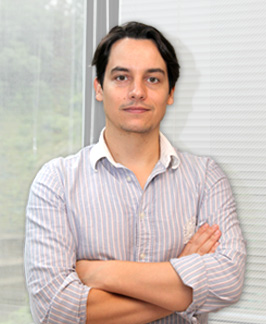
Dr. Bruno C.d.S. Oliveira is an Associate Professor at the University of Hong Kong's School of Computing and Data Science (SCDS), Department of Computer Science. He holds a DPhil from the University of Oxford (2008). Prior to his current position since 2013, he served as Research Professor at Seoul National University (2009-2011) and Senior Research Fellow at the National University of Singapore (until 2013). His research interests focus on Programming Languages , Modularity , Functional Programming , and Object-Oriented Programming . His work emphasizes foundational aspects like type systems, language design, and extensibility mechanisms. Notable articles include studies on type class implementations, functional graph programming, and meta-theoretical frameworks for programming language constructs. His research has been published in top venues such as POPL, PLDI, ECOOP, and ICFP. No scientific awards are explicitly mentioned in the provided text. Advising records and grant details are not listed, though his academic homepage at http://www.cs.hku.hk/~bruno may contain additional information.
Jens Palsberg is a Professor and former Department Chair of Computer Science at the University of California, Los Angeles (UCLA), where he currently serves as Director of the UCLA-Amazon Science Hub for Humanity and Artificial Intelligence and co-director of UCLA's quantum research center. He chairs ACM SIGPLAN and is a member of the ACM Council. His research spans programming languages, software engineering, quantum computing, compilers, embedded systems, and information security. Palsberg has authored over 80 technical papers, co-authored the book Object-Oriented Type Systems , and revised Appel's textbook on Modern Compiler Implementation in Java . His recent work shows a significant shift toward quantum computing, including compiler techniques and program analysis for quantum systems. Analysis of his recent publications reveals a clear transition from traditional programming language research to quantum computing, with nearly half of his 2022-2024 publications focusing on quantum topics while maintaining strong work in software engineering and programming languages. His quantum research particularly emphasizes compiler optimization, abstract interpretation, and circuit analysis. ACM SIGPLAN Distinguished Service Award (2012) UCLA teaching award for quantum computing courses (2023) National Science Foundation CAREER and ITR awards Purdue University Faculty Scholar award IBM Faculty Award Okawa Foundation research award Palsberg has served in numerous leadership roles including general chair of POPL, conference chair of LICS, and vice chair of ACM SIGBED. His research has been supported by DARPA, Intel, British Telecom, and the National Science Foundation. He was instrumental in establishing UCLA's Masters degree in quantum science and has mentored numerous students through his legendary proof sessions. He leads a research group of over 30 professors in UCLA's quantum research center and maintains active collaborations across academia and industry, particularly with Amazon through the UCLA-Amazon Science Hub.
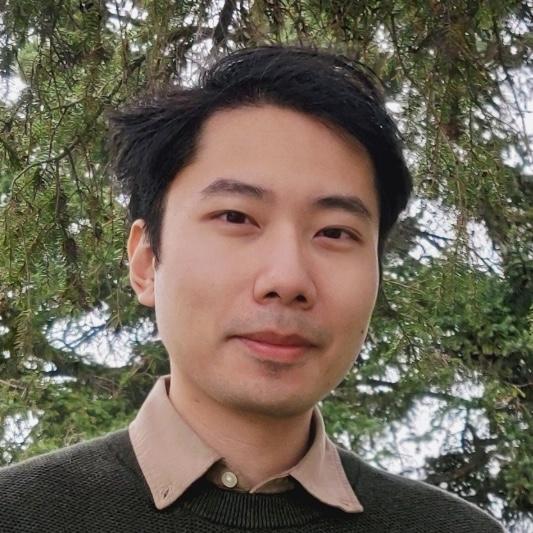
Henry Tang is an ATS Assistant Lecturer at the University of Alberta, affiliated with the Faculty of Science and Department of Computing Science. He specializes in software development education and foundational computing concepts. Courses Taught: CMPUT 174B (Introduction to the Foundations of Computation I), CMPUT 201 (Practical Programming Methodology), CMPUT 301 (Introduction to Software Engineering) His research interests focus on software engineering practices, including object-oriented design, Unix programming tools, C language methodology, and abstract data type implementations. Course descriptions highlight his expertise in software architecture, design patterns, and practical programming education. Contact: Email hktang@ualberta.ca for academic inquiries.
Prof. Dr. Zeki Bayram is a full Professor and current Chairman of the Computer Engineering Department at Eastern Mediterranean University (EMU). He has served as the founding chairman of the Internet Technologies Research Center (2006) and chaired the departmental ABET committee from 2010 to 2023. His academic contributions span semantic web services, mobile payment systems, and XML-based technologies. Founded Cybersoft Bilişim Teknolojileri Limited, a dormant software company in North Cyprus Active in academic service, including thesis supervision and editorial roles Teaches courses on programming languages, automata theory, and software tools Research focuses on semantic web service composition, secure payment schemes, and declarative programming paradigms. His work integrates logic programming, constraint solving, and ontology engineering. Prof. Bayram has published extensively in journals and conferences since the 1990s, with notable contributions to formal methods in service-oriented architectures.
Nuno Pereira Lopes is an Associate Professor at Instituto Superior Técnico , part of Universidade de Lisboa , and a researcher at INESC-ID . He also serves as an advisor at FuriosaAI , focusing on tensor contraction processors for AI workloads. Research Interests : Compilers, formal verification of LLVM optimizations, machine learning frameworks, undefined behavior exploitation, probabilistic model checking, blockchain security, and many-core code generation. Teaching : Compilers and Computer/Informatics Engineering projects. Funding : Supported by Google, Matter Labs, NLnet, Oracle, PRACE, RNCA, and Woven by Toyota. Recent Publications focus on LLVM backend validation , PyTorch pipeline parallelism , C++ dynamic cast optimization , undefined behavior in C/C++ , and AI tensor processors . His work bridges compiler design, formal methods, and AI hardware. Academic Service includes representing Portugal in ISO/IEC JTC 1/SC 22 (C++), organizing FLoC'26 , and serving on program committees for PLDI, EuroLLVM, and CGO.
Dr. Judith Riegert is a Research Associate at the Humboldt University of Berlin, Faculty of Humanities, Social Sciences, and Education, working at the Institute of Rehabilitation Sciences in the Department of Education for People with Intellectual Disabilities. She has been in this position since October 2016, with previous experience as Research Associate and Program Coordinator at the same institution. Her academic journey includes serving as Deputy Professor at Leibniz University Hannover (2016-2018) and as a Visiting Professor at Humboldt University (2019). 1997-2002: Studies at Justus Liebig University of Giessen and Heidelberg University of Education 2003-2004: Traineeship at Seminar for Didactics and Teacher Training Heidelberg 2004-2006: Special education teacher at Carl Orff Special School 2012: Completed doctorate (Dr. phil.) at Humboldt University Dr. Riegert's research focuses on educational theory questions in intellectual disability contexts, trans- and intermediality in inclusive literature teaching, pedagogical professionalization for inclusive subject teaching, and participation of adults with severe disabilities. Her work bridges theoretical frameworks with practical classroom applications, examining how to create meaningful learning experiences across subject areas while maintaining academic rigor. She investigates the tension between educational standards and individualized instruction, particularly in German, history, and mathematics education. Her recent publications demonstrate a strong focus on participation frameworks for people with severe disabilities, inclusive teaching methodologies across subject areas, and the development of pedagogical approaches that bridge educational theory and classroom practice. Her work consistently addresses the challenge of maintaining subject integrity while adapting instruction to diverse learning needs. November 5, 2014: Prize for Good Teaching 2014 from Humboldt University's Faculty of Humanities, Social Sciences and Education February 16, 2016: Honorary certificate from Polytechnische Gesellschaft Foundation for the 'Animals in Numbers' project Dr. Riegert provides academic advising for special education and primary school teaching students (surnames He to Z), supervises bachelor's and master's theses, and offers consultation hours both in person and via Zoom. Her advising focuses on supporting students in the M.Ed. program, particularly addressing application concerns and transcript issues. As a member of the German Society for Educational Science (DGfE), she contributes to research teams examining inclusive education methodologies and implementation of inclusive practices across educational settings.
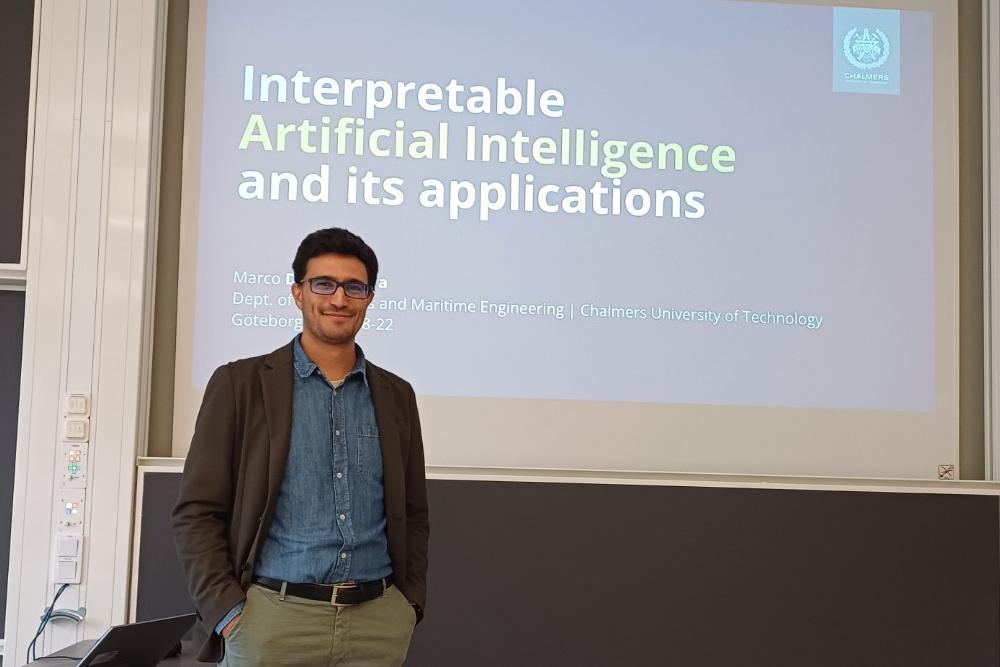
Marco L. Della Vedova is a Senior Lecturer in Applied Artificial Intelligence at Chalmers University of Technology, Sweden. He works in the Vehicle Engineering and Autonomous Systems division within the Department of Mechanics and Maritime Sciences, as part of Prof. Mattias Wahde's research group. Since 2025, he has served as Director of the Data Science and AI master's programme (MPDSC) at Chalmers, where he teaches courses including Introduction to Artificial Intelligence and Digitalization in Sports. Dr. Della Vedova earned his academic foundation at the University of Pavia, Italy, where he completed his BSc (2006), MSc (2009), and PhD (2013) in Computer Engineering. His doctoral research focused on "Real-Time Physical Systems and Electric Load Scheduling" under Prof. Tullio Facchinetti. During his PhD studies, he spent a year at U.C. Berkeley hosted by Prof. Francesco Borrelli at the Model Based Predictive and Distributed Control Lab. His research spans multiple AI domains with a strong emphasis on interpretability. Dr. Della Vedova develops interpretable methods for conversational AI, naturalness evaluation of forests using canopy height models, and geospatial applications. His work bridges theoretical AI with practical societal benefits, particularly in environmental monitoring, transportation systems, and orienteering. He has previously contributed to cloud computing, hate speech detection, and cyber-physical energy systems, demonstrating his interdisciplinary approach to AI research. Dr. Della Vedova's publication record reveals a consistent trajectory of impactful research across multiple domains of artificial intelligence. His recent work shows a strong focus on interpretability in AI systems, with significant contributions to natural language processing, geospatial analysis, and causal inference. The research demonstrates both theoretical depth and practical applications, particularly in environmental monitoring and social media analysis. His methodology often combines traditional machine learning approaches with novel interpretability techniques, creating bridges between complex AI systems and human understanding. Dr. Della Vedova has received several prestigious recognitions for his work: Best PhD thesis award from the Order of the Engineers of Bergamo (2013) Italian champion of Il Cervellone (2012) Top Italian performer in IEEEXtreme 6.0 programming competition (148th overall globally, 2012) Premio Arturo Schena award from Fondazione Credito Valtellinese (2010) With over 50 students supervised through bachelor's and master's theses, Dr. Della Vedova has established himself as a dedicated mentor in the AI community. His current PhD students include Minerva Suvanto working on interpretable NLP and Vivien Lacorre developing AI for railway infrastructure inspection. His supervision spans diverse topics from forest naturalness evaluation to hate speech detection and transportation optimization. Beyond formal supervision, he actively contributes to educational initiatives including serving as Director of Chalmers' Data Science and AI master's program and developing innovative teaching methods that connect theoretical concepts with real-world applications. Dr. Della Vedova is deeply embedded in both academic and professional communities. He leads the Applied Artificial Intelligence research group at Chalmers while maintaining strong connections with European research networks through projects like the ERASMUS+ EUrienteering initiative. His interdisciplinary approach is reflected in collaborations across computer science, environmental science, and social sciences. Notably, he applies his AI expertise to orienteering both as a researcher developing localization methods and as a licensed Event Advisor for the International Orienteering Federation, demonstrating how his professional and personal interests converge in innovative ways.
Raffi Khatchadourian is an Associate Professor in the Department of Computer Science at Hunter College and the Graduate Center of the City University of New York (CUNY). His research focuses on techniques for automated software evolution, particularly automated refactoring and source code recommendation systems, with the goal of easing the burden associated with evolving large and complex software through automated tools. He also conducts research on the automated analysis of Object-Oriented programs. Ph.D., Computer Science & Engineering, Ohio State University (2011) MS, Computer Science & Engineering, Ohio State University (2010) BS, Computer Science, Monmouth University (2004) Khatchadourian's research spans multiple areas of software engineering and programming languages, with particular emphasis on automated software evolution techniques. His work addresses critical challenges in refactoring legacy systems to modern language constructs, optimizing parallel processing in Java 8 streams, and addressing technical debt in machine learning systems. His recent research has expanded into deep learning program transformation, where he develops techniques to convert imperative deep learning code to more efficient graph execution models while ensuring safety. His approach combines static analysis, program transformation, and empirical validation to create practical tools that developers can integrate into their workflows. Analysis of Khatchadourian's recent publications reveals a strong focus on bridging the gap between theoretical program analysis and practical software engineering challenges. His work increasingly intersects with machine learning systems, examining both how to improve ML code through refactoring and how to ensure safety in deep learning frameworks. The research demonstrates consistent evolution from foundational work on Java language features toward more complex systems involving concurrency, deep learning, and automated program transformation. Distinguished Paper Award at SCAM '18 for work on Java 8 stream optimization EAPLS Best Paper Award at FASE '20 for study on Java 8 stream usage EAPLS Distinguished Paper Award at FASE '25 for Deep Learning refactoring work Best Paper Award nominee at IJCAI '24 for AI safety framework Khatchadourian actively mentors graduate and undergraduate students, with several advisees going on to successful academic and industry positions. His former Ph.D. student Tatiana Castro Vélez accepted a tenure-track Assistant Professor position at the University of Puerto Rico. He has supervised numerous master's theses and undergraduate research projects, often resulting in co-authored publications at top software engineering venues. His research has been supported by various grants, though specific funding details are not prominently featured in the available information. Through his work on tools like Fraglight for aspect-oriented programming and Hybridize Functions for deep learning refactoring, Khatchadourian has established a research group focused on practical program analysis and transformation. His lab develops Eclipse plugins and other IDE-integrated tools that help developers with automated refactoring, bug detection, and code optimization. The group maintains active collaborations with researchers at other institutions and contributes to open-source projects on GitHub.
Pat Barrow is a Senior Lecturer in Business Information Systems at Norwich Business School, University of East Anglia. He holds a PhD (2000) and MA (2007) from UEA, alongside a BSc (1993). His academic background focuses on stakeholder evaluation in Rapid Application Development and organizational aspects of Information Systems. Though he transitioned to a non-research role in 2000, his past research explored requirements engineering, UML formalisms, and systems evaluation in Saudi Arabian private organizations. He teaches extensively across undergraduate and postgraduate levels, including MBA programs. Education: BSc (1993), PhD (2000), MA (2007) from University of East Anglia Research interests include IS design, supply chain digitalization, and human-centric IS challenges. Though not currently publishing, his prior work addressed system evaluation methodologies and software development patterns. He has coordinated administrative roles such as Senior Advisor for Postgraduate Students (2023–) and Workload Allocation Model coordinator (until 2021).
Olaf Kramer is a Professor of Rhetoric and Knowledge Communication at the Department of General Rhetoric, Faculty of Humanities, University of Tübingen. He leads the Presentation Skills Research Center and serves as Managing Director of the Research Center for Science Communication (RCS). Since 2021, he has been the spokesperson for the RHET AI Center, focusing on artificial intelligence in science communication. Kramer is also a key editor of Science Notes magazine and the neue rhetorik / new rhetoric book series. Professor, Department of General Rhetoric, University of Tübingen Head, Presentation Skills Research Center Managing Director, Research Center for Science Communication (RCS) Spokesperson, RHET AI Center Editor, Science Notes and neue rhetorik series Education: Studied General Rhetoric, German Literature, Philosophy, and Psychology in Tübingen, Frankfurt (with Jürgen Habermas), and Chapel Hill, USA (with Lawrence Grossberg) Ph.D. (2008): Rhetoric in Goethe Habilitation (2015): Virtual Reality, with teaching authorization in General Rhetoric and German Literary Studies Olaf Kramer's research centers on science communication , communicative competence , political communication , digital rhetoric , and virtuality . His work bridges classical rhetorical theory with contemporary media and public discourse, particularly in scientific and political contexts. He investigates how knowledge is recontextualized in public communication and how digital platforms reshape rhetorical practices. The recent publications reflect a strong trend in interdisciplinary rhetoric , combining insights from law, theology, education, and digital media. His work explores the rhetorical dimensions of judicial decisions, science slams, social media, and AI, emphasizing the role of narrative, visual design, and audience engagement in shaping public understanding. The integration of virtuality and digital navigation into rhetorical theory highlights his innovative approach to modern communication challenges. Scientific Awards: No specific awards are mentioned in the provided text. Kramer actively supervises a large cohort of students and researchers, many of whom have collaborated on publications and projects. He has secured third-party funding for major initiatives like the Presentation Skills Research Center. His advisory and leadership roles extend to university governance, public engagement, and professional consulting for organizations such as the Max Planck Society and the German Foreign Office. He is deeply involved in public science communication through the Science-Notes lecture series, which he founded and moderates, and through media appearances on ZDF/3sat and RTL. His work also includes designing and leading rhetorical training programs for academic, corporate, and governmental clients, demonstrating a strong commitment to translating academic knowledge into practical applications.
Yvo Desmedt is the Jonsson Distinguished Professor in Computer Science at the University of Texas at Dallas and Director of the Cyber Security Research and Education Institute. An IACR Fellow and member of the Belgium Academy of Science, he invented e-Passports and e-Visas in 1988. His research spans cryptography, quantum computing, network security, and critical infrastructure protection. Desmedt pioneered techniques in binary software hardening including control-flow integrity and object flow integrity protections. Recent innovations include crook-sourcing for intrusion detection improvement and confidential computing for deep learning inference. His work bridges theoretical cryptography with practical security applications, earning recognition including the NSF IUCRC Technology Breakthrough Award. With over 200 publications, he has chaired major conferences including Crypto and Public Key Cryptography. Current projects examine vulnerability detection using graph learning and renewable control-flow integrity mechanisms for software security.
Tse-Hsun (Peter) Chen is an Associate Professor in the Department of Computer Science and Software Engineering at Concordia University, Montreal. He leads the Software PErformance, Analysis, and Reliability (SPEAR) lab, focusing on improving software quality through log analysis, AIOps, and mining software repositories. His research collaborates with companies like Microsoft, BlackBerry, and Ericsson. Education: PhD, MSc, and BSc in Computer Science from Queen's University and the University of British Columbia. Awards include the Gina Cody Research Award (2021) and recognition as one of the world's most active software engineering researchers (JSS study). Research interests include software testing, DevOps, and leveraging LLMs for SE tasks. Recent work emphasizes log parsing with LLMs (e.g., LibreLog) and fault localization. Graduates from his lab hold academic positions at institutions like York University and DePaul University. Teaching includes courses on software verification, testing, and process management. Active in program committees for ICSE, FSE, and MSR. Over 50 publications in top venues like TSE, ICSE, and FSE.
Yann-Gaël Guéhéneuc is a Professor at Concordia University's Department of Computer Science and Software Engineering. He leads the Ptidej Team, focusing on software engineering methodologies, IoT systems, and game engine architecture analysis. His research emphasizes static/dynamic analyses, service-oriented architectures, and machine learning design patterns. Current Affiliations: Concordia University (Full-time Professor) Ptidiej Team Lead Research Interests: Specializes in IoT system testing, microservices architecture, game engine design patterns, and anti-pattern detection in multi-language systems. His work bridges theoretical software engineering principles with practical industrial applications, particularly in legacy system modernization and machine learning system design. Recent Trends in Publications: Focuses on IoT testing methodologies, machine learning architecture patterns, and service-oriented system transformations. His 2025 works advance IoT system taxonomy and game engine analysis techniques. Advising: Supervises MASc and PhD programs in Software Engineering and Computer Science Labs/Teams: Ptidej Team develops software tools for system analysis (e.g., Magnet, SyDRA)
Robert 'Corky' Cartwright is a Professor of Computer Science at Rice University, specializing in programming languages and software engineering. His research focuses on parallel programming extensions for Java/Scala/Swift, smart programming environments for error-free code, pedagogic tools like DrJava, and intent-driven programming in the FAST language. He has contributed to cyber-physical systems modeling through frameworks like Acumen and DrHJ. Education: PhD (Computer Science, Stanford University, 1976), BA (Applied Mathematics, Harvard College, 1971). Awards include ACM Fellow (1998). Teaching emphasizes principles of programming languages and program design. His work bridges theoretical foundations (domain theory, formal semantics) with practical tools for education and industry.
Professor Sophia Drossopoulou is a Professor of Programming Languages in the Department of Computing at Imperial College London, part of the Faculty of Engineering. Her affiliations include the Centre for Cryptocurrency Research and Engineering and the Sound Programming Languages research group. She holds a visiting researcher position at Microsoft Research (UK) from May 2019 to May 2020. Her research focuses on foundational programming language design and formal methods, emphasizing concurrency, type systems, and program verification. Key areas include concurrent program reasoning (e.g., TaDA framework), memory management (reference capabilities, garbage collection), and secure systems (smart contracts, cyber-physical systems). She explores practical language extensions for performance optimization (e.g., cache locality) while maintaining safety guarantees through formal verification techniques. Her work spans theoretical contributions (formal semantics, logical frameworks) and applied systems (compilers, runtime verification tools like Zeno). Recent trends show strong engagement with actor-based models (Pony language), digital twins, and cybersecurity challenges in modern software systems. Awards and recognitions are not explicitly listed in the provided text, but her extensive publication record in top venues (ECOOP, POPL, TOPLAS) indicates academic impact. Her advising focuses on graduate students in systems programming and formal methods, though specific student names are not mentioned here. Labs and collaborations involve the Sound Programming Languages group at Imperial College, emphasizing interdisciplinary work between formal methods and practical language implementation. Current projects include improving concurrency semantics and verifying complex systems through compositional reasoning techniques.