Viridiane Fay is a researcher in the Institute of Modern Languages and Romance Studies at the University of Würzburg , specializing in French language practice and applied computational methods. During lecture periods, she holds office hours every Tuesday from 1 p.m. to 2 p.m., with appointments available during semester breaks. Role: French Editor, Language Practice Location: Am Hubland, 97074 Würzburg Contact: viridiane.fay@uni-wuerzburg.de Her research spans two distinct domains: French language pedagogy and computer vision/AI . While her institutional affiliation focuses on Romance Studies, her publication record reveals expertise in: Medical and underwater image processing Transformer-based architectures Federated learning and network optimization Watermarking and security algorithms Multi-modal AI applications Neuroscience signal analysis Recent work includes lightweight segmentation models (e.g., ContextFormer), drone/aerial imagery detection frameworks (CH-YOLO-Lite), and privacy-preserving AI systems (Find). Despite limited biographical details in the scrape, her 30+ publications since 2017 suggest significant technical contributions.
Kai Zeng is a Professor in the Department of Electrical and Computer Engineering at George Mason University's College of Engineering and Computing. He is also affiliated with the Department of Computer Science and Cyber Security Engineering. His research focuses on 5G wireless security, CPS/IoT security, spectrum sharing, machine learning, and physical layer security. Prior to joining Mason, he held faculty positions at the University of Michigan - Dearborn and was a postdoctoral scholar at UC Davis. Education : PhD in Electrical and Computer Engineering from Worcester Polytechnic Institute Research Highlights : Developed WindTexter, a commercialized product for secure covert communication in 5G environments. Lead PI on projects funded by Commonwealth Cyber Initiative, NSA, and NSF, focusing on secure communications, network forensics, and IoT security. Grants & Projects : $1.7M NTIA Wireless Innovation Fund project (2023) leveraging AI for O-RAN component testing. Cyber P3 Scholarship Program (2018-2020) supporting cybersecurity education. Labs/Teams : Engages in interdisciplinary research teams focusing on wireless security, including collaborations with industry partners like Progeny Systems and MITRE.
Stefano Basagni is a Professor in the Department of Electrical and Computer Engineering at Northeastern University, Boston, and serves as Associate Dean of the Global Engineering Campus. He holds dual PhDs from the University of Texas at Dallas (2001) and the University of Milan (1998), along with a B.Sc. from the University of Pisa (1991). His research focuses on wireless networks, underwater sensor systems, and protocol design/testing, with a strong emphasis on IoT and 5G/6G technologies. Basagni leads Northeastern's Institute for the Wireless Internet of Things and has secured grants for projects like the X-Mili platform and PAWR testbeds. He has published over 120 refereed papers, achieving an h-index of 54, and co-authored three books. His editorial roles include guest editorships for ACM/IEEE journals and TPC co-chair positions at conferences like SECON 2019 and IEEE Globecom. He is an ACM Distinguished Scientist, IEEE Senior Member, and recipient of the 2017 Faculty Research Team Award. Research highlights include SEANet (underwater IoT), NeutRAN (open RAN architectures), and contributions to O-RAN standards. His work on wake-up radio technology and energy-efficient protocols has been widely recognized. Basagni has advised numerous students and collaborates on initiatives like the Global Experiential PhD program.
Josep Miquel Jornet is a Professor in the Department of Electrical and Computer Engineering at Northeastern University (NU), serving as Associate Dean of Research in the College of Engineering and Associate Director of the Institute for the Wireless Internet of Things (WIoT). He leads the Ultrabroadband Nanonetworking (UN) Laboratory, focusing on terahertz communications, wireless nano-bio networks, and the Internet of Nano-Things. His work spans theoretical, experimental, and policy dimensions, with over 250 publications and $30M+ in grants from NSF, AFRL, and industry. Education: Ph.D., Georgia Institute of Technology (2013) M.S. and B.S., Universitat Politècnica de Catalunya (2008) Visiting Researcher, MIT (2007-2008) Research Interests: Terahertz communications for 6G, nano-bio-communication networks, spectrum policy above 100 GHz, and wearable/implantable medical devices. His lab develops novel nano-devices, communication protocols, and experimental platforms, emphasizing societal impact through spectrum regulation and STEM outreach. Grants & Awards: NSF CAREER Award (2019), IEEE Fellow (2024) US FCC first-of-its-kind licenses for THz systems Over $30M in federal and industry grants Labs & Leadership: UN Lab at NU, co-director of MS programs in IoT/Wireless Engineering. Leadership roles in IEEE, ACM, ITU, and NextG Alliance. Editor-in-Chief of Nano Communication Networks and Associate Editor of multiple journals.
Jacobus Van der Merwe is a Professor in the Department of Computer Science at the University of Utah's School of Computing. His research spans Networking , Security , and Mobile Networking , with a focus on wireless spectrum management, SDN/NFV, and cloud-based network infrastructure. Current projects: TCloud, PhantomNet, POWDER platform Leadership: Directed research in Radio Dynamic Zones, Zero-Trust architectures, and O-RAN systems Collaborations: Involved in IEEE and ACM conferences, Flux research group Research trends include: Wireless spectrum sharing and security (SigDetect, OZTrust) SDN/NFV applications in mobile networks (dNextG, RESCue) AI-driven network optimization (Spectrum LSTM prediction) Cloud-centric security and transparency (CloudSight, CapNet) Scientific awards include a Best Paper Award at IEEE DySPAN 2024 for POWDER-RDZ research. Advising and grants : Mentored numerous PhD/Master's students like Kirk Webb, Ryan West, and Hao Jiang. Secured funding for initiatives like the POWDER platform and PhantomNet infrastructure.
Dr. Sandra Scott-Hayward is a Senior Lecturer at Queen's University Belfast's School of Electronics, Electrical Engineering and Computer Science. She is Director of the QUB Academic Centre of Excellence in Cyber Security Education (ACE-CSE) and contributes to the Institute of Electronics, Communications & Information Technology. Her research focuses on SDN/NFV security, predictive analytics, network monitoring, and edge-based security. She leads projects like AIDE_NICYBER2025 and LINAS, emphasizing AI-driven solutions and secure infrastructure. Awards include the IEEE NFV-SDN Best Paper Award (2019) and Outstanding Leadership (2016). She actively advises on cybersecurity policy, collaborates internationally, and engages in public outreach through events like Belfast Pride and CyberFirst initiatives. Research interests span programmable network security, AI/ML in cyberdefenses, and secure non-terrestrial networks. Her work aligns with UN SDGs for sustainable infrastructure (Goal 9) and responsible innovation (Goal 9/17). Projects include mitigating O-RAN misconfigurations and enhancing 6G O-RAN QoS via deep reinforcement learning. She supervises PhD students in SDNFV security and advises on global cybersecurity frameworks. Recent articles address DDoS mitigation, secure data planes, and immersive cybersecurity training. Grants include £4.35M funding for R&D in AI-driven cybersecurity. Activities include speaking at NIST forums and editorial roles in journals like IEEE Transactions on Dependable and Secure Computing.
Navid Nikaein is a Professor at EURECOM's Communication Systems department, specializing in wireless networking and 5G/6G technologies. His research focuses on advanced protocols, network slicing, and large-scale emulation using the OpenAirInterface framework. He teaches graduate courses on ad hoc networking and mobile applications development. Research Interests : Uplink channel access for mixed traffic in LTE/LTE-A systems Scheduling schemes for cellular and ad hoc networks Hardware/software co-design for wireless emulation Network slicing and runtime systems for RAN flexibility Awards : Best-in-Session Presentation Award at INFOCOM 2016 Best Paper Award at Mobile Ad-Hoc Networks for Public Safety (2011) Key Projects : OpenAirInterface.org: Open-source LTE/5G platform FlexRAN: SD-RAN programmability framework Advising & Grants : Active in technical program committees for IEEE conferences and leads EU-funded research initiatives on 5G/6G architecture. Collaborates on projects like Mosaic5G and SliceNet for network slicing innovation. Labs/Teams : Leads the Communication Systems research group at EURECOM, focusing on prototyping next-gen wireless systems through open-source collaboration.
Michele Sevegnani is a Senior Lecturer in the School of Computing Science at the University of Glasgow, where he also earned his PhD. His work focuses on formal methods, particularly bigraphs with sharing, for modeling and verifying complex, location-aware, event-based systems. He is actively involved in major research initiatives including Probable Futures, TransiT, and CHEDDAR, funded by Responsible AI UK, UKRI, and industry partners. Education: PhD in Computing Science, University of Glasgow MSc in Bioinformatics, University of Edinburgh and University of Trento His research interests include formal verification, digital twins, probabilistic model checking, IoT, mixed-reality systems, and human-autonomy teaming. He has developed BigraphER, an open-source suite for bigraph simulation and analysis. His recent work addresses formal modeling of BDI agents, 5G/6G protocols, and AI in law enforcement. His publications span formal methods, AI, networking, and human-robot interaction, showing a consistent focus on applying rigorous mathematical models to real-world systems. Trends include runtime verification, safety assurance in autonomous systems, and the integration of AI with formal guarantees. Scientific Awards: Nominated for the BCS Distinguished Dissertation Award (2013) Recipient of Amazon Research Award (2022) He advises multiple PhD students and postdoctoral researchers. He has secured grants from the Royal Society of Edinburgh, Taiwan’s Ministry of Science and Technology, and Amazon. He has been a visiting researcher at UC Berkeley and collaborates with institutions in France and Taiwan. He leads the development of BigraphER and is a member of the editorial board of Science of Computer Programming . He regularly presents at international venues and workshops on formal methods and AI safety.
David M Johnson is a Researcher and Software Engineer at the School of Computing, University of Utah, specializing in cloud infrastructure, wireless systems, and network security. He designs and builds software for large-scale testbeds like CloudLab, CapNet, and POWDER, focusing on low-level system interactions and secure network architectures. Research Interests: His work spans computer systems virtualization security forensics software-defined networking (SDN) capability-based network design mobile sensor networks and emphasizes least-privilege principles and end-to-end containment in cloud and wireless environments. Publication Trends: Recent articles highlight his contributions to radio dynamic zones open RAN (Radio Access Network) slicing spectrum sharing secure network capabilities testbed automation kernel-level debugging with a strong focus on open-source tool development for wireless and cloud research. Scientific Recognition: He received the 2024 IEEE DySPAN Award Paper for his work on POWDER-RDZ. Collaborative Efforts: Johnson has worked extensively with teams on projects like A3 (attack diagnosis), Stackdb (stackable debugging), and SeaCat (secure application containment), often bridging systems software with security and network innovations.
Elizabeth Pérez serves as Associate Professor in the Department of Religious Studies at the University of California, Santa Barbara, where her ethnographic and historical research centers on Afro-Diasporic religious traditions across the Americas including Cuban Lucumí, Brazilian Candomblé, and Haitian Vodou. Her work examines ritual practices, material culture, and the intersection of gender, race, and spirituality within the Black Atlantic world. Pérez earned her undergraduate degree at Hampshire College, where she completed a thesis titled 'Cosa Sabrosa: The Writing of Saint Teresa of Avila,' establishing early foundations in vernacular Catholic studies that would inform her later work on Black Madonnas and Latinx Christianities. Her research investigates the poetics of Caribbean altar displays, women's religious leadership, and the social life of religious objects—particularly chromolithographs of Black Madonnas. Current projects focus on transgender experiences within Afro-Diasporic traditions, exploring how gender-nonconforming practitioners navigate religious frameworks that simultaneously challenge and reinforce essentialist gender constructs. Recent publications reveal evolving methodological approaches blending ethnography, poetry, and critical theory to examine vernacular Catholic iconography, trans religious archives, and the alimentary metaphors in Afro-Atlantic cosmologies. Her work consistently centers marginalized voices while interrogating colonial legacies in religious scholarship. Pérez's scholarship has received significant recognition including the 2024 Leonard Norman Primiano Book Prize for The Gut: A Black Atlantic Alimentary Tract and the 2017 Clifford Geertz Prize for Religion in the Kitchen. She has also been honored with the 2022 LGBTQ-RAN Educational Resource Prize and multiple poetry award finalist positions. 2024 Leonard Norman Primiano Book Prize for The Gut 2017 Clifford Geertz Prize for Religion in the Kitchen 2022 LGBTQ-RAN Educational Resource Prize 2025 Alta California Chapbook Prize Finalist 2024 Cardinal Poetry Prize Finalist Her University of California President's Postdoctoral Fellowship (2010-2011) supported foundational research on transgender religious practitioners, while ongoing projects examine remittance economies and the 'social life of things' within diasporic communities. Pérez's teaching includes specialized courses like 'Dark Goddesses & Black Madonnas' and 'The Virgin of Guadalupe: From Tilma to Tattoo,' connecting historical analysis with contemporary identity negotiations. Though not explicitly structured around formal labs, Pérez's research emerges through sustained community engagement with religious practitioners in Chicago's South Side and transnational networks of Afro-Atlantic religious communities, emphasizing collaborative knowledge production with ritual specialists and marginalized religious actors.
Rahim Rahmani is a full Professor at Stockholm University's Department of Computer and Systems Sciences, where he leads the laboratory for Distributed Immersive Participation . His work bridges Distributed Systems , Internet of Things (IoT) , and Healthcare Technology , with a focus on security, edge computing, and immersive systems for societal challenges. Research Interests : Distributed Intelligence, Edge Computing, Blockchain, Extended Reality (XR), Adversarial Machine Learning, and Cognitive Controllers for 5G/6G networks. Teaching : Program Director for the Master's Programme in Computer and Systems Sciences, teaching courses on IoT, Network Security, and Computer Architecture. Publication Trends : His recent work emphasizes secure data sharing in IoV using Blockchain, Federated Learning for healthcare diagnostics (e.g., sepsis and COVID-19 detection), and XR platforms for autism support. Key subfields include Context-Aware Systems , Decentralized Identity Management , and Edge-Cloud Collaboration .
Dr. Muhammad Ijaz is an Associate Professor and Department International Lead at the Department of Engineering, Manchester Metropolitan University, UK. He holds a PhD in Free-Space Optical Communications from Northumbria University (2013) and leads the Laser and Optics Communication (LOC) lab. His research focuses on optical wireless systems, IoT, 5G/LiFi, and embedded systems, secured over £950K in funding (2020–2025). He has over 100 publications, including high-impact journals and IEEE conferences, and supervises doctoral students in communication technologies. Notable projects include IoT-enabled smart sensors for industrial applications, KTP collaborations with Arctic Hayes Ltd, and innovations in energy-harvesting systems. Awards include a 2024 Technical Excellence KTP Award finalist nomination. Teaching includes Optical Communications, RF/Wi-Fi systems, and MATLAB-based signal processing. He contributes to research-informed education and serves on the Faculty International Committee. His work bridges academia and industry, emphasizing knowledge transfer and sustainable technologies. Key collaborations span industries like Trumeter Ltd and Polymeric Ltd, with global partners. The LOC lab’s applied research addresses challenges in smart cities, agriculture, and underwater communications, leveraging perovskite materials and MIMO systems. Awards and recognition include over 1,800 citations (Google Scholar), an H-index of 25, and impactful contributions to visible light positioning (VLP) and VLC channel modeling in harsh environments. His lab’s innovations include self-powered LiFi systems and adaptive modulation for underwater IoT.
Dr. Vuk Marojevic is an Associate Professor in the Department of Electrical and Computer Engineering at Mississippi State University (MSU), holding the Paul B. Jacob Chair. He leads research in wireless communications, focusing on open radio access networks (O-RAN), AI-driven security, and UAV (drone) communications. His work emphasizes software-defined radio (SDR), spectrum sharing, and testbed development for 5G/6G networks. Education: Ph.D. and M.S. in Electrical Engineering from Barcelona Tech–UPC (Spain) and University of Hannover (Germany), respectively. Key projects include leading NSF-funded initiatives like AERPAW and Open Artificial Intelligence Cellular (OAIC), which prototype AI-enabled control systems for cellular networks. He also co-designed the AERPAW testbed for UAV experimentation. Research interests span O-RAN security, AI at the physical layer, wireless security protocols, and vehicular communications. His contributions include open-source implementations of 4G/5G protocols and frameworks for secure slicing and intrusion detection in O-RAN deployments. He actively collaborates with industry and academic partners to advance standards for unmanned aircraft systems (UAS) in cellular networks. Publications highlight innovations in reinforcement learning for resource allocation, RIS (reconfigurable intelligent surfaces) applications, and secure UAV communications. He serves as an associate editor for IEEE Transactions on Vehicular Technology and IEEE Vehicular Technology Magazine. Current research includes prototyping zero-trust security architectures (ZTRAN) and evaluating interference mitigation in drone corridors. He mentors students in MS and Ph.D. programs focusing on wireless systems, security, and AI integration in next-gen networks.
Roberto Riggio is a Researcher at the Department of Information Engineering within the College of Engineering at Marche Polytechnic University (UNIVPM) in Italy. His work focuses on cutting-edge networking technologies with an emphasis on edge computing, 5G/6G networks, and software-defined networking solutions. His research has significant implications for the future of telecommunications infrastructure and distributed computing systems. Dr. Riggio's research interests center around network architecture and management, with particular expertise in edge computing, network function virtualization, and federated learning systems. His work explores the intersection of artificial intelligence and networking, developing novel approaches for resource allocation, service placement, and network optimization. His publications demonstrate a strong focus on practical implementations that address real-world challenges in telecommunications, particularly regarding quality of service, latency management, and security in next-generation networks. Analysis of his recent publications reveals a clear research trajectory focusing on the convergence of AI and networking technologies. His work increasingly emphasizes edge-based AI applications, particularly federated learning implementations that maintain data privacy while enabling distributed intelligence. He has made significant contributions to network slicing, zero-touch management, and O-RAN architectures, with applications spanning from vehicular communications to IoT systems. His publications consistently address the critical challenges of latency, resource allocation, and security in modern networked environments. Dr. Riggio actively contributes to the academic community through his research projects and publications, though specific awards or fellowships aren't documented in the available materials. His work appears in reputable venues focused on networking and telecommunications research. While specific details about his advising activities and grant funding aren't provided in the available documentation, his extensive publication record suggests active involvement in research projects. His work appears to be connected to several European research initiatives, particularly those focused on 5G and beyond networks, edge computing, and software-defined networking solutions. The collaborative nature of many publications indicates participation in multi-institutional research efforts. Based on his publication topics, Dr. Riggio likely participates in research groups or labs focused on networking and telecommunications at UNIVPM. His work on projects like AI@EDGE, O-RAN implementations, and network management platforms suggests involvement with specialized research teams developing next-generation networking solutions. His research has practical applications in areas including connected and automated mobility, IoT infrastructure, and content delivery networks.
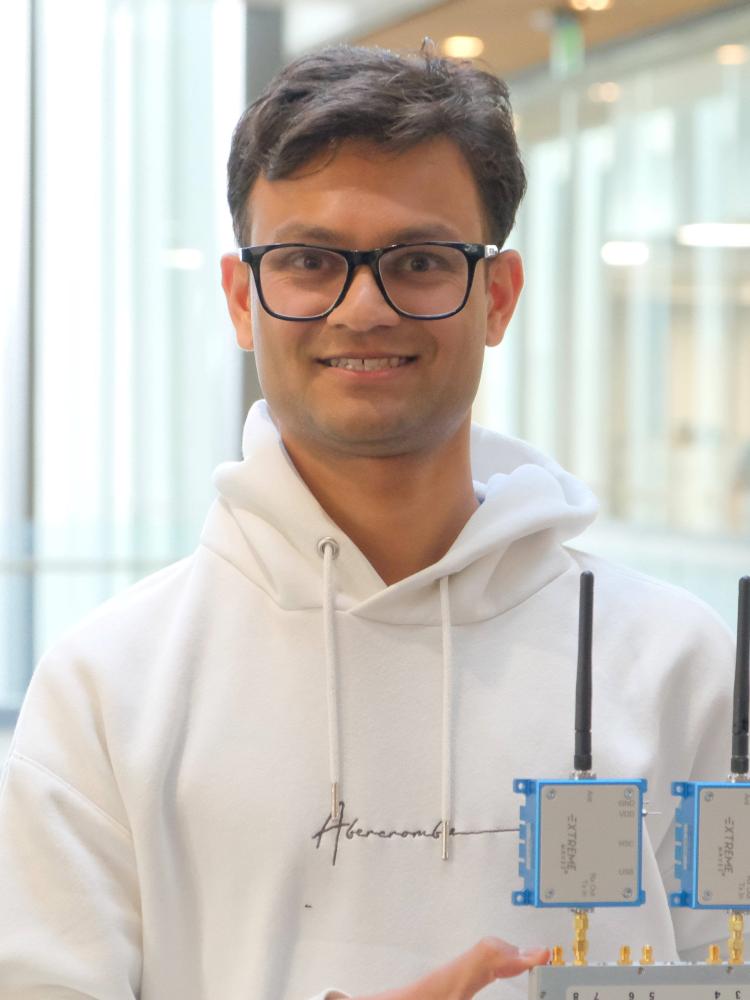
Ish Jain is an Assistant Professor in the Department of Electrical, Computer, and Systems Engineering at Rensselaer Polytechnic Institute (RPI), effective Fall 2024. He holds a PhD in Electrical and Computer Engineering from UC San Diego (2024), an MS from NYU (2018), and a BTech from IIT Kanpur (2016). His research focuses on next-generation wireless networks, combining communication, sensing, and security through experimental frameworks like mmWave testbeds. Key contributions include frequency-dependent multi-beam systems, mmWave localization for autonomous vehicles, and security against jamming/sensing spoofing. Education: PhD, UC San Diego (2018–2024) MS, NYU (2016–2018) BTech, IIT Kanpur (2012–2016) Research Interests: His work spans 6G Architecture (multi-beam frameworks, flexible frequency multiplexing), Wireless Sensing (localization, radar integration), and Security (jamming mitigation, spoofing defenses). He emphasizes practical deployments using open-RAN and programmable radios, with a focus on energy efficiency and scalability. Recognition: Qualcomm Innovation Fellowship VMware Research Grant Marconi Society Scholar Best Poster Award (Hotmobile 2023) 3-minute Thesis Winner (MobiSys/MobiCom) Current Courses: ECSE 4660/6660 Internetworking of Things (Spring 2025) ECSE 4560/6560 Modern Communication Systems (Fall 2025) Lab: Wireless Intelligent Systems Lab at RPI. Active in research centers like CMDIS. Collaborates widely via grants and industry partnerships.