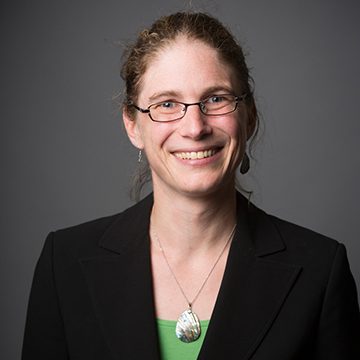
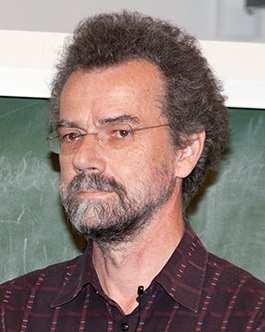
Grégoire Allaire is a Professor of Applied Mathematics at École Polytechnique, where he leads research in shape optimization , homogenization , and multi-scale modeling . His work bridges theoretical and applied domains, focusing on partial differential equations (PDEs), composite materials, and computational methods.
Professor Oscar Dias is a faculty member in the Department of Mathematical Sciences at the University of Southampton. His research focuses on Einstein's gravity, black holes, holographic dualities, and gravitational aspects of string theory. He actively supervises PhD students in mathematical sciences and holds grants from the Science and Technology Facilities Council (STFC), including projects like 'New Frontiers in Particle Physics, Cosmology and Gravity.' His work explores topics such as cosmic censorship, black hole dynamics, and numerical general relativity, with recent contributions published in journals like Physical Review Letters and Journal of High Energy Physics . Key research interests include the study of black hole binaries in de Sitter space, the stability of charged black holes, and the interplay between holographic dualities and quantum field theories. His projects often involve collaborations with leading institutions, addressing foundational questions in theoretical physics and cosmology. Professor Dias is a member of the Southampton Theory Astrophysics and Gravity (STAG) Research Centre and the String Theory and Holography group. His articles highlight advancements in understanding gravitational wave phenomena, quasinormal modes, and the behavior of black holes under various physical conditions. He currently accepts PhD applications and can be contacted via O.J.Campos-Dias@soton.ac.uk.
Adrián Lozano-Durán is an Associate Professor of Aerospace at the California Institute of Technology (Caltech), affiliated with the Guggenheim Laboratory for Aeronautics (GALCIT). He holds a B.S., M.S., and Ph.D. from the Polytechnic University of Madrid (2010–2015) and joined Caltech as a Visiting Associate in 2024 before becoming a faculty member in the same year. His research focuses on fluid dynamics, turbulence, and machine learning applications in computational fluid dynamics (CFD), particularly for aerospace systems. He leads the Aerofluids, Learning & Discovery (ALD) Lab, collaborating with MIT’s AeroAstro department. Key research areas include causal inference in fluid systems, reduced-order modeling, and machine-learning-based closure models for large-eddy simulation (LES). His work addresses challenges in low-speed aerodynamics, supersonic, and hypersonic flows. Notable recent contributions include advancements in LES wall models and information-theoretic approaches to turbulence control. He frequently presents at international conferences and has co-authored high-impact papers in Nature Communications , Journal of Fluid Mechanics , and Physical Review Research . Education: B.S., Polytechnic University of Madrid (2010) M.S., Polytechnic University of Madrid (2012) Ph.D., Polytechnic University of Madrid (2015) Affiliations: GALCIT, Caltech AeroAstro, MIT (collaboration) Advising focuses on students like Álvaro Martínez-Sánchez and Tristan, whose work spans causality in turbulence and flow control. He actively engages in interdisciplinary research, bridging fluid mechanics with machine learning and information theory to advance aerospace engineering solutions.
Professor Catherine Richardson serves as Professor of Early Modern Studies and Director of the Institute of Cultural and Creative Industries at the University of Kent. She joined the university in 2007 from The Shakespeare Institute and has held significant leadership positions including Associate Dean for Research and Innovation (Humanities) (2017-20), Deputy Head of School of English (2014-7), and Director of Research for the School of English (2012-7). Her research centers on the relationship between texts and material circumstances of production and consumption in early modern England, with particular focus on how material culture shaped social and cultural practices. Richardson examines the birth of creative industries in drama and performance cultures, skilled craft practices influenced by international migration patterns, and the evolution of cultural practices from the sixteenth century to present. She currently leads the AHRC-funded project 'The Cultural Lives of the Middling Sort, writing and material culture 1560-1660' in collaboration with The Shakespeare Birthplace Trust and Weald and Downland Living Museum. Richardson's extensive publication record reveals consistent scholarly engagement with material culture studies, with recent works increasingly incorporating digital humanities approaches. Her scholarship spans monographs, edited collections, and numerous journal articles examining domestic life, object biographies, and the intersection of physical artifacts with cultural narratives in early modern England. Her notable recognitions include: Fellow of the Royal Historical Society (2018) AHRC Peer Review and Strategic Review College Member (2017-22) The Malone Society council member (2002-) and Orders Secretary (2002-22) Pasold Research Fund Governor (Expert Member since 2019, 2021-present) As a dedicated supervisor, Richardson welcomes graduate students working on interdisciplinary projects related to early modern dramatic, social and cultural history. Her current AHRC project represents significant grant activity, developing digital resources that explore inclusion/exclusion dynamics in early modern English writing practices. She also serves as General Editor for the Oxford Complete Works of Christopher Marlowe and Series Editor for Arden Studies in Early Modern Material Culture. Through her directorship of the Institute of Cultural and Creative Industries, Richardson fosters research that bridges historical material culture studies with contemporary creative industry practices, creating innovative pathways for engaging with historical materials through modern technological approaches.
Sheelagh Carpendale is a Professor and Canada Research Chair in Information Visualization at Simon Fraser University's School of Computing Science. Her research focuses on Information Visualization, Interaction Design, and Human-Computer Interaction, with a strong emphasis on large display interaction, visual analytics, and personal visualization. She leads the Innovations in Visualization Interactive Experiences (ixLab) and has contributed to over 200 publications. Education: PhD (Computing Science, Simon Fraser University, 1999); BSc (Computing Science, Simon Fraser University, 1992). Research Interests: Dr. Carpendale's work bridges theory and practice, emphasizing user-centered design and interdisciplinary collaboration. Key areas include data physicalization (e.g., Kirigami-inspired visualizations), interactive technologies for healthcare, and educational tools like TangiBooks for programming concepts. Her lab explores novel interaction paradigms for large displays and mobile devices. Recognition: Recipient of the 2018 IEEE Visualization Career Award, numerous best paper awards, and leadership roles in conferences like IEEE VIS. Her contributions span academic, industrial, and public engagement contexts, including projects on clinical decision support and public data literacy. Grants & Labs: Active in securing research grants for projects like the Arctic Movement visualization and Energy Data initiatives. The ixLab collaborates with artists, scientists, and healthcare professionals to create impactful visualizations.
Emmanuel Kowalski is a Professor of Mathematics at ETH Zurich , where he has been since 2008. Previously, he held professorships at Université Bordeaux I (2000–2007) and was a Veblen Research Instructor at Princeton University and the Institute for Advanced Study (1998–2000). His research focuses on analytic number theory, automorphic forms, and algebraic geometry. Education: École Normale Supérieure de Lyon (1989–1992); PhD in Mathematics from Rutgers University (1998). Research Interests include automorphic forms, L-functions, sieve methods, exponential sums, and probabilistic number theory. His work often bridges number theory with algebraic geometry and harmonic analysis. He has authored over 70 research papers and 6 books, including the influential Analytic Number Theory (2004) with Henryk Iwaniec. Scientific Awards and Invitations include the von Neumann Visiting Fellowship at IAS Princeton (2009), membership in the Board of the Institut des Hautes Études Scientifiques (2016–present), and four invitations to lecture at the prestigious Bourbaki Seminar. He has also delivered key lectures at the Riemann International School of Mathematics and conferences honoring major mathematicians. Grants and Leadership He has organized numerous conferences and research programs, including the 2019 Arithmetic, geometry and modular forms conference at FIM and the 2022 goMath program on Women in Mathematics. He co-leads projects funded by the Swiss National Science Foundation (SNF), such as Trace functions and arithmetic Fourier transforms .
William H. Nienhauser, Jr. is the Halls-Bascom Professor of Classical Chinese Literature in the Department of Asian Languages and Cultures at the University of Wisconsin–Madison, College of Letters and Science. He is a leading authority on early Chinese literature, historiography, and poetry, with a particular focus on Sima Qian’s Shiji and the poetry of Du Fu. He has held visiting and research positions in China, Japan, Germany, and Taiwan, and remains academically active, including a 2018 appointment as Visiting Professor at Nankai University. His research interests include early traditional Chinese fiction, historiography, chuanqi and zhiguai tales, and the application of modern Western critical theories to Chinese literary texts. He is deeply engaged in the translation and annotation of classical works, especially the Shiji , often in collaboration with graduate students. His scholarship bridges philology, literary theory, and historical contextualization, contributing significantly to the global understanding of pre-modern Chinese literature. Nienhauser’s publications reveal a sustained focus on textual analysis, narrative structure, and the interplay between history and literature. His work spans from early Shijing poetry to Tang dynasty fiction, with a strong emphasis on Sima Qian’s historiographical methods and legacy. He has also contributed foundational reference works and critical editions, shaping the field of Chinese literary studies. His scientific awards reflect the international recognition of his scholarship: Woodrow Wilson Fellowship ACLS Fellowship NEH Fellowship Fulbright-Hayes Fellowship Japan Foundation Fellowship German Research Foundation Fellowship Alexander von Humboldt Foundation Fellowship Humboldt Foundation Lifetime Achievement Award (2003) Nienhauser has advised numerous graduate students in collaborative research projects, particularly on the Shiji and Du Fu. He has secured major fellowships and grants from prestigious organizations including the NEH, ACLS, Fulbright-Hayes, and the Humboldt Foundation, enabling extended research and translation work. His editorial roles, especially as a founding editor of Chinese Literature: Essays, Articles, Reviews (CLEAR), have been instrumental in advancing the field. While no formal lab or research center is mentioned, Nienhauser leads a major international collaborative translation project on the Shiji , involving scholars and students across institutions. His seminars and graduate courses foster a close-knit research community focused on classical Chinese texts.
Denise Neary is a Professor and Doctoral Studies Coordinator at the Royal Irish Academy of Music (RIAM), overseeing doctoral supervision and research methods in musicology. Previously, she was Senior Lecturer at Canterbury Christ Church University, UK. She organizes international guest lectures at RIAM and actively participates in academic societies such as the Society for Musicology in Ireland (SMI) and Performance Research Ireland. Her research focuses on 17th- to 19th-century music in Ireland and Britain, particularly church music and artistic research. She has supervised numerous doctoral dissertations, including studies on Beethoven, Schubert, and Irish choral traditions. Affiliations: RIAM (current), SMI (Council Member since 2009), RILM National Committee of Ireland. Educations: Extensive academic background in musicology, with research concentrated on historical performance practices and institutional music history. Her research interests span Irish musical heritage, cathedral music in England, and the evolution of artistic research methodologies. Recent work includes exploring performance as academic practice and the role of music in 17th-century Irish parish churches. She has contributed to major publications like the Encyclopedia of Music in Ireland (2013) and presented at international conferences on topics such as ‘Artistic Research in Music’ (2018). Denise has supervised over 20 doctoral students since 2010, specializing in performance analysis of classical and contemporary works. She also serves on advisory boards for Irish Musical Studies and collaborates internationally on projects like the ‘Doctors in Performance’ conference series. Labs/Teams: Leads the Doctoral Studies Program at RIAM, fostering interdisciplinary research in musicology and performance.
Lara A. Estroff is a Full Professor and the current Chair of the Department of Materials Science and Engineering at Cornell University's College of Engineering. She has been a faculty member since 2005 and served as Director of Graduate Studies from 2015 to 2019. Her academic leadership and research excellence position her at the forefront of bio-inspired materials and biomineralization research. Her educational background includes a B.A. in Chemistry from Swarthmore College (1997) and a Ph.D. in Chemistry from Yale University (2003), followed by an NIH-funded postdoctoral fellowship at Harvard University in the lab of Prof. George M. Whitesides. Dr. Estroff's research centers on the fundamental mechanisms of crystal growth, biomineralization, and pathological mineralization. She investigates how organisms control mineral formation and applies these principles to engineer synthetic materials with complex structures and functionalities. Her work spans biomaterials, tissue engineering, and energy materials—particularly hybrid organic-inorganic perovskites for photovoltaics. She employs advanced characterization techniques and has pioneered in situ methods to monitor crystallization dynamics. Her recent publications reveal a strong trend toward interdisciplinary research, integrating materials science with cancer biology, immunology, and machine learning. The articles emphasize bio-inspired synthesis, mineral-tissue interactions, and the development of functional crystalline materials for medical and energy applications. Faculty Early CAREER Award, National Science Foundation (2009) Fiona Ip Li '78 and Donald Li '75 Excellence in Teaching Award, Cornell College of Engineering (2007) Marilyn Emmons Williams Award, Cornell Undergraduate Research Board (2009) Keynote Speaker, Gordon Research Seminar on Biomineralization (2012) Lawrence Berkeley National Lab Affiliate (2013) Dr. Estroff leads a major DOE-funded project titled “Formulation Engineering of Energy Materials via Multiscale Learning Spirals,” a $3 million, three-year initiative using machine learning to optimize perovskite synthesis for solar cells. She has advised numerous graduate students and postdoctoral researchers, and her lab is known for fostering collaborative, cross-disciplinary research. She has also contributed to educational initiatives at Cornell, particularly in undergraduate research and materials education. Her research group operates at the intersection of chemistry, engineering, and biology, focusing on high-resolution characterization of biominerals, in situ crystal growth studies, and the design of in vitro models for cell-mineral interactions. The lab actively collaborates with institutions including Lawrence Livermore National Laboratory, National Renewable Energy Laboratory, and Johns Hopkins University.
Richard Jardine is a Professor of Geomechanics in the Department of Civil and Environmental Engineering at Imperial College London's Faculty of Engineering. He also serves as a College Proconsul and co-chairs the College Artworks Group. His work spans advanced geotechnical research, offshore renewable energy foundations, and international collaboration. Research Interests: His expertise includes soil properties, advanced laboratory and field measurement techniques, soil characterization, offshore geotechnics, foundation analysis, slope stability, driven pile behavior, soft ground engineering, full-scale monitoring, geotechnical instrumentation, and cold region geotechnics. His research is central to climate change adaptation and renewable power systems. Publication Trends: Recent articles focus on the mechanical behavior of chalk, sand, and glacial tills under monotonic and cyclic loading, particularly in offshore contexts. Emphasis is placed on numerical modeling (FE, MPM), pile-soil interaction, aging effects, and design method validation for offshore wind foundations. Fellow of the Royal Society (2024) Fellow of the Royal Academy of Engineering (2002) RAEng Medal (1997) British Geotechnical Association Medal (1990, 2015, 2021, 2023) Canadian Geotechnical Society Quigley Award (2019) ISSMGE McClelland Honour Lecture (2023) BGA Rankine Lecture (2016) Advising and Grants: Richard has led major international Joint Industry Projects including ALPACA, PISA, PAGE, and Unified Pile Design Method JIP, involving partners such as Orsted, NGI, Fugro, Oxford, and Zhejiang University. He has advised UK government, contractors, and energy firms on offshore projects in the Baltic Sea, Taiwan Strait, and North Sea. He holds a Royal Society Newton Advanced Fellowship with ZJU. Labs and Teams: He leads research within Imperial’s Geotechnics group and the Imperial Centre for Geohazards. His team conducts advanced laboratory and field testing, collaborates with Deltares (Netherlands), and maintains strong ties with Zhejiang University, where he is a Visiting Professor and Distinguished International Scholar.
Svetlana Lazebnik is a Full Professor and Willett Faculty Scholar in the Department of Computer Science at the University of Illinois at Urbana-Champaign (UIUC), part of the Grainger College of Engineering. She holds a Ph.D. from UIUC (2006) and previously served as an Assistant Professor at the University of North Carolina at Chapel Hill (2007–2011). Her research focuses on computer vision, including generative models for virtual try-on, image stylization, scene understanding, and joint modeling of images and language. She has advised numerous Ph.D. students and postdocs, many of whom now hold prominent academic and industry roles. Education: Ph.D. in Computer Science, UIUC (2006); supervised by Jean Ponce. Research Interests: Her work spans generative adversarial networks (GANs), diffusion models, virtual try-on systems (e.g., Dressing-in-Order, Street Try-On), exemplar-based stylization, and large-scale photo analysis. She has pioneered spatial pyramid matching and contributed to binary code learning for image retrieval. Key Awards: NSF CAREER Award (2008), Microsoft Research Faculty Fellow (2009), Sloan Research Fellow (2013), IEEE Fellow (2021), and the Longuet-Higgins Prize (2016) for her CVPR 2006 paper. Teaching: Recent courses include CS 444 (Deep Learning for Computer Vision), CS 543 (Computer Vision), and a Ph.D. Job Search Seminar. She has also taught at UNC Chapel Hill. Grants & Funding: Supported by NSF, Amazon, AWS, Microsoft, Sloan Foundation, Google, ARO, and Adobe. Notable grants include CCF 2348624 and IIS 1718221. Labs/Groups: Leader in the Illinois CS Vision Group, contributing to collaborative projects on embodied AI, multi-agent systems, and visual-semantic reasoning.
Peter Brummund is an Associate Professor of Economics at the University of Alabama, holding a position in the Department of Economics, Finance, and Legal Studies within the Culverhouse College of Business. He is also an IZA Research Fellow since December 2023, having previously served as a Research Affiliate since October 2018. In 2021, he was a Visiting Professor at WU Wien (Vienna University of Economics and Business). Education: PhD in Economics from Cornell University (2012) MA in Economics from Cornell University (2010) MSc in Development Studies from the London School of Economics (2006) BS in Computer Science from Taylor University (1999) Peter Brummund's research focuses on labor and development economics, with particular emphasis on how labor markets can enable people to work their way out of poverty. His work examines incomplete labor markets, job creation and destruction, job quality, job stability, minimum wages, monopsony, occupational segregation, program and policy evaluation, trade and labor, and the wage-productivity gap. He utilizes high-resolution datasets from numerous countries including Brazil, Ethiopia, Indonesia, Malawi, Uganda, United States, and Tanzania. His recent publications reveal a strong focus on labor market dynamics in developing countries, with particular attention to agricultural labor markets in Africa, occupational segregation trends in the United States, and the impacts of minimum wage policies. His methodological approach combines rigorous econometric analysis with detailed institutional knowledge of the labor markets he studies. Scientific Awards: Ernst Liu Family Economics Outstanding Teaching Award, Cornell, 2008 IZA Research Fellow (since December 2023) Professor Brummund has advised numerous PhD students, including Laura Connolly (2018, now at Michigan Tech) and Chris Oconnor (2021, now at Holy Cross), and currently advises Klara Kinnl and Melanie Gräser at WU Wien. His undergraduate mentoring has led to placements at prestigious institutions like Stanford's Institute for Economic Policy Research and recognition through the Randall Research Scholars Program and University of Alabama Undergraduate Research Awards. He teaches courses in Labor Economics, Development Economics, Policy Evaluation Methods, and Microeconomics at both undergraduate and graduate levels.
Daniel B. Szyld is a Professor in the Department of Mathematics at Temple University's College of Science and Technology. He is co-Director of the High-Performance Computing for Scientific Applications Professional Science Master’s program and a member of the Center for Computational Mathematics and Modeling. He holds leadership roles as President of the International Linear Algebra Society (ILAS, 2020–2026) and as a Board of Trustees member at ICERM (2024–2028), and previously served as Vice-President of SIAM (2014–2015). His research interests include Numerical Analysis , Scientific Computing , Numerical Linear Algebra , Iterative Methods , Preconditioning , Domain Decomposition , and High-Performance Computing . His work often focuses on Krylov subspace methods like GMRES, block solvers, and asynchronous algorithms, with applications in large-scale scientific simulations. The 15 most recent publications reflect a strong focus on enhancing the stability, convergence, and performance of iterative solvers, especially GMRES variants and domain decomposition methods. Topics include random sketching, deflation, weighted norms, multisketching in QR factorization, and asynchronous Schwarz methods. These works appear in top journals such as SIAM Journal on Matrix Analysis and Applications , Numerische Mathematik , and Electronic Transactions on Numerical Analysis , often in collaboration with leading researchers in the field. Scientific Awards and Recognitions: Commemorative medal, Charles University of Prague, 1997 Featured in Hall of Fame by Henk van der Vorst, SARA, 2010 Dean's Distinguished Award for Excellence in Research, Temple University, 2011 Fellow, American Mathematical Society, 2017 Fellow, Society for Industrial and Applied Mathematics, 2017 Achievement in Mathematics Award, Temple University, 2018 Faculty Senate Outstanding Service Award, Temple University, 2021 Daniel B. Szyld has served on the editorial boards of numerous prestigious journals, including Mathematics of Computation , Linear Algebra and its Applications , Numerical Linear Algebra with Applications , and was Co-Editor-in-Chief of Electronic Transactions on Numerical Analysis (2005–2013) and Editor-in-Chief of SIAM Journal on Matrix Analysis and Applications (2015–2020). His research has been supported by the National Science Foundation and the Department of Energy. He has advised students and postdocs, though specific names are not listed in the provided text. He is also involved in professional service through societies such as SIAM, AMS, ILAS, and NAM, and advocates for equity and ethical engagement in mathematics. Labs and Research Groups: He is a member of the Center for Computational Mathematics and Modeling at Temple University and co-Director of the High-Performance Computing for Scientific Applications Professional Science Master’s program, indicating active leadership in computational research and training.
Krzysztof Burdzy is a Professor of Mathematics and Adjunct Professor of Statistics at the University of Washington, where he is affiliated with the Department of Mathematics in the College of Arts and Sciences. He maintains an active research and teaching profile, currently offering undergraduate courses in probability. His research interests span Probability Theory , Stochastic Processes , Neumann Eigenfunctions , Hot Spots Problem , and the Philosophy of Probability . He is particularly known for his work on Brownian motion, eigenfunction behavior, and spectral theory in geometric domains. His recent work includes contributions to the resolution of the hot spots conjecture for Euclidean triangles and the discovery of interior hot spots in convex sets. The most recent articles reflect a deep engagement with both theoretical mathematics and foundational philosophy. Topics include spectral geometry, probabilistic methods in PDEs, critiques of philosophical theories of probability, and interdisciplinary reflections on epistemology. The publication trend shows sustained contributions from the 1990s through 2024, with a dual focus on rigorous mathematical proofs and meta-scientific analysis. Euclidean triangles have no hot spots (Annals of Mathematics, 2020) Convex sets can have interior hot spots (preprint, 2024) Hypocrisy++: On Philosophy of Probability and Sociology of Ideologies (2023) Burdzy has advised students in mathematics and probability, though specific names are not listed. He has received recognition through publications in top-tier journals such as Annals of Mathematics and Journal of Functional Analysis , though formal awards are not explicitly mentioned. He has delivered numerous talks on the philosophy of probability and its relationship to statistics. He is actively involved in public scholarship, maintaining a personal website with essays on quantum probability, real estate, philosophy, and AI. His work on the limitations of mathematics, suicide prevention, and critiques of post-modern thought reflect a broad intellectual engagement beyond technical mathematics. He does not appear to lead a formal lab or research team, but collaborates with scholars such as R. Bañuelos, W. Werner, and others in probability and analysis.
Prof. Dr. Peter Schneider is a faculty member at the University of Münster, affiliated with the Faculty of Mathematics and Computer Science and the Department of Mathematics and Computer Science . He is a principal investigator in the CRC 1442 Geometry: Deformations and Rigidity and contributes to the Mathematics Münster cluster. University: University of Münster School: Faculty of Mathematics and Computer Science Department: Department of Mathematics and Computer Science Academic Rank: Professor His research focuses on arithmetic geometry and representation theory , particularly the p-adic Langlands program , cohomology theories in mixed characteristics, and noncommutative algebraic structures. He investigates derived categories of p-adic representations, moduli spaces of Galois representations, and geometric approaches to automorphic forms. He has supervised numerous students, including Torsten Schoeneberg (2009), Marten Bornmann (2009), and Marius Kley (2016, 2019). His collaborative works with Rachel Ollivier, Otmar Venjakob, and Marie-France Vigneras explore modular Hecke algebras, Iwasawa theory, and (phi, Gamma)-modules. Emails: pschnei@wwu.de pschnei@uni-muenster.de Workshops Organized: Noncommutative Algebras (2006) Instructional workshop on noncommutative main conjectures (2011) International workshop on K-types for p-adic groups (2003)