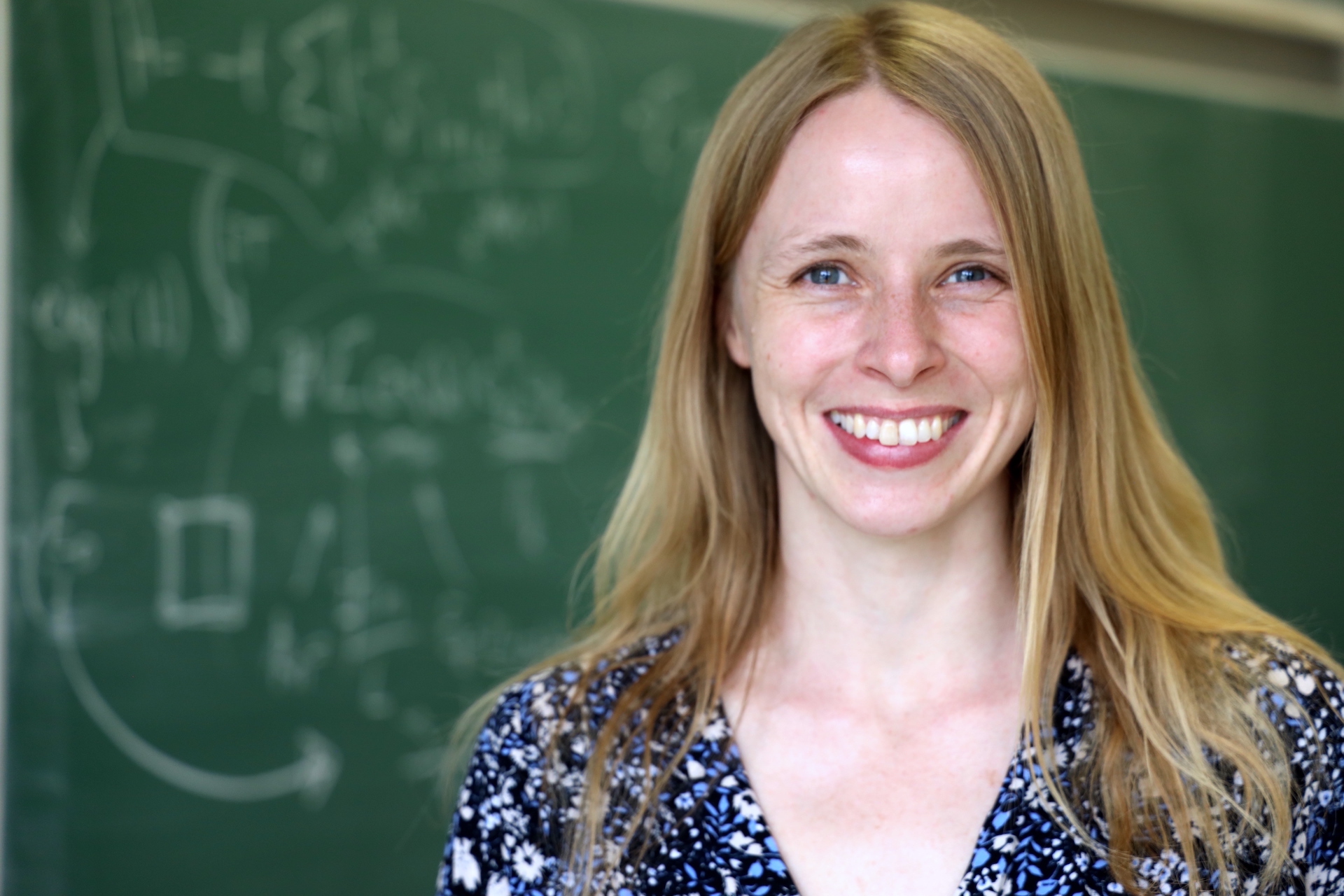
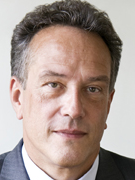
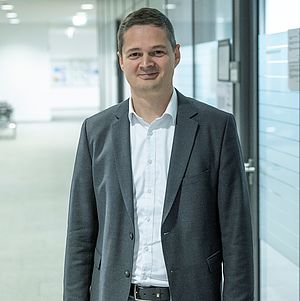
Angkana Rüland is a Professor at the University of Bonn's Mathematical Institute and holder of the Hausdorff Chair at the Hausdorff Center for Mathematics (HCM), a Cluster of Excellence. She is a member of the Transdisciplinary Research Area ‘Modelling’ and a recipient of the prestigious Leibniz Prize (2025). Her research focuses on inverse problems, fractional PDEs, and phase transformations in materials science, with contributions to the Calderón problem and microstructure analysis. She has held positions at Oxford, the Max Planck Institute in Leipzig, and Heidelberg University before returning to Bonn in 2023. Education: She completed her Abitur, bachelor's/masters, and PhD (2014, Hausdorff Memorial Prize) at the University of Bonn, where she also co-founded the Bonn Math Club. Her academic journey includes postdoctoral research at Oxford and leadership roles in Leipzig and Heidelberg. Research interests span inverse problems (e.g., fractional Calderón problem), material microstructures (shape-memory alloys), and mathematical physics. Her work bridges pure and applied mathematics, addressing questions in elasticity, nonlocal operators, and energy scaling laws. Scientific awards include the Leibniz Prize (2025) for her groundbreaking research and the Hausdorff Memorial Prize for her doctoral thesis. She aims to use Leibniz Prize funds to strengthen her research group at HCM, furthering interdisciplinary collaborations. Her contributions have positioned Bonn as a global leader in mathematical research, with 20 Leibniz laureates since 1986.
Annabelle Bohrdt is a Professor at the University of Regensburg's Faculty of Physics, affiliated with the Institute of Theoretical Physics. Her research focuses on strongly interacting quantum many-body systems, combining numerical methods, quantum simulation experiments, and machine learning techniques like neural networks. She explores topics such as the Fermi-Hubbard model, t-J model, and stripe formation in doped antiferromagnets. Her work bridges theoretical models and experiments, leveraging quantum gas microscopy and interpretable machine learning tools. Notable contributions include studies on pairing mechanisms in bilayer antiferromagnetic Mott insulators and the role of fluctuations in quantum many-body systems. Bohrdt actively collaborates with experimental groups to validate theoretical predictions. Teaching includes specialized courses on numerical methods for quantum many-body systems and machine learning applications in physics. She advises graduate and undergraduate students on projects in quantum matter and computational physics.
Rainald Loehner is a Distinguished Professor of Fluid Dynamics at George Mason University's Center for Computational Fluid Dynamics. Since 2003, he has led the Center for Computational Fluid Dynamics at George Mason University. He is currently a Hans Fischer Senior Fellow at the Technical University of Munich's Institute for Advanced Study (TUM-IAS) for 2023, hosted by Professors Kai-Uwe Bletzinger and Roland Wüchner in the 'Adjoint-Based System Identification of Large-Scale Structures' Focus Group. Loehner received his Diplom Ingenieur (Maschinenbau) degree from the Technical University of Braunschweig, and his PhD and a DSc in civil engineering from the University College of Swansea, Wales. After teaching at Swansea for a year, he worked at the Naval Research Laboratory in Washington, DC, followed by a research professorship at George Washington University. He joined George Mason University as an associate professor and was promoted to full professor in 1995 and distinguished professor in 2004. With over 35 years of experience, Professor Loehner's research spans the complete pipeline of numerical solvers and simulation tools. His expertise includes pre-processing, grid generation, numerical methods, field solvers, parallel computing, adaptive mesh refinement, fluid-structure interaction, shape optimization, system identification, and computational crowd dynamics. His current work focuses on developing advanced field solvers for compressible and incompressible flows, acoustics, electromagnetic wave propagation, heat and mass transfer, structural mechanics, and fluid-structure interaction. Key application areas include blast mitigation, ship hydrodynamics, blood flow, contaminant transport, and pedestrian safety. Loehner's recent research output (2020-2024) shows a strong trend toward digital twin technology and adjoint-based methods for structural analysis and optimization. His publications focus on high-fidelity digital twins for detecting structural weaknesses, risk assessment in engineering systems, and optimization of sensor placement. His work bridges computational mechanics with machine learning approaches, particularly in system identification and inverse problems, demonstrating how computational methods can solve complex real-world engineering challenges. 2020: Ranked #15119 in the Stanford List of Most Influential Scientists of the World; #8 in Aerospace and Aeronautics 2010: Distinguished International Career Award, Argentine Association of Computational Mechanics 2008: Fellow, International Association for Computational Mechanics 2006: Associate Fellow, AIAA 2005: Honorary Professor, University of Wales Swansea 2005: Advisory Professor, Shanghai Jiao Tong University 2004: Distinguished Professor of Fluid Dynamics, George Mason University 1999: Computational Mechanics Achievements Award, Japan Society of Mechanical Engineering 1993: Doctor of Science in Civil Engineering, University College of Swansea 1979-1983: Studienstiftung des Deutschen Volkes (Top 1% of German Students) Professor Loehner has mentored numerous students through his work at George Mason University and has supervised research in computational fluid dynamics, structural mechanics, and related fields. His research has been supported by various grants from government agencies and industry partners, enabling the development of advanced simulation tools applied in aerodynamics, hydrodynamics, shock-structure interaction, and medical applications. His codes and methods have been widely adopted in industry and academia for applications ranging from aircraft and ship design to medical simulations and urban pathogen transmission modeling. Loehner leads the Center for Computational Fluid Dynamics at George Mason University, which focuses on developing cutting-edge computational methods for fluid dynamics and related multiphysics problems. The center works on strategic application areas including blast mitigation, ship hydrodynamics, blood flow simulation, and pedestrian movement modeling. As a TUM-IAS Fellow, he collaborates with the Chair of Computational Modeling and Simulation at TUM on adjoint-based system identification of large-scale structures, bringing together expertise in computational mechanics and digital twin technology to address complex engineering challenges.
Prof. Florian Zaussinger is a faculty member at the Faculty of Applied Computer and Life Sciences at Mittweida University of Applied Sciences. His research focuses on thermal convection, fluid dynamics, and numerical simulations in both geophysical and astrophysical contexts. He has contributed extensively to studies on microgravity experiments, including the GeoFlow and AtmoFlow projects conducted on the International Space Station (ISS). University: Mittweida University of Applied Sciences Faculty: Applied Computer and Life Sciences Department: Mathematics Contact: +49 3727 58-1381 | florian.zaussinger@hs-mittweida.de | Building 6, Room 6-131 His research involves advanced numerical modeling of complex fluid systems, including spherical convection, dielectric heating, and double-diffusive processes. He has developed and applied computational tools like the ANTARES code to simulate convection in DA white dwarfs, planetary atmospheres, and Earth's mantle. His work bridges theoretical fluid mechanics with experimental validation in space-based microgravity environments. Recent publications highlight his expertise in thermo-electrohydrodynamic convection, planetary fluid flow analysis, and microgravity-induced instabilities. While the scraped data does not list scientific awards or students directly, his academic profile emphasizes interdisciplinary collaboration with engineering and life sciences, particularly in applied mathematics for fluid dynamics and experimental data processing.
Prof. Dr. Jens Eisert is a Professor at the Free University of Berlin, where he leads the Quantum Many-Body Theory, Quantum Information Theory, and Quantum Optics research group (Eisert AG) within the Institute of Theoretical Physics at the Dahlem Center for Complex Quantum Systems. His office is located at Arnimallee 14, Room 1.3.06 in Berlin-Dahlem. His research focuses on the intersection of quantum information theory and condensed matter physics, specifically exploring what information processing tasks are possible using individual quantum systems as information carriers. His group develops mathematical-theoretical foundations of quantum information, particularly in entanglement theory and tomography, while also investigating quantum optical implementations using light modes or cold atoms in optical lattices. A major emphasis of their work is on quantum many-body systems, including static properties, efficient numerical simulation methods like tensor networks, and non-equilibrium quantum dynamics. Recent publications highlight significant contributions in thermalization of quantum systems (Communications Physics 2025), quantum thermodynamics (Nature Physics 2025), and quantum error correction (PRX Quantum 2025). The group's work is characterized by combining the rigor of mathematical physics with physically motivated applicability, frequently leading to direct collaborations with experimental groups. Quantum Information Theory Quantum Many-Body Theory Quantum Optics Entanglement Theory Tensor Networks Quantum Error Correction Prof. Eisert maintains active supervision of numerous PhD students and postdoctoral researchers, with research positions regularly available in areas including quantum error correction, quantum information theory, tensor networks, and quantum simulation. His group has published extensively in top journals including Nature Physics, PRX Quantum, and Physical Review series.
Kentaro Inui is a distinguished researcher at Tohoku University , specializing in Natural Language Processing , Computational Linguistics , and Machine Learning . His work focuses on advancing language model behavior through rigorous empirical analysis, including mechanisms for detokenization , entity identification , and numerical reasoning . Inui has pioneered methods to rectify spurious beliefs in LLMs via unlearning techniques and explored the dynamics of reasoning strategies in neural models. His research addresses chat translation quality through metrics like MQM-Chat and investigates repetition neurons responsible for text generation patterns. Inui also contributes to argumentation analysis with annotation frameworks like LPAttack and develops resources such as COPA-SSE for commonsense reasoning. His work on universal graph-based relation extraction and cross-stitching architectures has established new benchmarks in NLP task performance. Inui's publications span top-tier conferences including ACL , EMNLP , and LREC , often involving collaborations with researchers like Benjamin Heinzerling and Jun Suzuki. His methodological innovations in semi-structured explanation generation , position embedding (e.g., SHAPE), and zero pronoun resolution demonstrate his focus on both theoretical and practical NLP challenges. While no direct awards or student mentorship data appear in the provided corpus, his extensive publication record (over 20 papers between 2021-2025) underscores significant contributions to NLP education tools , knowledge base integration , and dialogue system consistency . Current projects like ReCall mechanisms and numerical property encoding directions highlight his ongoing impact on model interpretability and reasoning accuracy.
Prof. Dr.-Ing. Annette Eicker is a Professor of Geodesy and Adjustment Calculations at the HafenCity University Hamburg (HCU), where she has been serving since 2016. Prior to her current position, she was an Academic Councillor at the Institute of Geodesy and Geoinformation at the University of Bonn (2014-2016), and has held visiting research positions at NASA's Jet Propulsion Laboratory in Pasadena, USA (2015) and the University of Rennes 1 in France (2014). Her research focuses on satellite gravimetry, particularly utilizing GRACE (Gravity Recovery and Climate Experiment) and GRACE-FO (Follow-On) mission data to monitor terrestrial water storage, study climate-related mass changes, and develop advanced methods for gravity field recovery. Her work bridges geodesy, hydrology, and climate science, with significant contributions to understanding global water cycle dynamics and developing next-generation gravity missions like MAGIC (Mass-change And Geosciences International Constellation). Analysis of her recent publications reveals a strong emphasis on improving the accuracy and applications of satellite gravity data for hydrological monitoring, with increasing focus on next-generation missions and daily gravity field solutions. Her research spans from fundamental method development (e.g., GROOPS software toolkit) to practical applications for water resource management and climate change monitoring. Prof. Eicker's work demonstrates leadership in the field of satellite gravimetry, with numerous publications in high-impact journals addressing critical challenges in Earth observation and climate monitoring. Though specific awards aren't mentioned in the provided materials, her extensive publication record and leadership in major projects like MAGIC indicate significant recognition within the geodetic and hydrological communities. Her research has strong implications for understanding climate change impacts on water resources, with applications in drought monitoring, flood risk assessment, and sustainable water management. She maintains active collaborations with international institutions including NASA's Jet Propulsion Laboratory and has contributed to major initiatives like the GlobalCDA Project, which integrates geodetic and remote sensing data with hydrological models.
Prof. Dr.-Ing. H. Siegfried Stiehl is a retired Senior Professor (until Sept 2021) at the Department of Informatics, University of Hamburg. He previously held roles including Dean of the Faculty of Mathematics, Computer Science, and Natural Sciences (2001–2006), Vice President for Research (2007–2013), and Head of the Image Processing Research Group. His academic journey includes a PhD from TU Berlin (1980) and a Habilitation in Computer Vision (1987). Education: 1973: Ing. Degree in Ingenieur-Informatik, Fachhochschule Furtwangen 1976: Diploma in Computer Science, TU Berlin 1980: Dr.-Ing. Dissertation on medical image processing, TU Berlin Research focuses on Computer Vision , Computational Neuroscience , and Cognitive Science , with contributions to medical image registration, 3D landmark detection, and biomechanical modeling. Key projects include the EU-funded 'COVIRA' consortium (1989–1995) and leadership in the SFB 950 'Manuscript Cultures' project (2015–2019). His 110+ publications span biomedical image registration, elastic deformation algorithms, and real-time signal processing. Notable collaborations include work with institutions like the University of Pennsylvania, University of Birmingham, and Philips Research. Leadership roles include organizing scientific events, serving on editorial boards (e.g., Biological Cybernetics), and founding the Interdisciplinary Nanoscience Center Hamburg (INCH) in 2001. His research has addressed challenges in neurosurgical interventions, VLSI implementation of neural networks, and interdisciplinary education.
Lena Funcke is an Assistant Professor of Theoretical Physics at Bonn University. Her research focuses on quantum computing, lattice field theory, and machine learning applications in physics. She explores topics such as topological phases, gauge theories, and quantum simulations. Her work bridges high-energy physics and computational methods, with a particular emphasis on overcoming noise challenges in quantum algorithms and leveraging machine learning for optimization tasks. Funcke’s research projects include C01 and C03, focusing on Hamiltonian lattice formulations and quantum computing methods for gauge theories. She investigates hybrid approaches combining Monte Carlo simulations with quantum computing to study quantum electrodynamics and topological systems. Her contributions highlight the interplay between theoretical physics and cutting-edge computational tools. Her publications span quantum algorithms for particle physics experiments, error mitigation strategies, and the application of normalizing flows to complex systems like the Hubbard model. She actively contributes to advancing the theoretical foundations of quantum computing and its practical implementation in solving fundamental physics problems.
Christoph Heinzl is a Professor of Cognitive Sensor Systems at the University of Passau since September 2022. He leads the Knowledge-based Image Processing research group at the Fraunhofer Development Center X-ray Technology (EZRT) . His academic background includes a PhD in Informatics and a Habilitation in 2022 , both from TU Wien . Research Focus: Scientific visualization, visual analytics, immersive analytics, virtual/augmented reality, machine learning, and X-ray computed tomography (XCT). Key Trends: Development of novel visualization techniques for complex volumetric data (e.g., dynamic volume lines, visual coherence frameworks), parameter space analysis, and cross-virtuality collaboration tools. Applications: Aerospace component inspection, defect analysis in composites (CFRP, GFRP), porosity quantification, and 4DCT time-series exploration.
Max Wardetzky is a Professor at the Institute for Numerical and Applied Mathematics within the Faculty of Mathematics and Computer Science at the University of Göttingen, Germany. His office is located at Lotzestraße 16-18, 37083 Göttingen, and he can be reached via email at wardetzky@math.uni-goettingen.de or by phone at +49 551 39 26778. Professor Wardetzky leads the Discrete Differential Geometry Lab at the University of Göttingen, where he conducts research at the intersection of mathematics, computer science, and geometry processing. His work bridges theoretical foundations with practical applications in computer graphics and scientific computing. His primary research interests include: Applied Geometry Discrete Differential Geometry Numerical Analysis Geometry Processing Physical Simulation Computer Graphics Professor Wardetzky's extensive publication record demonstrates significant contributions to the field of discrete differential geometry and its applications. His work shows a consistent focus on developing mathematically rigorous yet computationally efficient methods for geometric problems. Key trends in his research include the development of discrete analogues of smooth geometric objects, the study of convergence properties between discrete and continuous models, and the application of these methods to problems in computer graphics and physical simulation. Professor Wardetzky has made substantial contributions to the theoretical foundations of discrete differential geometry while maintaining strong connections to practical applications. His work on discrete Laplacians, curvature approximations, and geometric flows has influenced both theoretical mathematics and practical geometry processing algorithms.
Dr. Magdalena Schreter-Fleischhacker works at the Technical University of Munich within the Professorship of Simulation for Additive Manufacturing . Her research focuses on physics-based computational modeling of coupled liquid-powder-gas dynamics in metal additive manufacturing, including melt pool dynamics and powder-gas interactions . She specializes in multi-phase flow modeling using cut-element and diffuse interface methods with continuous/discontinuous Galerkin schemes . She also develops constitutive models for quasi-brittle materials like 3D printed concrete and rock, incorporating anisotropy , gradient-enhanced damage mechanics , and micropolar continua . Her computational work leverages matrix-free algorithms and parallel computing , with significant contributions to the deal.II finite element library . Research Interests Physics-based computational modeling of coupled liquid-powder-gas dynamics in additive manufacturing Multi-phase flow simulation using sharp/diffuse interface methods Advanced constitutive modeling for quasi-brittle materials (rock, soils, 3D printed concrete) High-performance computing and matrix-free algorithms Notable Contributions Development of consistent diffuse-interface models for melt-vapor dynamics Improvements to continuum surface flux models in additive manufacturing Formulation of gradient-enhanced damage-plasticity models for geological materials Principal contributor to the deal.II library (version 9.6) Supervised Student Projects Johannes Resch (2024): DG-based thermo-hydrodynamic melt pool simulations Julian Brotz (2024): DEM-FEM coupling for fluid-powder interaction Andreas Ritthaler (2024): Matrix-free cutDG formulation for complex flows Tinh Vo (2023): Laser modeling for melt pool simulations Scientific Awards ERC Starting Grant recipient
Tobias Neckel is an Associate Professor at the Institute for Informatics at the Technical University of Munich (TUM), where he leads research projects and coordinates academic programs. He has been the project team leader of the IGGSE Project ExaNIML since 2018, main coordinator of the Ferienakademie since 2014, and Program Coordinator of the Bavarian Graduate School of Computational Engineering (BGCE) since 2009. Diploma in Technomathematik from TU München (2005) Dr. rer. nat. in Informatics from TU München (2009) Neckel's research focuses on Uncertainty Quantification, Random Differential Equations, and High Performance Computing. His work develops efficient numerical algorithms using hierarchic and adaptive methods such as octrees/spacetrees and sparse grids, with applications in fluid-structure interactions and incompressible fluid flow simulation. His research bridges theoretical mathematics with practical computational science, emphasizing robust and efficient implementations. His recent publications demonstrate a strong trajectory in multi-fidelity modeling, uncertainty quantification, and high-performance computing. Neckel has made significant contributions to scalable hierarchical approximation methods, dynamic resource management in HPC, and the application of machine learning techniques to computational science problems. His work spans diverse application domains including plasma physics, hydrology, and computational engineering. Lehrfonds prize of the TUM (2014) Ernst Otto Fischer prize of the TUM (2011) Promotionspreis des Bunds der Freunde der TU München (2009) Neckel has supervised numerous graduate students and has been actively involved in curriculum development and teaching innovation. His book "Bits and Bugs: A Scientific and Historical Review of Software Failures in Computational Science" (2019) represents a significant contribution to understanding software reliability in scientific computing. He has organized minisymposia at major conferences including SIAM CSE and SIAM UQ, and serves on program committees for various computational science conferences. As coordinator of the Ferienakademie and the BGCE, Neckel plays a central role in advanced computational engineering education in Bavaria. His research group develops software for exascale computing and contributes to the Transregional Collaborative Research Centre 89 on Invasive Computing. Neckel also maintains international collaborations, with research stays at institutions including the Australian National University and Tokyo Institute of Technology.
Prof. Dr. Jochen Garcke is a faculty member at the Institute for Numerical Simulation, University of Bonn, with a dual affiliation at Fraunhofer SCAI's Department of Numerical Data-Based Prediction. His work bridges numerical simulation and machine learning, focusing on high-dimensional problems, sparse grids, and optimal control. Key research themes: Sparse grids, machine learning for simulations, reinforcement learning, uncertainty quantification Teaching includes courses on Numerical Methods in Science and Technology and Scientific Computing , emphasizing practical machine learning applications. Recent publications explore hybrid models combining data-driven and physics-based approaches in automotive engineering, wind turbines, and geoscientific modeling. His group employs adaptive sparse grids, graph algorithms, and spectral methods to tackle challenges in crash simulations, fluctuating renewable energy systems, and turbulent flow analysis. Collaborations span Fraunhofer SCAI and industry 4.0 initiatives.
Yannis Kevrekidis is a Professor at Princeton University with a distinguished career in computational mathematics and chemical engineering. He is currently a Hans Fischer Senior Fellow at the Technical University of Munich (TUM-IAS) and has held visiting positions at institutions like the Zuse Institute Berlin and Caltech. Education : National Technical University of Athens (Chemical Engineering) University of Minnesota (PhD in dynamical systems) Research Interests : Equation-Free and Variable-Free Modeling Complex Systems Dynamics Multiscale Computation Integration of Machine Learning with Scientific Computing Pattern Formation & Instability Analysis Key Article Trends : Advanced data-driven modeling of dynamical systems Manifold learning for reaction coordinates Projective integration methods Coarse-grained modeling across disciplines Applications in epidemiology, neuroscience, and fluid dynamics Scientific Awards : Guggenheim Fellowship Humboldt Research Award Computing in Chemical Engineering Award (AIChE) Bodossaki Academic Award Allan P. Colburn Award Collaborations : Extensive international collaborations with institutions in Germany, Austria, and the UK Key role in the Complex Systems Modeling and Computation focus group at TUM-IAS