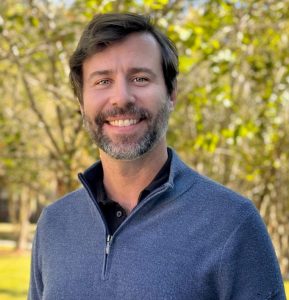
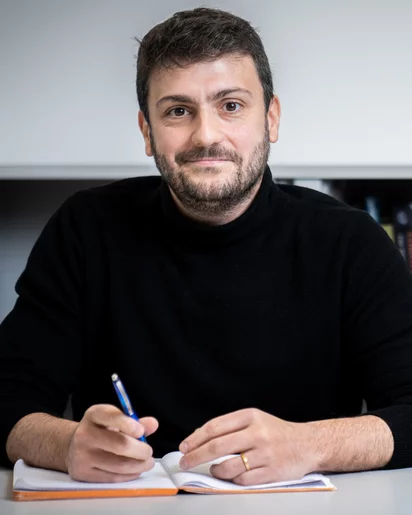
Imre Bartos is an Associate Professor of Physics at the University of Florida, specializing in multi-messenger astrophysics that combines gravitational waves, neutrinos, and electromagnetic signals. His research investigates extreme cosmic explosions involving black holes and neutron stars, with emphasis on merger environments in active galactic nuclei. Groundbreaking work includes demonstrating how nearby neutron star mergers influenced Solar System composition, identifying AGN disks as factories for eccentric black hole mergers, and developing techniques to probe black hole origins through gravitational wave localization. His group participates in major collaborations including LIGO, LISA, and IceCube observatories. Professor Bartos received the Sloan Fellowship and shares Breakthrough Prize honors for contributions to gravitational wave astronomy. He leads observational programs using Chandra, VLA, and Fermi telescopes while mentoring students in computational astrophysics techniques.
Kathleen C. Howell is the Hsu Lo Distinguished Professor of Aeronautics and Astronautics at Purdue University's School of Aeronautics and Astronautics. Her expertise spans orbit mechanics, spacecraft trajectory optimization, and mission design in multi-body systems. She holds degrees from Iowa State University (B.S., 1973), Stanford University (M.S., 1977; Ph.D., 1983). B.S. in Aerospace Engineering, Iowa State University, 1973 M.S. in Aeronautical & Astronautical Engineering, Stanford University, 1977 Ph.D. in Aeronautical & Astronautical Sciences, Stanford University, 1983 Her research focuses on libration point orbits, solar sail trajectories, and trajectory optimization in Earth-Moon and interplanetary systems. She has pioneered methods for analyzing Lissajous trajectories, invariant manifolds, and low-thrust mission design. Recent work includes solar sail applications for lunar coverage and ARTEMIS mission trajectory analysis. Publications highlight innovations in multi-body dynamics, with contributions to journals like Acta Astronautica , Journal of Guidance, Control, and Dynamics , and AIAA/AAS Conference Proceedings . Her work emphasizes practical mission design tools and visualization techniques. Awards: Fellow, AIAA (2013) W.A. Gustafson Teaching Award (2012) Dirk Brouwer Award (2004) Presidential Young Investigator Award (1984) Multiple Elmer F. Bruhn Teaching Awards Her advising and grants include leadership in space mission design, formation flight, and solar sail technology. She has collaborated on projects like the TRIANA mission and contributed to the Cassini end-of-mission analysis. Active in professional societies, she has edited conference proceedings and delivered invited lectures globally.
Mark Hertzberg is an Associate Professor in the Department of Physics and Astronomy at Tufts University, located within the School of Arts and Sciences. He holds a PhD from MIT (2010), following degrees from the University of Sydney. His research focuses on theoretical physics at the intersection of cosmology, particle physics, and astrophysics, with a particular emphasis on dark matter (e.g., axions), cosmological inflation, gravitation theory, and quantum phenomena. He has been Director of the Institute of Cosmology at Tufts since 2023. Education: PhD Physics, MIT, 2010 MSc Physics, University of Sydney, 2004 BSc Physics & Mathematics, University of Sydney, 2002 Research Interests: Dark matter structure and axion physics Cosmological inflation and post-inflationary dynamics Gravitational theory and quantum gravity constraints Large-scale structure and cosmic microwave background analysis Grants: Multiple NSF awards including 'Cosmology and Fundamental Physics' (2024-2026) and 'Constraining Physics Beyond the Standard Model with Cosmological Observations' (2023-2026). Teaching: Courses include General Relativity, Cosmology, Quantum Field Theory, and graduate research supervision.
Matias Zaldarriaga is the Richard Black Professor in the School of Natural Sciences at the Institute for Advanced Study (IAS), Princeton. His research focuses on theoretical cosmology, gravitational waves, and the Cosmic Microwave Background (CMB). He has held previous faculty positions at Harvard University (2003-2009) and New York University (2001-2002). Education: Ph.D. in Physics, Massachusetts Institute of Technology, 1998 Licenciado en Ciencias Físicas, Universidad de Buenos Aires, 1994 Zaldarriaga's work centers on decoding the early universe through CMB analysis and gravitational-wave astrophysics. He investigates inflation, large-scale structure formation, and black hole dynamics, leveraging advanced statistical methods to probe fundamental physics from cosmological data. His recent publications (2023-2025) demonstrate a strong focus on gravitational-wave data analysis, including novel algorithms for detecting binary black hole mergers, constraints on inflationary physics from large-scale surveys, and modeling supermassive black hole evolution. Key themes include higher-order waveform harmonics, pulsar timing arrays, and computational innovations for gravitational-wave astronomy. Awards and Honors: Gruber Cosmology Prize (2021) MacArthur Fellowship (2006) European Physical Society Gribov Medal (2005) Sloan Fellowship (2004) Helen B. Warner Prize, American Astronomical Society (2003) Packard Fellowship (2001) He collaborates extensively with international teams (e.g., LIGO-Virgo-KAGRA, DESI) and mentors researchers in cosmology and astrophysics. His group develops open-source tools for gravitational-wave inference and cosmological parameter estimation.
Jennifer Ryan is a Professor of Numerical Analysis and Division Head of Numerical Analysis, Optimization, and Systems Theory at the Department of Mathematics, KTH Royal Institute of Technology. Her research focuses on designing and developing numerical schemes to extract accuracy from simulations, particularly through superconvergence properties and computational efficiency improvements. She applies these techniques to applications such as imaging, fluid visualization, and plasma dynamics. Education: PhD in Applied Mathematics, Brown University; MS in Mathematics, Courant Institute; BA in Applied Mathematics, Rutgers University. Professional Activities: Member of editorial boards for BIT Numerical Mathematics, ESAIM:M2AN, and Communications on Applied Mathematics and Computation; Steering committee member of AWM's Women in Numerical Analysis and Scientific Computing (WINASc). Her publications emphasize discontinuous Galerkin methods, SIAC filtering, and applications in fluid dynamics. She has served on multiple grant review panels and received awards for diversity and inclusion initiatives. Grants: Principal Investigator for projects funded by the Swedish Research Council, NSF, and US Air Force Office of Scientific Research. Awards: Fellow of UK Higher Education Academy, DAAD Fellowship, and Householder Fellowship.
Professor Dejan Gajic is a mathematician specializing in mathematical physics and general relativity at Leipzig University's Faculty of Physics and Earth Sciences. He leads research on black hole dynamics, particularly extremal black holes, and was awarded a €1.5M ERC Starting Grant (2023) to study their mathematical properties. His work bridges partial differential equations and theoretical physics. Education: PhD in Mathematics from the University of Cambridge (201?), followed by research positions at Imperial College London, the University of Cambridge, and Radboud University. His research focuses on Einstein’s equations, black hole stability, and gravitational collapse. Research Interests: Mathematical theorems on extremal black holes’ dynamical properties, wave equations in curved spacetime, and asymptotic behavior of gravitational fields. Current projects include the ExBHGravRad initiative, exploring rapid-rotation black holes’ physical phenomena. Key Achievements: ERC Starting Grant (2023), selection from >2600 applicants. Plans include establishing a research group in Leipzig and enhancing the Center for Mathematical Physics (joint with Max Planck Institute for Mathematics in the Sciences). Labs/Teams: Leading the new black hole mathematics research group at Leipzig, collaborating with the Max Planck Institute. Aims to host international scholars and elevate Leipzig’s global profile in mathematical physics.
Greg Haff is a Professor of Strength and Conditioning and Director of the Strength and Power Research Group at Edith Cowan University's School of Medical and Health Sciences. He holds a PhD from the United States (1999) and has extensive experience in strength and conditioning research, education, and professional practice. His work focuses on neuromuscular adaptations, training theory, velocity-based training methods, and recovery strategies. Haff has received numerous awards, including the National Strength and Conditioning Association’s Impact Award (2021) and the UK Strength and Conditioning Coach of the Year (2014). Affiliations: ECU School of Medical and Health Sciences, Strength and Power Research Group Education: PhD (1999), MS (1996), BS (1993) in Physical Education from the United States. Research Interests: Haff’s research explores optimal training methodologies, including periodization, eccentric loading, and velocity-based resistance training. He investigates how neuromuscular adaptations enhance athletic performance and reduce injury risk. His work spans sports science, biomechanics, and exercise physiology. Publications & Awards: Over 270 scientific papers, 9 books, and 28 book chapters. Notable awards include the William J. Kraemer Sport Scientist of the Year (2011) and the NSCA Young Investigator Award (2001). His research has been cited over 9,000 times (Scopus h-index 53). Grants & Labs: Leads the Strength and Power Research Group, focusing on applied strength training and performance optimization. Research spans athlete development, recovery strategies, and injury prevention.
Dr. Imad El Haddad serves as Group Head of the Molecular Cluster and Particle Processes group at the Laboratory of Atmospheric Chemistry (LAC), part of the Center for Energy and Environmental Sciences at Paul Scherrer Institute (PSI), Switzerland, since 2018. Previously, he held positions as Tenured Scientist and Deputy Head (2018-2019), Senior Scientist in the Smog Chamber group (2015-2018), and Postdoctoral Fellow (2011-2015) at PSI. His research aims to quantify how anthropogenic emissions alter atmospheric pollutant composition and impact Earth's climate and public health through molecular-level analysis using advanced mass spectrometry techniques. His academic background includes: Ph.D. in Atmospheric Chemistry, University of Provence, Marseille (2007-2011) Master's in Environmental Sciences (with distinction, rank 1/9), University of Provence (2006-2007) Master's in General Chemistry (with distinction, rank 1/10), Saint-Joseph University of Beirut (2005-2006) Bachelor of Science in Chemistry (with distinction, rank 1/14), Saint-Joseph University of Beirut (2002-2005) El Haddad's work centers on molecular fingerprinting of atmospheric aerosols , utilizing mass spectrometry (GC/MS, HPLC/APCI-MS2, HPLC/ESI-MS2) to identify primary and secondary molecular markers. He conducts smog chamber experiments to characterize emissions from wood burning, traffic, and cooking processes, determining secondary organic aerosol potential and oxidation state evolution. His group also studies in-cloud aqueous-phase aging and collaborates with global modelers to link aerosol composition to climate forcing and health outcomes like oxidative stress. Recent publications (2025-2024) reveal three dominant trends: (1) rigorous molecular-scale analysis of secondary aerosol formation under varying humidity/temperature, (2) source apportionment breakthroughs in diverse regions (India, Europe, Arctic) using 14C and AMS data, and (3) quantification of health-relevant aerosol properties such as oxidative potential through DTT assays. High-resolution mass spectrometry is a consistent methodological thread across these studies. His scientific awards include: MENRT research fellowship from French ministry of research (2007-2010) Excellence Scholarship (top 1% student, University of Saint Joseph, 2005) Distinction Prize (best student, University of Saint Joseph, 2005) As Group Head, El Haddad oversees the Molecular Cluster and Particle Processes group's research direction and mentorship of junior scientists. While specific grant details are absent from the text, his leadership in multi-institutional publications (e.g., CERN CLOUD, iCUPE) implies active grant management and international collaboration. The group's work bridges laboratory simulations, field deployments, and health/climate modeling to address air pollution complexities. The Molecular Cluster and Particle Processes group develops cutting-edge online/offline mass spectrometers for 1 Hz-resolution atmospheric analysis. They deploy instruments in laboratory smog chamber experiments and global field studies, focusing on molecular marker identification, emission source characterization, and aging process quantification. Collaborations with biochemists and climate modelers extend their impact beyond pure aerosol physics into health risk assessment and policy-relevant climate science.
Dr. Kathi Diel serves as an Akademische Rätin (Academic Councilor) at Saarland University, holding a tenured faculty position equivalent to Associate Professor in the Department of Psychology within the Faculty of Social Sciences. Her research profile demonstrates active engagement in both theoretical and applied psychological research with international collaborations spanning multiple continents. Dr. Diel's research focuses primarily on social comparison processes and their motivational consequences, with particular emphasis on how comparison direction (upward vs. downward) and extremity (moderate vs. extreme standards) influence goal pursuit behaviors. Her work reveals that upward comparisons enhance self-improvement motivation when standards are moderate and attainable, but lead to goal disengagement when standards are extreme. She has developed a comprehensive motivational framework that identifies three key response patterns to social comparisons: pushing (increased effort), coasting (reduced effort), and disengagement (giving up). More recently, Dr. Diel has expanded her research to environmental psychology, investigating how social comparison dynamics affect climate action behaviors. Her work reveals that people often engage in downward comparisons regarding environmental behavior to maintain positive moral self-images, which can lead to reduced effort in climate action (coasting). She explores interventions that might shift people toward more motivating upward comparisons in environmental contexts. Her publication record shows consistent high-impact output with numerous articles in top psychology journals including Journal of Personality and Social Psychology , Personality and Social Psychology Bulletin , and Journal of Environmental Psychology . Her recent work has increasingly focused on large-scale international collaborations, most notably the International Climate Psychology Collaboration spanning 63 countries, demonstrating her growing influence in global environmental psychology research. Dr. Diel collaborates extensively with prominent researchers including Wilhelm Hofmann, Martina Friese, and the international team behind the global climate intervention studies. Her research methodology combines experimental laboratory studies with real-world intervention approaches, demonstrating both theoretical rigor and practical application. Her work bridges fundamental social psychology with pressing contemporary issues, particularly climate change behavior. By applying social comparison theory to environmental contexts, she has created a novel research trajectory that addresses how people's perceptions of others' environmental behaviors influence their own climate action efforts.
Dimitrios E. Anagnostou is Associate Professor in the Institute of Sensors, Signals & Systems within Heriot-Watt University’s School of Engineering & Physical Sciences, Edinburgh. He directs an anechoic-chamber & microwave characterisation facility, leads a thriving research group, and is currently recruiting PhD candidates. Education & Career: BSEE, Democritus University of Thrace, Greece (2000) MSEE, University of New Mexico, USA (2002) PhD, University of New Mexico, USA (2005) Post-doc, Georgia Tech (2005-2006) Assistant → tenured Associate Professor, South Dakota School of Mines & Technology (2007-2016) Associate Professor, Heriot-Watt University (2016-present) Research Focus: His work spans compact & reconfigurable antennas, 5G Massive-MIMO arrays, metasurfaces, metamaterials, functional materials (VO 2 ), RF-MEMS, microwave packaging, radar sensing for assisted-living, and AI/deep-learning applications in electromagnetics. He pursues “green” RF electronics printed on paper/organic substrates and hybrid integration of antennas on solar cells. Recent Publication Trends (2022-2025): Output is dominated by metasurface-enabled beam-steering antennas, VO 2 -based reconfigurable devices, radar absorbers/rasorbers, biomedical radar for vital-sign monitoring, and AI-assisted signal processing, with strong emphasis on experimental validation and open-access dissemination. Scientific Awards & Fellowships: IEEE John D. Kraus Antenna Award DARPA Young Faculty Award Marie Skłodowska-Curie Individual Fellowship (H2020) ASEE Campus Star Award Young Alumni Award, University of New Mexico Honored Faculty Award, SDSMT (×4) Distinguished Scientist Living Abroad, Hellenic Ministry of Defense Advising & Grants: He has mentored numerous PhD and MSc researchers; his students have won Best PhD Thesis and faculty-wide Engineering Prizes. He is supported by EU and UK research grants and continuously seeks motivated doctoral applicants. Facilities & Teams: He manages the Microwave Facility (anechoic chamber, mm-wave measurement systems) and collaborates with international academic/industry partners across Europe, North America and beyond.
Harald Pfeiffer is a Professor at the University of Potsdam and Group Leader in the Astrophysical and Cosmological Relativity department at the Max Planck Institute for Gravitational Physics (Albert Einstein Institute) in Potsdam. His research focuses on numerical relativity and gravitational wave astrophysics, particularly simulations of black hole and neutron star mergers to interpret observations from detectors like LIGO and Virgo. He holds a PhD from Cornell University and has held academic roles at the Canadian Institute for Theoretical Astrophysics (2009–2017). Notably, he was elected a Fellow of the American Physical Society in 2023 for his contributions to numerical relativity. His expertise includes developing computational tools to solve Einstein’s equations on supercomputers and analyzing gravitational wave data. Key interests include understanding spacetime behavior during mergers, improving waveform models, and preparing for future detectors like LISA. He collaborates extensively with international initiatives such as the LIGO Scientific Collaboration. Selected Awards: Fellow of the American Physical Society (2023) Research and Grants: His work bridges theoretical advances and observational data, contributing to waveform catalogs and detector sensitivity improvements. He leads a team advancing numerical relativity techniques for next-generation gravitational wave astronomy. Labs/Teams: Leads the Astrophysical and Cosmological Relativity group at the Max Planck Institute, fostering interdisciplinary research in gravitational wave science.
K.S. Babu, Ph.D. , is a Regents Professor in the Department of Physics at Oklahoma State University . His research focuses on theoretical physics beyond the Standard Model, particularly in neutrino mass models, grand unification, and baryon/lepton number violation. Email: kaladi.babu@okstate.edu Contact: 405-744-5810 | 232 Physical Sciences, OSU Dr. Babu's work spans several key areas: Grand Unified Theories (GUTs): Studies of SO(10), SU(5), and E6 unification frameworks. Neutrino Physics: Development of models like the Zee-Babu mechanism for neutrino masses and research on oscillations. Dark Matter & Cosmology: Proposals for dark matter candidates and connections to inflation and baryogenesis. CP Violation & Leptogenesis: Mechanisms for generating matter-antimatter asymmetry. His recent publications highlight advancements in: Spontaneous CP violation in SO(10) (2025) Left-right symmetric models for leptogenesis (2025) Ultraviolet-completed two-loop neutrino mass models (2025) Probing baryon number violation at IceCube and LHC (2024) Accidental Peccei-Quinn symmetry for axion models (2024) Dr. Babu actively collaborates on international initiatives such as the Center for Theoretical Underground Physics (CETUP) and contributed to the Snowmass 2013 Community Planning Study. His lab has mentored numerous graduate and postdoctoral researchers, including Kirtiman Ghosh, Sudip Jana, and Shaikh Saad.
Olaf Kaczmarek is a researcher at the Faculty of Physics , Bielefeld University , specializing in Lattice Quantum Chromodynamics (QCD) and Strongly Interacting Matter . He leads projects related to QCD thermodynamics , quark-gluon plasma , and heavy quark transport . Principal Investigator in TRR 211/2 Subproject A06: Hadronic Excitations and Spectral Functions in the Medium (2025) Co-PI in TRR 211/2 Subproject Z02: Software Development Center (2025) Contributor to GPUHEP2014 and LATTICE2024 symposia Research Focus: Thermal QCD phase transitions, heavy quark diffusion , transport coefficients , lattice simulations , and quarkonium spectroscopy . His work bridges theoretical physics and high-performance computing , particularly in Multigpu Systems for QCD calculations. Recent Publications explore topics like the chiral crossover , spatial string tension , and thermal photon production , with keywords spanning Quantum Chromodynamics , Lattice Gauge Theory , and High Temperature Physics . Teaching: Offers courses in Lattice Field Theory , GPU Computing , and Gradient Flow for graduate students. Contributes to collaborative seminars in the CRC-TR211: Strong-interaction matter under extreme conditions .
Jaouad Mourtada is an Assistant Professor in the Department of Statistics at ENSAE/CREST, École Nationale de la Statistique et de l'Administration Économique since September 2020. Previously, he was a postdoctoral researcher at the Laboratory for Computational and Statistical Learning at the University of Genoa (2019-2020). He completed his PhD in Statistics at École Polytechnique under the supervision of Stéphane Gaïffas and Erwan Scornet. His educational background includes a Master's degree in Mathematics with specialization in Probability and Random Models (2016), a Master's degree in Fundamental Mathematics (2015), and a Bachelor's degree in Mathematics from Pierre and Marie Curie University and École Normale Supérieure (2013). Dr. Mourtada's research focuses on the intersection of statistics and learning theory, with particular interest in high-dimensional statistics, online learning, and density estimation. His work explores the complexity of prediction and estimation problems through rigorous theoretical analysis. His research spans statistical learning theory, robust statistics, and the theoretical foundations of machine learning algorithms. His publication record since 2017 demonstrates consistent contributions to top-tier venues in statistics and machine learning, with recent work focusing on universal coding, aggregation methods, robust regression, and the theoretical analysis of kernel methods and random forests. His research shows a progression from online learning and expert aggregation to more complex statistical learning problems involving high-dimensional data and model misspecification. He teaches courses including Statistical Learning Theory for Master 2 Data Science students and Probability Theory at ENSAE. His teaching spans theoretical foundations of machine learning and core probability concepts for advanced statistics students.
Prof. Dr. Gisela Zifonun is a retired University Professor of German Linguistics at the University of Mannheim and former Head of the Grammar Department at the Institut für Deutsche Sprache (IDS) until July 2011. She holds a doctorate (1971) and habilitation (1994) in German Linguistics. Her career includes roles as a scientific employee at the IDS (1973–1995), Head of the Grammar Department (1986–1995), and professorships at the Free University of Berlin (1995–1998) and the University of Mannheim (1998–2011). Her research focuses on grammar theory, German syntax/semantics/morphology, language typology, and comparative linguistics. Key projects include the Grammar of German in European Comparison (GDE-N) and the EuroGr@mm initiative. She has authored/co-authored over 130 works, including monographs and edited volumes on German linguistics. Notable publications include Das Deutsche als europäische Sprache (2021) and Grammatik des Deutschen im europäischen Vergleich (2017). Her work emphasizes cross-linguistic analysis and corpus-driven research. Research interests span syntax, morphology, and typological comparisons across German, Romance, and Slavic languages. Recent contributions address gender-inclusive language reform and corpus-based studies. She has supervised numerous academic projects and serves as a key figure in German linguistic infrastructure, including IDS initiatives. No explicit awards are listed, but her extensive bibliography reflects significant scholarly impact. Professional roles include managing the IDS’s Grammar Department and coordinating international collaborations. Her work bridges theoretical linguistics with applied research, contributing to both academic discourse and language policy discussions.