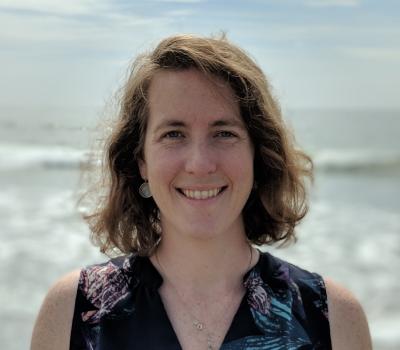
Meagan Wengrove is an Associate Professor in the Department of Civil and Construction Engineering at Oregon State University’s College of Engineering. She leads the Coastal Boundary Dynamics Research Group, focusing on coastal engineering with nature, boundary layer physics, and innovative ocean sensing technologies. Her work integrates field experiments, laboratory studies, and numerical modeling to address pressing coastal challenges related to climate change, sea level rise, and storm resilience. Her research interests include coastal dune morphodynamics, sediment transport in vegetated environments, ice-ocean boundary layer interactions, and the application of distributed fiber optic sensing (DAS) for real-time ocean monitoring. She investigates how natural systems such as coastal dunes, dynamic revetments, and submerged aquatic vegetation can be leveraged for sustainable coastal protection. Dr. Wengrove’s recent publications highlight interdisciplinary work on glacier melt physics and coastal dune behavior. Her research shows that pressurized air bubbles in glacier ice significantly enhance melting rates, with major implications for climate models. Another key finding reveals that newly planted vegetation can accelerate dune erosion during extreme storms, challenging conventional wisdom in coastal management. She mentors a diverse team of graduate and undergraduate researchers, including PhD students Nadia Cohen and Kaelan Weiss, and has advised former PhD student Liz Holzenthal. Her research is funded by the National Science Foundation, Keck Foundation, National Geographic Society, Office of Naval Research, U.S. Army Corps of Engineers, and Oregon Sea Grant. Dr. Wengrove teaches courses in coastal dynamics, coastal engineering with nature, programming and sensors, and fluid mechanics. She is actively involved in outreach and science communication, with features in Nature Geoscience , AGU EOS , National Geographic , and Oregon Public Broadcasting.