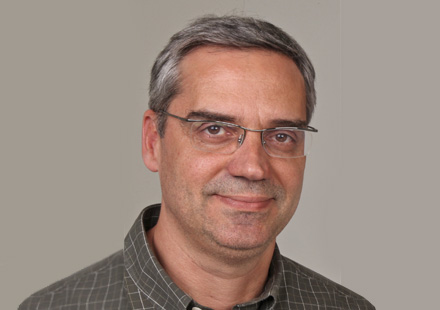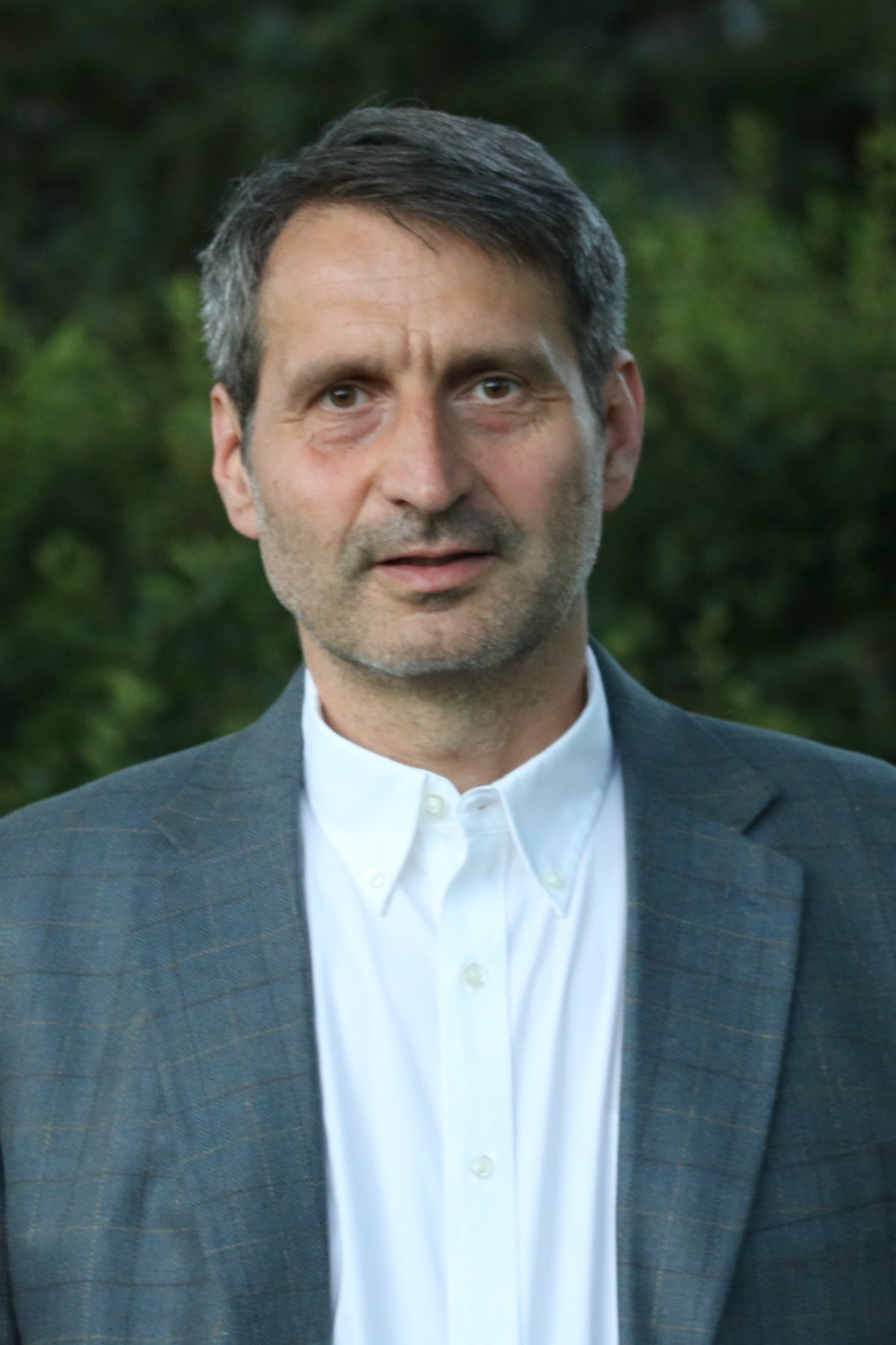
Vladimir Sverak serves as a Distinguished McKnight University Professor in the School of Mathematics at the University of Minnesota, where he maintains an active research program and teaches graduate courses in partial differential equations. His office is located in Vincent Hall 236 (206 Church Street SE, Minneapolis, MN 55455) with contact details including email sverak@umn.edu and phone (612) 625-1899. As of 2020, he continues to instruct courses such as Complex Analysis (Math 5583) and Topics in PDE (Math 8590), demonstrating ongoing academic engagement. Professor Sverak's research centers on fundamental questions in partial differential equations, particularly concerning existence, uniqueness, and singularity formation in fluid dynamics systems. His work focuses extensively on Navier-Stokes and Euler equations, examining behavior in critical function spaces where standard analytical methods often fail. He employs both rigorous mathematical techniques and numerical investigations to explore phenomena like non-uniqueness, blowup scenarios, and scale-invariant solutions, contributing significantly to the theoretical understanding of fluid mechanics. Analysis of his 15 most recent publications (2012-2017) reveals consistent thematic focus on Navier-Stokes equations, with particular attention to borderline spaces, axisymmetric flows, and singularity analysis. His collaborative approach is evident through frequent co-authorships with leading researchers including G. Seregin, H. Jia, and T. Gallay, reflecting the interdisciplinary nature of modern mathematical fluid dynamics research. His scientific recognition includes: Distinguished McKnight University Professor Research support comes from the National Science Foundation (grant DMS 1956092), while his teaching contributions span both foundational and advanced topics. Course materials for offerings like Elementary Partial Differential Equations (Math 5587/5588) and Introduction to Ordinary Differential Equations (Math 5525) remain accessible through university platforms, demonstrating commitment to pedagogical resources. Though student advising details aren't specified, his graduate-level course instruction indicates active mentorship within the mathematics community. Professor Sverak's work continues to advance mathematical fluid dynamics through rigorous analysis of nonlinear PDEs, maintaining strong connections between theoretical developments and physical fluid behavior while contributing to both research and education in mathematical sciences.