Prof. Ramakrishna Gokaraju is a Professor and Graduate Chair in the Department of Electrical and Computer Engineering at the University of Saskatchewan. His academic journey includes roles as Assistant Professor (2003), Associate Professor (2009), and full Professor (2015). He holds a B.E. from NIT Trichy (1992), M.Sc. and Ph.D. from the University of Calgary (1996, 2000). His research focuses on power system protection, smart grids, and sustainable energy systems, including small modular reactors (SMRs) and renewable integration. He has advised 8 PhD and 25+ Master’s students, with over 80 publications in top journals/conferences. Dr. Gokaraju’s honors include the Izaak Walton Killam Memorial Scholarship (1998–2000) and the Professor of the Year Award (2008). He has held visiting roles at the University of Manitoba (2009–2010), IIT Kanpur (2018), and institutions in Australia and India. His work emphasizes high-speed digital relaying, PMU-based solutions, and transient stability protection. Current research includes wind generator modeling, SMR integration, and energy storage systems for remote communities. His technical contributions span fault location algorithms, grid resilience enhancement, and GPU-based optimization for transport systems. Ongoing projects explore hybrid energy systems combining SMRs with renewables. Lab affiliations include the Power Systems Research Group at the University of Saskatchewan, focusing on smart grid innovation and sustainable energy solutions.
Granger Morgan is the Hamerschlag University Professor of Engineering at Carnegie Mellon University, holding joint appointments in the Department of Electrical and Computer Engineering, the Department of Engineering and Public Policy, and the H. John Heinz III College. His research focuses on science, technology, and public policy, particularly energy systems, climate change, risk analysis, and regulatory frameworks. He co-directs the NSF Center for Climate and Energy Decision Making and the Electricity Industry Center. Education: Ph.D., Applied Physics and Information Science, University of California, San Diego (1969) M.S., Astronomy and Space Science, Cornell University (1965) B.A., Physics, Harvard College (1963) Research Interests: Energy decarbonization and electric power resilience Climate change mitigation and adaptation strategies Risk assessment and policy analysis Hydrogen and nuclear energy systems Global technology adoption dynamics Awards and Affiliations: FAS Public Service Award (2016) Member, National Academy of Sciences Fellow, AAAS, IEEE, and Society for Risk Analysis National Academies Report Review Committee Co-Chair Advisory roles at DOE, PNNL, and international energy councils Advisory and Grants: Leadership in national studies on electric grid resilience and hydrogen infrastructure Recipient of NSF and industry-funded research grants Guidance on global energy policy and regulatory frameworks Labs and Teams: NSF Center for Climate and Energy Decision Making (co-director) Carnegie Mellon Electricity Industry Center Interdisciplinary energy policy research groups
Timothy Abram is a Professor of Nuclear Fuel Technology at the University of Manchester, holding the Westinghouse Chair since 2008. He leads the U-Battery HTGR project and serves as Visiting Senior Research Fellow at NNL. His expertise spans nuclear fuels (MOX, ATF, TRISO) and reactor systems (gas-cooled, VHTR), with roles in IAEA, UK Government advisory boards, and the UK Nuclear Regulator’s committee. He directs the Rolls-Royce University Technology Centre for Nuclear Science and Engineering. Education: BSc and PhD (details unspecified). Research focuses on advanced nuclear fuels, thermal conductivity, and sustainable energy solutions, contributing to UN SDGs. Projects include molten salt reactor research (Radiochemical Facilities, DAWNMANTLE) and waste minimization strategies. Over 15 EU projects and 72 research outputs demonstrate his global impact. Awards: Not explicitly listed. Collaborations include international networks in nuclear innovation and material science. Advising roles include external examiner for Royal Navy and Cambridge MPhil programs.
Lina Bertling Tjernberg is a Professor at the Department of Electrical Engineering, KTH Royal Institute of Technology, and Deputy Head of the School of Electrical Engineering and Computer Science (EECS) with responsibility for research conditions and impact. She served as Director of KTH's Energy Platform during 2018-2024 and holds memberships in IVA (Swedish Royal Academy of Engineering Sciences) and the IEEE Power & Energy Society. Research Focus: Applying mathematics (statistics, optimization, life cycle assessment) to enhance reliability and predictive maintenance in electric power systems, with emphasis on future electricity grids integrating microgrids, battery storage, HVDC, nuclear/pumped/hydro/wind/solar power, hydrogen, and electrified transport. Collaborations: Engaged with Comillas Pontifical University (Madrid), Addis Ababa University, Norwegian University of Science and Technology (NTNU), and IEA Wind. Key Research Trends: Recent articles highlight advancements in microgrid control (2025), SMR nuclear energy integration (2025), AI-driven asset management (2024), hydrogen sector coupling (2024), and renewable forecasting techniques (2024). Awards: 2021 Power Woman of the Year 2022 Energy Power List (Sweden’s top 20 energy influencers) Leadership Roles: Swedish Electromobility Center (SEC) board Chair of Swedish Electrical Standards (SEK Svensk Elstandard) Member, IEEE PES ISGT Europe steering committee
Indrek Jõgi is an Associate Professor of Plasma Technology at the University of Tartu's Institute of Physics within the Faculty of Science and Technology. He serves as Assistant Director of the Institute of Physics and Programme Director of the Doctoral Programme in Chemical and Physical Sciences. His academic career spans over 15 years at the University of Tartu, with progressive roles from Research Fellow to his current Associate Professor position. Dr. Jõgi earned his PhD in Physics (Optics and Spectroscopy) from the University of Tartu in 2007, following a Master's degree in Applied Physics in 2003 and a diploma in Physical Information Technology in 2001. His doctoral research focused on conduction mechanisms in thin atomic layer deposited films containing TiO 2 . His research interests center on plasma physics and technology, particularly the electrical properties of thin metal-oxide films, plasma-chemistry, and thermodynamically non-equilibrium plasma properties. His work bridges fundamental plasma physics with practical applications in materials science, nuclear fusion technology, and biomedical applications. He specializes in plasma diagnostics using Laser-Induced Breakdown Spectroscopy (LIBS) for fusion reactor materials analysis and has made significant contributions to understanding ionization processes in various gas mixtures. His recent publications demonstrate a strong focus on plasma applications for nuclear fusion materials analysis, particularly using LIBS techniques for detecting hydrogen isotopes and impurities in fusion reactor wall materials. His work spans plasma diagnostics, thin film deposition techniques like atomic layer deposition, and biomedical applications of plasma technology including cancer cell treatment research. His scientific awards include: IOP Outstanding Reviewer Award for Journal of Physics D: Applied Physics (2022) IOP Outstanding Reviewer Award for Journal of Physics D: Applied Physics (2018) III award in the PhD student category at the National Contest of Students on Scientific Research (2007) Dr. Jõgi serves in significant administrative roles including Assistant Director of the Institute of Physics and Programme Director for the Doctoral Programme in Chemical and Physical Sciences. He is the Estonian representative in the Governing Board of Fusion for Energy and the General Assembly of EUROfusion consortium. He also represents Estonia in COST Actions 23139 (from 2025) and previously served as Vice STSM Coordinator for COST Action 19110 (2020-2024). With approximately 90 peer reviews completed according to Web of Science, he is an active contributor to scholarly discourse in his field. He leads the Laboratory of Plasma Physics at the University of Tartu and is a member of the International Scientific Committee for the HAKONE symposium series on High Pressure Low Temperature Plasma Chemistry. His research team collaborates extensively with international fusion research facilities including WEST tokamak in France and Magnum-PSI in the Netherlands.
Jack Beuth is a Professor of Mechanical Engineering at Carnegie Mellon University (CMU), affiliated with the College of Engineering. He has been on the faculty since 1992 and leads the NextManufacturing Center, focusing on additive manufacturing (AM) research. His work emphasizes process mapping for AM, material science, and machine learning integration in manufacturing processes. Key affiliations include the Engineering Research Accelerator and the Manufacturing Futures Institute. Education: Ph.D. in Engineering Sciences, Harvard University (1992) M.S. in Engineering Sciences, Harvard University (1989) M.S. in Engineering Science and Mechanics, Virginia Tech (1987) B.S. in Engineering Science and Mechanics, Virginia Tech (1984) Research Interests: Additive Manufacturing (process modeling, material characterization, and defect analysis) Melt pool dynamics and thermal modeling Machine learning for process optimization and quality control Advanced materials for AM (e.g., Ti-6Al-4V, Inconel 718) His research has led to innovations like 'process map' approaches for AM, enabling better control over variables such as melt pool geometry and microstructure. Awards and Recognition: Ralph R. Teetor Educational Award (1998) George Tallman and Florence Barrett Ladd Development Professorship (2000) ASME Curriculum Innovation Award (2005) Benjamin Richard Teare Teaching Award (2009) Grants and Collaborations: $3.5M cooperative agreement with the U.S. Army Combat Capabilities Development Command’s Army Research Laboratory (ARL) for AI-driven AM process optimization. Collaborations with Westinghouse Electric Company on 3D-printed nuclear components, such as spacer grids for pressurized water reactors. Labs and Teams: NextManufacturing Center: A research hub for AM innovation, emphasizing industrial partnerships and applied research. Beuth’s Additive Lab: Specializes in melt pool analysis, process mapping, and material behavior under AM conditions.
Anne E. White is the School of Engineering Distinguished Professor of Engineering and associate vice president for research administration at the Massachusetts Institute of Technology (MIT). She serves in the Department of Nuclear Science and Engineering within MIT's School of Engineering and is a key researcher at the Plasma Science and Fusion Center (PSFC). White has held significant leadership roles including NSE department head from 2019 to 2023 and co-chair of the MIT Climate Nucleus from 2021 to 2024. She currently chairs the Fusion Energy Sciences Advisory Committee (FESAC), providing federal advisory input to the U.S. Department of Energy Office of Science. White received her PhD in physics from UCLA, where she conducted research at the Electric Tokamak. Her early career included research positions at the National Spherical Torus Experiment at Princeton Plasma Physics Laboratory and the DIII-D National Fusion Facility at General Atomics before joining MIT as a faculty member. Her educational background laid the foundation for her expertise in plasma physics and fusion energy research. Professor White's research focuses on magnetic fusion energy, specifically on understanding turbulent transport in magnetically confined fusion plasmas. Her work spans diagnostic development, novel experimentation, and validation of nonlinear gyrokinetic codes. She aims to demonstrate nuclear fusion as a practical part of the world's sustainable energy future. Her group develops and uses radiometers, reflectometers, and interferometers to measure fluctuations in plasma density, temperature, and flows in tokamaks. This research is critical for improving predictive capabilities of turbulent transport models, which is essential for developing viable fusion reactors. Analysis of Professor White's recent publications reveals a strong focus on plasma diagnostics and turbulence measurements across multiple tokamak facilities. Her work spans experimental measurements on ASDEX Upgrade, Alcator C-Mod, NSTX, and DIII-D tokamaks, with particular emphasis on electron temperature fluctuations, turbulence characterization, and transport model validation. A significant theme is the development and application of novel diagnostic techniques for simultaneous measurements of multiple plasma parameters. Her research increasingly incorporates computational approaches, including gyrokinetic simulations and machine learning methods, to interpret experimental data and advance predictive capabilities in fusion plasma physics. Professor White has received numerous prestigious awards throughout her career: Fellow, American Physical Society Division of Plasma Physics (2019) Cecil and Ida Green Career Development Professor, MIT (2014) American Physical Society Katherine E. Weimer Award (2014) Fusion Power Associates Excellence in Fusion Engineering Award (2014) Junior Bose Award for Excellence in Teaching, MIT (2014) PAI Outstanding Faculty Award from MIT student chapter of the American Nuclear Society (2013) Norman C. Rosenbluth Career Development Professor, MIT (2012-2014) Department of Energy Early Career Award (2011-2016) Marshall N. Rosenbluth Outstanding Doctoral Thesis Award (2009) As an educator and mentor, Professor White has advised numerous students through MIT's Department of Nuclear Science and Engineering. She has taught courses including Principles of Plasma Diagnostics, Seminar in Fusion & Plasma Physics, and Introduction to Plasma Physics. Her leadership extends to developing educational resources, notably leading a team in 2018 to create a free MITx MOOC focused on nuclear science and engineering for global high school learners. Professor White has secured significant research funding through Department of Energy awards, including the Early Career Award (2011-2016) and various fusion energy fellowships throughout her career. Her research group at MIT's Plasma Science and Fusion Center has contributed to multiple major fusion facilities and has been instrumental in advancing understanding of plasma turbulence and transport. Professor White leads the Fusion and Plasmas Lab at MIT, which focuses on diagnostic development and turbulence measurements in fusion plasmas. Her team has made significant contributions to research on four major tokamaks: Alcator C-Mod, ASDEX Upgrade, DIII-D, and National Spherical Torus Experiment Upgrade. At MIT's Plasma Science and Fusion Center, she previously served as assistant division head for magnetic fusion energy collaborations and ran the Gyrokinetic Simulation Working Group and the Alcator C-Mod Transport Group. Her lab maintains close collaboration between experimental work, theoretical modeling, and computational simulation to advance the understanding of plasma turbulence and transport phenomena critical for fusion energy development.
Sergi Colominas Fuster, PhD , is a Full Professor and Coordinator of the Master’s Degree in Analytical Chemistry at the Department of Analytical and Applied Chemistry, IQS School of Engineering, Universitat Ramon Llull. He has been serving in this leadership role since 2021 and was promoted to Full Professor in 2025. His educational background includes a PhD in Chemistry (2006, URL), a Chemical Engineering degree (2001, IQS), and a Degree in Chemistry (1999, URL). Sergi's research is centered on the design, development, and characterization of electrochemical sensors , with a strong emphasis on applications in nuclear fusion technology and bioanalysis . His work focuses on sensors for molten metals and biosensors, particularly for detecting hydrogen and tritium in fusion reactors. He is an active member of the EQBA – Electrochemistry and Bioanalysis Group , which specializes in analytical, electrochemical, spectrometric, and optical techniques. His recent publications (2023–2025) highlight advancements in 3D-printed perovskite-based high-temperature electrochemical sensors for hydrogen monitoring in fusion environments. These works demonstrate innovation in fabrication techniques such as cold isostatic pressing and 3D printing, contributing to safer and more efficient fusion energy systems. Key research projects he is involved in include: EUTECTIC : Industrial production of Li-6 enriched lead-lithium eutectic for nuclear fusion. ECSINFUS : Development of electrochemical sensors for fusion applications. EUROFUSION : Implementation of fusion roadmap activities under Horizon Europe. He has secured research grants from competitive programs such as AGAUR and the European Commission, reflecting his leadership in fusion-related analytical chemistry. His work bridges materials science, electrochemistry, and energy technology. Sergi contributes to multiple academic programs, including the Master’s in Analytical Chemistry, Materials Science and Engineering, Pharmaceutical Chemistry, and the PhD in Chemistry and Chemical Engineering, indicating his broad academic engagement and mentorship.
Angela Di Fulvio is an Associate Professor and Donald Biggar Willett Faculty Scholar at the University of Illinois at Urbana-Champaign, holding joint appointments in the Department of Nuclear, Plasma, and Radiological Engineering and the Center for Digital Agriculture at NCSA. She leads the Nuclear Measurement Laboratory (NML), focusing on radiation detection technologies for nonproliferation, medical physics, and nuclear security. Her academic journey includes a Ph.D. in Nuclear Engineering and Industrial Safety from the University of Pisa (2012), preceded by M.Sc. and B.Sc. degrees in Bioengineering. Her research emphasizes neutron detection instrumentation, radiation protection in therapy, and safeguards applications. Key areas include next-generation thermal neutron detectors, boron neutron capture therapy dosimetry, and spent nuclear fuel imaging. She has pioneered work on pulse shape discrimination using commercial ASICs and developed algorithms for neutron-gamma discrimination in harsh environments. Di Fulvio’s 15+ peer-reviewed articles span advanced detection systems, Monte Carlo modeling, and machine learning for radiation imaging. Notable contributions include a physics-based forward model for spent fuel imaging and variational autoencoder-based pulse discrimination. Her work has been recognized with the Dean’s Award for Excellence in Research. Professional roles include Associate Editor of Radiation Measurements and editorial board member of Nature Scientific Reports . She chairs APS’s Instrumentation and Measurement Science group and ANS’s Nuclear Nonproliferation Policy Division. Recent courses taught include NPRE 451-452 labs, Nuclear Safeguards, and Student Research Seminars.
Preet Singh is a Professor and Associate Chair for Graduate Studies in the School of Materials Science and Engineering at Georgia Tech, with affiliations to the College of Engineering. His research focuses on corrosion science, electrochemistry, and environmental degradation of materials, particularly metals and alloys. Prior to joining Georgia Tech in 2003, he was a faculty member at the Institute of Paper Science and Technology (IPST), where he investigated corrosion issues in the pulp and paper industry. Professor Singh's work explores fundamental mechanisms of material degradation in industrial environments, aiming to develop mitigation strategies against environment-induced failures. Key research areas include corrosion fatigue, hydrogen embrittlement, stress corrosion cracking, and oxidation behavior. His group employs experimental approaches to study material reliability under varying chemical and mechanical conditions. Recent publications demonstrate interdisciplinary collaboration across oncology, agriculture, and energy systems, reflecting broad applications of materials science principles. Research trends show increased focus on biomedical materials and sustainable technologies alongside core corrosion studies. Professor Singh advises graduate students including Abdullah Alzubail, Yousif Al Rabie, Sai Shreeya, Yara, and Sean Li. He directs the Corrosion and Materials Reliability Laboratory (CMCRL), which partners with industry to solve practical engineering challenges related to material performance.
Oliver Schmitz is a Professor in the Department of Nuclear Engineering & Engineering Physics at the University of Wisconsin-Madison, where he leads research in plasma edge physics for magnetic confinement fusion and next-generation particle accelerators. His work bridges experimental plasma science, computational modeling, and diagnostic development with applications in both tokamaks and stellarators. Education: PhD (2006), Heinrich-Heine-Universität Diploma (2003), Rheinische Friedrich-Wilhelms-Universität Professor Schmitz's research focuses on 3D plasma edge transport phenomena, plasma-wall interactions, and helicon plasma generation for wakefield accelerators. His group employs advanced computational tools like EMC3-EIRENE for 3D plasma edge modeling and develops active spectroscopic diagnostics to measure plasma parameters through atomic emission analysis. Key themes include resonant magnetic perturbation effects in tokamaks, inherent 3D physics in stellarators, and high-density plasma sustainment for accelerator applications. He actively develops atomic models to interpret spectroscopic data and operates helicon plasma test stands for fundamental process studies. Recent publications reveal strong emphasis on experimental-computational integration for fusion boundary physics, with significant contributions to ITER divertor solutions, stellarator exhaust optimization, and plasma-facing materials. The work shows growing focus on wakefield accelerator diagnostics through helicon plasma sources and advanced spectroscopy, alongside persistent innovation in 3D modeling of plasma-material interfaces. Scientific Awards: 2020 Thomas and Suzanne Werner Chair Professorship 2018 UW Madison Teaching Academy Fellow 2017 ITER Science Fellowship & Vilas Mid-Career Award 2015 DOE Early Career Award & NSF CAREER Award 2011 Torkil Jensen Award (General Atomics) 2007 Günther-Leibfried-Preis (Jülich) Professor Schmitz directs multiple DOE/NSF-funded research programs including his UW Madison laboratory and AWAKE project contributions at CERN. He mentors graduate students through NE 890/990 thesis research courses and has developed nationally recognized K-12 outreach including the "Plasma Show" for elementary schools and "Plasma Academy" for high-school educators developing AP Physics curriculum modules. His leadership extends to university governance through the Kaufman seminar on academic leadership. His research group operates helicon plasma test stands and computational facilities for EMC3-EIRENE simulations, with current efforts focused on high-density plasma sources for accelerators and resilient divertor solutions for stellarators. The group maintains strong international collaborations with ITER, CERN, and major fusion facilities worldwide.
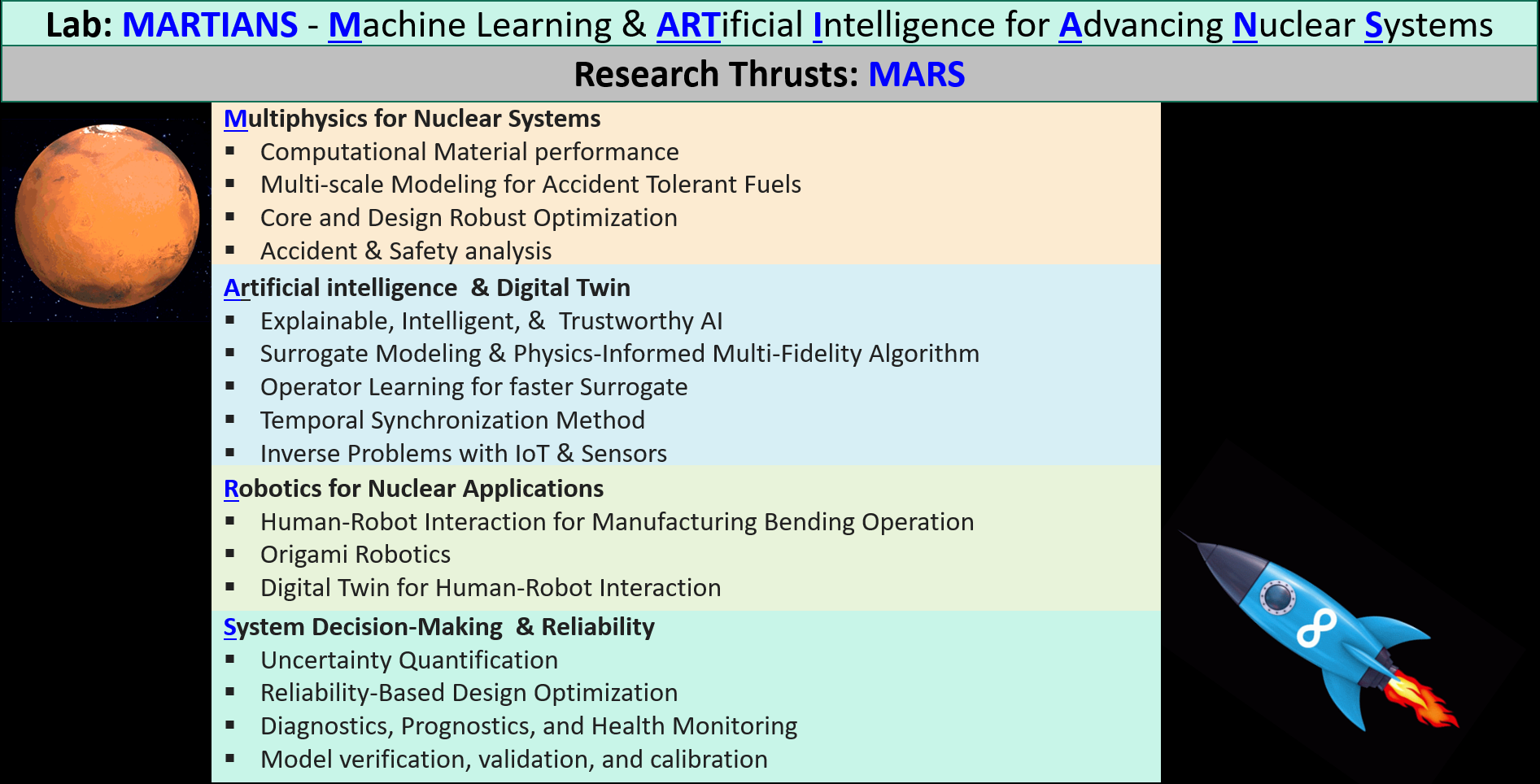
Syed Bahauddin Alam is an Assistant Professor at the University of Illinois Urbana-Champaign (UIUC) in the Nuclear, Plasma & Radiological Engineering department. He holds appointments in the Grainger College of Engineering and the National Center for Supercomputing Applications (NCSA). His research focuses on AI-driven digital twins, uncertainty quantification, and cybersecurity for nuclear systems. Education: B.Sc. in Electrical and Electronics Engineering, Bangladesh University of Engineering and Technology (BUET), 2011 MPhil in Nuclear Energy, University of Cambridge, 2013 PhD in Nuclear Engineering, University of Cambridge, 2018 Research Interests: AI and Digital Twins for Nuclear Energy Multiscale Modeling with Uncertainty Quantification Cybersecurity for Nuclear Systems Sensors and Instrumentation for Reactor Monitoring His work emphasizes explainable AI (XAI), physics-informed machine learning, and robust design optimization. Key contributions include AI-powered digital twins for nuclear systems, which received global media coverage and top 5% Altmetric scores. Awards & Honors: 2025 Dean’s Award for Excellence in Research (UIUC) 2024 Illinois Innovation Award Finalist 2022-2021 Outstanding Teaching Award (Missouri S&T) 2017 Cambridge Philosophical Society Research Studentship Award Grants & Funding: $700,000 U.S. Nuclear Regulatory Commission (NRC) Distinguished Faculty Development Award (2024) $2 million DOE grant for nuclear fuel storage solutions (2023) $500,000 NRC R&D Grant (2024) Labs & Teams: Leads the MARTIANS Lab (Machine Learning and ARTificial Intelligence for Advancing Nuclear Systems), focusing on hybrid data-physics-driven AI and explainable machine learning for nuclear engineering challenges.
John Hale, Ph.D., is a Professor and Chair of Computer Science at The University of Tulsa's Tandy School of Computer Science, where he holds the Tandy Endowed Chair in Bioinformatics and Computational Biology. He is a founding member of the TU Institute of Bioinformatics and Computational Biology (IBCB) and a faculty research scholar in the Institute for Information Security (iSec). Education: Ph.D., Computer Science, The University of Tulsa (1997) M.S., Computer Science, The University of Tulsa (1992) B.S., Computer Science, The University of Tulsa (1990) Dr. Hale's research spans cybersecurity , bioinformatics , cyber-physical systems , and applied formal methods . His work focuses on neuroinformatics, cyber trust, attack modeling, secure software development, and information privacy. Recent publications highlight trends in large-scale graph analysis for cybersecurity, attack graph generation on high-performance computing clusters, and security frameworks for nuclear reactor control systems. His research also explores hybrid attack graph modeling, reflective deception strategies, and compliance methods for cyber-physical infrastructures. Scientific Awards: 2000 National Science Foundation CAREER Award Dr. Hale has advised numerous research projects and received funding from the U.S. Air Force, Army, NSF, NIH, DARPA, NSA, and NIJ. He has testified before Congress on cybersecurity and holds a patent for anti-piracy technology. His lab work includes developing cyber-physical testbeds and science DMZ security solutions.
Scott Kemp is an Associate Professor at the Massachusetts Institute of Technology (MIT) within the Department of Nuclear Science and Engineering , where he also directs the Laboratory for Nuclear Security and Policy . His interdisciplinary research bridges physics, political science, and history to address challenges in nuclear security, energy policy, and critical infrastructure protection . Education: B.Sc. in Physics from University of California, Santa Barbara; Ph.D. in Public and International Affairs from Princeton University Research focuses on: Strategic implications of hypersonic and advanced conventional weapons Securing vulnerabilities in energy/water/gas infrastructure Technological tools for nuclear disarmament verification Decarbonization policy frameworks Scientific recognition includes: Fellow of the American Physical Society (2017) Sloan Research Fellowship in Physics (2016) NEC Corporation Award in Computation (2015) Fulbright Fellow (2003) As an academic advisor in MIT's Energy Studies Program , he mentors students in policy-science intersections while serving on the International Policy Lab and President’s Committee for Distinguished Fellowships .
Jozef Vleugels is a full Professor at KU Leuven's Faculty of Engineering Sciences, where he serves as Department Head of Functional Materials (SIEM) within the Department of Materials Science. He is also Chairman of the Leuven Centre for Materials and serves as contact person for the Functional Materials research unit located at Castle Park Arenberg 44 in Leuven. His research focuses on advanced materials processing, particularly in ceramics, powder metallurgy, and additive manufacturing. Vleugels has extensive expertise in zirconia-based dental biomaterials, nuclear materials, and refractory ceramics. His work integrates traditional ceramic processing techniques with cutting-edge additive manufacturing technologies, including direct ink writing (DIW) and binder jetting for complex geometries. His recent publications demonstrate a strong emphasis on dental applications of zirconia ceramics, laser surface modification techniques, microwave processing, and high-entropy carbide systems. His research group is actively involved in numerous EU and national projects related to additive manufacturing of multi-material components, nuclear applications, and dental biomaterials. Prof. Vleugels teaches several courses including Ceramics and Powder Metallurgy, Advanced Ceramic Materials, and project-based courses in materials science. He supervises numerous doctoral candidates and collaborates extensively with industry partners on applied research projects. He is an active member of multiple research networks including the Materials Science Division, KIEM – KU Leuven Institute for Energy and Society, and Leuven.AM – KU Leuven Institute for Additive Manufacturing. He also serves on various faculty and departmental councils including the Faculty Council of Engineering Sciences and the Departmental Council of Materials Science.