Lia Snead is an Assistant Professor of Music at Wartburg College, where she contributes to the academic and artistic development of students through teaching and leadership in music education. Her scholarly work intersects conducting, brass pedagogy, and ensemble performance, reflecting her dedication to advancing musical practice and community engagement. D.M.A., University of South Carolina (2023) M.M., Northern Illinois University (2016) B.M.E., Georgia Southern University (2011) Dr. Snead's research and professional interests span music education, conducting pedagogy, and brass instrument instruction. She actively engages in clinical and adjudication roles, fostering excellence in band programs and music festivals. Professional honors include membership in Tau Beta Sigma, a national honorary band sorority recognizing leadership in music education. Her career highlights include revitalizing band programs at multiple institutions and achieving superior ratings in competitive festivals.
Yang Yang is an Associate Professor at the Johnson Shoyama Graduate School of Public Policy, University of Saskatchewan, specializing in consumer behavior and food policy research. Her work examines how cultural values and communication strategies influence public acceptance of novel food technologies and Arctic food systems. Her academic credentials include: PhD in Agricultural Economics, University of Saskatchewan M.Sc. in Finance, Umeå University, Sweden M.Sc. in Economics, Dalarna University, Sweden B.Sc. in Economics, Tianjin University of Finance and Economics, China Yang's research program investigates consumer and farmer decision-making through experimental economics methodologies. She employs discrete choice experiments to analyze how narratives, cultural worldviews, and information framing affect responses to food technologies like gene editing and nanotechnology. Her work bridges agricultural economics with behavioral science, emphasizing heterogeneous consumer responses and the role of storytelling in science communication. This research has direct applications for food policy design, marketing strategies, and sustainable food system development. Analysis of her 2018-2020 publications reveals an evolving focus from technical assessments of consumer acceptance toward understanding communication mechanisms. Early work examined nanotechnology and biotechnology acceptance, while recent studies emphasize narrative framing effects and cultural value influences. A consistent thread is the investigation of Arctic food systems, where she explores certification impacts and indigenous knowledge integration. She received the Richardson-Applebaum Scholarship for Best PhD Dissertation (2018) and has secured research funding through collaborations with: Agriculture and Agri-Food Canada Arctic Council Northern Foods Yang actively mentors graduate students and teaches courses in resource economics and statistics. She is currently accepting MPP and PhD students for 2026 in food policy, experimental economics, and science communication. Her collaborative work with Drs. Jill Hobbs and David Natcher forms a core research team addressing socio-economic dimensions of food innovation, particularly in northern and indigenous contexts.
Peter William Tinning serves as a Research Fellow in the Department of Electronic & Electrical Engineering at the University of Strathclyde's Faculty of Engineering. He is affiliated with the Centre for Microsystems and Photonics (CMP) where he develops advanced microscopy technologies, particularly focusing on miniaturized structured illumination systems using 3D printed components and MEMS. His research interests span biomedical imaging, optical microscopy, MEMS technology, and super-resolution imaging techniques. Tinning specializes in developing hardware solutions for live cell imaging, with particular expertise in structured illumination modalities, light sheet microscopy, and photoacoustic imaging systems. His work bridges physics, engineering, and biomedical applications. Analysis of his recent publications reveals a strong focus on practical microscope development using MEMS scanning mirrors, with applications in super-resolution imaging of cellular processes. His research shows a progression from fundamental optical techniques to increasingly miniaturized and specialized systems with clear biomedical applications. Scientific Awards: Stephen Young Entrepreneurship Award (2024) Tinning is currently leading the Northern Light Microscopy project as Principal Investigator, funded by the Royal Academy of Engineering (£78,250), and serves as Co-investigator on an Innovate UK project focused on MEMS super-resolution microscopy. His entrepreneurial activities include developing business models around his research innovations. Based at the Centre for Microsystems and Photonics, Tinning works within a multidisciplinary team focused on microsystems, photonics, laser gas diagnostics, and microfluidics for biomedical applications.
Nina Wakeford is a Professor in the Department of Art at Goldsmiths, University of London, serving as Director of Research. Her practice combines performance, moving image, and installation art with deep engagement in feminist, LGBT, and queer histories. Current research explores Cold War paranoia and queer club cultures Recipient of multiple international exhibition invitations Active contributor to curatorial theory and practice Notable collaborations include the Artist Citizens Jury at CCA Goldsmiths (2022) and the development of 'Our Pink Depot' into a major performance for London Transport Museum (2025). Key publications include co-editing Inventive Methods: The Happening of the Social (Routledge, 2012). Her recent works have appeared at: Stadtgalerie Bern (2022) Science Gallery London (2020) MACBA Barcelona (2019) Whitechapel Gallery (2017)
Professor Thalia Anthony is a leading scholar at the University of Technology Sydney , where she has served as Professor of Law since 2020. She also holds an Adjunct Senior Research Fellow position at Charles Darwin University since 2022. Faculty of Law, UTS Jumbunna Institute for Indigenous Education and Research Collaborations with Aboriginal legal services and community centers Her research critically examines the criminal law’s colonial legacy , focusing on Indigenous criminalisation, carceral systems, and legal redress for historical injustices. Key themes include: Decolonizing criminology Indigenous sovereignty and self-determination Criminalization of poverty and homelessness Police reform and accountability Indigenous cultural competencies in legal education Recent publications analyze: Hyper-policing in Indigenous communities Automobility as a colonial control mechanism Indigenous women’s experiences in prison Corporate crime accountability failures Legal frameworks for housing justice Awarded the Deputy Vice-Chancellor’s Medal for Research Impact (2018) and recognized as a Top 50 Australian Thinker (The Conversation), she contributes to policy debates through: Senate committee reports UN submissions Royal Commission research High Court expert testimony Her teaching innovations include co-developing Indigenous graduate attributes in law curricula and supervising advanced legal research on sentencing equity.
Sam Grönholm is a University Lecturer in the Faculty of Social Sciences, Business and Law at Åbo Akademi University, specializing in Social Sciences with a focus on sea and shipping governance. His work is deeply embedded in urban climate governance, experimentalist governance models, and EU policy impacts on the Baltic Sea Region. He actively contributes to interdisciplinary research and public discourse on climate action and sustainability. University: Åbo Akademi University School: Faculty of Social Sciences, Business and Law Department: Social Sciences Academic Rank: Lecturer Email: sam.gronholm@abo.fi Sam Grönholm’s research centers on urban climate action, particularly in mid-sized cities like Turku. His work explores the paradoxes of mainstreaming climate governance, the role of experimentalist policy approaches, and the dynamics of multilevel governance in the Baltic Sea Region. He investigates how cities act as key agents in global climate efforts, often in the absence of binding national support, and how transnational learning can enhance local policy innovation. His recent publications and projects reveal a strong trend in comparative urban climate governance, especially through the 'Matching Forerunner Cities' initiative, which analyzes climate policies in Turku, Groningen, Rostock, and Potsdam. His 2023 book chapter examines EU influences on Baltic Sea governance, while his 2022 article in Current Research in Environmental Sustainability discusses the paradox of mainstreaming experimental governance. These works, along with multiple reports and media contributions, show a consistent focus on policy implementation, urban resilience, and sustainability transitions. Sam Grönholm has not received any explicitly mentioned scientific awards in the provided text. He has supervised or collaborated with multiple researchers and is currently a Co-Investigator in the 'Heat-Pioneer' project, funded by the City of Turku, which explores integrating heat pumps into renewable energy infrastructure. His academic activities include invited talks, public presentations, and media engagements, highlighting his role in bridging research and policy. He has presented on topics ranging from Baltic Sea governance to climate challenges in Nordic cities, demonstrating strong engagement with both academic and public audiences. Sam Grönholm is involved in a research team analyzing urban climate governance, particularly through the 'Matching Forerunner Cities' project. His work is collaborative, involving scholars from multiple institutions, and is closely tied to municipal policy development in Turku and other Nordic and European cities.
Dr. Martin Acheampong is a Research Fellow at the GIGA Institute for African Affairs, part of the German Institute for Global and Area Studies (GIGA). His research focuses on democracy, political representation, and executive power in Africa, particularly in Ghana and South Africa. He is actively involved in projects analyzing the personalization of executive power during the COVID-19 pandemic and legislative dynamics in emerging democracies. PhD in Political Science (expected), University of Bamberg MA in Development and Governance, University of Duisburg-Essen BA in Political Science and Sociology, Kwame Nkrumah University of Science and Technology, Ghana Dr. Acheampong’s research centers on democratization , political institutions , and governance in Sub-Saharan Africa. His work examines how formal and informal institutions shape parliamentary representation and how executive power is personalized in both democratic and authoritarian regimes. He has conducted field research in Ghana and South Africa, focusing on legislative behavior and candidate selection. His recent publications and presentations reflect a strong trend toward analyzing executive personalization during crises, electoral technologies , and grassroots peacebuilding . These works span comparative political analysis across the Global South, with a regional focus on West Africa. Co-author, Personnel, Institutions, and Power: Revisiting the Concept of Executive Personalization (GIGA Working Papers, 2024) Contributor to Ten Things to Watch in Africa in 2024 (GIGA Focus Africa, 2024) Presenter at ECPR and MPSA conferences on executive power and legislative selection Dr. Acheampong has taught Institutions, Democracy and Politics in Africa at the University of Hamburg (2024) and previously served as a Lecturer at the University of Bamberg. He is a core member of the research project COVID-19 and Executive Personalization in the Global South , funded by the DFG (2021–2024), and frequently contributes to public discourse through media interviews and policy briefs. He is affiliated with research teams focused on political accountability, peacebuilding, and institutional resilience in Africa, collaborating with leading scholars such as Prof. Dr. Mariana Llanos and Dr. David Kuehn.
Brian Eiler is an Assistant Professor of Psychology at Davidson College , where he joined in 2019. His academic background includes a Ph.D., M.A., and B.A. in Experimental Psychology from the University of Cincinnati, followed by a post-doctoral fellowship at Northern Arizona University. Research Focus: Complex systems perspectives on human behavior, social justice, and well-being Methodologies: Computational modeling, agent-based simulations, virtual reality, motion tracking, physiological measurements (electrodermal response, heart rate dynamics) His work spans social, industrial-organizational, and health psychology, with specific projects examining sexual violence dynamics through naturalistic data, cultural influences on student-athlete health, and organizational culture modeling. He integrates philosophy, complexity science, artificial intelligence, and data science into his research and teaching. At Davidson, he teaches Psychological Research-Design and Analysis (PSY 310) and is developing an advanced seminar in Psychological Models. His teaching emphasizes personal mentorship and equipping students with advanced quantitative skills for real-world applications.
Peter Johansen is an Associate Professor in the Department of Anthropology at McGill University, specializing in archaeological approaches to political power dynamics in everyday life. His research spans Neolithic to Medieval periods in South India and British Columbia's First Nations heritage projects. Ph.D., University of Chicago (2008) Research focuses on multi-scalar landscapes shaped by entrenched and emergent power modalities through metallurgy, settlement patterns, and ritual practices. Co-director of the Maski Archaeological Research Project (MARP), examining agro-pastoralism and socio-political organization in the Raichur Doab region. Recent publications analyze techno-political assemblages in South Indian metallurgy (2024), Neolithic mortuary practices (2023), and interdisciplinary fieldwork outcomes (2019-2018). His work bridges material culture studies with political archaeology to understand resource control dynamics. Collaborates with Nlaka’pamux communities in British Columbia on Indigenous-led heritage management. Based in Montreal, Quebec, he teaches graduate courses while directing field projects across two continents.
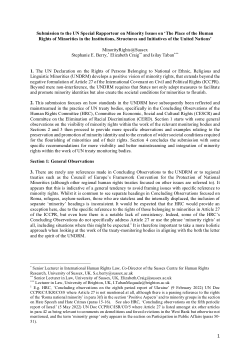
Dr Elizabeth Craig is an Associate Professor in the School of Law, Politics and Sociology at the University of Sussex , where she has served as Senior Lecturer since 2014 and previously since 2003. Her roles include staff welfare, development and empowerment lead in law and founder and former steering group chair of the Minority Rights Solidarity Network . She has held significant administrative positions including Director of Teaching and Learning , Deputy Chair of the UG Exam Board , and Convenor of the LLM International Human Rights Law program. Education: PhD from Queen's University Belfast (2006) LLM (by research) from the University of Sheffield (2000) BA in Law with German from the University of Sheffield (1997) PGCertHE from the University of Sussex (2006) Her research focuses on Minority Rights Law with particular emphasis on Cultural Identity , Language Rights , and Post-Conflict Justice . She is currently developing a book critiquing the European minority rights system and exploring a new paradigm, while conducting archival research on League of Nations petitions procedures . Her work spans International Law , Human Rights , and Legal Education . She has published extensively on the Framework Convention for the Protection of National Minorities , including studies on Western Balkan implementation , UK cultural identity , and Northern Ireland . Her publications show trends in Legal Standardization , Compliance Mechanisms , and Post-Conflict Legal Systems . Dr Craig supervises PhD students in areas including Culture and Identity Rights , Religious Freedom , and International Minority Law . Current supervisees include Abdulaziz MM Alharbi (Saudi Legal Reforms) and Moheb Mudessir (Afghanistan Minority Rights). She has taught at Sussex for over two decades, with current modules including Human Rights I , Understanding Law and Law, Justice and Inequality , and Indigenous and Minority Rights . Her teaching emphasizes Human Rights Law , Legal Equity , and Discrimination .
Dr. Phil Ramsey is a Lecturer in the School of Communication and Media at Ulster University , where he teaches political communication, public relations, and digital media. He earned his BA, MA, and PhD in media studies from Ulster University, focusing on government communication during the New Labour era. PhD: Media Studies (2011) MA: International Media Studies (2007) BA (Hons): Media Studies (2006) Ramsey’s research centers on media policy and public service media in the UK, particularly the BBC’s governance. He examines the political economy of media systems, public value frameworks, and devolution of broadcasting powers. His work also addresses cultural policy, media-democracy relationships, and critical public relations approaches. Recent publications analyze Northern Ireland’s media ecosystem, cross-border broadcasting challenges, and digital transformation of public service media. His research trends reflect intersections between UN Sustainable Development Goals (education, reduced inequalities) and media policy. Scientific awards include: Fellow of the Higher Education Academy (2017) Grants : Lead on AHRC-funded project Broadcasting Policy in a Devolved UK (£79,596.73) Ramsey actively contributes to academic networks, including: Chair of MeCCSA Policy Network (2018-2021) Executive Committee Member, Cultural Policy Observatory Ireland British Academy Advisory Group Member
Kyle Paradis is a Lecturer in Sport Sociology/Sport Psychology (Mental Health) at the School of Sport, Faculty of Life & Health Sciences, Ulster University, Jordanstown Campus. His work bridges sport psychology, mental health, and physical activity research, with a focus on longitudinal behavioral studies and depressive disorder correlations. Education: PhD in Psychology (Western University, 2014) Master of Education: (2023) Master of Human Kinetics: (University of Windsor, 2010) Bachelor of Arts (Honours): (Laurentian University, 2008) Research interests include: Sport Psychology Mental Health in Sports Contexts Group Dynamics Longitudinal Behavioral Analysis Physical Literacy Adolescent Movement Behavior Depressive Disorders His recent publications emphasize longitudinal studies of organizational stressors, physical activity's role in mitigating depression, and group dynamics in sports officiating. He actively participates in international conferences and serves on program committees for sport psychology events.
Gudrun Nyunt is an Associate Professor and Program Coordinator for Higher Education and Student Affairs in the Department of Counseling and Higher Education at Northern Illinois University’s College of Education. She has been at NIU since fall 2018 and teaches courses in applied research design, qualitative methodologies, college student development, and higher education administration. She is also an ACUE Distinguished Teaching Scholar. Education: Ph.D. in Student Affairs, University of Maryland, College Park M.A. in Education with a concentration in Higher Education and Student Affairs, University of Connecticut B.A. in Journalism, State University of New York at New Paltz Her research centers on equity and inclusion in higher education, focusing on three interconnected strands: employment in higher education, student mobility, and mental well-being. She applies critical frameworks to examine how white supremacy culture shapes work environments, how study abroad reinforces global inequities, and how intersecting identities affect student and staff experiences. Her work strongly emphasizes social justice, identity, and organizational change. The recent publications reflect a consistent trend in applied, qualitative research that bridges theory and practice in student affairs. Her work spans topics from BIPOC women in study abroad to staff well-being in residence life, from anti-Asian hate to virtual exchange pedagogy. The overarching themes include diversity, equity, inclusion, identity development, and organizational justice across international, residential, and academic contexts. Scientific Awards: Excellence in International Research Award, ACPA’s Commission for Global Dimensions of Student Development (2024) Gudrun has received grant funding from the ACPA Foundation, NASPA Foundation, ACUHO-I, and NASPA Region IV-East. She actively mentors through her role as program coordinator and editorial leadership. She is also deeply involved in professional service, currently serving as Vice President of Membership for ACPA – College Student Educators International. Her editorial roles include Associate Editor for the Journal of College and University Student Housing and board memberships with the Journal of College Student Development , Journal of Diversity in Higher Education , and Journal of Student Affairs Research and Practice . She has previously worked in Residence Life at Miami University, University of North Florida, and University of Connecticut, served as a resident director for Semester at Sea, and held administrative roles at Webster University’s Vienna campus. She is also a co-editor of the book International Student Identities and Mental Well-being: Beyond the Single Story (2023).
Olha Ketsman, Ph.D., is an Assistant Professor in the Department of Educational Technology, Research and Assessment at Northern Illinois University's College of Education. Her work bridges educational technology, teacher preparation, and research methodology, with a strong emphasis on practical integration in K-12 and higher education settings. Research Interests: Technology Integration in Teaching and Learning Pre- and In-Service Teacher Education Mixed Methods Research Methodology Blended and Mobile Learning Environments Virtual Reality and Immersive Media in Education Instructional Design and Professional Development Her recent publications demonstrate a consistent focus on how emerging technologies and blended pedagogies influence teaching practices and student engagement. She explores both quantitative and qualitative dimensions of educational innovation, particularly in science and language classrooms. Her work often investigates implementation challenges, teacher perspectives, and the effectiveness of multimedia tools such as PocketLab and cinematic virtual reality. Scientific Contributions: Extensive research on blended learning in teacher education Investigations into mixed methods research trends in educational technology journals Pioneering studies on cinematic virtual reality in school libraries and its impact on empathy Analysis of instructional videos in STEM education Evaluation of standards-based grading and professional development barriers Dr. Ketsman teaches a wide range of courses including ETT 401A/B (technology integration in elementary classrooms), ETT 510 (instructional media), ETT 740/743 (seminars in instructional technology), and ETR 525/535 (qualitative and mixed methods research). She also supervises practicum and internship experiences in instructional design and research evaluation, contributing significantly to graduate student development. She earned her Ph.D. and M.A. from the University of Nebraska-Lincoln, building a foundation in educational research and technology. Her office is located in Gabel Hall 101, and she is an active contributor to the academic mission of NIU’s College of Education.
Todd Reeves is an Associate Professor in the Department of Educational Technology, Research and Assessment at Northern Illinois University's College of Education. His work bridges educational research, assessment, and teacher development, with a strong methodological focus on quantitative analysis and psychometrics. Research Interests: Educational Assessment Teacher Education and Development Educational Technology Quantitative Research Methods Psychometrics and Measurement Professional Development Evaluation His research leverages large-scale datasets like TALIS and focuses on validating assessment instruments, evaluating teacher induction, and understanding data-driven decision-making. He has published extensively in top journals such as Teaching and Teacher Education , Studies in Educational Evaluation , and Journal of Psychoeducational Assessment . Scientific Awards and Recognition: Omnibus Award, Mid-Western Educational Research Association (2022) Student Recruitment Award, Mid-Western Educational Research Association (2017, 2018) Top Reviewer: Social Sciences, Publons (2017) Sentinels of Science Award: Social Science, Publons (2016) Certificate of Recognition for Mentoring, College of Education, NIU (2014–2017) Honorable Mention Dissertation Award, AERA (2014) Grants and Advising: Dr. Reeves is actively involved in major externally funded projects with the National Science Foundation and U.S. Department of Education, serving as project evaluator and co-principal investigator. These grants focus on STEM education, rural education pathways, and Grow Your Own teacher programs. While no formal advisees are listed, his mentoring has been formally recognized by the College of Education. Labs and Teams: He collaborates with research teams across NIU and external partners, particularly in evaluation and methodology. He is associated with research initiatives such as Project SEED and participates in professional networks including the Mid-Western Educational Research Association and AERA.