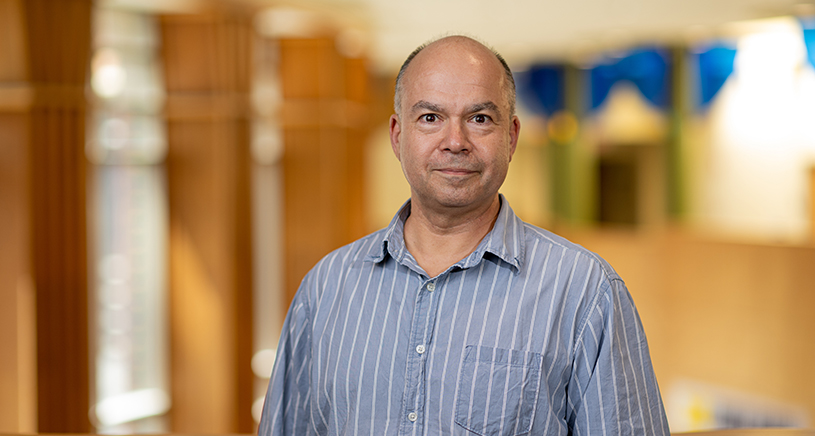
Felix Voigtlaender is a Professor for Mathematics with a focus on Reliable Machine Learning at the Mathematical Institute for Machine Learning and Data Science, KU Eichstätt-Ingolstadt. He has held previous academic positions at TU Munich as an Emmy Noether Group Leader, at the University of Vienna as a Senior Scientist, and at KU Eichstätt and TU Berlin in research and postdoctoral roles. PhD: RWTH Aachen University, 2015 Master: RWTH Aachen University, 2013 Bachelor: RWTH Aachen University His research lies at the intersection of mathematics and machine learning, with a strong emphasis on the theoretical underpinnings of neural networks. He investigates approximation properties, expressiveness, and the existence of adversarial examples. His work also extends into harmonic analysis, functional analysis, and multiscale systems such as wavelets and shearlets. He is deeply interested in the mathematical foundations of data science, including sampling theory and information-based complexity. The recent publications highlight a consistent focus on the mathematical analysis of neural networks, particularly approximation capabilities and universal approximation theorems in both real and complex domains. His work often provides sharp theoretical bounds and deep insights into the behavior of deep learning models in high-dimensional settings. Friedrich-Wilhelm-Award 2016 for his PhD thesis Felix Voigtlaender has supervised students and is actively involved in teaching and academic development, notably contributing to the launch of a new BSc program in Data Science at KU Eichstätt-Ingolstadt. He has collaborated with prominent researchers such as Götz Pfander, Gitta Kutyniok, and Hartmut Führ, and has been funded through competitive grants like the Emmy Noether program. He leads a research group focused on rigorous mathematical approaches to machine learning challenges. He is affiliated with the Mathematical Institute for Machine Learning and Data Science, a newly founded institute at KU Eichstätt-Ingolstadt, which will be based in Ingolstadt. His team is involved in both theoretical exploration and practical applications of data science methods.