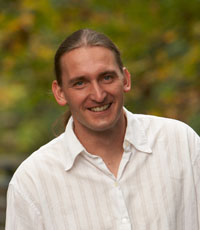
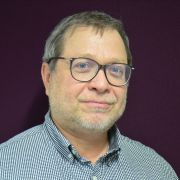
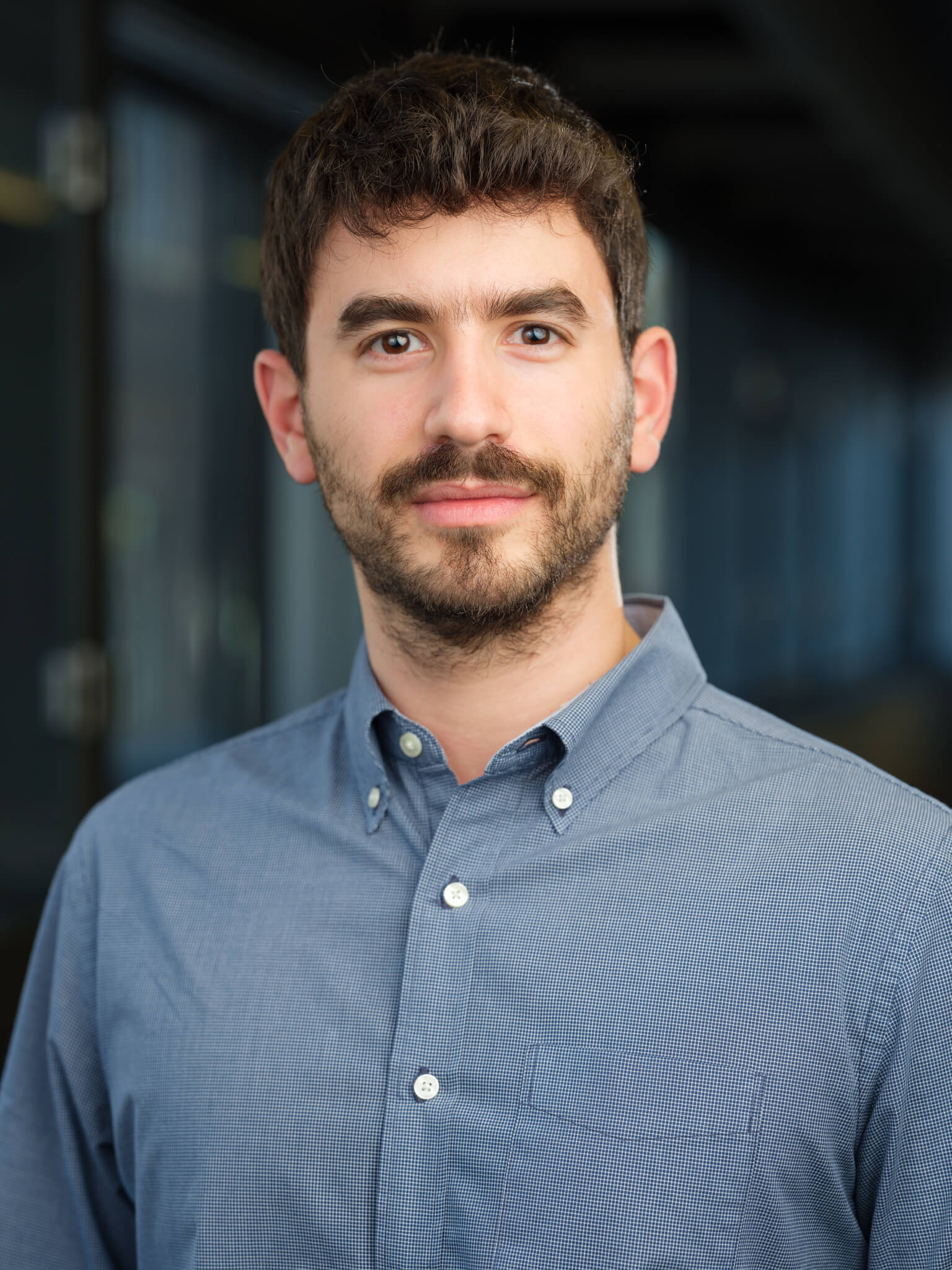
Manuel Melon is a Professor at the Acoustics Laboratory of the University of Le Mans , where he co-supervises the International Master in Electroacoustics (IMDEA) . His career spans institutions like the Conservatoire National des Arts et Métiers in Paris and focuses on advanced acoustic research. His research interests include electroacoustics , sound field synthesis , personalized listening zones , and acoustic material characterization using transducer arrays. He explores both theoretical and applied aspects of wave propagation in complex media. Recent publications highlight trends in acoustic metamaterials for directional sound control, MEMS speaker modeling , and adaptive filtering for automotive sound zones. He also contributes to online acoustic education through the ACOUCOU platform.
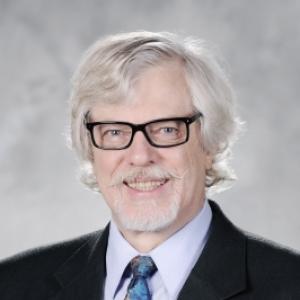
Lucas Illing is a Professor of Physics at Reed College, where he leads research in nonlinear dynamics and optics within the Department of Physics. His work bridges theoretical concepts with experimental implementations, focusing on how complex behaviors emerge from simple interacting components. Dr. Illing's research centers on nonlinear dynamic phenomena, particularly in systems with time-delayed feedback. His laboratory employs tabletop experiments combined with numerical modeling and analytical approaches to investigate fundamental questions in nonlinear dynamics. Key areas of focus include: Emergence of structure and complexity in adaptive component systems Dynamics of time-delay relay systems and electronic circuits Optoelectronic oscillators with narrowband feedback Network behavior in coupled nonlinear systems Chaos synchronization and amplitude death phenomena Analysis of his publication record from 2010-2024 reveals a consistent research trajectory focused on time-delay systems, particularly in electronic and optoelectronic implementations. His work shows progression from fundamental studies of single oscillators to more complex network behaviors, with practical applications in communication systems and computational methods. The research demonstrates strong integration of experimental work with theoretical modeling, often using custom-built electronic circuits to explore nonlinear phenomena. Dr. Illing has supervised numerous undergraduate researchers through Reed College's thesis program and summer research opportunities. His students have pursued diverse projects related to nonlinear dynamics, with many continuing to graduate programs or technical careers. Funding for this research appears to come from internal college fellowships including the Delord-Mockett Fund, James Borders Physics Student Fellowship, and Reed College Science Research Fellowship. His laboratory maintains experimental setups for investigating electronic and optoelectronic time-delay systems, water wheel chaos demonstrations, and related nonlinear phenomena. The research environment emphasizes hands-on experimental work combined with computational modeling, providing students with comprehensive research experience in nonlinear dynamics.
Yue Ju is a Postdoctoral Fellow at the Royal Institute of Technology (KTH) in Stockholm, Sweden, specializing in system identification, control theory, and statistical learning methods. Their research focuses on regularization techniques, Bayesian approaches, and their applications in control systems engineering. Dr. Ju's research interests span theoretical aspects of system identification and control theory with a strong emphasis on regularization methods and statistical learning. Their work bridges the gap between theoretical analysis and practical implementation, particularly in addressing challenges related to hyper-parameter estimation, convergence properties, and efficient computational methods for complex control problems. Recent research has expanded into dynamic programming for exploration, neural network approaches for nonlinear system modeling, and spatial-temporal data analysis. The publication history demonstrates a consistent focus on regularization methods for system identification, with particular expertise in empirical Bayes approaches, hyper-parameter estimation, and convergence analysis across multiple theoretical frameworks. Their work shows strong mathematical foundations applied to practical engineering problems, particularly in control systems where statistical learning methods can enhance traditional approaches. Dr. Ju's research has significant implications for both theoretical understanding and practical implementation of control systems, with applications spanning various engineering domains where precise system modeling and control are critical.
Daniel E. Rivera is Professor of Chemical Engineering at Arizona State University, affiliated with the Ira A. Fulton Schools of Engineering and the College of Health Solutions as a Health Solutions Ambassador. He serves as Program Director for Arizona State University's Control Systems Engineering Laboratory in the School for Engineering of Matter, Transport and Energy. Education: Ph.D. Chemical Engineering, California Institute of Technology (1987) M.S. Chemical Engineering, University of Wisconsin-Madison (1984) B.S. Chemical Engineering, University of Rochester (1982) Rivera's research bridges traditional engineering with healthcare applications, focusing on robust process control, system identification, and control engineering principles applied to process systems, supply chain management, and behavioral medicine interventions. His work represents a pioneering effort to apply engineering methodologies to health behavior modification, particularly in developing adaptive interventions using control systems approaches. His expertise spans Dynamical Systems Theory, Modeling and Simulation, and Health Information Technology. His recent publications demonstrate a clear trajectory toward applying control systems engineering to mobile health applications, with emphasis on personalized physical activity interventions, gestational weight management, and optimizing behavioral interventions using model predictive control frameworks. This work reflects his unique interdisciplinary perspective that combines control theory with behavioral science to create data-driven health solutions. Scientific Awards: K25 Mentored Quantitative Research Career Development Award from the National Institutes of Health (2007) Distinguished Member of the IEEE Control Systems Section (2019) Fellow of the American Institute of Chemical Engineers Fellow of the Society of Behavioral Medicine Rivera has secured significant research funding throughout his career, with current projects focused on control systems approaches for weight loss maintenance, personalized prenatal weight gain intervention, and optimizing CPAP adherence. His NIH-funded research demonstrates leadership in translating engineering principles to health behavior interventions, particularly in drug abuse prevention through control systems methodologies. His extensive grant portfolio shows consistent support for innovative applications of control engineering across multiple domains. Daniel Rivera directs the Control Systems Engineering Laboratory at ASU, where his team develops innovative control strategies that bridge theoretical engineering with practical healthcare applications. His laboratory serves as a hub for interdisciplinary research, connecting chemical engineering, electrical engineering, and behavioral medicine to solve complex problems in both industrial and healthcare settings.
Hans-Georg Brachtendorf is a Professor at the Research Center Hagenberg Embedded Systems within the School of Informatics, Communications and Media at the University of Applied Sciences Upper Austria - Hagenberg Campus. His work focuses on advanced circuit simulation techniques, RF engineering, and digital signal processing with significant contributions to harmonic balance methods and nonlinear circuit analysis. His research interests span electronic circuit design, RF power amplifiers, digital signal processing, and nonlinear dynamics. Specializing in harmonic balance methods and oscillator circuits, he has developed innovative techniques for steady-state circuit simulation, nonlinear adaptive filtering, and multiplier-less digital filter design. His work bridges theoretical mathematics with practical electronic engineering applications, particularly in THz-wave detection and wireless communication systems. Analysis of his recent publications (2022-2025) reveals a strong focus on nonlinear dynamics identification using symbolic regression, optimization of digital filters through multiplier-less architectures, and governing equation reconstruction from measurement data. His work demonstrates consistent advancement in computational efficiency for circuit simulation while addressing modern challenges in RF and THz technologies. While no specific scientific awards are listed in the available data, his research has generated significant academic impact with 43 publications since 1994 and an h-index reflecting substantial citation influence. Professor Brachtendorf has supervised at least two academic works according to institutional records, though specific student names are not provided. His research activities include collaborations evidenced by joint publications with researchers such as Steiger, Dalpiaz, and Kronberger across multiple institutions. The Research Center Hagenberg Embedded Systems serves as his primary laboratory environment, focusing on digital transformation within ICT strength areas with particular emphasis on circuit simulation and signal processing applications.
Søren Wengel Mogensen is an Associate Professor at the Department of Finance, Copenhagen Business School, Denmark. His research focuses on developing advanced statistical and machine learning methodologies for complex systems analysis. Research Interests: Dr. Mogensen's work spans causal inference, stochastic processes, survival analysis, and time-series modeling. Key themes include: Causal discovery algorithms for industrial and biological systems Graphical representations of dependencies in high-dimensional data Time-varying mediation in survival contexts Bayesian networks for cascade modeling Publication Trends: His recent articles (2021-2025) demonstrate a strong emphasis on theoretical-statistical innovation with applications in healthcare, industrial monitoring, and computational finance. Dominant methodologies include kernel-based independence tests, continuous-time Bayesian networks, and constrained stochastic process modeling.
Le Chen is a Doctoral Researcher at the Empirical Inference Department of the Max Planck Institute for Intelligent Systems and ETH Zurich , advised by Prof. Bernhard Schölkopf and Prof. Dieter Büchler. Previously, he obtained his M.S. in Electrical Engineering and Information Technology from ETH Zurich and gained research experience at Microsoft Mixed Reality & AI Lab, Tencent AI Lab, and Tencent Robotics X Lab. Research Interests: Le Chen focuses on the intersection of robotics and machine learning, with a specific emphasis on reinforcement learning for dexterous manipulation, visual-inertial calibration, and uncertainty-aware robotic perception. His work spans dynamic motion control, policy gradient subspaces, and novel algorithms for 3D/4D reconstruction. Key Contributions: He co-developed the RP1M dataset for bimanual piano manipulation and contributed to tendon-driven robot design ( Safe & Accurate ) and LEAP-VO for robust visual odometry. His research also includes Gaussian splatting dynamics for 4D content creation ( GaussianFlow ). Scientific Awards: Best Systems Paper Finalist at RSS 2024 for the RP1M dataset
Dr. Madhur Tiwari is an Assistant Professor at Florida Institute of Technology's College of Engineering and Science, Department of Aerospace, Physics, and Space Sciences. As Lab Director of the Autonomy Lab, he specializes in aerospace robotics, machine learning, control systems, and computer vision for autonomous technologies in space and aerial systems. PhD in Aerospace Engineering Former affiliation: Embry Riddle Aeronautical University Research Interests: His work focuses on data-driven techniques for aerospace autonomy, including system identification, nonlinear dynamical system linearization, adaptive/optimal control for asteroid proximity operations, spacecraft swarm navigation, and AI integration in aerospace robotics. Projects involve GPS-denied navigation and robust control systems. Laboratory: The Autonomy Lab develops cutting-edge tools for aerospace autonomy, utilizing simulation environments (e.g., Gazebo) and real-world testbeds like the ModalAI Voxl m500 quadcopter hardware. Research topics: Spacecraft dynamics, multi-agent systems, 3D reconstruction of space bodies, safety-critical control Teaching: Currently instructs Spaceflight Mechanics and Modern Control Theory courses.
Erik I. Verriest is a Professor in the School of Electrical and Computer Engineering at the Georgia Institute of Technology , where he has been a faculty member since 1980. He also served as a visiting professor at Georgia Tech Lorraine during the 1991–92, 1993–94, and 1994–95 academic years. His research focuses on mathematical system theory, control systems, delay-differential systems, and their applications in robotics and autonomy. Education: 1973 – Burgerlijk Electrotechnisch Ingenieur , State University of Ghent, Belgium 1975 – M.Sc., Stanford University 1980 – Ph.D., Stanford University Research Interests: Professor Verriest's work spans a wide range of theoretical and applied areas in control and system theory. He has made significant contributions to the algebraic theory of time-varying linear systems , balancing techniques , and array algorithms . His more recent work includes periodic and hybrid systems , delay-differential systems , model reduction for nonlinear systems , and control under communication constraints . He has also explored applications in cryptography , data compression , and optical computing . His research is deeply rooted in mathematical system theory , with a focus on nonlinear dynamics , optimal control , and stability analysis of complex systems. His work often bridges theoretical insights with practical applications in robotics and autonomous systems . Publications Trend: From 2020 to 2025, Professor Verriest has published extensively on optimal control methods , delay systems , and nonlinear dynamics . His recent work emphasizes model-free control strategies , state-dependent delays , and energy-efficient control in autonomous systems . He has also contributed to the theoretical foundations of generalized functions and operator differential equations with applications in signal processing and system modeling. Scientific Awards & Honors: While specific awards are not listed in the provided text, Professor Verriest is noted to be a member of the IFAC Committee on Linear Systems and has served on numerous International Program Committees (IPCs) , indicating recognition and leadership in his field. Contact & Affiliation: Email: erik.verriest@ece.gatech.edu Office: VL 492, Georgia Institute of Technology Phone: 404.894.2949 He is also affiliated with the Institute for Robotics and Intelligent Machines (IRIM) at Georgia Tech, where he is a Core Faculty member in Robotics .
Roland Toth is a Full Professor in the Control Systems Group within the Department of Electrical Engineering at Eindhoven University of Technology (TU/e). His research bridges Linear Parameter-Varying (LPV) modeling and control, focusing on system identification, machine learning integration, and industrial applications. BSc/MSc in Electrical Engineering/Information Technology from University of Pannonia (2004) PhD in Control Engineering at TU Delft (2008) Postdoctoral experience at TU Delft (2008-2010) and UC Berkeley (2010-2011) Academic career progression: Assistant Professor (2012), Associate Professor (2018), Full Professor (2024) Roland’s work explores LPV models as intermediaries between Linear Time-Invariant (LTI) systems and nonlinear dynamics. Key research areas include: Data-driven modeling for industrial applications Fusion of machine learning and model-based control Automated controller design algorithms High-precision mechatronic systems Smart Process Operations and Control (SPROC) His publications (2010-2018) emphasize prediction-error frameworks, series-expansion representations, and practical implementations across chemical processes and mechatronics. Awards include the 2016 grant for LPV modeling and control synthesis innovations. Roland contributes to education through courses on robust control, stochastic processes, and machine learning for systems, while leading the Autonomous Motion Control Lab and collaborating with EAISI High Tech Systems.
Dr. Tara Baldacchino is a Senior Lecturer in the School of Electrical and Electronic Engineering at the University of Sheffield, specializing in systems engineering and inclusive pedagogy. With a PhD from the University of Sheffield (2011), she bridges technical and educational research through her work in curriculum design and employability integration. Her affiliations include the Automatic Control and Systems Engineering (ACSE) department and the Dynamical Systems and Systems Engineering research group. PhD (University of Sheffield, 2011) MSc Advanced Control (University of Sheffield, 2007) BEng Electrical Engineering (First Class, University of Malta, 2006) Her research focuses on embedding employability and inclusive engineering design into technical curricula, with a particular emphasis on systems engineering principles. She teaches programming, embedded systems, and project-based learning frameworks such as ACS130 , ACS233 , and the Group Control Project module. Recent publications highlight her expertise in Bayesian system identification , nonlinear dynamics , and medical robotics , with applications spanning EMG signal analysis, magnetic capsule endoscopy, and structural health monitoring. Her methodological work includes probabilistic models and mixture-of-experts frameworks for robust system estimation. As Mechatronic and Robotic Engineering Programme Lead and Computer Systems Engineering Programme Lead , she shapes interdisciplinary curricula while maintaining active collaboration between ACSE and the Mechanical Engineering Department.
Professor Michael Balikhin is a distinguished academic in the Space Systems Laboratory at the University of Sheffield's School of Electrical and Electronic Engineering . With over 30 years of research experience, his work focuses on space plasma physics , collisionless shocks , plasma turbulence , and radiation belt dynamics . He serves as Principal Investigator for the Digital Wave Processor instruments on ESA's Cluster satellites and as editor of Journal of Geophysical Research: Space Physics . PhD in Physics (1989) Joined Sheffield in 1995 Key contributor to Cluster mission Leading expert in nonlinear space plasma systems Research Areas His research spans space weather , solar-terrestrial relations , and spacecraft instrumentation , with particular emphasis on electron heating mechanisms , shock structures , and nonlinear system identification . The 15 most recent articles demonstrate his expertise in gamma-ray burst analysis , magnetospheric wave dynamics , and multi-point space plasma observations . Scientific Recognition Leverhulme Grant (2024-2027) STFC/NERC grants exceeding £1.5M EPSRC Platform Grant (2010-2015) Over 20 years of ESA Cluster mission involvement Key Collaborations Extensive collaborations with ESA , STFC , AGU , and international space agencies. Currently working with University of Michigan , Space Research Institute (Austria) , and Skobeltsyn Institute (Russia) .
Changfu Zou is an Associate Professor in Control Engineering at Chalmers University of Technology, affiliated with the Automatic Control Research Unit. He specializes in modeling and automatic control of energy storage systems, particularly lithium-ion batteries, with significant industry collaborations including Volvo Cars, Volvo Trucks, Polestar, Scania, and CEVT AB. PhD in Automation and Control Engineering from the University of Melbourne Visiting Researcher at University of California, Berkeley (2015–2016) His research integrates machine learning with electrochemical models to enhance battery performance in electric vehicles and energy systems. Key projects include predictive control for fast charging, digital twin development, and grid-integrated EV charging optimization. Recent publications focus on multi-phase battery modeling , thermal management , and health-aware charging algorithms . He supervises projects funded by the European Commission, Swedish Research Council, and Knut and Alice Wallenberg Foundation. Awards IEEE Vehicular Technology Society Best Vehicular Electronics Paper Award IEEE Transactions on Transportation Electrification Prize Paper Award IEEE VTS Climate Challenge Award Nordic Energy Challenge Award As Associate Editor for journals like IEEE Transactions on Vehicular Technology and iScience , he contributes to editorial oversight in transportation and energy systems.
Dr. Hidehiro Yonezawa is a Senior Lecturer in the School of Engineering and IT at the University of New South Wales Canberra (UNSW Canberra), where he has been appointed since September 2013. He is also a Chief Investigator at the ARC Centre of Excellence for Quantum Computation and Communication Technology since 2015. His academic career began at the University of Tokyo, where he completed his PhD in 2007 under Prof. Akira Furusawa, later serving as a Research Associate and then Lecturer from April 2009 until September 2013. Dr. Yonezawa's research spans experimental quantum optics, quantum information, and quantum control. His work focuses on generating non-classical quantum states of light (particularly squeezed states), continuous variable quantum teleportation, adaptive optical phase estimation, measurement-based quantum computation, coherent-control quantum computation, and quantum tomography. His research demonstrates strong interdisciplinary connections between quantum physics, optical engineering, and information theory, with applications in quantum computing and communication technologies. His recent publications reveal a strong trend toward quantum information processing with continuous variables, particularly in quantum tomography, quantum control systems, and measurement-based quantum computation. His work bridges theoretical quantum information science with experimental quantum optics, with a growing emphasis on practical implementations of quantum technologies. The research shows increasing collaboration with international teams working on quantum materials and quantum technology development. Dr. Yonezawa has received notable recognition for his contributions to quantum science, including The Young Scientists' Prize, the Commendation for Science and Technology by the Minister of Education, Culture, Sports, Science and Technology of Japan (2014) Incentive award from The Laser Society of Japan (2009) As a Senior Lecturer at UNSW Canberra, Dr. Yonezawa actively mentors PhD students, offering scholarships of $35,000 AUD for exceptional candidates with High Distinction undergraduate results or completed Masters by Research degrees. His position as Chief Investigator at the ARC Centre of Excellence for Quantum Computation and Communication Technology provides significant research funding and collaborative opportunities in quantum technology development. Dr. Yonezawa's laboratory work is centered around experimental quantum optics, with a focus on continuous-variable quantum information processing. His research group at UNSW Canberra collaborates extensively with the Furusawa laboratory at the University of Tokyo and other international quantum research centers, particularly in the development of time-domain multiplexed quantum systems and quantum measurement technologies.
Dr. Anastasios Tsiamis is a Lecturer at the Department of Information Technology and Electrical Engineering at ETH Zürich, working in the Automatic Control Laboratory (Professur Control and Computation). His research focuses on the intersection of control theory and machine learning, specifically investigating how system theoretic properties affect the statistical difficulty of learning in system identification, online estimation, and control. Dr. Tsiamis received his Diploma (MEng, five-year degree) in Electrical and Computer Engineering from the National Technical University of Athens (NTUA). He completed his Ph.D. in Electrical and Systems Engineering at the University of Pennsylvania under Professor George Pappas, following graduate research with Professor Petros Maragos and undergraduate work with Professor Kostas J. Kyriakopoulos at NTUA. His primary research areas include Statistical Learning and Control, Data-Driven Control, Online Learning, Risk-Aware Control, and Security and Privacy in Networked Control Systems. Dr. Tsiamis has made significant contributions to understanding the fundamental statistical limits of learning in control systems, particularly focusing on sample complexity. His work on risk-aware optimization develops algorithms that safeguard against catastrophic events while maintaining good average performance, and his security research addresses eavesdropping attacks in remote estimation and motion planning. Analysis of Dr. Tsiamis's recent publications reveals a strong focus on data-driven approaches to control theory with emphasis on distributionally robust methods, risk-aware optimization, and finite sample guarantees. His work bridges theoretical foundations with practical applications across system identification, online learning, and adaptive control, providing rigorous non-asymptotic guarantees for learning-based control algorithms. Dr. Tsiamis has received several notable research recognitions: Best student paper award at IEEE 61th Conference on Decision and Control (2022) Spotlight Presentation at 41st International Conference on Machine Learning (2024) Finalist for best student paper award at American Control Conference (2019) Finalist for young author prize at IFAC World Congress (2017) Oral presentation at 2nd L4DC Conference (2020) Dr. Tsiamis teaches Linear System Theory (227-0225-00L) at ETH Zürich and collaborates extensively with Professor John Lygeros, Professor Manfred Morari, and researchers from the University of Pennsylvania. His publication record demonstrates strong collaborative research across multiple institutions while advancing theoretical foundations of learning-based control. As an active member of the Automatic Control Laboratory at ETH Zürich, Dr. Tsiamis contributes to advancing control systems science through rigorous mathematical analysis and innovative algorithmic development, with applications spanning robotics, energy systems, and networked control.