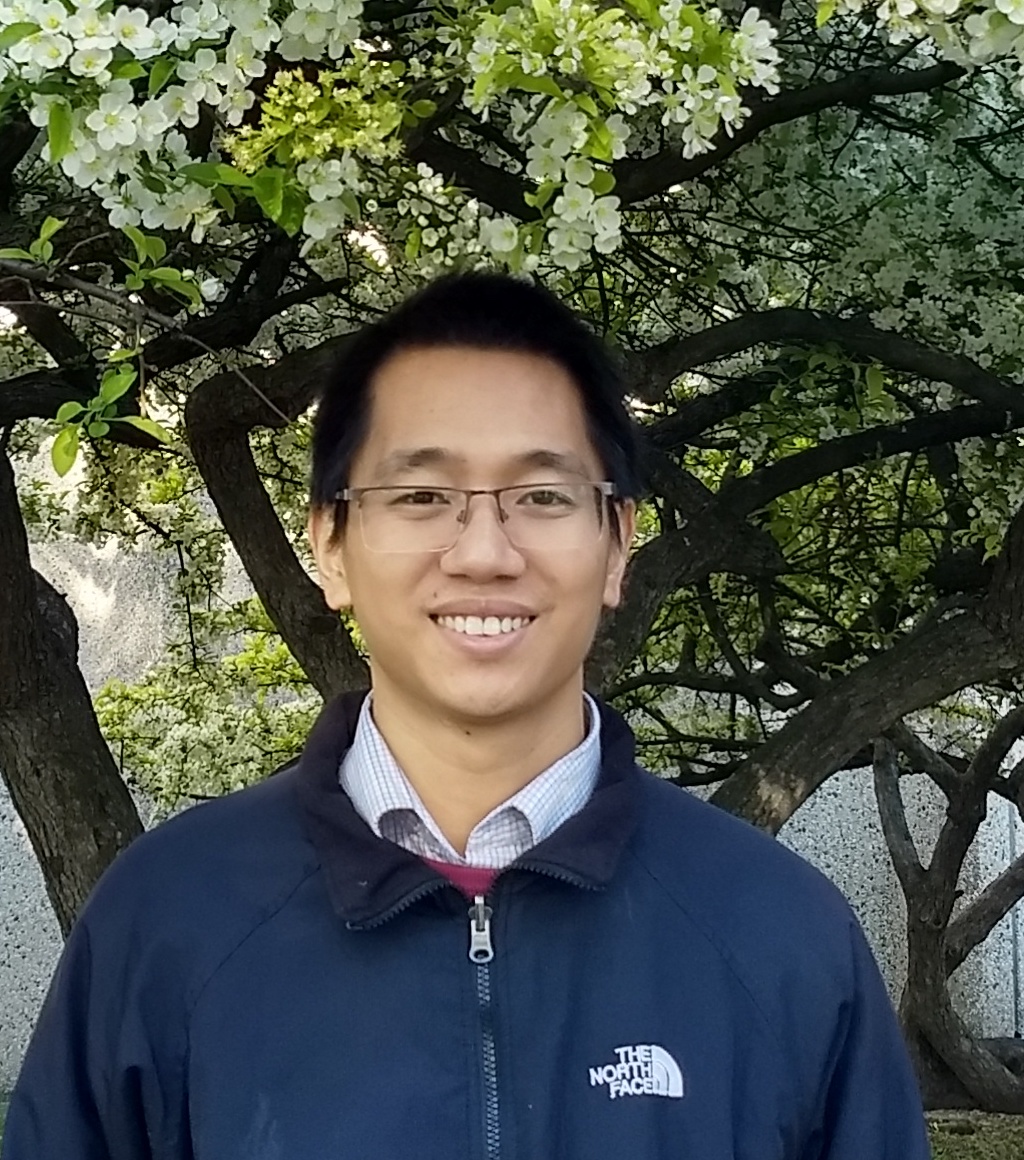
Tung T. Nguyen is a Visiting Assistant Professor of Computer Science at Lake Forest College, with a PhD in Mathematics from the University of Chicago (2020). He will transition to a tenure-track Assistant Professor position at Elmhurst University in Fall 2025. His research bridges computational number theory, spectral graph theory, and nonlinear dynamics, with recent work exploring AI-driven theorem proving. He actively mentors students, emphasizing experimental projects that merge mathematical rigor with coding. Education: PhD in Mathematics (University of Chicago, 2020) under Prof. Kazuya Kato; Postdoc at Western University (2020-2024); Undergraduate at Vietnam National University. Research focuses on Algorithms for prime number theory Applications of algebraic structures in graph theory Nonlinear oscillator networks and synchronization phenomena Key awards: 2025 SIAM Early Career Travel Award (to present work at AG25 conference) and MAA Project NExT fellowship. Organized conferences include the virtual celebration of Prof. Moshe Rosenfeld's 85th birthday. Teaching includes Probability & Statistics and independent studies on prime number algorithms. Collaborates on initiatives like the Vietnam PolyMath REU program.
Yossiri Adulyasak is a Full Professor in the Department of Logistics and Operations Management at HEC Montréal, holding the Canada Research Chair in Supply Chain Analytics. He is also an Adjunct Professor at the University of Montreal's Department of Computer Science and Operations Research and a scientific advisor at IVADO Labs. His research focuses on supply chain optimization, data-driven decision-making, and robust optimization under uncertainty, with applications in retail, transportation, and humanitarian logistics. Education: PhD in Operations and Logistics Management (HEC Montréal), Master of Civil Engineering in Transportation Engineering (Chulalongkorn University). Research Interests : Supply chain analytics, large-scale optimization algorithms, stochastic programming, machine learning integration, and resilient supply chain design. His work emphasizes practical applications in logistics networks, inventory management, and dynamic resource allocation under uncertainty. Recent Articles : Focus on AI-driven retail analytics, robust optimization for lot-sizing and facility location, and humanitarian logistics. Key topics include pandemic response strategies, electric vehicle routing, and drone delivery systems. Awards : Recipient of the 2021 Prix de recherche Chenelière Éducation/Gaëtan Morin for excellence in scientific publications. Supervision : Directed 3 PhD dissertations and over 40 master’s and project supervisions, collaborating with companies like Bombardier, Pratt & Whitney Canada, and JDA. Active in industrial partnerships for supply chain optimization solutions. Lab/Teams : Member of GERAD (Group for Research in Decision Analysis) and IVADO Labs, contributing to cross-disciplinary AI and operations research initiatives.
Dr. Kamil Khan is an Associate Professor of Chemical Engineering at McMaster University , part of the Faculty of Engineering . His research focuses on deterministic global optimization, nonsmooth optimization, and dynamic optimization of chemical process systems, integrating applied mathematics and algorithm development. He holds a B.S.E. from Princeton University, M.S. and Ph.D. from MIT, and completed a postdoc at Argonne National Laboratory. He teaches CHEM ENG 4E03/6E03: Digital Computer Process Control , covering digital control systems and model predictive control. His lab, the Khan Research Group , explores topics like convex relaxations, automatic differentiation, and adjoint sensitivity analysis for process optimization. Recent work includes advancements in computational methods for dynamic systems, membrane fouling prediction in water treatment plants, and subgradient evaluation for global optimization. His research bridges theoretical mathematics with practical engineering challenges.
Christopher Swartz is a Professor in the Department of Chemical Engineering at McMaster University and Director of the McMaster Advanced Control Consortium (MACC). He specializes in process systems engineering, with a focus on operations optimization, dynamic modeling, and supply chain optimization. His work integrates advanced control strategies with real-time optimization to enhance industrial process efficiency under dynamic conditions. Education: B.Sc. (Eng.) Chemical Engineering, University of Cape Town Ph.D. Chemical Engineering, University of Wisconsin Professional Licenses: P.Eng. (Ontario), MAIChE, MCSChE Research Interests: Dynamic optimization of transient processes (e.g., electric arc furnaces, air separation units) Integration of design and control for plant operability Supply chain optimization under uncertainty Economic model predictive control and real-time optimization Large-scale dynamic optimization under uncertainty using parallel computing Teaching: Teaches CHEM ENG 3P04 (Process Control), covering transient process behavior, automatic control theory, and computer process control. MACC Leadership: Directs MACC, a research consortium advancing process automation through industry-academia collaboration. MACC focuses on cutting-edge control technologies, data analytics, and sustainable design.
Shaahin Filizadeh is a Professor in the Department of Electrical and Computer Engineering at the University of Manitoba's Price Faculty of Engineering. He previously served as the Department's Associate Head (Graduate Programs) from 2012 to 2019 and maintains an active research program in power systems and power electronics. His educational background includes a B.Sc. (1996) and M.Sc. (1998) in Electrical Engineering from Sharif University of Technology, Tehran, Iran, and a Ph.D. (2004) in Electrical Engineering from the University of Manitoba. Power Systems Power Electronics Modeling and Simulation of Power-Electronic Intensive Networks HVDC Converters and Modular Multilevel Converters (MMCs) Dynamic Phasor Modeling Techniques Electrified Vehicular Systems and Energy Storage Integration His research focuses on advanced energy conversion systems, power-electronic intensive networks, and specialized modeling methods including average-value models and dynamic phasors. Current work emphasizes low-inertia systems, battery energy storage converters, and MMC topologies with DC fault blocking capability. He directs the Power Electronics and Energy Conversion Atelier for Modeling, Prototyping, and Simulation (PEEC-AMPS), a state-of-the-art facility equipped with PSCAD/EMTDC, RTDS, and modular multilevel converters. Dr. Filizadeh serves as Chair of the IEEE Task Force on Dynamic Phasor Modeling Techniques and holds editorial positions at IEEE Transactions on Energy Conversion and IEEE Power Engineering Letters. He has supervised over 40 graduate students including 9 doctoral candidates and 32 master's students. His research has been supported by grants enabling hardware-in-loop simulation capabilities and advanced modeling tools for power system applications. His laboratory, PEEC-AMPS, features EMT simulation software, real-time simulators, modular multilevel converters, and power-electronic prototyping equipment for rapid development of energy conversion systems.
Dr. Hekmat Alighanbari is a Professor and Chair of the Department of Aerospace Engineering at Toronto Metropolitan University. He holds a PhD from McGill University (1995), MASc from Shiraz University (1989), and BSc from Isfahan University of Technology (1986). His expertise spans aeroelasticity, nonlinear dynamics, and fluid-structure interactions. Prior to academia, he worked as a senior aerospace engineer at Bombardier, blending industry experience with academic teaching since 1999. Research interests focus on aeroservoelasticity, flow-induced vibrations, and chaos theory. He teaches advanced courses such as AER 722 (Aeroelasticity) and AER 416 (Flight Mechanics). Dr. Alighanbari pioneered Toronto Metropolitan University's aerospace engineering program, the first of its kind in Canada, and actively contributes to curriculum modernization. He emphasizes student mentorship, offering guidance on academic and professional pathways. Despite administrative duties, he prioritizes student interaction, advocating for practical engineering education that bridges theoretical knowledge with real-world applications. His efforts aim to ensure graduates are industry-ready, as reflected in his statement: "Our graduates gain the experience they need to find jobs quickly."
Hoa Nguyen is an Assistant Professor in the Department of English at Toronto Metropolitan University. She holds a BA from the University of Maryland, College Park, and an MFA from New College of California, San Francisco. Her research focuses on poetry, creative writing, diasporic and immigrant subjectivity, Asian American poetry, and contemporary poetics. Nguyen is a prominent figure in diasporic literary communities, co-founding the She Who Has No Masters collective, a transnational network of Vietnamese and Southeast Asian womxn and non-binary writers. Her award-winning publications include *A Thousand Times You Lose Your Treasure* (2021), which earned a National Book Award nomination and the Canada Book Award, and *Violet Energy Ingots* (2016), shortlisted for the Griffin Prize. She has been recognized with prestigious accolades such as the Neustadt Prize nomination (2019), often compared to the Nobel Prize in Literature. Education: BA, University of Maryland, College Park MFA, New College of California, San Francisco Awards: 2021 Canada Book Award 2017 Griffin Poetry Prize Nominee 2019 Neustadt Prize Nominee Community Engagement: Founder of She Who Has No Masters Mentorship Program Member of Vietnamese/Southeast Asian diasporic collective focusing on artistic collaboration and community repair
Effie J. Pereira is an Assistant Professor in the Department of Psychology at Queen's University within the Faculty of Arts and Science. Previously, she was an NSERC Banting postdoctoral research fellow at the University of Waterloo working with Dr. Daniel Smilek in the Vision & Attention Laboratory. Her research program focuses on attentional dynamics, examining how attentional processes fluctuate over time across social situations, internal thoughts, and digital environments. Dr. Pereira earned her PhD in Experimental Psychology and Cognitive Science from Queen's University in 2020, followed by a Master's degree in Psychology-Brain Behaviour and Cognitive Science in 2014, and a Bachelor's degree in Psychology and Economics in 2008, all from Queen's University. Her research investigates the "ebbs and flows" of attentional processes over time, challenging traditional views of attention as static. She employs a multidisciplinary approach combining behavioral experiments (attentional tasks, experience sampling, collaborative activities), psychophysiological methods (eye tracking, EEG, fMRI), and computational approaches (nonlinear analyses, machine learning). Her work has revealed that individual patterns of attentional fluctuations are stable and predictable, with meaningful implications for real-world outcomes. Analysis of Dr. Pereira's recent publications shows a consistent focus on temporal dynamics of attention across contexts. Her research has evolved from examining basic attentional mechanisms to investigating attention in complex digital environments and social contexts. A notable trend is her increasing use of computational methods to analyze nonlinear patterns in attentional time series data, reflecting her technical expertise and innovative approach to cognitive science. NSERC Banting Postdoctoral Research Fellow As a mentor, Dr. Pereira takes a scaffolded approach, working with students to identify short-term and long-term goals that support their development as independent researchers. She leads the Queen's Attentional Dynamics (QuAD) lab and is actively recruiting graduate students for Fall 2026 in the Cognitive Neuroscience and Social-Personality area, with a focus on Canadian students due to current funding restrictions. Her mentorship emphasizes technical skill development including programming in Python, JavaScript, R, and MATLAB, as well as experience with eye tracking, EEG, and fMRI systems. Dr. Pereira directs the Queen's Attentional Dynamics (QuAD) lab, where she develops and applies innovative methodologies to study attentional fluctuations. She has created several specialized software platforms including TESSA (Temporal Experience Sampling Smartphone Application), VICTOR (Video Teleconferencing Platform), and MECO (Message Communication Platform) to study attention in naturalistic settings. Her lab also utilizes DAMARIS, EEGAN, FELIX, and EMMA for advanced analysis of attentional time series data.
James M. Fraser is a Professor of Physics at Queen's University, Canada, leading an experimental research team in coherent imaging, ultrafast nanosystems, and laser processing. He holds a PhD from the University of Toronto and has pioneered real-time monitoring techniques for high-power laser manufacturing, including welding and additive manufacturing. His work bridges fundamental physics and industrial applications, with six patents and the co-founding of Laser Depth Dynamics, now part of IPG Photonics. Fraser is recognized for teaching excellence, winning the CAP Teaching Medal and 3M National Fellowship. He directs the NSERC CREATE-MAPS program, fostering interdisciplinary training in photonics and sensing for graduate students in Physics, Chemistry, and Chemical Engineering. Research interests include optoelectronic properties of carbon nanotubes, 2D materials, and laser processing dynamics. His innovations in inline coherent imaging enable real-time control of manufacturing defects and material behavior. Fraser's contributions span academic publications, patents, and industry partnerships, emphasizing both scientific discovery and practical application. Education: PhD, University of Toronto Awards: CAP Teaching Medal, 3M National Fellowship, OCE Martin Walmsley Fellowship Labs/Teams: Experimental Physics Lab, Laser Depth Dynamics (spin-off)
Stan Dimitrov is a Professor in the Department of Management Sciences at the University of Waterloo, Canada, and Director of the Business Data Analytics Lab. He holds a PhD in Industrial and Operations Engineering from the University of Michigan (2010). His research focuses on the intersection of operations research and information systems, with expertise in sustainable operations management, business analytics, mechanism design, prediction markets, game theory, nonlinear optimization, and network design. He has secured funding from NSERC, SSHRC, Mitacs, and the University of Waterloo. Education: PhD in Industrial and Operations Engineering, University of Michigan (2010) MEng in Industrial and Operations Engineering, University of Michigan (2006) BSc in Computer Science, University of Michigan (2004) Research interests include addressing industry challenges in pricing, process improvement, and customer relationship management. His work spans theoretical contributions (e.g., game theory, optimization) and applied domains such as wildfire management, circular economy policies, and mental health impacts of digital financial tools. Recent studies analyze pandemic-driven consumer behavior shifts and the role of AI in dynamic pricing. He has received prestigious awards including the 2021 Canadian Operational Research Society Eldon Gunn Service Award and the 2018 Faculty of Engineering Distinguished Performance Award. His teaching portfolio includes advanced courses on scheduling, game theory, and data analytics, with a focus on graduate and professional development programs. Advising and grants: Dimitrov actively supervises graduate students and holds Sole-Supervisory Privilege Status at Waterloo. His funded projects investigate topics like wildfire budgeting, circular economy subsidies, and eco-innovation licensing. Labs/Teams: Leads the Business Data Analytics Lab, which develops data-driven solutions for organizational challenges. Collaborates on interdisciplinary initiatives in sustainable operations and emergency network resilience.
Andrew Milne is an Associate Professor in the Department of Mechanical and Mechatronics Engineering at the University of Waterloo . He specializes in teaching and research across fluid mechanics, thermodynamics, and engineering education. His courses include ME 100 (Introduction to Mechanical Engineering Practice), ME 250 (Thermodynamics 1), and SYDE 383 (Fluid Mechanics), taught over the past five years. His research integrates fluid dynamics with practical engineering challenges, such as drag reduction in turbulent flows and superhydrophobic surface applications. He actively mentors graduate students and focuses on innovative teaching methodologies, including hackathon-style design projects and assessment strategies. Professor Milne’s work bridges theoretical and applied engineering, emphasizing sustainable solutions and student-centered pedagogy. While no awards are listed, his contributions to curriculum development and hands-on learning environments are central to his academic profile. He is currently accepting applications for graduate research in his areas of expertise.
Pooya Ronagh is a Research Assistant Professor at the University of Waterloo, affiliated with the Department of Physics & Astronomy and the Institute for Quantum Computing (IQC). He also serves as a Scientific Lead at the Perimeter Institute Quantum Intelligence Lab (PIQuIL) and directs the Hardware Innovation Lab at 1QBit. His work bridges quantum computation, machine learning, and optimal control, focusing on quantum algorithms, error correction, and hybrid quantum-classical systems. Education: PhD in Mathematics (University of British Columbia, 2016), MSc in Mathematics (UBC, 2011), dual BSc in Mathematics and Computer Science (Sharif University of Technology, 2009). Awards include the Benjamin Franklin Fellowship (2009). Research Interests: Quantum algorithms for machine learning, reinforcement learning, fault-tolerant quantum architectures, cryogenic systems, and quantum control. He explores applications of quantum simulation to improve learning efficiency and robustness in AI systems. Recent work includes optimizing quantum error correction decoders, developing scalable superconducting architectures, and advancing neural network-based quantum state tomography. His contributions span theoretical frameworks (e.g., lattice surgery scheduling) and experimental methods (e.g., SFQ pulse control). Teaching: Courses like PHYS 490 (Machine Learning in Physics) emphasize practical coding and interdisciplinary projects. Grants and collaborations involve industry and academic partners in quantum hardware and software development. Labs: Hardware Innovation Lab (1QBit), IQC Quantum Control Group Future Work: Scaling quantum supercomputers, cryogenic neural decoders, quantum-enhanced generative AI
Dr. Adam H. Monahan is a Professor in the School of Earth and Ocean Sciences at the University of Victoria. His research focuses on atmospheric and oceanic processes, including stochastic dynamics, boundary layer meteorology, climate variability, and renewable energy meteorology. He is a member of the UVic Climate Modelling Group and has contributed to studies on wind energy, large-scale atmospheric variability, and Arctic climate dynamics. His work integrates statistical methods, stochastic parameterization, and numerical modeling to understand climate systems. Dr. Monahan has advised numerous graduate students and post-doctoral researchers, including current students in BSc, MSc, and PhD programs. His research spans interdisciplinary collaborations, with publications in journals such as Journal of Climate , Journal of Applied Meteorology and Climatology , and Nonlinear Processes in Geophysics . He teaches courses on Earth System Modelling, Atmospheric Sciences, and Dynamic Meteorology. His recent work emphasizes stochastic processes in climate models, Arctic sea ice dynamics, and the impact of boundary layer variability on wind energy systems. He has explored observational constraints on climate projections and the influence of anthropogenic factors on climate extremes.
Ali Ameli is an Assistant Professor in the Department of Earth, Ocean & Atmospheric Sciences at the University of British Columbia (UBC). He leads the HydroGeoScience for Watershed Management (HGS-WM) Research Group and is affiliated with the Institute of Applied Mathematics. His work focuses on understanding water and solute movement in watersheds, climate impacts, and land-use alterations to inform sustainable water management. Education: PhD in Geological Engineering (University of Waterloo, 2015), followed by postdoctoral research at the University of Saskatchewan and Uppsala University. Research Interests: Groundwater Ecohydrology, Hydro-geological Engineering, Watershed Management, Applied Hydro-geochemistry, Statistical Machine Learning. Recent projects include modeling water table dynamics via machine learning, snowmelt partitioning under climate variability, and interdisciplinary approaches for water security assessments. Supervision & Collaboration: He supervises graduate students in MSc and PhD programs and collaborates with agencies like water conservation organizations. Active in mentoring visiting researchers and co-op students, he emphasizes experiential learning through internships and placements. Affiliations: Institute of Applied Mathematics (UBC), leadership in interdisciplinary water research initiatives, and global collaborations with geochemists and ecologists.
Professor Peter D. Lawrence holds a faculty position at the University of British Columbia (UBC) within the Department of Electrical & Computer Engineering, part of the Faculty of Applied Science. He has been a Professor since 1974 and has held visiting research roles at Chalmers University of Technology (1970-1972) and MIT (1972-1974). His educational background includes a B.A.Sc. from the University of Toronto (1965), M.Sc. from the University of Saskatchewan (1967), and Ph.D. from Case Western Reserve University (1970). He is a Professional Engineer (P.Eng.) and Fellow of the Canadian Academy of Engineering (FCAE). Research interests focus on improving human-machine interfaces, sensor technologies for control systems, and medical robotics. Key areas include teleoperation of heavy machinery, vision-based control, EEG-based brain interfaces, and functional approximation methods for complex systems. Collaborations span multiple disciplines at UBC, including Mechanical Engineering, Computer Science, Mining Engineering, and Forestry, with funding from NSERC and PRECARN/IRIS. Medical Robotics: Brain-computer interfaces and ultrasound-guided surgery. Autonomous Systems: Path planning and vision-based tracking for excavators and haul trucks. Sensing Technologies: Eye-tracking, joint-angle sensors, and slip detection for mobile robots. His teaching contributions include coordinating the Project Integrated Program (PIP) for ECE students and co-developing the interdisciplinary New Venture Design course with the Sauder School of Business. He leads the RCL Lab and has authored books on real-time microcomputer systems and contributed to IEEE publications. Awards include recognition as a Fellow of the Canadian Academy of Engineering.