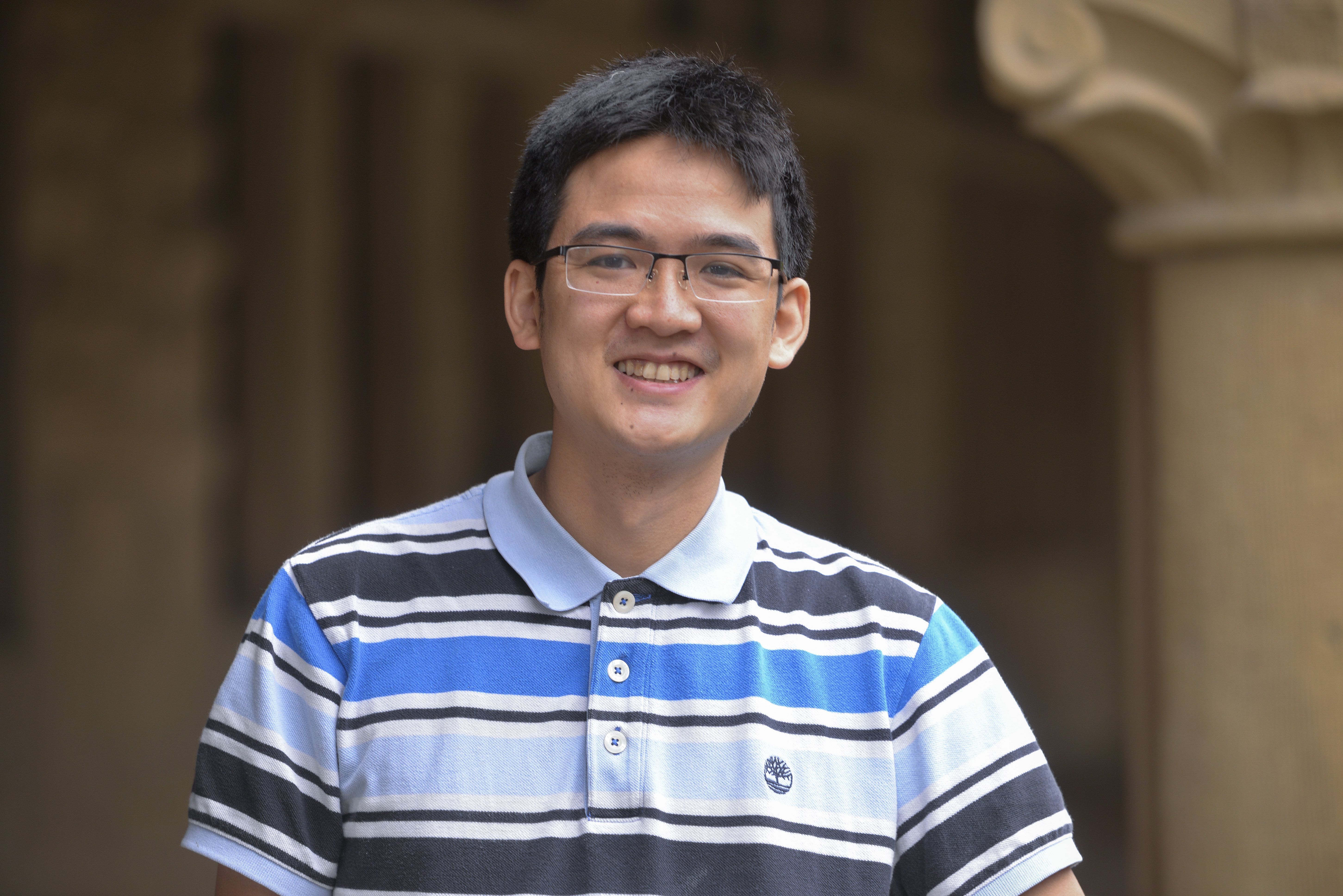
Jonathan Winghong Luk is a Professor in the Department of Mathematics at Stanford University. His research focuses on nonlinear partial differential equations, general relativity, and mathematical physics, with a particular emphasis on gravitational wave dynamics, shock formation, and high-frequency spacetime solutions. Contact: Email: jluk@stanford.edu Office: 382-Z, Building 380, Stanford, CA 94305 Research Trends: His recent publications examine nonlinear wave equations on dynamic spacetimes, gravitational phase mixing, impulsive gravitational wave interactions, and stability of black hole interiors. He frequently collaborates with experts like C. Huneau, S.-J. Oh, and J. Speck. Academic Activities: Luk organizes the Analysis and PDE seminar at Stanford with Eugenia Malinnikova and Ryan Unger. He has developed lecture notes on nonlinear wave equations and Fourier analysis, complemented by example sheets.
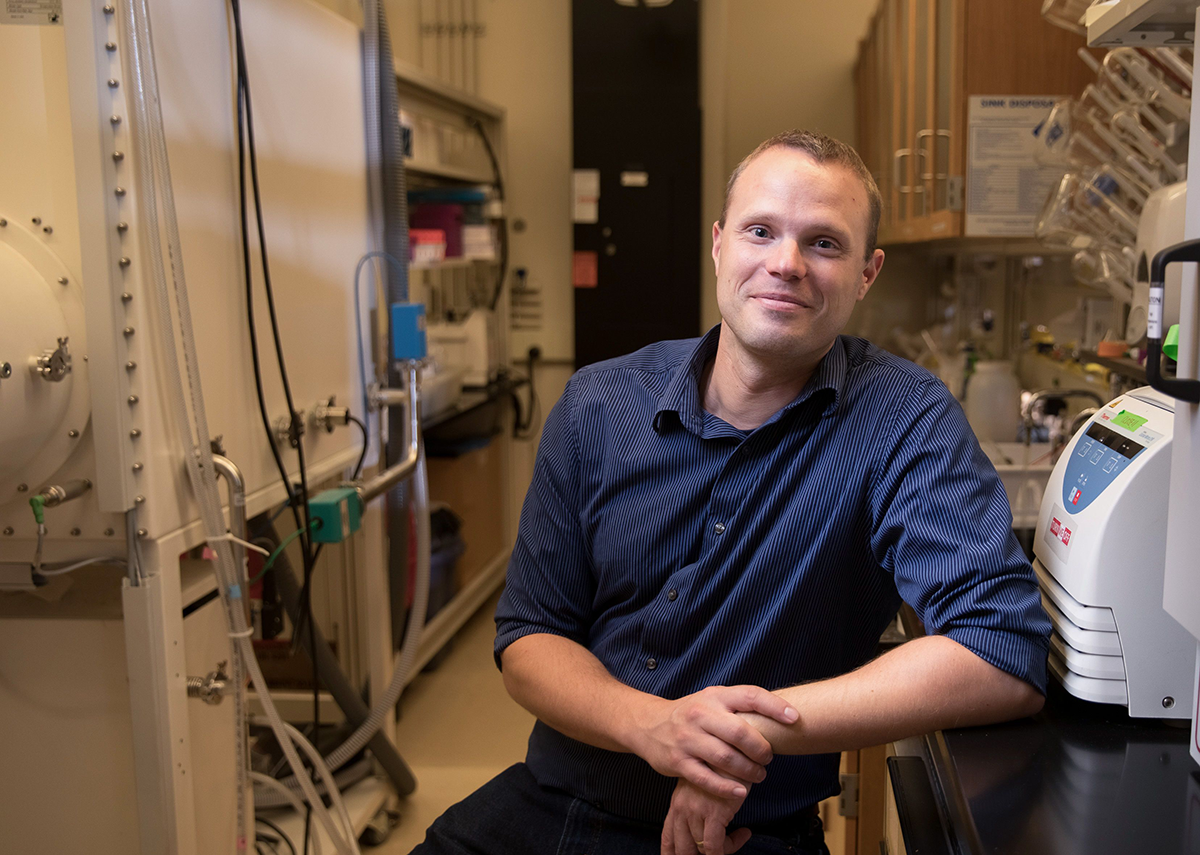
Bradley D. Olsen is a full professor in the Department of Chemical Engineering at the Massachusetts Institute of Technology (MIT), where he leads research at the intersection of polymer science, soft matter physics, and bioengineering. His work focuses on designing materials for critical applications in biotechnology, hemostasis, and sustainable polymer development while advancing fundamental understanding of polymer network mechanics and self-assembly. Education: Ph.D. in Chemical Engineering, University of California Berkeley (2007) S.B. in Chemical Engineering, Massachusetts Institute of Technology (2003) Olsen's research spans protein-based materials, block copolymer phase behavior, and mechanochemical hydrogels. He has pioneered methods for quantifying polymer network topology, developing hemostatic nanoparticles, and creating bio-inspired materials for selective biomolecular transport and medical applications. His recent publications emphasize data-driven approaches to polymer characterization and educational outreach in materials science. Scientific Awards: American Physical Society (APS) Fellow (2023) Fulbright Amazonia Scholar (2023) Alexander and I. Michael Kasser Chair in Chemical Engineering (2021) ACS Macro Letters Young Investigator Award (2021) MIT Committed to Caring Honor (2019) AIChE Owens Corning Early Career Award (2019) APS Dillon Medal (2018) Kavli Emerging Leader in Chemistry (2017) ACS Polymer Division Fellow (2016) Camille Dreyfus-Teacher Scholar (2015) Alfred P. Sloan Research Fellow (2014) NSF Career Grant (2013) NIH Postdoctoral Fellowship (2008-2009) Hertz Fellow (2003-2007) Barry M. Goldwater Scholarship (2002) Olsen has received significant grant support including NSF Career (2013) and AFOSR (2012) awards. His teaching activities include innovative international outreach like the 2025 soccer-themed science camp in Brazil. The Olsen Group at MIT explores advanced materials with applications ranging from trauma care to sustainable polymers.
Peter K. Kitanidis is a Professor in the Department of Civil and Environmental Engineering and the Institute for Computational and Mathematical Engineering at Stanford University . His research focuses on groundwater flow , hydrologic forecasting , and stochastic inverse modeling , with applications to pollutant remediation and CO₂ storage monitoring . Education : Diploma, National Technical University of Athens (1974) M.S., MIT (1976) Ph.D., MIT (1978) Research Interests : Groundwater modeling and contaminant transport Hydraulic tomography and aquifer characterization Stochastic methods for uncertainty quantification Bioremediation and enhanced in-situ pollutant decay Dilution and mixing processes in heterogeneous media Real-time river flow forecasting Scientific Awards : L.G. Straub Award (1979) W.L. Huber Research Prize (1994) ISI Highly Cited Researcher (2001) AGU Hydrologic Sciences Award (2011) ASCE Pioneers in Groundwater Lecturer (2011) Advising and Grants : Advised 20+ PhD and MS students (1978–2018) Principal investigator on NSF, EPA, and DOE-funded projects Developed software for groundwater data analysis and CO₂ monitoring Contributed to bioremediation protocols and hydraulic tomography algorithms Labs and Teams : Kitanidis Laboratory for groundwater crisis solutions Collaborated with Oak Ridge National Laboratory and Stanford Hydrogeology Group Mentored postdocs (2000–2017) in reactive transport and inverse modeling
Stephen Roberts is a Professor at the Australian National University (ANU) in the College of Science, Department of Mathematics. He is the lead developer of the ANUGA open-source hydrodynamic modeling software, which simulates dam breaks, floods, and tsunamis for governments and engineers. Roberts has made significant contributions to computational mathematics, particularly in numerical methods for partial differential equations, sparse grid data fitting, and finite element approximations scaling to millions of data points. MSc, Flinders University (1980) PhD, University of California, Berkeley (1985) His research interests include: Computational methods for shallow water wave equations Development of Python-based scientific computing frameworks Global sensitivity analysis and uncertainty quantification Adaptive mesh algorithms for fluid dynamics Recent publications focus on energy-stable numerical schemes, multiscale flood simulation, and convergence analysis in sensitivity methods. Roberts actively collaborates with environmental agencies and has led major computational science education programs at ANU. Stephen serves as Treasurer of the Computational Mathematics Group (ANZIAM) and leads projects in: Parallelization of hydrodynamic models CO2 leak detection via atmospheric measurements Optimization of sparse grid combinations His work combines theoretical advancements with real-world applications in disaster risk reduction and climate policy.
Betsy Stovall is a Professor of Mathematics at the University of Wisconsin–Madison and holds the Letters and Science Mary Herman Rubenstein Professor chair. She serves as the AMS Associate Secretary for the Central Section . Education : Not explicitly stated in provided text. Appointments : Regular faculty at UW–Madison since at least 2012 Organizer of graduate analysis seminars Research Interests : Stovall specializes in harmonic analysis , focusing on operators involving curvature, oscillatory integrals, and Fourier restriction phenomena. Her work intersects with partial differential equations (PDEs) through the study of dispersive equations and geometric analysis problems. Teaching : Complex Analysis (Math 623) - Fall 2021 Calculus III (Math 234) - Fall 2020 Graduate Analysis Seminar - Spring 2022 Organized UW Madison undergraduate summer school in Analysis (2018) Scientific Contributions : Sole or joint author of 15+ publications NSF RTG grant in Analysis and PDE Active in harmonic analysis seminars and educational initiatives Administrative Roles : AMS Associate Secretary Co-organizer of RTG/Student seminars Summer school director
Andrea Blanco-Redondo is Florida Photonics Center of Excellence Endowed Professor at University of Central Florida's College of Optics and Photonics. Her research focuses on quantum photonics, topological photonics, and nonlinear phenomena in integrated photonic systems. Research areas include: Topological protection of quantum states Pure-quartic soliton dynamics Programmable photonic circuits Non-Hermitian photonic systems Silicon-based quantum devices Recent publications (2023-2025) show primary focus on topological photonics (6/11) and soliton physics (4/11), with emerging work in optical neural networks. Current group includes 3 PhD students and 2 undergraduate researchers with backgrounds in optics, quantum physics, and materials science. Significant honors: Optica Fellow (2024) Geoff Opat Early Career Prize (2016) Ada Byron Award for women in technology (2014) Marie Curie Fellowship (2013)
Olivia Constantin is an Associate Professor in the Department of Mathematics at the Faculty of Mathematics. She has been actively publishing since 2008, with research contributions in functional analysis, complex analysis, and mathematical fluid dynamics. PhD in Mathematics (implied by academic position and research output) Her research primarily focuses on operator theory on function spaces, especially Fock and Bergman spaces, and the application of complex analysis to fluid flows. Key areas include Hankel operators, integral operators, embedding theorems, and the analysis of water waves and oceanic gyres. Her work combines deep analytical techniques with applications in fluid mechanics. Recent publications show a strong trend toward using complex-analytic methods to study irrotational flows, traveling water waves, and gyre dynamics, indicating an interdisciplinary approach bridging pure and applied mathematics. Her 2025 paper on velocity extrema in ocean gyre flows highlights ongoing contributions to geophysical fluid dynamics. She has led two research projects: Operatorenklassen (2012–2016) and Analysis of Operators on Spaces of Holomorphic Functions (2017–2019), demonstrating sustained research leadership. Active speaker at academic conferences, with 18 recorded scientific activities including talks from 2008 to 2023 Olivia Constantin collaborates with prominent mathematicians such as A. Aleman, J. A. Peláez, A.-M. Persson, and D. Kalaj. She has not received any explicitly mentioned scientific awards. There is no information about her advising students or managing labs or research teams.
Dr Jordan Pitt is an academic affiliated with the University of Sydney's Faculty of Science. He holds the role of Associate Dean (Indigenous Strategy and Services) while also actively contributing as an applied mathematician. His work emphasizes interdisciplinary research and Indigenous inclusion in academia. Dr Pitt completed his PhD at the Australian National University in 2019, focusing on tsunami and storm surge modeling. He pursued post-doctoral research at the University of Adelaide, where his studies expanded into ocean wave-sea ice interactions. Current research investigates how wave dynamics influence sea ice growth/melt cycles, a critical factor in Earth's climate systems. Research Interests: Mathematical modeling of environmental systems Ocean wave mechanics Climate change impacts on sea ice Computational fluid dynamics While no specific scientific awards are explicitly listed, Jordan has been involved in initiatives like co-convening the Academy of Science’s 'Looking Back, Moving Forward' Public Lecture Series (2023) and organizing the ANZIAM 2024 Early Career Workshop. His efforts bridge Indigenous communities with STEM fields through programs like Science Pathways. As an educator and researcher, Jordan has not listed formal advisees or grants in the provided texts. His professional networks include roles in Indigenous strategy and academic service. Jordan’s work is associated with laboratories and teams focused on environmental fluid dynamics and climate modeling, though specific lab names are not mentioned.
Camil Muscalu is a Professor of Mathematics at Cornell University, affiliated with the College of Arts and Sciences. His research focuses on harmonic analysis and partial differential equations, particularly exploring the interplay between Fourier series, singular integrals, and their applications in physics and number theory. He has authored influential works such as Classical and Multilinear Harmonic Analysis with Wilhelm Schlag. Education: Ph.D. in Mathematics from Brown University (2000). Research Interests: Harmonic Analysis Partial Differential Equations Fourier Analysis Operator Theory Functional Analysis Recent Articles: Highlighting contributions to multilinear operators, sparse domination techniques, and the helicoidal method, with applications to estimates for Schrödinger equations and Fourier restriction problems. Collaborations include work with Terence Tao, Christoph Thiele, and Cristina Benea. Advising: Supervised 10+ Ph.D. students, including notable alumni Eyvindur Palsson, Cristina Benea, and Itamar Oliveira. Editorial roles at Communications on Pure and Applied Analysis , Journal of Functional Analysis , and Mathematische Zeitschrift . Labs/Teams: Active in Cornell’s Analysis Seminar and Oliver Club, fostering collaborative research in harmonic analysis and related fields.
Yvain Bruned is a Professor of Mathematics at Université de Lorraine, Nancy, France, where he leads research in singular stochastic partial differential equations and related fields. He serves as Principal Investigator for the ERC Starting Grant LoRDeT (2023-2028), which focuses on advancing the theory of decorated trees and Hopf algebraic structures for solving singular SPDEs and dispersive PDEs at low regularity. Previously, he was a Lecturer at the University of Edinburgh (2019-2022) and completed postdoctoral work at Imperial College London and University of Warwick under Martin Hairer. His educational background includes: PhD in Mathematics (2012-2015), UPMC (Paris 6), on "Singular KPZ type equations" under Lorenzo Zambotti Master 2 in Probability and Statistics, ENS Cachan / Rennes 1, with honors Master 1 in Mathematics, ENS Cachan, with honors Bachelor in Mathematics and Computer Science, University of Rennes 1, with honors Student at ENS Cachan Brittany extension (2009-2013) Classes Préparatoires in Mathematics and Physics (2007-2009) Bruned's research centers on singular stochastic partial differential equations, with particular focus on Regularity Structures, renormalization theory, and their connections to Hopf algebras. His work bridges theoretical mathematics with applications in quantum field theory, wave turbulence, and numerical analysis. He has developed novel approaches using decorated trees to handle renormalization procedures for singular SPDEs and has extended these methods to dispersive PDEs with random initial data. His research program aims to establish existence and uniqueness results for quasilinear and dispersive SPDEs while developing algebraic tools through deformations of Hopf algebras. His extensive publication record demonstrates consistent contributions to the field of singular SPDEs, with a clear trajectory from foundational work on Regularity Structures to more recent applications in dispersive PDEs and numerical methods. The publications reveal a strong collaborative network with leading researchers in stochastic analysis, mathematical physics, and algebra. His work shows increasing sophistication in handling renormalization procedures through algebraic structures, with recent papers exploring connections between different mathematical frameworks. His major scientific recognition includes: ERC Starting Grant LoRDeT (2023-2028) Bruned actively supervises a large group of researchers, currently advising 4 PhD students and 2 postdoctoral researchers at Université de Lorraine, with several former PhD students having completed their degrees at the University of Edinburgh. His ERC grant has enabled him to organize multiple international workshops in Nancy, fostering collaboration between researchers in singular SPDEs, algebraic structures, and numerical analysis. The grant also supports the development of software platforms for decorated trees and their Hopf algebraic structures. As Principal Investigator of the ERC LoRDeT project, Bruned leads a vibrant research team based at the Elie Cartan Institute of Lorraine, which includes postdocs, PhD students, and visiting researchers. The team regularly organizes specialized workshops on topics including operads, symmetries for quantum field theory, and normal forms for singular dynamics, creating a dynamic research environment that bridges multiple mathematical disciplines.
Professor Lydia Bourouiba is a faculty member at the Massachusetts Institute of Technology (MIT), affiliated with the Department of Civil and Environmental Engineering and the Institute for Medical Engineering and Science (IMES). Her research focuses on the intersection of fluid dynamics and disease transmission, with a strong emphasis on biophysics, interfacial flows, turbulence, and multiphase systems. Ph.D. in Applied Mathematics from McGill University (2008) Research on fluid fragmentation, droplet/bubble dynamics, and pathogen transport Co-Founder and Associate Director of the NSF Center for Pandemic Prevention (APPEX) Her work spans fundamental and applied domains, including: Biophysics of pathogen transport in air and water Turbulent multiphase flows in respiratory events Fluid-plant interactions in agricultural disease Nonlinear dynamics in public health contexts Key article trends highlight: Biomedical fluid mechanics Climate and environment-driven disease modeling High-risk/high-reward public health innovations Interdisciplinary approaches combining physics, biology, and engineering Scientific awards include: Fellow of the American Physical Society (2021) American Institute for Medical and Biological Engineering Fellow (2022) Smith Family Foundation Odyssey Award for biomedical research Ole Madsen Mentoring Award She serves as Associate Editor for the journal FLOW and has founded conferences like the Gordon Research Conference on Fluids in Disease Transmission. Her lab (Fluids and Health Network) develops experimental and theoretical frameworks to address contamination, pandemic control, and fluid-health-environment interactions.
Yongjie Yuan is a Researcher at the Technical University of Munich under the Associate Professorship of Computational Photonics within the TUM School of Computation, Information and Technology. His research focuses on quantum cascade devices, Josephson traveling-wave parametric amplifiers, and noise modeling in superconducting circuits. Institution: Technical University of Munich School: TUM School of Computation, Information and Technology Academic Rank: Researcher Email: yongjie.yuan@tum.de Yuan's work integrates quantum mechanics with computational photonics , emphasizing the modeling of superconducting circuits and microwave parametric amplifiers . He investigates dissipative-dispersive systems , flux-driven amplifiers , and nonlinear junction topologies to enhance quantum device performance. Recent publications highlight his contributions to quantum amplifier design , Josephson junction modeling , and noise dissipation analysis in microwave photonics. His research is associated with the EU Project QOMBS, focusing on quantum cascade devices and parametric amplification. Quantum Cascade Devices Josephson Traveling-Wave Parametric Amplifiers Quantum Noise Modeling Nonlinear Circuit Analysis Microwave Photonics Yuan actively participates in teaching and supervising activities, contributing to courses on computational photonics , quantum engineering , and partial differential equations for electrical engineering. He collaborates with researchers like Christian Jirauschek and Michael Haider on quantum device simulations.
Michele Dolce is a Lecturer and Scientist at the École Polytechnique Fédérale de Lausanne (EPFL), affiliated with the School of Basic Sciences (SB) and the Chair of Mathematical Analysis, Calculus of Variations and PDEs (AMCV). He previously held positions as a Postdoc at EPFL and a Research Associate at Imperial College London, where he worked under Prof. Michele Coti Zelati. His academic journey includes a PhD from the Gran Sasso Science Institute. Current affiliation: EPFL, School of Basic Sciences (SB), Department of Mathematics (MATH), AMCV Past affiliation: Imperial College London His research focuses on the mathematical analysis of Partial Differential Equations (PDEs) in fluid dynamics and kinetic theory. Key areas include hydrodynamic stability, long-time behavior of viscous vortex systems, and time-decay properties of kinetic models like the Boltzmann and Wave Kinetic Equations. Recent work explores vortex merging phenomena and Taylor dispersion in rotationally symmetric flows. Scientific activities include organizing workshops such as "Long time dynamics in random and deterministic systems" (2025) and co-organizing events like the "Deterministic and random features of fluids" summer school (2023) and the "Enjoying Probability and Fluids in Lausanne" workshop (2023). His publications span journals including Communications in Mathematical Physics, Archive for Rational Mechanics and Analysis, and Journal of Mathematical Fluid Mechanics. Supported by Swiss National Science Foundation (SNF Ambizione grant PZ00P2_223294) Partially funded by GNAMPA (INdAM group)
Daniela De Silva is the Olin Professor of Mathematics and Chair of the Department of Mathematics at Barnard College, Columbia University. She holds a B.A. from the University of Naples Federico II and a Ph.D. from the Massachusetts Institute of Technology (MIT). Her research focuses on partial differential equations (PDEs), particularly free boundary problems and geometric analysis. She teaches advanced courses such as Calculus and Analysis at Barnard and organizes the Geometry and Analysis seminar at Columbia University. Her work explores regularity theory for free boundaries, phase transitions, and harmonic analysis. Notably, her contributions include studies on energy-minimizing free boundaries and monotonicity formulas. De Silva has also contributed to nonlinear Schrödinger equations and has held academic positions at institutions like Johns Hopkins University and MIT before joining Barnard in 2007. Her research interests span theoretical and applied aspects of PDEs, with a focus on geometric implications and singularities. While her work has been featured in prestigious journals like Comm. on Pure and Applied Math , Duke Math. J. , and Indiana Univ. Math. J. , she remains active in academic outreach, including discussions on topics like the mathematics of melting ice and the significance of π in popular media.
Dr. Fengyan Li is a Professor in the Department of Mathematical Sciences at Rensselaer Polytechnic Institute (RPI). She holds a PhD in Applied Mathematics from Brown University (2004) and previously held a postdoc at the University of South Carolina. Her research focuses on numerical analysis and scientific computing, particularly discontinuous Galerkin methods for applications in wave propagation, fluid dynamics, plasma physics, and nonlinear optics. She has received prestigious awards including the NSF-CAREER Award (2009) and Alfred P. Sloan Fellowship (2008). Dr. Li serves on editorial boards of journals like SIAM Journal of Numerical Analysis and IMA Journal of Numerical Analysis. Education: PhD in Applied Mathematics (Brown University, 2004); MS & BS in Computational Mathematics (Peking University, 2000 & 1997). Research interests emphasize multi-scale simulations, reduced-order modeling, and high-order methods. Her work addresses challenges in kinetic transport, nonlinear optics, and plasma dynamics. She has delivered plenary talks at major conferences, including ICOSAHOM (2018) and NAHOMCon (2022). Professional service includes leadership roles in the Association for Women in Mathematics (AWM), co-organizing symposiums, and mentoring. She is a 2025 AWM Fellow and advises RPI's AWM Student Chapter.