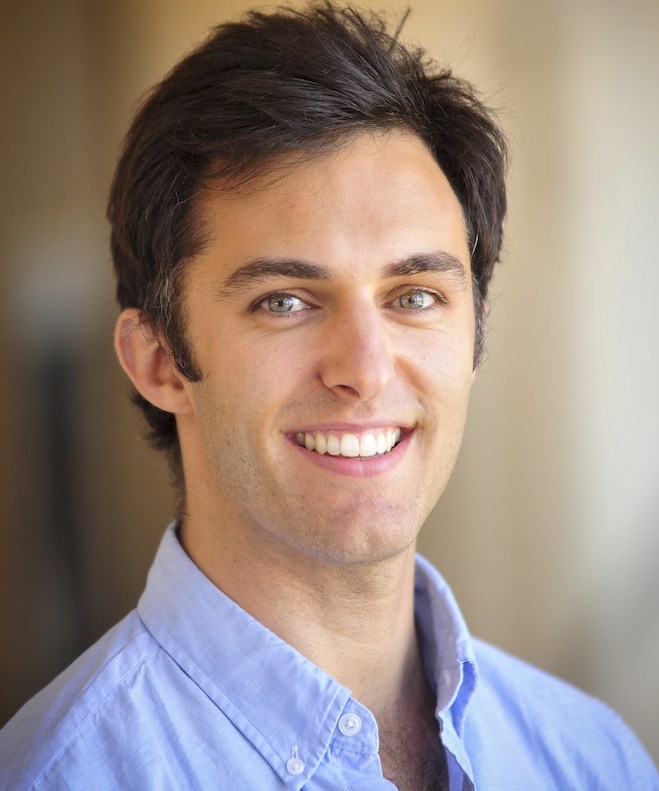
Daniel M. Roy is a Full Professor at the University of Toronto, with cross-appointments in the Department of Computer Science, Department of Statistical Sciences, and Department of Electrical and Computer Engineering. He serves as Research Director at the Vector Institute and holds the CIFAR Canada AI Chair. Research Focus: Foundational principles of prediction, inference, and decision-making under uncertainty across machine learning, statistics, mathematical logic, applied probability, and computer science. Scientific Contributions: Key work in learning theory, statistical network analysis, probabilistic programming, and information-theoretic frameworks for generalization. Awards: ICML 2024 Best Paper Award for "Information Complexity of Stochastic Convex Optimization" and promotion to Full Professor in 2024. Student Advising: Actively mentors Ph.D. candidates and postdoctoral researchers with strong quantitative backgrounds, particularly at the intersection of machine learning, statistics, and computer science. Email: daniel.roy@utoronto.ca
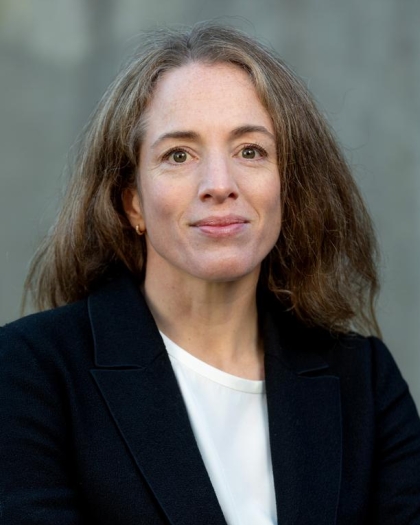
Inga Berre is a Professor at the Department of Mathematics, University of Bergen, and serves as Director of the Center for Modeling of Coupled Subsurface Dynamics (CSD). She leads the Porous Media Research Group and was appointed Argyris Visiting Professor at the University of Stuttgart's SimTech Cluster of Excellence in 2023. Research Interests: Mathematical modeling, partial differential equations, numerical methods for coupled thermo-hydro-mechanical-chemical processes in subsurface systems, and fault reactivation induced by injection/production. Scientific Leadership: Member of SIAM Council (2022-2027), Chair of SIAM GS activity group (2021-2022), Co-Chair of SET-Plan Deep Geothermal Implementation Working Group (2019-2021), and Chair of the Joint Program Geothermal, European Energy Research Alliance (2018-2021). Awards: 2011 Meltzer Award for Young Researchers. Advisory Roles: Member of Scientific Advisory Boards for GFZ (2024-2027) and SFB1313 (2018-), among others. Teaching: Developed courses on calculus, functional analysis, mathematical modeling, and numerical methods at the Bergen Summer Research School.
Karmenlara Ely Seidman is a Professor and Artistic Director in Acting and Performance at the Norwegian Theatre Academy (NTA), Østfold University College, and a part-time Professor II at the School of Music, UiT The Arctic University of Norway. She holds a Ph.D. in Philosophy (2008) and an M.A. in Performance Studies (2001) from NYU's Tisch School of the Arts. Her research explores interdisciplinary intersections of performance, ethics, and cultural memory, with foci including: Relational aesthetics and embodiment in performance Intergenerational art practices and indigenous/diaspora knowledge systems Transatlantic archives and decolonial methodologies Experimental pedagogy and institutional reimagining Street performance and ritual/game structures Her publications emphasize performative archives, actor training, and ethical frameworks, frequently engaging with themes of cultural memory, embodiment, and institutional critique. Recent works demonstrate a strong focus on decolonial praxis and interdisciplinary collaboration. She leads major funded projects including: Sea Matters (2023–2026): Performance research pedagogy laboratory Spectral Collaborations (2019–2022): Performative entanglement in Nordic Transatlantic Slavery archives Infinite Record (2013–2017): Archive memory and performance She mentors PhD students internationally, serves on evaluation committees across Nordic institutions, and has developed innovative study programs bridging artistic practice and scholarly research.
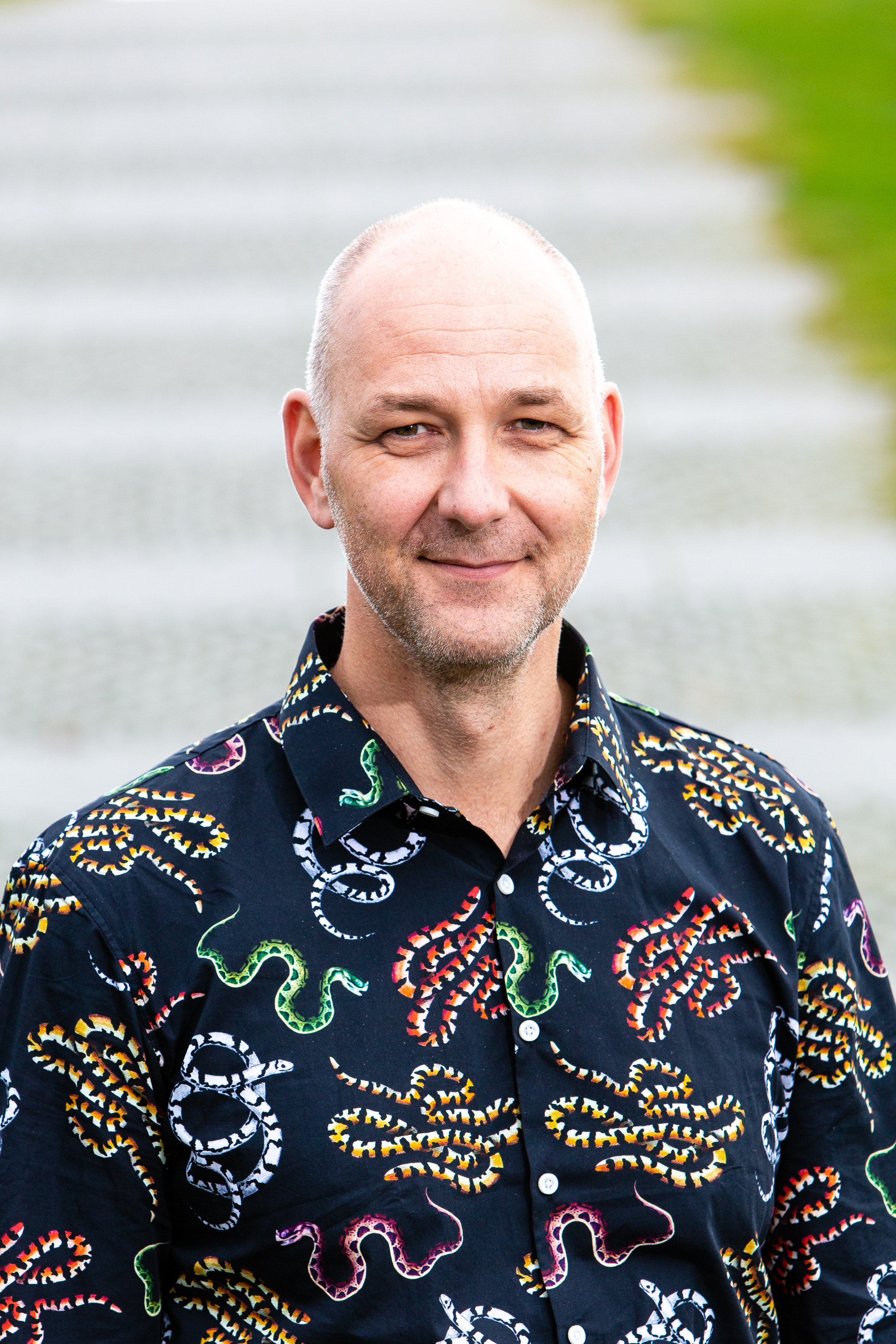
Jan Bang serves as Professor in the Department of Rhythmic Music at the University of Agder (UiA), Norway, with office K2022 at Universitetsveien 25, Kristiansand. A prominent Norwegian composer, musician, and producer of international standing, he co-founded and directs the Punkt Festival with Erik Honoré since 2005. The festival's live sampling concept has been presented in 25 cities globally including London Jazz Festival, Paris' Banlieues Bleues, and San Sebastian Jazz Festival. His primary research interests focus on Electronic Music, Jazz Studies, Live Sampling, and Music Production. Bang explores real-time remix methodologies, the intersection of silence and sound, and political dimensions of art. His work emphasizes technological innovation in performance contexts while maintaining strong ties to Norwegian and global jazz traditions through collaborative improvisation and cross-genre experimentation. Recent publications (2023-2025) reveal concentrated activity in live electronic performance documentation, festival curation, and artistic responses to global conflicts. Collaborations with Ensemble Modern and Eivind Aarset dominate output, alongside politically engaged commentary like his 2025 La Stampa piece on Gaza. Themes consistently address latency as creative material, cultural memory in sound, and the role of electronic processing in contemporary music ecosystems. Bang conducts international masterclasses (Barcelona, Rome) but no formal graduate students or specific grant projects are documented in the source text. His advising appears practice-based through festival workshops and performance collaborations rather than traditional academic supervision. He co-founded the Punkt Festival as a primary creative platform, operating as both artistic director and research vehicle. Additionally affiliated with UiA's Electronic Music and Songwriting and Production research groups, his work integrates festival operations with academic inquiry through projects like Stillefeldt vs Punkt (with Birmingham City University) and Global Jazz Studies networks.
Professor Talal Rahman is a faculty member at the Western Norway University of Applied Sciences, where he works in the Department of Computer Science, Electrical Engineering and Mathematical Sciences. His office is located at Bergen KRONSTAD D305, and he can be reached at phone number +47 55 58 72 46. Professor Rahman's research spans several key areas in computational mathematics and scientific computing. His primary research interests include: Scientific Computing Numerical Analysis Numerical Methods for Partial Differential Equations Preconditioning Finite Element with Domain Decomposition Methods Variational Image Processing Artificial Intelligence and Machine Learning applications Professor Rahman's extensive publication record demonstrates a strong focus on domain decomposition methods, particularly Schwarz methods and their applications to multiscale problems. His recent work shows an increasing integration of machine learning techniques with traditional numerical methods, as evidenced by publications on neural network applications for environmental modeling and capelin migration patterns. His research also extends to biomedical applications, including computational analysis of biodegradable materials and bone tissue engineering scaffolds. He has made significant contributions to the development of adaptive preconditioners and parallel algorithms for solving complex numerical problems, with his work on the TV-Stokes model for image processing representing an important contribution to the field of variational image processing. Professor Rahman has supervised numerous research projects and students, though specific student names are not provided in the available information. His research appears to be supported by grants related to computational science and engineering, though specific grant details are not mentioned in the provided text. Based on his research areas, Professor Rahman likely collaborates with various research groups focused on computational science, with potential connections to biomedical engineering labs and environmental research teams studying the Barents Sea ecosystem.
Johan Sokrates Wind is a Research Fellow at the University of Oslo's Department of Mathematics, specializing in Differential Equations and Computational Mathematics. His primary affiliation is with the Faculty of Mathematics and Natural Sciences. He holds a Master's in Industrial Mathematics from the Norwegian University of Science and Technology (NTNU) and began his PhD in August 2021. Wind's research focuses on deep learning, neural networks, and overparameterized machine learning systems. He has explored topics such as the Neural Tangent Kernel, Deep Linear Networks, and implicit biases in optimization algorithms. His work bridges theoretical analysis with practical implementations, as evidenced by his blog The Good Minima , where he publishes technical insights on neural network behavior and training dynamics. Notably, he has contributed to projects like real-time visual odometry on smartphones during his part-time role at Arm Ltd. Wind is an active participant in competitive programming and Kaggle competitions, showcasing his problem-solving skills and algorithmic expertise. His research emphasizes analytically tractable models and the mathematical foundations of modern AI systems. Recent investigations include the RWKV language model architecture, efficient CIFAR-10 classification, and the role of initialization and learning rates in SGD's implicit bias. Wind’s publications highlight interdisciplinary approaches, combining elements of optimization theory, computational mathematics, and applied machine learning. He maintains an active blog with detailed technical posts, demonstrating a commitment to open science and knowledge-sharing. His academic journey reflects a balance between theoretical rigor and practical innovation, positioning him as a rising researcher in computational and mathematical aspects of deep learning.
Tore August Kro is an Associate Professor at the Department of Engineering at Høgskolen i Østfold (HiOA). His research focuses on topology, stratified spaces, and mathematics education. He has contributed to foundational work in algebraic topology, including studies on categorical bundles and classifying spaces. Kro has authored textbooks for engineering mathematics and explored interdisciplinary applications of topology in data analysis. His work also includes collaborations on STEM education initiatives and media appearances explaining mathematical concepts like pi. Key publications span from 2006 to 2016, covering topics such as stratified Frölicher spaces and Thom's isotopy lemmas. Research Highlights: Stratified spaces, topological data analysis, and categorical structures. Education Contributions: Textbooks for engineering mathematics and regional STEM education projects. Media Engagement: Radio interviews on mathematical topics for public outreach.
Aksel Hiorth is a Professor of Reservoir Technology at the University of Stavanger (UiS) and Chief Scientist at NORCE. He holds a PhD in theoretical physics from the University of Oslo. His research focuses on subsurface flow modeling, geochemical interactions, and applications of porous media principles in medicine. He leads the Computational Engineering master's program and has pioneered workflows like IORSim for field-scale geochemical simulations. Education: PhD in Theoretical Physics (University of Oslo). Research Interests: Multi-scale reservoir modeling (pore to field scale) Geochemical processes in porous media Non-Newtonian fluid dynamics Medical applications of computational fluid dynamics Publications highlight advancements in physics-informed neural networks (PINNs), lattice Boltzmann methods, and EOR (Enhanced Oil Recovery) technologies. His work addresses challenges in reservoir optimization, water diversion strategies, and fluid-rock interactions in chalk reservoirs. Key innovations include predictive models for wettability alteration and mineral dissolution/precipitation. Awards include SR Bank's Innovation Award (2010), NPD's IOR Prize (2010), and Lyse’s Research Award (2013). He contributed to establishing the National IOR Centre of Norway, recognized for advancing improved oil recovery techniques. Advancing interdisciplinary research: His labs integrate computational engineering with petroleum geoscience, bridging fundamental physics and applied reservoir engineering. Current projects explore sustainable reservoir management and biomedical fluid dynamics solutions.
Fredrik Breien is an Associate Professor at the University of Bergen, affiliated with SLATE (Centre for the Science of Learning & Technology). He leads educational programs at SLATE and oversees development of the Interdisciplinary Master in Artificial Intelligence and Learning Sciences, launching in 2026. His research focuses on collaborative design frameworks like eLuna, which empowers stakeholder participation in creating narrative-driven game-based learning tools. With 20+ years of industry experience, he has designed over 60 game-based learning systems for museums, education sectors, and public initiatives. Education background includes advanced qualifications in informatics and media studies. Research emphasizes narrative structures in serious games, specifically evaluating how non-linear narratives enhance engagement and learning outcomes. Key contributions include the eLNVM model for categorizing narratives in educational games and the mixed-reality visual language system in eLuna framework. Current work bridges academic research with practical applications, collaborating with science centers and educational institutions to develop immersive learning experiences. His interdisciplinary approach addresses challenges in stakeholder collaboration, situational awareness in teams, and curriculum integration through game-based methods.
Magne Thoresen is a Professor in the Department of Biostatistics at the University of Oslo, specializing in high-dimensional statistics. His work focuses on developing statistical methods for complex data analysis, with applications across medical research, epidemiology, and public health. He has held leadership positions including Head of the Department of Biostatistics from 2008-2014. Education: PhD in Biostatistics, University of Oslo (2002) MSc in Statistics, University of Oslo (1992) Professor Thoresen's research spans high-dimensional data analysis and measurement error modeling, with significant contributions to biostatistics, genetics, and epidemiology. His work addresses methodological challenges in analyzing complex datasets from medical studies, particularly in the areas of omics data integration, longitudinal analysis, and variable selection. He has developed innovative statistical approaches for handling high-dimensional problems across diverse medical applications. His methodological expertise bridges theoretical development with practical implementation in biomedical research. His recent publication record demonstrates consistent expertise in high-dimensional statistical methods, with applications spanning nutrition science, gerontology, genetics, and critical care medicine. Thoresen's work shows particular strength in developing approaches for ultra-high dimensional data, measurement error correction, and variable selection that maintains statistical validity. His research bridges theoretical statistical development with practical medical applications across multiple disciplines, evidenced by collaborations with researchers in diverse medical fields. Teaching: PhD courses in statistics (MF9010, MF9130, MF9555, MF9580) Master's course quantitative methods for International public health/Interdisciplinary health research (INTHE4020) Professional study program in medicine (MED1100, MED3001, MED3006)
Olav Egeland is a Professor at the Department of Mechanical and Industrial Engineering, NTNU. He holds a siv.ing (1984) and dr.ing (1987) in Electrical Engineering from NTNU. Previously, he served as Professor of Robotics at the Department of Engineering Cybernetics (1989–2004), and led Marine Cybernetics AS as CTO/CEO (2004–2011). His academic roles include Head of Department of Engineering Cybernetics (1996–1998), Vice Dean of Faculty of Electrical Engineering and Telecommunications, and Research Committee member at NTNU. He contributed to strategic programs like SFI Offshore Mechatronics and the Centre of Ships and Ocean Structures. His research focuses on nonlinear control, machine learning for mechanical systems, robotics, and offshore applications. Notable awards include the Automatica Prize Paper Award (1996) and IEEE Outstanding Paper Award (2000). He has supervised 85 MSc and 30 PhD students, with recent advisees exploring topics like robotic welding, Hamiltonian dynamics learning, and generative AI in robotics. Key projects include vision systems for offshore drilling, laser scanning for aluminum welding, and adaptive control algorithms. His work spans publications in IEEE Transactions, European Journal of Control, and Springer monographs, emphasizing modeling, simulation, and advanced control techniques. Education: Siv.ing (Electrical Engineering), NTNU, 1984 Dr.ing (Electrical Engineering), NTNU, 1987 Research Themes: Nonlinear control and adaptive systems Machine learning applications in robotics and offshore engineering Robotics vision and sensor-based control Offshore mechatronics and crane dynamics Grants & Roles: Strategic University Program in Marine Cybernetics (1997–2004) Work Package Lead in SFI Offshore Mechatronics Research collaborations in European Journal of Control and IEEE Transactions Labs & Teams: Active in NTNU’s robotics and control research groups, contributing to industrial partnerships like Marine Cybernetics AS and SFI initiatives.
Professor Barbara Szybinska Matusiak holds a professorship at the Norwegian University of Science and Technology (NTNU) within the Institute of Architecture and Technology under the Faculty of Architecture and Design . Specializing in Light and Color in Architecture , her work bridges scientific research with practical architectural solutions. She has led major projects like NFR-funded 'DagsLys' and 'HOME', and pioneered the Light & Colour Centre at NTNU (established 2017). Education: Completed a dr.ing. (PhD) at NTNU (1998) on daylighting in linear glass barn buildings at high latitudes. Research Focus: Daylight harvesting systems, façade integration, biophilic design, and lighting ergonomics for occupants. Awards: Member of Norwegian Academy of Science and Letters (2017) and Daylight Academy (2019); nominated for Norwegian Lighting Prize (2019). Her research emphasizes quantifiable metrics for daylight quality, including No-Greenery Line and Greenery-View Factor . She actively chairs international committees like CEN's daylight standardization group and contributes to organizations such as CIE and IEA. Teaching focuses on advanced daylighting and color theory in master's programs. She has supervised four PhD candidates and one post-doctoral researcher, and frequently reviews for top journals like LEUKOS and Energy and Buildings . Key innovations include the Dagslys Laboratory (2002) and ROMLAB (2006), full-scale lighting research facilities. Grants: Multiple IEA SHC Task projects, including Subtask A on user-centered lighting solutions. Publications: Over 100 peer-reviewed articles spanning daylight modeling, façade technology, and cross-cultural lighting studies.
Ida-Marie Høyvik is a Professor at the Department of Chemistry, Faculty of Natural Sciences, Norwegian University of Science and Technology (NTNU). She leads research in electronic structure theory, specializing in cost-effective computational methods for molecular systems, including coupled-cluster wave functions and multilevel descriptions. Her current focus is on wave function models for open molecular systems interacting with their environment. She is funded by the Research Council of Norway and the Center for Basic Research as a Young CAS Fellow (2022-2024). Education: PhD in Chemistry from Aarhus University (2013), Master's in Chemistry from NTNU (2010). Her work includes developing the 'eT' electronic structure program, advancing linear-scaling multilevel Hartree-Fock methods, and studying redox processes through particle-breaking wave functions. She has supervised numerous graduate students and contributed to interdisciplinary education initiatives linking mathematics and engineering. Research interests span electronic structure theory, quantum chemistry, and computational methods for large molecular systems. Her publications emphasize localization of molecular orbitals, coupled cluster theory, and real-time approaches for multiphoton processes. She actively participates in conferences and serves on academic committees.
Jan-Joachim Rückmann is a Professor in the Department of Informatics at the University of Bergen, Norway. His research lies at the intersection of mathematical optimization, nonlinear programming, and their applications in finance and engineering. He is actively engaged in theoretical and applied research, with a focus on generalized semi-infinite programming and complementarity constraints. His research interests include non-linear programming, parametric optimization, robust optimization, data envelopment analysis, and the application of topological and differential geometric methods to optimization problems. He has made significant contributions to the theory of stability and stationarity in mathematical programs with complementarity constraints (MPCC) and semi-infinite programming. The recent publications highlight a strong trend in theoretical optimization, particularly in MPCC, stability of stationary points, and generalized semi-infinite programming. Several works explore duality, constraint qualifications, and convexification techniques. There is also interdisciplinary work applying optimization to mathematical finance, gas explosion modeling, and computational social choice using machine learning. While no scientific awards are listed, his extensive publication record in top journals such as Mathematical Programming , SIAM Journal on Optimization , and Optimization underscores his scholarly impact. He has served as guest editor for multiple special issues on parametric optimization, reflecting his leadership in the field. Though no students or grants are explicitly mentioned, his long-standing collaboration with researchers such as H. Günzel, D. Hernandez Escobar, F. Guerra Vazquez, and O. Stein indicates active research advising and team involvement. His work with the European Space Agency on trajectory analysis and space applications also points to applied research collaborations. Dr. Rückmann is affiliated with the Department of Informatics, contributing to both theoretical advances and practical applications of optimization methods. His work integrates deep mathematical analysis with real-world problem solving in engineering and economics.
Jochen A. Jungeilges is a Professor of Economics at the Department of Economics and Finance, School of Business and Law, University of Agder. He holds academic qualifications including Master's degrees in Economics (University of Bielefeld) and Applied Statistics (Louisiana State University), a PhD in Economics (University of Bielefeld), and a Habilitation from the University of Osnabrück. His research focuses on economic dynamics and applied econometrics, with particular emphasis on nonlinear deterministic and stochastic dynamic systems in micro- and macroeconomics, statistical methodology, and empirical social choice. Recent work explores network analysis applications to financial time series. Publications appear in journals like the Journal of the European Economic Association, Communications in Non-linear Science & Numerical Simulation, and Structural Change and Economic Dynamics. Teaching responsibilities include Financial Econometrics (SE-419), Empirical Finance (SE-510), and Machine Learning with Applications in Finance (SE-507). He has served on appointment boards, participated in international dissertation procedures, and reviewed for journals like the Journal of Economic Behavior & Organization.