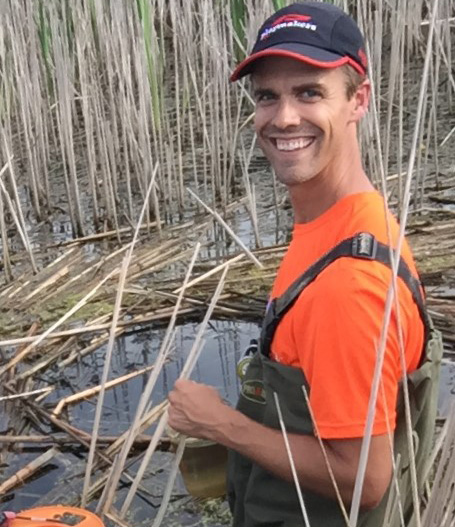
Anthony Kendall is an Assistant Professor at Michigan State University's College of Natural Science, affiliated with the Department of Earth and Environmental Sciences. His research focuses on regional-scale landscape hydrology, investigating the terrestrial hydrologic cycle in relation to climate, vegetation, and biogeochemical cycles. Key research areas include: Development of the Landscape Hydrology Model (LHM) for large-scale hydrologic process analysis Integration of machine learning algorithms with environmental data processing Field data collection as foundational hydrologic science practice Big data discovery and analysis in environmental contexts His expertise spans water resources, agrivoltaics, and hydrogeology, with particular emphasis on Great Lakes systems and pollution dynamics.
Heather J. Lynch is a Professor in the Department of Ecology and Evolution at Stony Brook University, specializing in statistical ecology and Antarctic conservation biology. Her research integrates advanced quantitative methods with field studies to address critical questions about Antarctic wildlife dynamics, particularly penguin populations. She leads the Lynch Lab, which focuses on understanding how climate change, fishing, and tourism impact Antarctic ecosystems through innovative approaches combining satellite remote sensing, computer vision, and ecological modeling. Dr. Lynch's research interests center on Antarctic conservation biology with emphasis on penguin population dynamics, biogeographic distribution patterns, and climate change responses. Her work employs cutting-edge techniques including satellite imagery analysis, drone surveys, and statistical modeling to monitor wildlife populations across vast, remote regions. Key research themes include developing predictive models for population responses to environmental change, creating automated monitoring systems using machine learning, and translating ecological data into actionable conservation strategies for Antarctic stakeholders. The lab's interdisciplinary approach bridges ecology, applied mathematics, computer science, and earth systems science to tackle complex conservation challenges. Her scientific contributions include development of novel wildlife survey methodologies using satellite imagery and computer vision, with applications in penguin and seal population monitoring. Notable projects include managing the Antarctic Site Inventory vessel-based breeding bird survey program in partnership with Oceanites, and creating decision support tools for Antarctic conservation management. Dr. Lynch has received recognition including the American Physical Society's LeRoy Apker Award for her undergraduate physics thesis. Dr. Lynch's laboratory employs highly interdisciplinary approaches that integrate field research with statistical analysis and technological development. The lab actively collaborates with students and postdocs from diverse backgrounds including ecology, marine science, statistics, computer science, and engineering to develop end-to-end solutions for Antarctic ecological challenges. Current efforts focus on understanding penguin responses to climate change, developing automated monitoring systems using drones and satellite imagery, and creating predictive models for conservation decision-making in the rapidly changing Antarctic environment.
Karl-Villem Võsa is an Expert (0.75 FTE) at Tallinn University of Technology's School of Engineering, Department of Civil Engineering and Architecture. He previously served as a Junior Research Fellow (2018-2023) and has been with the institution since 2018 in various research capacities. Dr. Võsa is a certified HVAC Engineer with level 7 qualification and has been a member of the Estonian Society of Heating and Ventilation Engineers since 2014. His research focuses on building indoor climate, energy efficiency, and HVAC systems with particular emphasis on ventilation effectiveness for infection control, heat emission efficiency of heating systems, and thermal comfort parameters. Dr. Võsa teaches Energy Simulation of Buildings (EEA5042) and has been involved in numerous research projects including the Energy Efficiency Excellence Center (2024-2030) and Post-COVID ventilation project (2024-2028). Analysis of his recent publications (2022-2024) reveals a significant focus on ventilation effectiveness for infection risk control in classrooms, cruise ships, and offices, reflecting the post-pandemic research priorities in building science. His work combines experimental measurements with CFD simulations to assess air distribution effectiveness and infection transmission risks. His scientific recognition includes: 2022 State Real Estate Ltd. PhD scholarship 2014 Estonian Society of Heating and Ventilation Engineers Society scholarship Dr. Võsa has secured funding from multiple sources including the Estonian Research Council, European Commission, and Academy of Finland for projects totaling millions of euros in research funding. His work bridges theoretical building physics with practical applications for improving indoor environmental quality and energy performance.
Jakub Szulwic is an Assistant Professor at the Department of Geodesy, Faculty of Civil and Environmental Engineering, Gdańsk University of Technology. His work focuses on applying advanced geodetic and remote sensing technologies to solve complex problems in civil engineering, environmental monitoring, and cultural heritage preservation. Dr. Szulwic earned his doctoral degree in Geodesy and Cartography from the Faculty of Geodesy and Spatial Management at the University of Warmia and Mazury in Olsztyn in 2003. His academic journey has positioned him as a specialist in terrestrial laser scanning, photogrammetry, and geospatial data processing. Dr. Szulwic's research interests span across multiple domains of geospatial technology. His primary focus areas include geodesy , photogrammetry , remote sensing , lidar , terrestrial laser scanning , geoscience , civil engineering , geoinformatics , and geomatics . His work demonstrates how these technologies can be applied to diverse fields from structural engineering to environmental monitoring and agricultural technology. His publication record shows a consistent focus on practical applications of geospatial technologies. Recent work includes studies on HBIM (Historical Building Information Modeling), marine gravimetric measurements, light pollution monitoring, agricultural technology, and structural diagnostics. His research demonstrates a pattern of applying advanced scanning and imaging technologies to solve real-world problems across multiple domains including civil engineering, environmental science, and agriculture. Dr. Szulwic leads several significant research projects including PLAN-B (addressing light and noise pollution impacts on biodiversity), BalMarGrav (marine gravity mapping), SoURCE (utility risk/cost evaluation), and MarLS (3D laser scanning from vessels). These projects are funded by European programs including Horizon Europe, European Territorial Cooperation, European Space Agency, and European Regional Development Fund. He is actively involved in laboratory work and research teams focused on geodetic measurements, with particular expertise in laser scanning applications both on land and at sea. His work with the Department of Geodesy at Gdańsk Tech has established him as a key researcher in applying geospatial technologies to solve complex engineering and environmental challenges.
Kennet Christian Uggeldahl serves as Assistant Professor in the Department of Food and Resource Economics within the Faculty of Science at the University of Copenhagen. His work centers on environmental economics, specializing in the valuation of non-market environmental goods through advanced choice experimentation methodologies. Education: PhD in Environmental Economics, University of Copenhagen (2015-2018). Dissertation: "Essays on decision making processes, information acquisition, and preferences in stated choice experiments: Applications to economic valuation of consumer and environmental goods". Research Focus: Uggeldahl pioneers the integration of eye-tracking technology with choice experiments to analyze decision-making processes in biodiversity valuation. His expertise spans stated preference methods for quantifying non-market values, with particular emphasis on Danish conservation contexts. Current work investigates public perceptions of biodiversity conservation value and socio-economic integration of biodiversity metrics. Publication Trends: Recent publications (2024-2025) demonstrate increasing policy relevance, focusing on operationalizing biodiversity valuation in Danish socio-economic analyses and green transition strategies. Earlier work (2016-2019) established methodological innovations in choice experiment reliability using eye-tracking, with applications to water quality and agricultural land management. All research consistently applies discrete choice modeling to environmental valuation within Danish ecosystems. Scientific Awards: No specific awards documented in source materials. Advising and Grants: While no advisees are listed, collaborative patterns indicate active engagement with senior researchers (e.g., Jacobsen, Olsen, Lundhede). His 2024 newspaper contribution with 25 co-authors across environmental disciplines suggests participation in large-scale policy initiatives, though specific grant funding isn't detailed. Research Environment: Uggeldahl operates within the Section for Environment and Natural Resources at IFRO (Institute of Food and Resource Economics), focusing on empirical environmental valuation methods. His work connects closely with Danish environmental agencies through applied policy analysis in biodiversity conservation and water resource management.