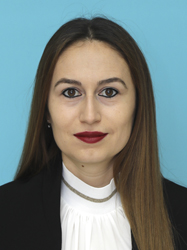
Muhammad Bilal Khan is an Assistant Professor at the Department of Electronics and Power Engineering, College of Electrical and Mechanical Engineering, National University of Sciences and Technology (NUST), Pakistan. His research spans mathematical theory and practical applications in wireless communication sensing technology. His primary research interests include Fuzzy Set Theory , Fractional Calculus , Mathematical Inequalities , and RF Sensing Applications in healthcare. His theoretical work focuses on developing new mathematical frameworks for fuzzy-number valued functions, particularly exploring pre-invexity, harmonic convexity, and related integral inequalities. On the applied side, he has made significant contributions to non-contact health monitoring systems using software-defined radio technology for detecting conditions like text neck syndrome, spinal curvature disorders, and breathing abnormalities. Analysis of his 15 most recent publications reveals a dual research trajectory: approximately 60% focus on theoretical mathematical contributions in fuzzy analysis and integral inequalities, while 40% address practical applications of wireless sensing in healthcare. His mathematical work frequently appears in journals like Axioms and Symmetry , while his applied research is published in venues including IEEE Access and Sensors . His notable scientific contributions include developing novel frameworks for (q 1 , q 2 )-Linear Diophantine Fuzzy Sets and advancing the theory of Diamond Intuitionistic Fuzzy Sets. His healthcare applications research has pioneered non-invasive monitoring techniques using RF sensing for elderly fall detection, text neck syndrome diagnosis, and breathing pattern analysis. Dr. Khan maintains active collaborations with researchers across multiple institutions, particularly working with Mohamed S. Soliman (13 joint publications), Muhammad Aslam Noor (12 publications), and Savin Treanta (8 publications) on mathematical theory, while collaborating with Najah AbuAli, Mubashir Rehman, and Xiaodong Yang on healthcare sensing applications.