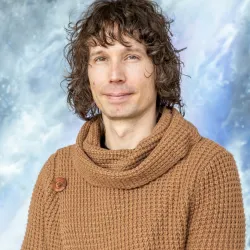
Andrea Alu is a Distinguished Professor of Electrical Engineering and Einstein Professor at the City University of New York (CUNY) Graduate Center. He serves as Founding Director of the Photonics Initiative at the Advanced Science Research Center (ASRC). His primary affiliation is with the Department of Electrical Engineering, with additional ties to the Physics department. Alu’s research focuses on metamaterials, metasurfaces, and photonics, particularly in areas like topological acoustics, nonlinear optics, and bioelectronic devices. His work has produced groundbreaking innovations in wave manipulation, including applications in biomedical engineering and quantum systems. Alu’s academic career includes leadership roles in the field of photonics, with contributions to roadmapping initiatives for 2D materials and metamaterials. He has pioneered concepts such as time-modulated metasurfaces and nonlocal optical effects. His research is supported by grants focusing on metamaterial theory, quantum metamaterials, and bio-inspired systems. Notable achievements include the 2023 Optical Materials Express Emerging Researcher Best Paper Prize (2024). Collaborative efforts extend to labs and teams at the ASRC, emphasizing interdisciplinary projects in photonic computing, acoustic cloaking, and reconfigurable meta-devices. His work bridges fundamental physics with applied engineering, addressing challenges in energy-efficient systems and medical technology.
Dr. Israel Vaughn is an Instrument Scientist at the Advanced Instrumentation and Technology Centre within the Research School of Astronomy and Astrophysics at the Australian National University. With a PhD in Optical Sciences from the University of Arizona, their work focuses on optical instrumentation, space optics, and polarimetric remote sensing. Education: PhD in Optical Sciences, Wyant College of Optical Sciences, University of Arizona; Master of Mathematics (By Coursework), University of New Mexico. Dr. Vaughn’s research interests include: Engineering Instrumentation Electromagnetics Astronomical Instrumentation Nonlinear Optics Spectroscopy Space Instrumentation Recent publications highlight their contributions to adaptive optics systems for the Giant Magellan Telescope, metasurface lenslet arrays, and polarimetric imaging innovations. Their work also extends to space-based mission concepts like the Ultraviolet Extinction Sky Survey (UVESS).
Dr. Luigi La Spada is a Lecturer in Electrical and Electronic Engineering at Edinburgh Napier University's School of Computing Engineering and the Built Environment. His academic journey includes a PostDoctoral Research Assistant position at Queen Mary University of London (2014-2017) and a Lecturer role at Coventry University (2017-2018). He is actively involved with multiple research groups including the Centre for Artificial Intelligence and Robotic, Centre for Conservation and Restoration Science Engineering Research Group, and Centre for Cybersecurity, IoT and Cyberphysical Systems. His educational background includes: Bachelor's and Master's degree (summa cum laude) in Electronics Engineering from University of RomaTre (2008, 2010) PhD in Electronic Engineering (Biomedical Electronics, Electromagnetics, and Telecommunications) from University of RomaTre and University of Pennsylvania (2011-2014) Dr. La Spada's research spans metamaterials engineering, electromagnetic wave control, and advanced sensor development, with significant contributions to metasurface applications and nanoparticle technology. His work has expanded into AI applications for security systems, quantum cryptography for UAV communications, and medical diagnostics. His interdisciplinary approach bridges theoretical electromagnetic concepts with practical engineering solutions across aerospace, healthcare, and agricultural technology sectors. His publication record shows a clear evolution from fundamental electromagnetic research toward applied technologies, particularly in quantum-enhanced security systems, AI-driven biometrics, and medical applications of metamaterials. Recent work demonstrates strong interdisciplinary connections between electromagnetic theory, quantum physics, and artificial intelligence, with increasing focus on practical implementations in aerospace, healthcare, and agricultural monitoring systems. Dr. La Spada has received significant recognition for his research contributions: 2018 Advances in Engineering (AIE) 'key scientific contributor to excellence in science and engineering research' 2017 URSI Young Scientist Award (Canada) Finalist for 2017 IEEE Young Scientist Award 2016 ISAP Best Paper Award (Japan) 2015 EAI recognition for 'new technologies in telecommunications and sensing' His research has received international scientific recognition and media coverage from CNN, CBS, Times, and Aspen Institute. Dr. La Spada currently supervises PhD student Nida Zeeshan on AI-based biometrics facial recognition. He has secured substantial research funding including a £184,194 European Commission grant for Intelligent Multi-Agent Robotic Systems (iMARS) and multiple Scottish Funding Council projects totaling over £74,000. His current grants span robotics, AI visual systems, medical device development (Airglove technology), and wireless power transfer. Dr. La Spada is actively involved in the Centre for Artificial Intelligence and Robotic and Centre for Cybersecurity, IoT and Cyberphysical Systems, where he contributes to developing innovative methods in AI, Robotics, IoT, and 5G technologies. His work connects theoretical electromagnetic concepts with practical applications in healthcare, aerospace, and security systems.
Prof Francois Rigaut is the Adaptive Optics Principal Scientist and MAVIS Principal Investigator at the Australian National University's Research School of Astronomy and Astrophysics. With a PhD from University of Paris 7 (1992) on the pioneering COME-ON Adaptive Optics (AO) system, he has led AO developments across institutions like ESO, Gemini Observatory, and CFHT. Current Affiliation: Australian National University (since 2012) Academic Rank: Researcher Research Focus: Adaptive Optics, space debris tracking, astronomical instrumentation, and wavefront sensor innovations Research Interests: His work spans AO theory (e.g., Fourier modeling, Tip-Tilt indetermination), practical implementations (GeMS, PUEO), and emerging applications in health sciences. He is advancing laser tomography AO for the Giant Magellanic Telescope and developing AO for laser beam conditioning in space debris mitigation. Recent Projects: Lead projects include MAVIS (VLT instrument), ESO GHOST Real-Time Computer , and AO systems for space debris tracking. Collaborations span institutions like Keck Observatory, ESO, and Gemini, with a focus on next-generation AO for large telescopes. Contributions: Rigaut pioneered Ground Layer AO and quantified Shack-Hartmann sensor noise. His fingerprint highlights expertise in Adaptive Optics (100%), Spectrographs (25%), and Wavefront Sensors (25%). Contact: Email francois.rigaut@anu.edu.au
Jonathan Simon is an Associate Professor of Physics and Applied Physics at Stanford University, where he leads the Simon Lab. His research spans the interface of condensed matter physics and quantum optics, with a particular focus on creating and studying quantum materials from light. Simon received his PhD from Caltech and previously held positions at the University of Chicago's James Franck Institute before joining Stanford. His work bridges theoretical concepts with experimental innovation, developing novel techniques to explore quantum phenomena. Department of Physics, School of Humanities and Sciences Department of Applied Physics, School of Engineering Former faculty at University of Chicago, James Franck Institute Simon's research explores three interconnected themes: building materials from light to understand fundamental material properties; investigating small quantum systems where coherent interactions produce emergent behaviors; and examining topological aspects of matter where 'hidden' non-local order affects material properties. His lab develops cutting-edge experimental platforms including small waist cavity arrays, cavity Rydberg polaritons, and systems for topological photonics. Recent publications reveal a strong focus on quantum optical technologies, photonic materials, and topological phenomena. The lab has made significant advances in cavity QED, quantum microscopy, and quantum transduction, with multiple high-impact publications each year in top physics journals. Simon's lab actively trains the next generation of quantum scientists, with numerous graduate students and postdocs contributing to publications and developing innovative technologies. His students have gone on to prestigious fellowships and positions in academia and industry. The Simon Lab maintains strong funding support for its research program, enabling the development of sophisticated experimental apparatus and supporting a vibrant research group. Current projects include exploring quantum Hall physics with light, developing new quantum imaging technologies, and creating platforms for quantum information processing. The lab operates state-of-the-art facilities for quantum optics research, including multiple laser systems, high-finesse optical cavities, and custom electronics for quantum control. Recent technical innovations include the development of a Mega-FPS low light camera and advanced cavity array microscopes for quantum manipulation.