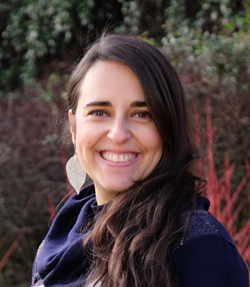
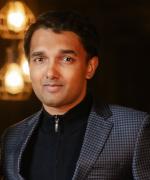
John Nassour is a Researcher at the Technical University of Munich's School of Computation, Information and Technology, affiliated with the Chair of Cognitive Systems. He holds engineering degrees from Tishreen University (electronics), a Master's in intelligent systems from University of Cergy-Pontoise/École Nationale Supérieure de l'Électronique, and a joint PhD from University of Versailles/TUM. His interdisciplinary research focuses on computational cognitive systems applied to robotics, including wearable devices, humanoid robots, soft robotics, and robot learning for locomotion/manipulation. Before joining TUM in 2020, he was a lecturer/researcher at Chemnitz University of Technology. He teaches courses in cognitive systems, neuro-inspired engineering, and soft robotics.
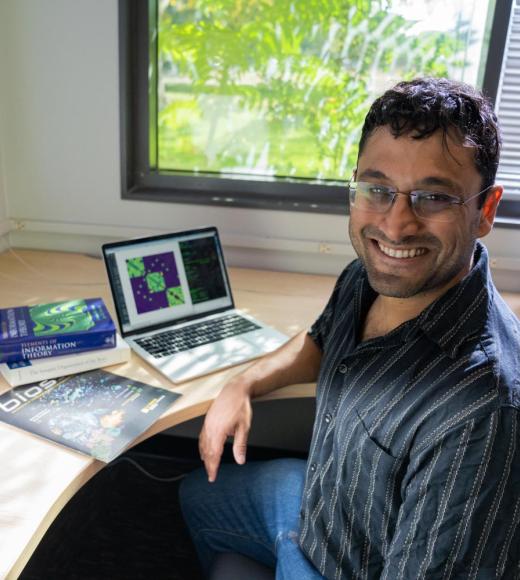
Rishidev Chaudhuri is an Associate Professor at the University of California, Davis in the Department of Neurobiology, Physiology and Behavior within the College of Biological Sciences. His research focuses on computational neuroscience and neural dynamics, employing mathematical models to investigate how neural circuits generate cognitive processes such as memory, perception, and decision-making. His work explores neural dynamics through models of memory systems, attentional mechanisms, and probabilistic inference. Recent publications highlight advances in understanding hippocampal memory scaffolds, parietal-frontal interactions, and neuromorphic computing inspired by brain architecture. Education: BA in Physics (Amherst College), PhD in Applied Mathematics (Yale University) Centers: Center for Neuroscience; affiliated with Applied Mathematics and Neuroscience Graduate Groups Scientific awards and honors are not explicitly mentioned in the provided materials.
Bryan Tripp is an Associate Professor at the University of Waterloo, specializing in computational neuroscience, deep learning, robotics, and medical AI. He leads the BRAIN Lab, which focuses on developing neural system models that interact with the physical world through robots. His research integrates neurobiological models with advanced machine learning techniques to study visuomotor processes and robotic applications. Tripp teaches courses such as Computational Neuroscience (SYDE 552), Deep Learning (SYDE 577), and Biomedical Engineering Design Workshops (BME 461/462). His lab has achieved milestones including the OREO robotic head, the first spiking neural network model for complex action planning, and comprehensive datasets for robotic grasping. His recent work emphasizes Medical AI applications, with graduate positions available. The BRAIN Lab is affiliated with the Centre for Theoretical Neuroscience and Waterloo.AI, contributing to interdisciplinary AI research initiatives.
Dr. Miaoqiang Lyu is a Research Fellow at the School of Chemical Engineering , The University of Queensland . His work focuses on lead-free perovskites , flexible energy storage , and optoelectronic devices . Research Interests : Designing low-toxicity and stable semiconducting lead-free perovskites for solar energy conversion Developing flexible energy storage devices for Internet-of-Things (IoT) sensors Advancing zinc batteries and aqueous electrolyte systems Photocatalytic hydrogen production and CO2 reduction Recent Article Trends : Focus on 2D/3D heterostructures, interstitial metal doping, and solvent-engineered interfaces Applications in indoor photovoltaics, artificial synaptic functions, and wearable electronics Lead-free perovskites for resistive memory and energy storage Scientific Awards : ARC DECRA Fellow Advance Queensland Industry Research Fellow CRC for Polymers grant Supervision & Funding : Principal advisor for two PhD projects on lead-free perovskites and flexible batteries Current grants: Enabling low-toxicity perovskites for indoor photovoltaics (2026-2030), Printable zinc ion batteries (2025-2026) Labs & Collaborations : Affiliated with the Nanomaterials Centre at UQ Collaborations with Professor Lianzhou Wang , Professor Ian Gentle , and Associate Professor Ruth Knibbe
Salem Lahlou is an Assistant Professor in the Machine Learning Department at the Mohamed bin Zayed University of Artificial Intelligence (MBZUAI), having joined in September 2024. He previously served as a Senior Researcher at the Technology Innovation Institute (TII) in 2024. His academic background includes a PhD from Mila and Université de Montréal (UdeM) under Yoshua Bengio (2023), with prior studies in applied mathematics at École Polytechnique and statistical learning at École Normale Supérieure Paris-Saclay. His research focuses on developing more capable and reliable AI systems through three interconnected pillars: Novel Method Development : Core contributions to Generative Flow Networks (GFlowNets), uncertainty estimation techniques (DEUP), and curriculum learning frameworks Large Language Model Advancement : Enhancing reasoning capabilities and alignment through preference optimization and trace-based learning Community Tooling : Creation of torchgfn library for GFlowNets and benchmarks including BabyAI, FinChain, and LLM-BabyBench Core research areas span Machine Learning, GFlowNets, Uncertainty Estimation, LLM Reasoning, Reinforcement Learning, and AI for Science. Recent publications (2023-2025) demonstrate strong emphasis on GFlowNet theory/improvements (8+ papers), LLM reasoning evaluation (FinChain, LLM-BabyBench), uncertainty quantification, and societal AI impacts. Key application domains include mathematical reasoning, financial systems, privacy preservation, and cognitive science. He currently advises graduate students including Junyi (privacy risks in SNNs) and Abhijith (LLM reasoning). His group collaborates with MBZUAI faculty (Nils Lukas, Alham Fikri, Mingming Gong, Martin Takac) and industry partners on projects involving Conversational AI, Personalization, and Affective AI.
Kwantae Kim is an Assistant Professor at the Department of Electronics and Nanoengineering within Aalto University's School of Electrical Engineering . He leads the Tiny Systems and Circuits (TSirc) Group , focusing on power-efficient analog/mixed-signal ICs for biomedical and neuromorphic sensor systems. IEEE Senior Member (2025) Collaborates with institutions across Europe, Asia, and America Specializes in ultra-low-power AI-embedded IoT platforms His research emphasizes Tiny, Sensory, Intelligent, and Wireless IoT systems through: Development of energy-efficient IC architectures Democratizing access to advanced chip design Hardware-software co-design for edge computing Recent publications highlight innovations in: Spoken-language-understanding SoCs Temporal-sparsity-aware keyword spotting Open-source silicon frameworks Awards include: 2025 IEEE Senior Member 2023 Best Poster Award (AICAS) 2019 Samsung HumanTech Silver Award Research partnerships span: Prof. Tobi Delbruck (UZH/ETH Zurich) Prof. Hoi-Jun Yoo (KAIST) Prof. Shih-Chii Liu (UZH) Prof. Sohmyung Ha (NYU Abu Dhabi)
Muhannad S. Bakir is the Dan Fielder Professor in the School of Electrical and Computer Engineering at Georgia Institute of Technology, and Director of the 3D Systems Packaging Research Center . His research focuses on heterogeneous integration , electrical/photonic interconnects , thermal modeling , and electronics for healthcare , with over 180 publications and 12 U.S. patents. Research areas include: Advanced cooling and power delivery for emerging systems Biosensor-CMOS integration 2.5D/3D IC packaging Polylithic integration technology Nanofabrication for microsystems Scientific accolades include: 2018 IEEE EPS Exceptional Technical Achievement Award 2013 Intel Early Career Faculty Honor Award 2012 DARPA Young Faculty Award 2011 IEEE CPMT Outstanding Young Engineer Award Best paper awards at IEEE ECTC, IITC, and CICC 2020 Georgia Tech Doctoral Thesis Advisor Award His lab explores integrated 3D systems with emphasis on co-design of thermal, power, and electrical networks for machine learning and healthcare applications.
Ningyuan Cao is an Assistant Professor in the Department of Electrical Engineering at the University of Notre Dame, College of Engineering. He leads the Circuit and System Intelligence Research Lab , focusing on the intersection of advanced hardware design and real-time/low-power machine learning applications. Education : Ph.D., Electrical and Electronics Engineering, Georgia Institute of Technology (2020) M.S., Electrical Engineering, Columbia University (2015) B.S., Electrical and Electronics Engineering, Shanghai Jiao Tong University (2013) His research investigates custom analog/mixed-signal circuits , digital architecture , and micro-system design for machine learning acceleration, distributed intelligence, and data-driven IC design automation. Key application domains include Internet-of-Everything, tactile internet, and mixed reality systems. Recent publications highlight work on Bayesian neural networks , privacy-preserving bio-signal encoders , transformer-based surrogate models , and compute-in-memory architectures . Technical themes span neuromorphic computing, uncertainty quantification, and hardware security.
Shih-Chii Liu holds the rank of Privatdozent (Associate Professor) in the Department of Information Technology and Electrical Engineering at ETH Zürich. He is affiliated with the Institute of Neuroinformatics , a joint institute between the University of Zurich and ETH Zurich. His research focuses on neuromorphic engineering, bio-inspired neural hardware, and edge computing systems, emphasizing energy-efficient algorithms and sensor technologies. Key research areas include neuromorphic sensors for real-time data processing, sparsity-aware neural networks, and adaptive computing architectures for edge devices. His work spans applications such as speech enhancement, wearable health monitoring, and bio-inspired keyword spotting systems. He leads the Sensors Research Group, which develops neuromorphic systems integrating novel sensors, spiking neural networks, and low-power hardware accelerators. Recent projects include the DeltaKWS low-power keyword spotting IC, EFLOP computational cost metrics for spiking networks, and NeuroBench benchmarking frameworks for neuromorphic systems. His contributions emphasize bridging biological neural principles with practical engineering solutions for IoT and embedded systems. Liu teaches courses such as Neuromorphic Engineering I and collaborates on cross-disciplinary projects involving neuroprosthetics, smart wearables, and multimodal sensor fusion. His work is characterized by hardware-software co-design approaches to tackle challenges in real-time, low-latency, and energy-constrained computing environments.
Professor David Thomas holds the position of Professor in Computer Engineering at the University of Southampton's Electronics and Computer Science Department. His research focuses on the intersection of software and hardware, particularly leveraging FPGAs for novel digital architectures and event-driven computing. He has a notable academic trajectory, having previously served as a Lecturer and Senior Lecturer at Imperial College London before joining Southampton in 2021. Dr. Thomas is actively involved in supervising PhD students and contributes to interdisciplinary research projects funded by the EPSRC, such as the SONNETS initiative exploring scalable event-triggered systems. Education: BSc in Computer Science (Imperial College London), PhD in Digital Architectures (Imperial College London). Postdoctoral roles included Research Associate and Research Fellow at Imperial's Department of Computing. Research Interests: Event-driven computing, FPGA-based systems, high-level synthesis, and high-performance computing. His work emphasizes practical implementations of theoretical models, such as custom processors and application-specific accelerators. Current projects include optimizing random number generation for FPGAs and exploring meta-programming techniques for hardware design. Advising and Grants: Supervises multiple PhD students in areas like neuromorphic computing and algorithm optimization. Active in securing funding for distributed system architectures and FPGA-based solutions. Labs/Teams: Member of the Cyber Physical Systems research group. Collaborates with interdisciplinary teams on projects like POETS (Partially Ordered Event-Triggered Systems) for large-scale parallel computing.
Said Hamdioui serves as a full Professor in the Department of Computer Engineering within the Faculty of Electrical Engineering, Mathematics and Computer Science at Delft University of Technology. His research focuses on cutting-edge hardware architectures for neuromorphic computing and energy-efficient AI acceleration, with particular emphasis on memristor-based systems, emerging memory technologies, and fault-tolerant designs for edge applications. His research interests span Neuromorphic Computing , Memristor-Based Architectures , and Energy-Efficient AI Hardware , addressing critical challenges in hardware security, computation-in-memory, and reliable edge AI deployment. Recent work demonstrates significant advancements in RRAM/FeFET testing methodologies, spiking neural network implementations, and spin wave computing alternatives to traditional CMOS. His publications reveal strong trends toward real-world deployment of brain-inspired hardware with practical constraints like power efficiency, testability, and security. Award highlights include: DATE'20 Best Paper Award DFT'21 Outstanding Student Paper ETS 2021 Best Paper Award LATS 2018 & 2022 Best Paper Awards Professor Hamdioui actively contributes to the research community through editorial roles at IEEE Transactions on VLSI Systems , IEEE Design & Test , and Journal of Electronic Testing from 2017-2018. His leadership in multi-partner projects like CONVOLVE and NEUROKIT2E demonstrates strong industry-academia collaboration for edge AI solutions. Current work shows increasing focus on practical deployment challenges including in-field fault monitoring, security vulnerabilities in neuromorphic systems, and realistic brain simulation frameworks.
Saugata Ghose is an Assistant Professor in the Siebel School of Computing and Data Science at the University of Illinois Urbana-Champaign (UIUC), with affiliate appointments in the Coordinated Science Laboratory and the Department of Electrical and Computer Engineering. His research focuses on data-centric computing, processing-in-memory architectures, memory systems, and hardware-software co-design. He holds a Ph.D. and M.S. in Computer Engineering from Cornell University and dual B.S. degrees in Computer Engineering and Computer Science from SUNY Binghamton. His academic positions include roles at Carnegie Mellon University (2016–2020) and postdoctoral research at CMU (2014–2016). Ghose has received notable awards such as the 2024 HPCA Hall of Fame, 2023 Intel Rising Star Faculty Award, and the 2019 CMU Wimmer Faculty Fellowship. His work has been supported by grants from NSF, Samsung, and Sandia National Laboratories. Research Interests: His group (ARCANA) explores data-centric architectures, processing-in-memory (PIM), and emerging memory technologies. Key areas include architectures for smart cities, autonomous systems, and genomics. He teaches courses on computer architecture and systems organization. Awards: HPCA Hall of Fame (2024) Intel Rising Star Faculty Award (2023) CMU Wimmer Faculty Fellow (2019) Cornell ECE Teaching Assistant Award (2013) Grants & Projects: NSF $2M for semiconductor advancements Samsung/Sandia grants for PIM programming models UIUC/ZJU DREMES collaboration on neuromorphic PIM Labs/Teams: Leads the ARCANA Research Group, focusing on reimagining computing around new applications. Collaborates with ASAP and HYBRID centers for co-design tools and neuromorphic architectures.
Giuliana Di Martino is an Associate Professor in Device Materials at the Department of Materials Science & Metallurgy, University of Cambridge. She leads the Di Martino Lab, which focuses on sustainable power solutions for non-volatile memory (NVM) and brain-like computing systems. Education : Bachelor and Master degrees from Università di Catania and Scuola Superiore di Eccellenza di Catania; PhD in Nanoplasmonics for Materials Innovation at Imperial College London (2014). Her research bridges plasmon-enhanced light-matter interactions and optically-accessible memristive devices , leveraging ultra-concentrated light in plasmonic nanocavities to study atomic-scale dynamics in memory nano-devices. Recent work includes self-assembly of nanomaterials , surface-enhanced Raman spectroscopy (SERS) , and low-power electronics for sustainable IT. Scientific Awards : Winton Advanced Research Fellowship (2018) Her grants include funding from EPSRC , Leverhulme Trust , Isaac Newton Trust , Royal Society , and ERC Starting Grant . The Di Martino Lab collaborates within the Device Materials Group (DMG), which includes three Principal Investigators.
Prof. Slawomir Stanczak is a Full Professor in Network Information Theory at Technische Universität Berlin and Head of the Wireless Communications and Networks department at Fraunhofer Heinrich-Hertz-Institut (HHI). His expertise spans wireless communications, signal processing, and machine learning, with a focus on 5G/6G networks and reconfigurable intelligent surfaces. He has held visiting roles at RWTH Aachen University and Stanford University, and leads initiatives like the 6G Research & Innovation Cluster and the xG-Incubator project. Education: Dipl.-Ing. in Electrical Engineering, TU Berlin (1998) Dr.-Ing. (summa cum laude), TU Berlin (2003) Habilitation (venia legendi), TU Berlin (2006) Research & Awards: Recipient of the Best Paper Award from the German Communication Engineering Society (2014) Research grants from the German Research Foundation Co-authored over 200 peer-reviewed papers and two books Chair of the ITU-T Focus Group on Machine Learning for Future Networks (2017-2020) Leadership & Projects: Chairman of 5G Berlin association since 2020 Coordinator of 6G Research & Innovation Cluster and CampusOS flagship project Project lead of xG-Incubator (StartUpConnect initiative) Teaching: Offers courses on Machine Learning and Wireless Communication at TU Berlin.
Nabil Imam is an Assistant Professor at the School of Computational Science and Engineering within the College of Computing at Georgia Institute of Technology. He holds a Ph.D. in electrical engineering and neuroscience from Cornell University, advised by Rajit Manohar and Barbara Finlay. Prior to academia, he conducted research at IBM and Intel Labs, focusing on neuromorphic engineering and AI. His current research integrates computational neuroscience, probability theory, and control systems to model biological computation, with an emphasis on process algebras for asynchronous circuits and systems. Education: Ph.D. in Electrical Engineering and Neuroscience, Cornell University (Advisors: Rajit Manohar, Barbara Finlay) Research interests include computational neuroscience, parallel computing, probabilistic methods, and neuromorphic systems. His work bridges biological neural mechanisms with technological applications, such as neuromorphic olfactory circuits and cortical development models. Notable contributions include neuromorphic chips featured in Science and Nature . His publications highlight interdisciplinary trends in neural coding, neuromorphic hardware, and evolutionary neuroscience. Recent work explores dual computational systems in mammalian brain evolution and self-organizing cortical structures. Earlier projects include scalable spiking-neuron integrated circuits (Science, 2014) and neurosynaptic cores with event-driven architectures (Best Paper Award, 2012). Awards: Best Paper Award at IEEE International Symposium on Asynchronous Circuits and Systems (2012) Teaching includes CSE 8803: Computational Methods for Complex Systems. His lab investigates process algebra frameworks for asynchronous systems and biological computation principles. Collaborations span industry (IBM, Intel) and academic institutions. Future directions emphasize theoretical neuroscience and neuromorphic technology applications.