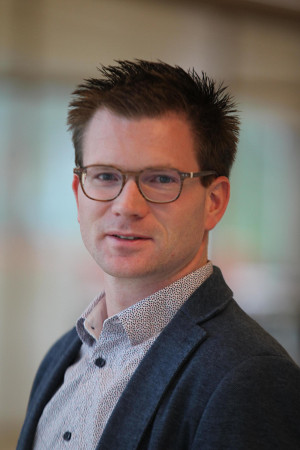
Thomas Demeester is an Associate Professor at Ghent University's Faculty of Engineering and Architecture, Department of Information Technology (EA05), and a Postdoctoral Researcher at IMEC. He leads the Internet Technology and Data Science Lab research unit and has supervised over 25 doctoral researchers across diverse AI topics. His work bridges theoretical AI research with practical applications in healthcare, business analytics, and human-computer interaction. His research spans artificial intelligence with particular focus on natural language processing, machine learning, neural networks, and computer vision. Demeester's work shows strong interdisciplinary connections between theoretical AI development and practical applications in healthcare diagnostics, business analytics, educational technology, and human-robot interaction. His recent publications demonstrate expertise in language model alignment, multimodal learning, synthetic data generation, and efficient model architectures. Analysis of his recent publications reveals a strong focus on practical AI applications with emphasis on interpretability, efficiency, and multimodal integration. His work spans healthcare AI (medical data analysis, diagnostics), business applications (bankruptcy prediction, labor market analysis), educational technology (question generation, assessment), and human-AI interaction (emotion analysis, social robotics). The publications show consistent innovation in neural network architectures, particularly with Hopfield networks and diffusion models. As an academic supervisor, Demeester has mentored numerous PhD students across multiple research domains, with notable projects in language model adaptation, entity extraction, multimodal interaction, and medical AI applications. His research is supported by multiple grants from the Research Foundation - Flanders (FWO) and other funding bodies, particularly in the areas of neural networks, natural language processing, and healthcare AI. His laboratory work focuses on the Internet Technology and Data Science Lab, where his team develops cutting-edge AI solutions with emphasis on practical deployment. Current research directions include multimodal large language models, neuro-symbolic AI approaches, efficient model training techniques, and applications of AI in healthcare and business domains.