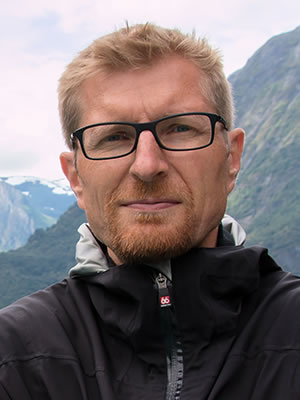
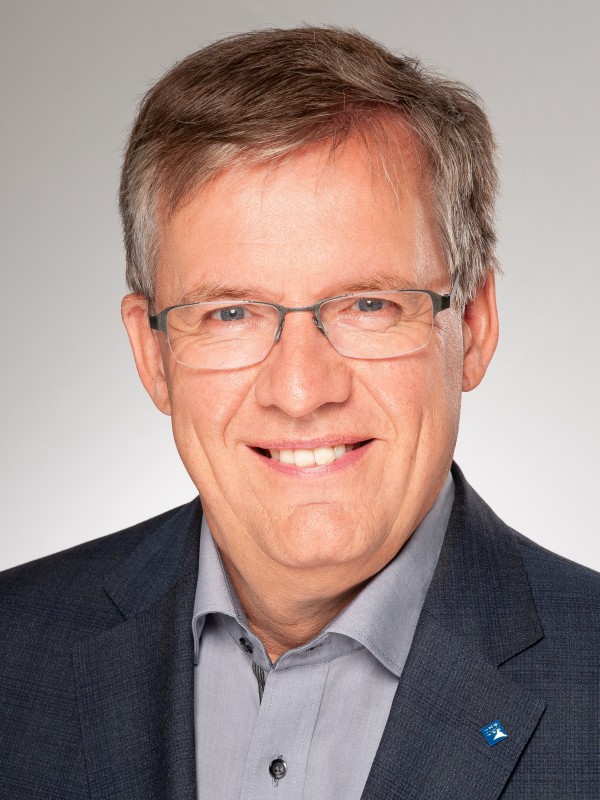
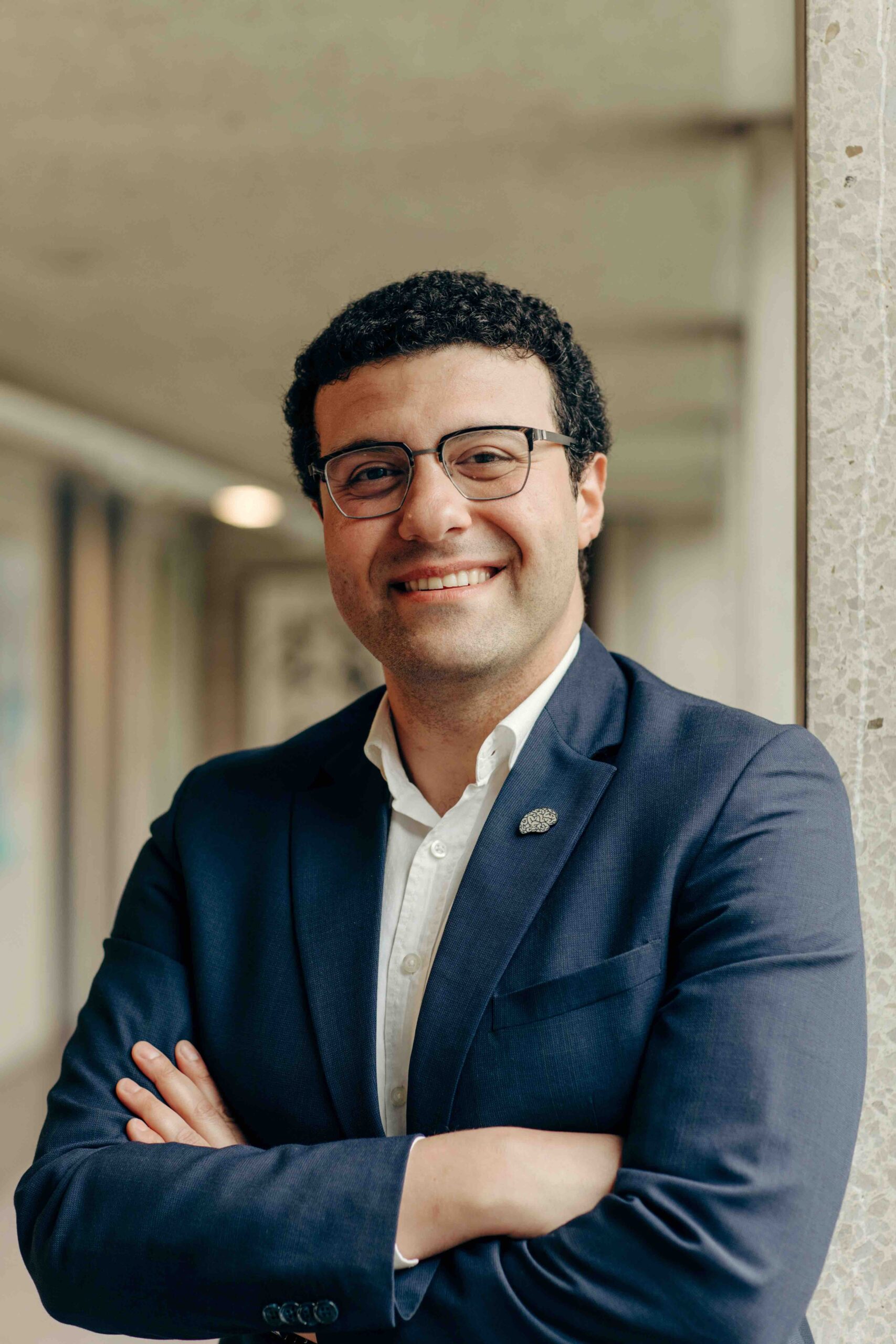
Prof. Dr.-Ing. Dipl.-Wirt. Ing. Diethelm Bienhaus is a faculty member at the Faculty of Information Technology (MNI) at Technische Hochschule Mittelhessen . His academic focus spans Cyber-Physical Systems , Industry 4.0 , and Assistive Technologies , with long-term projects in building automation and age-appropriate assistance systems. Research Interests: Cybersecurity for industrial systems, robotics, embedded systems, and human-computer interaction. Committee Roles: Member of the MNI Department Council, Head of Curriculum Development for Computer Engineering, and Chair of multiple appointment committees. Funded Projects: Led initiatives in secure digitalized healthcare production, dendrochronological analysis automation, and industrial connectivity platforms. Email: diethelm.bienhaus@mni.thm.de
Dr. Sudharman K. Jayaweera is a Professor in the Department of Electrical and Computer Engineering at the University of New Mexico, Albuquerque, NM. He holds a PhD in Electrical Engineering from Princeton University (2003), an MS in Electrical Engineering from Princeton University (2001), and a BE in Electrical and Electronic Engineering with First Class Honors from the University of Melbourne, Australia (1997). He is a Senior Member of IEEE and serves as an editor for IEEE Transactions in Vehicular Technology. Dr. Jayaweera's research spans several key areas in modern communications and signal processing: Cognitive radios and autonomous learning systems Wireless communications and statistical signal processing Machine learning applications in communications Smart-grid technologies and cyber-physical systems Satellite communications and space networks Vehicular networks and distributed systems His recent work shows a clear trend toward integrating artificial intelligence with traditional communications systems, particularly focusing on UAV networks, spectrum management, and security aspects of cognitive radio systems. The publications reflect a strong emphasis on practical implementations of theoretical concepts, with applications ranging from smart grids to space communications. Dr. Jayaweera has received numerous scientific awards including the IEEE PACRIM 2011 Gold Award for Best Communications Paper, the IEEE AVSS '06 Best Paper Award, and the WPMC '03 Excellent Paper Award. He has also been recognized with fellowships including the National Research Council (NRC) Senior Fellow at the Naval Postgraduate School and ASEE Air Force Summer Faculty Fellow. As an advisor, Dr. Jayaweera has mentored numerous graduate students to completion of their PhD and MS degrees. His former students have gone on to successful careers at institutions including Syracuse University, SUNY Oswego, Qualcomm, Sandia National Labs, and other leading technology companies. He also directs the EYES Summer Internship program for international students at UNM. Dr. Jayaweera leads the Communications and Information Sciences Lab (CISL) and the Cognitive Radio Lab (CRL) at UNM, where his teams work on cutting-edge research in autonomous cognitive radios (which he terms "Radiobots"), machine learning for communications, and next-generation wireless systems.
Prof. Dr.-Ing. habil. Volker Kühn serves as Professor and Head of the Institute of Communications Engineering at the University of Rostock within the Faculty of Computer Science and Electrical Engineering. He concurrently holds the position of Vice Dean of the Faculty while directing academic operations as Chairman of both the Electrical Engineering and Medical Information Technology Examination Boards. His research integrates wireless communications theory with biomedical applications, specializing in spatial modulation techniques, information bottleneck optimization, and electrical impedance tomography signal processing. Current work focuses on machine learning-enhanced physiological monitoring systems and distributed compression algorithms for sensor networks, with significant contributions to bias-free spectral estimation from irregularly sampled data. Analysis of his 2021-2025 publications reveals three dominant research thrusts: (1) neural network applications for medical signal processing, (2) information-theoretic optimization of communication protocols, and (3) advanced spectral estimation methods for biomedical and sensor data. This interdisciplinary approach bridges communications engineering with healthcare technology development. Prof. Kühn actively mentors students as Study Advisor for Electrical Engineering and Academic Advisor for Medical Information Technology. His leadership extends to the ITG Technical Committee 5.1 on Information and Systems Theory and IEEE societies. The Institute of Communications Engineering under his direction maintains specialized laboratories for wireless communications testing, medical signal acquisition, and MIMO system prototyping, supporting both fundamental research and industry collaboration projects in 5G/6G technologies and healthcare IoT.
Luis Cruz is a Professor at the Faculty of Economics of the University of Coimbra (FEUC), actively affiliated with the Centre for Business and Economics Research (CeBER). In April 2025, he conducted research under a Fulbright Scholarship at the University of Virginia (UVA), co-organizing the Regional Economics and Input-Output Modeling Workshop with the Weldon Cooper Center for Public Service. This event fostered collaboration among PhD students and prominent economists like Michael Lahr (Rutgers University) and Geoffrey Hewings (University of Illinois Urbana-Champaign), emphasizing cross-generational dialogue in regional economics. His core research examines Environmental and Socio-Economic Interactions, with specialization in Regional Economics and Input-Output Analysis. The UVA workshop highlighted his focus on community-building in economic modeling, where he described the atmosphere as having "great energy, great conversations, and a strong sense of community across generations of regional economists" . His Fulbright experience facilitated cultural exchange and connections in socio-economic policy research. Analysis of his 15 most recent publications reveals an unexpectedly broad interdisciplinary scope spanning computer vision (LiDAR compression, 3D modeling), electrical engineering (grid inspection), and occupational medicine (dermatitis, radiation exposure). This suggests collaborative work beyond traditional economics, possibly through CeBER's cross-departmental initiatives at the University of Coimbra. Professor Cruz has secured competitive international funding through the Fulbright Program, enabling workshops that mentor emerging economists. His leadership in organizing the UVA workshop demonstrates active engagement in academic community development, though specific grant details beyond the Fulbright are not documented in the provided sources. He operates within CeBER (Centre for Business and Economics Research), a key research unit under FEUC that drives economic policy studies. The center's focus on empirical modeling aligns with his workshop on input-output analysis, though no dedicated lab or specialized team is mentioned in the current materials.
Prof. Jörn Ostermann is a Full Professor and Head of the Institut für Informationsverarbeitung at Leibniz Universität Hannover since 2003, with prior roles at AT&T Bell Labs and AT&T Labs-Research. He served as Dean of the Faculty of Electrical Engineering and Computer Science (2011–2013) and member of the Senat (since 2020). His research spans video coding, computer vision, machine learning, 3D modeling, and computer-human interfaces , with applications in SAR imaging, predictive maintenance, children's speech analysis, and cochlear implants. Key projects include Next Generation Video Coding , Conditional Coding for Learned Compression , and GreenAutoML4FAS . Notable trends in his recent publications (2025–2023) include Neural network-based video compression Uncertainty estimation in speech recognition Zero-delay coding for cochlear implants Domain adaptation for aerial image segmentation 3D mesh compression standards Error concealment in VVC coding Scientific recognitions: AT&T Standards Recognition Award (1998) ISO Award (1998) IEEE Fellow (2005) Distinguished Lecturer, IEEE CAS Society (2002/2003) MPEG Convenor (2020–2023) He co-authored a graduate textbook on Video Communications , holds >30 patents, and has led >20 research projects. His work bridges academic research and industrial standardization, particularly in MPEG and IEEE committees.
Moataz Assem is a Wellcome Trust Early Career Fellow at the MRC Cognition and Brain Sciences Unit , University of Cambridge. Affiliated with the Cambridge Neuroscience network, his work focuses on the neural basis of human intelligence through advanced neuroimaging techniques. School: Clinical Medicine His research examines the multiple-demand (MD) cortical circuit —its anatomical precision, functional dynamics, and role in cognitive control. Using fMRI , intracranial EEG , and concurrent TMS-fMRI , he explores how this network organizes thoughts and behavior, including its interaction with sensory-biased regions. Key publications span 2025-2019 in journals like Neuropsychologia , Cerebral Cortex , and Trends in Cognitive Sciences , addressing topics such as domain-general vs. domain-specific brain regions , task coding , and neurostimulation protocols . His 2025 work reveals a patchwork organization of intelligence-related cortical regions. Scientific accolades include the Wellcome Trust Early Career Award (2024). Collaborators span institutions like Harvard , Washington University , and Stanford , with ongoing projects testing PhD candidates and postdocs in computational psychiatry and neuroimaging.
Gregory Jefferis is a Professor and Research Leader at the MRC Laboratory of Molecular Biology (MRC LMB), University of Cambridge, where he heads a group investigating olfactory processing in Drosophila . His work bridges neural circuitry, behaviour, and computational neuroanatomy within the Cambridge neuroscience ecosystem. Jefferis' research focuses on how odour information transforms into behaviour through higher olfactory centres, particularly examining third-order neurons in the lateral horn that integrate specific olfactory channels. His lab employs cutting-edge techniques including genetic labelling, in vivo whole-cell patch clamp recording, and high-resolution computational neuroanatomy to decode innate and learned behavioural responses to general odours and sex pheromones. Recent work demonstrates strong trends in connectome mapping and computational analysis, with 2024 publications in Nature and Cell detailing the complete adult fly brain connectome and neurotransmitter classification via machine learning. His group actively contributes to open-source neuroanatomy tools like the natverse while exploring fundamental questions about sensory processing and memory retrieval in olfactory circuits. Jefferis leads a collaborative team including Isabella Beckett, Sebastian Cachero, Shahar Frechter, Florian Kampf, Myrto Mitletton, Markus Pleijzier, Gerald Rubin, Philipp Schlegel, Valeria Silva-Moeller, Tomke Stuerner, and Catherine Whittle, with extensive international partnerships evident in recent multi-institutional publications.
Taro Sekiyama is an Associate Professor at the National Institute of Informatics in Japan. His research focuses on programming language theory and applications, particularly in type systems, gradual typing, and program verification with effects. Academic Rank: Associate Professor University: National Institute of Informatics His research interests span type theory , polymorphic algebraic effects , gradual typing , and temporal verification . His work combines theoretical foundations with practical applications, including Rust programming language verification and effect handling. The analysis of Taro Sekiyama's publications reveals a consistent focus on: Algebraic effect systems Refinement type theory Gradual typing semantics Temporal verification techniques Neural-guided program analysis Effect handler design
Dr. Wenchao GU is a Postdoctoral Researcher at the Chair of Software Engineering & AI at the Technical University of Munich (TUM) , working under the supervision of Prof. Chunyang Chen. His academic journey includes a PhD in Computer Science and Engineering from The Chinese University of Hong Kong (CUHK) (2024), an MSc in Information Science from Tohoku University (2017), and a B.Eng in Mechanical and Aerospace Engineering from Tohoku University (2015). Research Interests: Dr. GU's work focuses on Artificial Intelligence for Software Engineering (AI4SE) , leveraging Large Language Models (LLMs) to advance source code understanding, analysis, and generation. Key areas include code optimization , vulnerability detection , and UI code generation . His research bridges theoretical innovations with practical tools for automated code efficiency improvement, semantic code retrieval, and natural language generation in software development workflows. Publication Trends : His recent work emphasizes iterative LLM refinement via evolutionary search (2025), segmented deep hashing for scalable code retrieval (2025), and contrastive learning in code search (2023). Earlier studies explored AST-guided transformers for code summarization (2022) and semantic dependency learning in code retrieval (2021). Scientific Awards: Distinguished Paper Award, ICSE 2025 The Aoba Foundation Scholarship (2015) JASSO Scholarship (2012) Tohoku University President Fellowship (2012) Mentorship: Dr. GU supervises 11 current students (including 1 PhD) and has advised 5 graduated Master's students. He actively seeks candidates with web/Android development expertise for UI code generation projects.
Zekeriya Uykan serves as a Visiting Professor in the Department of Information and Communications Engineering at Aalto University, affiliated with the Communication Engineering research group. His current research profile is accessible via Aalto University's research portal, and he maintains direct contact through university email and phone channels. His primary research domains encompass Wireless Communications, Network Optimization, Machine Learning, and Neural Networks, with specialized focus on channel charting, femtocell optimization, device-to-device communications, and antenna placement. Recent work integrates Hopfield Neural Networks and stochastic optimization techniques to address dynamic resource allocation challenges in 5G/6G systems, emphasizing practical implementation in heterogeneous wireless environments. Analysis of his 2023-2024 publications reveals a strong trajectory toward machine learning-driven solutions for next-generation wireless networks, particularly in channel modeling and interference management. This builds upon his foundational contributions to relay network capacity bounds and SINR-balancing systems, demonstrating consistent innovation in merging theoretical information theory with applied neural network models. As a visiting researcher, Uykan actively collaborates within Aalto University's Communication Engineering group, contributing to advanced projects in wireless infrastructure design and optimization. His work bridges academic theory with industry-relevant communication system challenges, particularly in dense network scenarios requiring intelligent interference mitigation.
Tengda Han is a research scientist at Google DeepMind , focusing on video understanding and visual-language models . He previously completed his PhD at the University of Oxford under Andrew Zisserman and earned a Bachelor of Engineering from Australian National University in mechanical & material engineering, with prior studies in business administration and law at Renmin University of China . Research Interests: His work explores neural networks for video analysis, including self-supervised learning , video captioning , object counting , and prompt engineering . Key projects include AutoAD for movie description, Temporal Alignment Networks , and Dense Predictive Coding for video representation. Scientific Awards: Best Paper Award at ACCV 2024 Best Poster Award at BMVC 2023 BMVA Sullivan Doctoral Thesis Prize Runner-up Collaborations & Students: He has collaborated with researchers like Andrew Zisserman , Max Bain , and Arsha Nagrani , and mentored students Junyu Xie , Toby Perrett , and Niki Amini-Naieni on projects including Shot-by-Shot and Unique Video Captioning .
Daniel Adolfo Llano is a Professor at the University of Illinois at Urbana-Champaign with multiple appointments: Professor in the Department of Molecular and Integrative Physiology, Neuroscience Program, and Biomedical and Translational Sciences. He serves as Director of the MD/PhD Medical Scholars Program at Carle Illinois College of Medicine and Theme Lead at the Beckman Institute for Advanced Science and Technology. His office phone is (217) 244-0740. Dr. Llano leads a laboratory investigating auditory processing mechanisms, particularly how complex sounds like speech are decoded by the brain. His research focuses on: Descending cortical projections in auditory processing Neural basis of generative sensory models Aging-related auditory network dysfunction Neurodegenerative disease mechanisms (especially Alzheimer's) Using electrophysiological, optical, and anatomical approaches, his team studies cortical-subcortical interactions in the auditory pathway. His recent publications (2019-2025) demonstrate strong focus on: Advanced neuroimaging techniques (super-resolution ultrasound, two-photon microscopy) Alzheimer's biomarkers (pTau proteins, amyloid detection) Auditory system organization (cortical layers, inferior colliculus) Neurovascular relationships in neurodegeneration Environmental impacts on auditory processing Major Scientific Honors: Presidential Early Career Award for Scientists and Engineers (PECASE, 2019) Helen Corley Petit Scholar (2017) Benjamin Goldberg Professorial Scholar (2017) Advances in Medicine Award, Carle Hospital (2016) Golden Apple Teaching Award (2015) Excellence in Teaching Recognition (2012-2019, 2021) Dr. Llano leads a research team at the Beckman Institute focusing on auditory neuroscience and neurodegenerative diseases. The laboratory employs cutting-edge techniques including in vivo two-photon imaging, ultrasound localization microscopy, and electrophysiology to study auditory processing and neurovascular changes in aging and disease models.
Irina Nikishina is a postdoctoral researcher at the University of Hamburg's Department of Informatics, working in the Language Technology Group under Prof. Chris Biemann. As a researcher in computational linguistics and natural language processing, she contributes to projects like ACQuA-2.0, focusing on semantics, argument mining, taxonomies, and knowledge graphs. PhD in Computational and Data Science and Engineering (2022), Skolkovo Institute of Science and Technology Bachelor's and Master's degrees from National Research University Higher School of Economics (NRU HSE) Her research spans taxonomy enrichment, comparative question answering systems, and biomedical concept representation. She organizes shared tasks like RUSSE’2020 and RuArg-2022, and co-founded the RusNLP semantic search engine for Russian NLP conferences. She chairs the Network Analysis track at the International Conference on Analysis of Images, Social Networks and Texts (AIST) and has served as secretary for AIST 2020 and 2021. Recent publications focus on large language models' performance in lexical semantics, multilingual comparative argumentation systems, and knowledge graph integration for QA tasks. Her work includes developing tools like TaxFree for candidate-free taxonomy enrichment and exploring cross-modal approaches for taxonomic graph expansion.
Dr. Francesco Paolo Casale serves as Principal Investigator in Machine Learning in Biomedicine at the Helmholtz Munich Institute AI for Health, part of Helmholtz Zentrum München and affiliated with Ludwig-Maximilians-Universität München's Biomedical Center. His research develops machine learning and statistical tools to analyze genetic cohorts with deep molecular and phenotypic data, addressing fundamental biomedical questions about disease mechanisms and progression. His academic foundation includes: PhD in Statistical Genetics from University of Cambridge & EMBL-EBI (2012-2016) M.Sc. in Physics of Complex Systems from Università di Napoli Federico II (2009-2012) B.Sc. in Physics from Università di Napoli Federico II (2009) Casale's research integrates machine learning, statistical inference, and systems genetics to develop scalable tools for genetic association studies, deep learning models for imaging genetics, and computational methods examining gene-environment interactions. His work emphasizes model robustness and interpretability while investigating molecular and cellular traits associated with disease severity. Current projects focus on rare variant analysis, aberrant gene expression prediction, and longitudinal omics data integration. His publication record shows a clear progression from foundational statistical genetics methods toward increasingly sophisticated integration of machine learning with multi-omics data. Recent work emphasizes practical biomedical applications including disease risk prediction through Mendelian randomization frameworks, advanced single-cell analysis techniques, and histopathology image classification. The research demonstrates consistent methodology development focused on scalability for large datasets while maintaining biological interpretability. Key recognitions include: Highly Recognized article in PloS Genetics Research Prize (2018) Microsoft Research New England Postdoctoral Fellowship (2017) EMBL studentship (2012) Honors for MSc and BSc degrees from Università di Napoli Federico II Throughout his career at Microsoft Research, Insitro, and Helmholtz Munich, Casale has led research teams developing computational approaches at the intersection of human genetics and machine learning. His work contributes to landmark projects including the 1000 Genomes Project and Blueprint initiative, with conference presentations at major venues including NeurIPS, ASHG, and EASL. Current grant support likely stems from Helmholtz Association funding mechanisms and collaborative biomedical research programs. He directs the Systems Genetics and Machine Learning Research team at Helmholtz Munich, which operates within the Biomedical Center ecosystem of LMU Munich. The team focuses on leveraging large-scale genetic datasets with machine learning to understand disease biology, with particular emphasis on target identification and characterization for therapeutic development. Current research directions include multi-timepoint omics analysis, disease subtyping, and developing interpretable models for clinical translation.
Max Hinne is an assistant professor at the Department of Artificial Intelligence, Radboud University, Nijmegen, The Netherlands, where he leads the Uncertainty in Complex Systems research group. His work bridges artificial intelligence, neuroscience, and statistics through advanced Bayesian methodologies. Dr. Hinne's research focuses on Bayesian modeling of brain networks using neuroimaging data. His primary interests include: Bayesian nonparametric models, particularly Gaussian processes Structural and functional brain connectivity analysis Predictive modeling of neural systems Causal inference frameworks Uncertainty quantification in complex systems Development of computational tools for neuroscience His approach emphasizes how probabilistic methods can address uncertainty in complex biological systems while providing interpretable models of brain function. Analysis of Dr. Hinne's publication trajectory reveals a consistent focus on Bayesian methods applied to increasingly diverse domains. Starting with foundational work in brain connectomics, his research has expanded to include applications in developmental psychology, medical genetics, and educational technology. His most recent work demonstrates sophisticated integration of nonparametric Bayesian methods with domain-specific challenges, particularly in handling uncertainty in complex, high-dimensional data across multiple scientific fields. Dr. Hinne actively mentors students and invites master's thesis projects focused on Bayesian nonparametric methods for neuroimaging data. He has developed several software tools including the Bayesian Connectomics Toolbox (BaCon), latent space modeling code, and GP CaKe for causal inference. His research group maintains strong connections with the Donders Institute for Brain, Cognition and Behaviour, facilitating interdisciplinary collaborations between statisticians, neuroscientists, and domain experts.