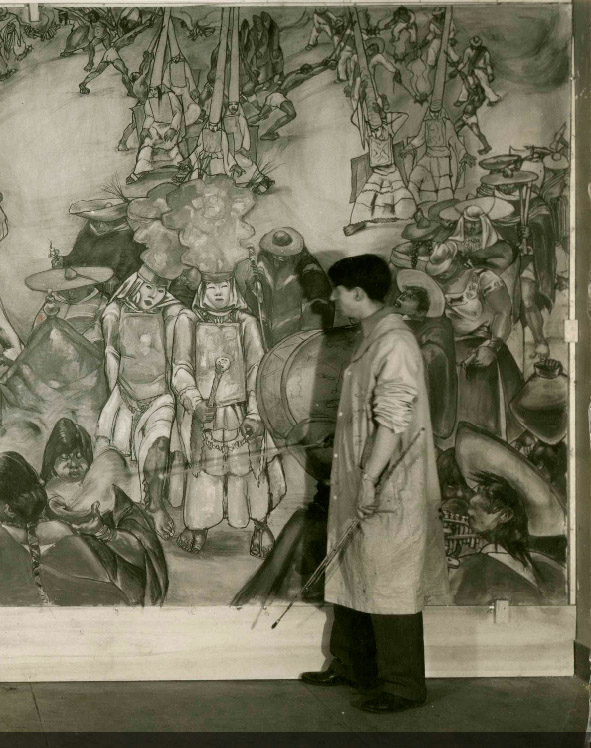
Camilo Egas (1889–1962) was a pivotal Ecuadorian artist and academic who founded the first Art Department at the New School in New York City. He served as Director of the Art Workshops (1935) and later Director of the Art Department until his death in 1962. Egas taught courses in Modern Art, Painting, Oil, and Drawing, and co-taught Advanced Painting with Robert Gwathmey (1946–1951). He integrated European artistic techniques with indigenous Ecuadorian themes, pioneering Pictorial Indigenism and contributing to Latin American modernism. Education: Studied art in Quito, Rome, and Madrid. Key works include the mural Ecuadorian Festival (1932) for the New School and contributions to the 1939 New York World Fair. His art emphasized Andean themes, indigenous struggles, and national identity, blending Social Realism, Surrealism, and Abstract Expressionism over his career. Legacy: Founded Ecuador’s first art periodical Helice , co-founded the Indigenist Movement, and mentored artists like Berenice Abbott and Stuart Davis. His interdisciplinary approach merged anthropology, archaeology, and visual arts to redefine Latin American cultural narratives.
Darren Jorgensen is a Lecturer at the UWA Design School , University of Western Australia, specializing in twentieth century and contemporary art. His research bridges Australian art, Aboriginal art, Chinese art, and experimental music, with a focus on critical theory and poststructuralism. PhD in Science Fiction and the Sublime Co-founder of Guan Kan journal on contemporary Chinese art Contributor to Dispatch Review and Artlink His research projects examine illustrated literature from remote Aboriginal communities and art from Australian pastoral stations. He has collaborated on ARC-funded initiatives exploring Indigenous art conditions and digital transformations of Australian art databases. Recent writings analyze post-industrial music, science fiction aesthetics, and cross-cultural art practices. Recent Research Trends : Darren's 15 most recent publications (2024-2025) span exhibition reviews, book critiques, and cultural analyses. Key themes include: Transnational Australian-Chinese art dialogues Aboriginal art's relationship to land, heritage, and decolonization Industrial/post-industrial music influences in visual art Critical theory applications to contemporary art practices Illustrated literature as cultural document Scientific Awards : Best Small Exhibition Catalogue (2019) for collaborative curatorial work Teaching & Supervision : Supervises postgraduate and honours students across diverse topics including Aleister Crowley's esoteric art, whale acoustics, and continental philosophy's impact on aesthetics. His teaching philosophy integrates Kant, Isabelle Stengers, and poststructuralist theory. Research Collaborations : Collaborates with institutions across Australia and internationally, particularly through projects like the Beijing Realism exhibition and remote Aboriginal art studies. Maintains active research networks in art history, critical theory, and experimental practices.
Carrie Moyer is a renowned painter, writer, and co-founder of the public art project Dyke Action Machine! She currently serves as a Professor and Director of the MFA Program in Studio Art at Hunter College, part of the City University of New York (CUNY) system. Moyer has exhibited extensively in the US and Europe, including solo museum shows at the Tang Museum (2013) and the Worcester Museum of Art (2012), and was featured in the 2017 Whitney Biennial. Her work spans painting, agitprop, and graphic design, often exploring themes of feminist art, queer identity, and political activism. Moyer attended Pratt Institute (BFA), the Milton Avery Graduate School of the Arts at Bard College (MFA), and the Skowhegan School of Art. Her research interests include contemporary painting, feminist art, queer art, political art, agitprop, graphic design, and the history of acrylic paint, abstraction, modernism, and painting. Her artistic practice intertwines with cultural critique, drawing from 20th-century abstract movements and pop culture to create socially engaged works. Articles by Moyer have appeared in Art in America, Artforum, and The Brooklyn Rail, focusing on feminist art, abstraction, and political themes. She has received significant recognition through awards from the Guggenheim and Joan Mitchell Foundations, Anonymous Was a Woman, and Creative Capital. Moyer’s teaching at Yale and Rutgers Universities, alongside her leadership at Hunter College, reflects her commitment to mentoring emerging artists. Her studio practice, marked by vibrant acrylic and glitter works, is complemented by decades of activism through Dyke Action Machine!—a collaboration with Sue Schaffner that subverted mainstream advertising with lesbian imagery.
David Holzman is an Adjunct Professor of Theory and Piano at the School of Performing Arts, Long Island University (LIU). He holds a B.M. magna cum laude from Mannes College of Music and an M.M. from Queens College, CUNY. He is internationally recognized for his performances and recordings of 20th- and 21st-century piano music, particularly works by modernist composers such as Stefan Wolpe, Donald Martino, and Ralph Shapey. His research and performance interests center on contemporary classical music, avant-garde piano techniques, and the cognitive and physical challenges of interpreting complex modern scores. He has published extensively on these topics, including in Contemporary Music Review and Sonus Magazine , and contributes liner notes that combine scholarly insight with accessible commentary. His work on performing with hearing loss adds a unique dimension to his scholarship. The body of his recent publications and recordings reveals a sustained engagement with American modernism, serialism, and the music of Jewish composers. His work bridges performance, analysis, and pedagogy, often exploring the psychological and physical dimensions of playing highly complex music. He has been a frequent lecturer at institutions such as Columbia University, NYU, and Darmstadt, further extending his influence beyond the concert stage. Honors include: Grammy nomination for Best Instrumental Solo Performance Indie Award for Best Classical CD Deems Taylor Award for Best Liner Notes Grants from the National Endowment for the Humanities, Aaron Copland Foundation, and Alice B. Ditson Fund Commissioning support from Reader’s Digest-Meet the Composer and New Jersey Council on the Arts Holzman has advised and mentored through masterclasses, lecture-recitals, and recordings. His performances at venues like Merkin Hall, Bargemusic, and the Darmstadt Festival have been supported by grants and institutional sponsorships. He has collaborated with the Stefan Wolpe Society and performed at festivals dedicated to experimental music, contributing significantly to the preservation and promotion of underrepresented modernist repertoire. He is actively involved in performance-based research and maintains a strong digital presence through his website battlemuse.com , where he shares insights on performance, hearing loss, and contemporary music. His work at the intersection of disability and artistry offers a compelling narrative on resilience and innovation in music.
Jo Melvin is a Professor in Fine Art and Feminisms at Chelsea College of Arts, University of the Arts London. She serves as Director and Curator of the Barry Flanagan Estate, focusing on curatorial research engaging with forgotten histories, archives, and oral traditions to critique colonialism, decoloniality, and identity politics. Her work emphasizes queer perspectives and reinterpreting ancient/modern imperial narratives. Her research explores intersections of gender, memory, and art practice through exhibitions like 'The Feuilleton' (2021), 'PAINTING STONE' (2021), and collaborations with Vittoria Bonifati at Villa Lontana (Rome). Notable publications include Picturing the Invisible (2022) and Seth Siegelaub: Better Read Than Dead (2020). Recent exhibitions include Barry Flanagan retrospectives (Ikon Gallery 2019) and Villa Lontana projects like 'MEMORY GAME' (2020) and 'SCULPTURELESS SCULPTURE' (2018). Her teaching includes supervising research degrees addressing topics like participatory art practices and architectural archives. Key collaborations involve co-editing exhibition catalogues and organizing events that bridge art, theory, and activism. Current work continues exploring decolonial methodologies and slow curatorial paradigms.
Dr. Lena Fritsch is a Curator of Modern and Contemporary Art at the Ashmolean Museum and an Associate Member of Nuffield College, University of Oxford. She bridges academic and curatorial roles, teaching within the Faculty of Oriental Studies and History of Art while developing international art exhibitions such as Anselm Kiefer: Early Works (2025) and This is What You Get: Stanley Donwood | Radiohead | Thom Yorke (2025–26). Her research focuses on Japanese art and photography (20th–21st centuries) , Neo-Expressionism , body and gender theories , and art-music-text intersections . She explores themes like death in art , collective memory , and forgotten women photographers , with publications including Ravens & Red Lipstick: Japanese Photography since 1945 (2018, 2nd ed. 2024) and The Body as a Screen: Japanese Art Photography of the 1990s (2011). Recent publications highlight her curatorial scholarship on 21st-century Japanese art , experimental photography , and avant-garde practices . She co-curated the Roppongi Crossing 2022 triennial and large-scale retrospectives like Agnes Martin (2015) at Tate Modern, emphasizing cross-cultural dialogues and post-war artistic movements. Her academic leadership includes teaching, research, and editorial work, with affiliations at institutions like Tate Modern and Staatliche Museen zu Berlin. Lena Fritsch’s career exemplifies interdisciplinary collaboration between museum curation and university scholarship .
Gregg Lambert is the Dean's Professor of the Humanities at Syracuse University's College of Arts and Sciences. He holds a Ph.D. in Comparative Literature and Philosophy from the University of California, Irvine. Lambert is renowned for his work in continental philosophy, particularly on Gilles Deleuze and Jacques Derrida, and his exploration of baroque aesthetics, critical theory, and contemporary academic institutions. He founded the Syracuse University Humanities Center and led the Central New York Humanities Corridor until 2019. His research spans philosophy of religion, political philosophy, and the impact of the pandemic on thought. Lambert teaches courses in existentialism and continental political philosophy, including a three-year seminar on Marxism. He has authored over 18 books and numerous articles, with recent works including Philosophy after Friendship (2024) and The World is Gone (2022). He directs the Perpetual Peace Project in response to the Ukraine war and is completing a follow-up to his earlier work on friendship in philosophy. His academic service includes roles on editorial boards for Philosophy Today and advisory roles for the Edinburgh University Press. Lambert’s work is translated into multiple languages, reflecting his global influence in continental philosophy.
Jaan Toomik (b. 1961) is a renowned Estonian contemporary artist and professor at the Department of Painting, Estonian Academy of Arts. His work bridges painting, video art, performance, and installation, reflecting metaphysical, biocentric, and shamanist perspectives. Education: MA in Painting, Estonian Academy of Arts (1991) Research & Artistic Interests: Toomik’s practice explores life and death, spirituality, and humanity’s connection to natural cycles. His minimalist approach often uses meditative repetition and autobiographical themes, exemplified in works like Father and Son (1998) and Untitled (Man) (2001). Awards & Recognition: Konrad Mägi Medal (2005) Principal Prize at Oberhausen Short Film Festival (2008) Recipient of National Artists’ Salary (2022–2024) Exhibitions & Collections: Represented Estonia at Venice (1997, 2003), São Paulo (1994), and Berlin Biennales. His works are held by Kiasma Helsinki, Stedelijk Museum Amsterdam, Ludwig Museum Budapest, Kumu Tallinn, and Louis Vuitton Foundation.
Jason Rosenfeld is Professor of Art History and former Distinguished Chair (2009–2012) at Marymount Manhattan College, where he has been a faculty member since 2003. He is affiliated with the Department of Art and Art History and contributes extensively to the academic and curatorial landscape through teaching, writing, and exhibition curation. His educational background includes a B.A. in Art History and Economics from Duke University, and M.A. and Ph.D. from the Institute of Fine Arts, New York University. His doctoral research focused on Pre-Raphaelite landscape and Victorian natural history. B.A., Art History and Economics, Duke University M.A., Institute of Fine Arts, New York University Ph.D., Institute of Fine Arts, New York University Rosenfeld’s research spans 19th-century European art, British Victorian and Pre-Raphaelite art, modern architecture, and contemporary art, with special attention to figuration, landscape, and New York City’s art scene. He has authored major monographs on artists such as Sir John Everett Millais, Cecily Brown, and Shahzia Sikander, and has curated or co-curated significant exhibitions including Pre-Raphaelites: Victorian Avant-Garde at Tate Britain and the National Gallery of Art, which achieved historic attendance. The 15 most recent publications reflect a consistent engagement with British and American art, from Victorian to contemporary practices. His work increasingly examines the intersections between historical movements and modern reinterpretations, particularly in landscape and figuration. He frequently contributes to exhibition catalogs and writes criticism for The Brooklyn Rail , where he also conducts interviews with leading contemporary artists. His scientific recognition includes the Distinguished Chair at MMC. He has served as juror and curator for the 59th annual Raleigh Fine Arts Society North Carolina Artists Exhibition (2024) and has contributed to major institutions such as the Metropolitan Museum of Art and Tate Britain. Rosenfeld advises independent studies in Art History and has supervised honors theses on artists like Joseph Stella and Huguette Caland. He has secured curatorial and scholarly collaborations, including co-curating River Crossings with painter Stephen Hannock and contributing to major exhibition catalogs. His academic service includes leadership as President of the Faculty Council (2013–2015) and membership on strategic planning and curriculum committees. He is a frequent lecturer and presenter at academic conferences and museums, including the Frick, Yale, and the National Gallery of Art. He has curated exhibitions on Ben Wilson and Stephen Hannock and is currently working on a book about Shahzia Sikander, forthcoming in 2025 from Lund Humphries.
Jonathan Wallis is Professor of Art History and Humanities at Moore College of Art & Design, where he serves as Chair of Creative & Critical Studies and program head for Visionary Academic Honors. He previously held the Penny and Bob Fox Distinguished Professorship from 2015-2018 and received the Christian R. and Mary F. Lindback Award for Distinguished Teaching in 2013. His academic leadership extends to his role as Interim Faculty Forum President. PhD and MA in History of Art from Tyler School of Art, Temple University BA from University of New Hampshire Wallis's research focuses on the intersection of ethics, socially engaged art, and critical pedagogy, with particular expertise in surrealism and fantasy art. His work explores the post-Surrealist contributions of Salvador Dalí while examining contemporary issues in curatorial practice. As a curator, he has presented exhibitions on diverse modern and contemporary art subjects, including the significant River of Inferno exhibition featuring Chinese-American artist Yiu-Ngok Yuen. His publications span multiple prestigious venues including Art and the Public Sphere , Journal of Curatorial Studies , Papers of Surrealism , and Woman's Art Journal . Wallis has also served as guest editor for a special double-issue of Art and the Public Sphere on ethics. His scholarly work demonstrates consistent engagement with ethical questions in art, community partnerships, and innovative approaches to art historical methodology. Penny and Bob Fox Distinguished Professor (2015-2018) Christian R. and Mary F. Lindback Award for Distinguished Teaching (2013) 2024 National Fantasy Fan Federation Laureate Award for Best Novel 2024 Valorious Awards - Stellar Instinct (2nd place) 2022 Indie Ink Awards runner-up for Non-Binary Representation Wallis maintains an active creative practice under the pen name Jonathan Nevair, producing award-winning character-driven space operas and spy-fi thrillers that explore themes of identity and social structures. His dual career in academic scholarship and creative writing exemplifies his commitment to bridging theoretical frameworks with practical artistic expression.
Teresa Eckmann is an Associate Professor of Contemporary Latin American art in the School of Art at the University of Texas at San Antonio (UTSA), where she teaches in the Department of Art and Art History. She has been a faculty member at UTSA since 2008, when she joined as an Assistant Professor before being promoted to her current rank. Her academic journey includes a Ph.D. in Latin American Studies with a concentration in art history from the University of New Mexico (2004), along with prior professional experience as Assistant Curator at the National Hispanic Cultural Center and a Post-Doctoral Fellowship at UNM's Center for Southwest Research. Eckmann's educational background reflects her multidisciplinary approach to art: she holds a B.A. in studio art from the University of Massachusetts, Amherst, and trained as a professional dancer at the North Carolina School of the Arts, where she was a dance major. She performed with the Berkshire Ballet and as an apprentice with the Pittsburgh Ballet Theatre following high school. Eckmann specializes in modern and contemporary Latin American art, with particular focus on contemporary Mexico. Her research interests span Modern and Contemporary Latin American Art, 19th-21st Century Art of Mexico, Museum Studies, Public Art, Graphic Arts of Latin America and the Caribbean, and Latin American Film. Her work often explores themes of national identity, gender representation, border aesthetics, and the politics of cultural representation in Mexican and Latin American art. Her scholarly output reveals consistent engagement with Mexican neo-expressionist artist Julio Galán, whose work serves as a lens through which she examines broader questions of Mexican identity, gender, and cultural representation. Her publications also demonstrate significant contributions to the study of Neo-Mexicanism, border art, Chicano art, and public art in the Mexican-American context, particularly in Texas. Mitacs Globalink Research Award Abroad (2019-22) Faculty Development Leave for 'Conversations on Contemporary Mexican Art and Queering Mexicanidad' (2021) Clustered & Connect Hiring Program Proposal 'Social and Environmental Challenges in Latin America' (2019) Mellon Pathways Mentor awards (2017, 2016) Alvarez International Study Fund Awards (2017, 2016, 2015) Mexico Center Educational Research Fellowships (2017, 2016, 2011, 2009) New Mexico History Scholars Program Fellow (2016) Eckmann has secured numerous grants supporting her research and publications, including COLFA Classroom to Career Faculty Curriculum Grant (2022), Diane and Bruce Halle Foundation subvention for her Julio Galán monograph (2022), and multiple subventions from the Center for Regional Studies at UNM. She has served as a mentor through the Mellon Pathways program, guiding students like Jessica Vargas and Nicole Poole. Her curatorial work includes exhibitions such as 'Alberto Mijangos: 159, A Retrospective of His Art (and Life)' (2018) and '$t@tU.S.? Prints from Puerto Rico to San Antonio' (2017), demonstrating her commitment to connecting academic research with public engagement. Through her dual background in studio art and dance, Eckmann brings a unique perspective to her scholarship, often considering the performative aspects of identity in visual culture. Her work bridges academic research, curatorial practice, and community engagement, particularly through her focus on Mexican and Mexican-American art in the San Antonio context.
Per Faxneld is a Professor at the Department of History and Contemporary Studies, Södertörn University. His research spans esotericism, alternative spirituality, new religious movements, and secularization, with particular attention to legitimization strategies, religious authority, identity creation, and the intersection of esotericism with art, literature, and martial arts. He is currently leading a Swedish Research Council-funded project analyzing spirituality debates within Bujinkan Budō Taijutsu (Ninjutsu) communities in Sweden. Primary academic affiliation: Södertörn University Core research themes: Esotericism, secularization, religious modernity, gender dynamics in Satanism, esoteric dimensions of martial arts Publication record: Over 15 recent articles (2025-2020) covering Satanic feminism, occult art, martial arts spirituality, and transnational religious exchange His work bridges historical and contemporary esoteric traditions, examining their cultural adaptation and symbolic resonance. Publications frequently address the tension between secularization and spiritual persistence, particularly in martial arts contexts. He has contributed to academic anthologies like EASTSPIRIT and Buddhist Modernities , and his 2021 article Martial Arts Spirituality in Sweden: The Occult Connection remains influential. Current trends in his research include: gender politics in Satanic traditions, esoteric symbolism in modernist art and literature, and cross-cultural spiritual exchange. While no formal awards are listed, his 2017-2022 publications solidify his position as a leading scholar in Western esotericism and contemporary religious studies. Teaching roles and lab affiliations remain unspecified in available sources.
Christa Noel Robbins is an Associate Professor of Art History at the University of Virginia, specializing in Twentieth- and Twenty-first Century Art, Critical Theory, and Media Theory. She joined UVa in 2015 after serving as the Mellon Caltech-Huntington Postdoctoral Instructor at the California Institute of Technology. PhD in Art History from the University of Chicago (2010) Her research explores queer modernism, community-building in avant-garde practices, and the intersection of art criticism with psychoanalytic and Marxist theories. She is the author of Artist as Author: Action and Intent in Late-Modernist American Painting (University of Chicago Press, 2015) and has published extensively in journals like Critical Inquiry , Oxford Art Journal , and Art in America . Her recent articles and talks focus on themes such as occasional art, Reichian psychoanalysis in abstraction, and participatory structures in performance art. These works span subfields like postwar American art, queer aesthetics, medium specificity, and institutional critique. Scientific Awards and Distinctions: Mellon Caltech-Huntington Postdoctoral Instructor in Art History Robbins also contributes to editorial and curatorial discourse, including a co-edited cluster on form for Open Set and organizing the Art + Technology Speaker's Series at Caltech. She has no formal advisees listed but collaborates with scholars like Kris Cohen.
Rebecca M. Brown is a Professor and Director of Undergraduate Studies in the Department of the History of Art at Johns Hopkins University, part of the Krieger School of Arts & Sciences. She holds a PhD from the University of Minnesota and specializes in South Asian and diasporic visual culture, focusing on modernism, colonialism, and the interplay between space and temporality. Her work examines urban spaces, architecture, and visual practices from the late 18th century to the present, with recent research on K.C.S. Paniker’s art and postcolonial linguistic landscapes. Education: PhD in South Asian and Islamic Art History (University of Minnesota), BA in History of Art (Pomona College). Teaching experience includes roles at St. Mary’s College of Maryland, Swansea University, Georgetown University, and George Washington University. She chairs the Advanced Academic Programs in Museum Studies and Cultural Heritage Management at JHU and has curated exhibitions for institutions like the Peabody Essex Museum and the Walters Art Museum. Research interests span colonial and postcolonial visual culture, including photography, painting, film, and museum studies. Her scholarship critiques Eurocentric modernism, emphasizing decolonial frameworks and the materiality of art. Recent publications explore themes such as documentary photography, neo-tantrism, and the intersections of spirituality and modern art. Professional roles include serving as a consultant for the Shelley and Donald Rubin Foundation and presenting at venues like the Clark Art Institute and National Museum of Korea. She advocates for innovative pedagogy in art history surveys and interdisciplinary approaches to gender studies, postcolonial theory, and film studies.
Dr James Boaden is a Senior Lecturer in the Department of History of Art at the University of York, specializing in Modern and Contemporary Art with a focus on American art from the mid-20th century. His research examines intersections between experimental film/video and traditional art forms, particularly exploring queer sexuality and surrealist legacies. He holds a PhD from the Courtauld Institute of Art (2008), where his thesis analyzed filmmaker Stan Brakhage’s collaborations with artists like Joseph Cornell and Carolee Schneemann. His current projects include revising his PhD into a book on Brakhage’s collaborations and a new study on life narratives in 1970s American art/film. He supervises PhD students researching topics like posthuman agency, AIDS imagery in art, and the Bowery School. Boaden has organized film screenings at institutions including Tate Modern and Nottingham Contemporary, and has published in journals like Art History and Oxford Art Journal . His research interests span experimental film, queer theory, surrealist legacies, and California art. He has contributed to major exhibitions such as Andy Warhol: My Perfect Body and Maria Lassnig . Teaching modules include 'Art in the USA 1945–1970' and 'American Artists’ Film and Video.' Organized conferences like Art outside the Canon (2013) and Sexuality and the Surrealist Sensorium (2010) External examiner for Nottingham University’s MA History of Art (2013–2015) Contributed over 25 publications including articles on Robert Rauschenberg, Bruce Conner, and surrealist networks His work bridges art history and film studies, emphasizing queer methodologies and material culture analysis. Ongoing projects explore post-war American art’s relationship with film and the persistence of surrealist practices beyond the movement’s official end.