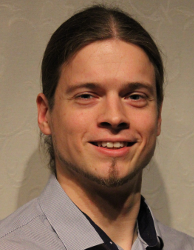
Dennis Krupke is a Researcher at the Department of Informatics, University of Hamburg, affiliated with the Human-Computer Interaction (HCI) group and the Technical Aspects of Multimodal Systems (TAMS). His work bridges robotics, virtual reality, and human-computer interaction, focusing on natural interfaces for human-robot cooperation. Education: Diploma in Informatics (2014), University of Hamburg Research Interests: Human-Robot Interaction (HRI) Bio-inspired Robotics and Sensor Systems Modular Robotics and Low-cost Prototyping Mixed Reality for Immersive Scenarios Scientific Awards: Finalist, IROS KROS Best Paper Award on Cognitive Robotics (2018) Highly Commended Paper, Industrial Robot Innovation Award (2017) CLAWAR Association Best Technical Paper Award (2015) Best Innovative Robot Award, CLAWAR (2014) Publications & Projects: Co-developed a printable modular robot with Florens Wasserfall Contributed to ROS-Unity integration for VR-based robotics Explored locomotion techniques for modular robots using reinforcement learning
Mehrdad Mahdavi is an Associate Professor in the field of Computer Science and Engineering. He has secured multiple National Science Foundation (NSF) grants, including EFRI BRAID: Neuroscience Inspired Visual Analytics, CAREER: Foundations of Collaborative Machine Learning, and CNS Core: Medium: When Next Generation Wireless Networks Meet Machine Learning. His research spans diverse areas of machine learning and optimization. His work focuses on Machine Learning , Optimization Algorithms , Quantum Computing , and Graph Neural Networks . He investigates memory-efficient training methods, generalization in unsupervised learning, quantum sampling for complex distributions, and distributed algorithms for collaborative learning. His research also intersects with healthcare applications, such as AI-driven lung ultrasound analysis for diseases like COVID-19. Recent publications highlight trends in Continual Learning , Temporal Graph Learning , Quantum Algorithms , and Federated Learning . His studies address theoretical frameworks for generalization, optimization challenges in non-convex and non-logconcave problems, and scalable solutions for graph-based machine learning tasks. He has contributed to energy consumption modeling, quantum sampling, and distributed risk minimization. As a Principal Investigator (PI) and Co-PI, he has led NSF-funded projects on collaborative machine learning , neuroscience-inspired visual analytics , and AI-enabled materials discovery . These grants underscore his focus on foundational research with applications in wireless networks, quantum computing, and interdisciplinary domains.
Prof. Dr. Didier Stricker is a leading academic in computer science, serving as Scientific Director at the German Research Center for Artificial Intelligence (DFKI) and Professor at the University of Kaiserslautern-Landau (RPTU). His career spans over two decades, including leadership roles at Fraunhofer IGD and founding the Augmented Vision research unit at DFKI/RPTU, which now includes ~30 researchers. Education: Electrical Engineering (Technical University of Grenoble, Karlsruhe) PhD: Computer Vision-based Calibration and Tracking Methods for Augmented Reality (2002, TU Darmstadt) His research focuses on virtual and augmented reality , computer vision , human-computer interaction , and on-body sensor networks . He leads major EU/national projects like LUMINOUS (Language-Augmented XR) and SHARESPACE (Ethical Hybrid Shared Spaces), with industrial partnerships including Sony, Google, and John Deere. Recent publications emphasize 3D reconstruction , neural network optimization , and XR systems . Key trends include event camera processing , scene flow estimation , and multimodal AI for industrial applications . He holds patents in AR tracking and has received the 2006 Innovation Prize from the German Society of Computer Science. Scientific Awards : Innovation Prize (2006) Best Paper/Demonstration Awards at ISMAR, EUSIPCO, CVPR, and ICRA As a reviewer for journals and conferences in VR/AR and computer vision, he contributes to shaping research standards. His lab ( AG Augmented Vision ) combines academic and industrial collaborations to advance cognitive interfaces and extended reality systems.
Dr. Mukesh Prasad is an Associate Professor at the School of Computer Science , University of Technology Sydney (UTS). With expertise in Machine Learning , Artificial Intelligence , and Computer Vision , his research addresses applications in healthcare, biomedical science, and smart infrastructure. He holds a Ph.D. in Computer Science from National Chiao Tung University, Taiwan, and an M.S. in Computer and Systems Sciences from Jawaharlal Nehru University, India. Key research areas: Machine Learning, AI, Brain-Computer Interfaces, IoT, and Evolutionary Computation Industry experience: Principal Engineer at TSMC (2016-2017), Postdoctoral Researcher at National Chiao Tung University Dr. Prasad has secured competitive grants for AI applications in disaster response, conversational agents, and medical diagnostics. His work has been published in high-impact venues like IEEE , ACM Transactions , and Springer Nature , with over 200 peer-reviewed papers. He serves on editorial boards for journals including Frontiers in Neurorobotics and ACM Computing Surveys . Scientific Awards: Vice Chancellor Teaching and Learning Citation Award (2019) Alumni Fellowship for Ph.D. (2014) Golden Bamboo NCTU Fellowship (2010) Professional Members: IEEE (2011), ACM (2019)
Christian Peco Regales is an Assistant Professor in the Department of Engineering Science and Mechanics, conducting interdisciplinary research at the intersection of computational mechanics, materials science, and biomimetics with significant contributions to machine learning applications in engineering. His research portfolio demonstrates expertise in: Deep learning frameworks for biological material modeling Data-driven design of advanced composites Biomimetic optimization inspired by natural systems Microstructure characterization of particle-enriched materials Fluid-structure interaction algorithms Drone swarm intelligence derived from biological networks Dr. Regales' recent publications reveal a strong focus on neural network applications for material design, with particular emphasis on translating biological network principles (such as slime mold behavior) into drone swarm collaborative algorithms. His work integrates computational mechanics with machine learning to address challenges in composite material design, biological tissue modeling, and fluid-structure systems. He currently leads two major National Science Foundation projects: CAREER: Transferring biological networks emergent principles to drone swarm collaborative algorithms (2024-2029, Principal Investigator) Collaborative Research: Particle Reinforced Ice as a Tunable Acoustic Couplant (2021-2024, Co-Principal Investigator) His research contributes to United Nations Sustainable Development Goals through innovations in sustainable materials and clean energy technologies, with a publication record showing accelerated output (31 research outputs) and growing impact (h-index 12, 790 citations).
Zheng Wen is an Associate Professor (non-tenure-track) at Waseda University, affiliated with the Faculty of Science and Engineering and the Global Center for Science and Engineering. His research spans multiple interdisciplinary domains at the intersection of information technology, security systems, and artificial intelligence applications. Dr. Wen received his Ph.D. from Waseda University between 2013 and 2019, following undergraduate studies at Wuhan University from 2005 to 2009. Dr. Wen's research interests focus on the convergence of emerging technologies for practical applications. His primary areas include Data Science , Internet of Things (IoT) , Blockchain , and Artificial Intelligence , with specific applications in communication networks, disaster management, and content-oriented networking. His work demonstrates a strong emphasis on solving real-world problems through technological innovation, particularly in security-critical domains. Analysis of Dr. Wen's publication record reveals a consistent research trajectory focused on applying machine learning and AI techniques to security and communication challenges. His recent work shows increasing emphasis on blockchain applications for IoT security, GNSS spoofing detection for drone systems, and millimeter-wave imaging for security applications. The interdisciplinary nature of his research connects computer science, electrical engineering, and practical security implementations. Dr. Wen is an active member of professional organizations including IEEE and IEICE, reflecting his engagement with the broader academic community in his fields of expertise. While specific details about his advising and grant activities are not provided in the available information, his extensive publication record across multiple domains suggests active research supervision and likely participation in collaborative research projects. His work on drone security, blockchain applications, and millimeter-wave imaging indicates potential industry partnerships and practical implementations of his research. Dr. Wen's research appears to be conducted within collaborative teams focusing on security systems, wireless communications, and AI applications, with frequent co-authorship patterns suggesting established research groups working on related projects in these domains.
Borsos Ágnes, DLA, habilitated associate professor at the University of Pécs within the Institute of Architecture , specializes in Interior Design, Applied and Creative Design . With dual expertise as a Chartered Architect and academic, she leads the Parameterized Comfort Research Group and contributes to international collaborations including projects with Metro State University of Denver , Central Academy of Fine Arts (China) , and Roma Tre University . Her career spans 16 years of academic leadership, including head of department and course leadership for Hungarian/English architect programs. Education : DLA (2010) and Habilitation (2015) at University of Pécs' Breuer Marcell Doctoral School International Experience : Erasmus+ mobility in Valencia, Munich, Rome; visiting professorships in China and USA Research focuses on sustainable residential architecture , human-centered spatial design , and architectural solutions for marginalized groups . She pioneered flexible housing systems and health-oriented interior design through projects like the BASKET community-building initiative and the CLOSE 0 ENERGY FAMILY HOUSE competition. Her work bridges prefabrication technology with social sustainability , emphasizing adaptive reuse of housing stock and environmental comfort . Recent publications and conference participations highlight her leadership in parametric design and human migration crisis solutions . She co-authored studies on structural adaptability of residential buildings and eco-modular urban living , presented at venues including Wessex Institute and Places and Technologies conferences. Awards include the Mihály Pollack Commemorative Medal and multiple Innovation Awards for academic and research contributions. As an educator, she supervises PhD/DLA candidates and has led international student teams in design competitions like the London Affordable Housing Challenge . Her 15+ recent articles address topics ranging from office environmental comfort to prefabricated apartment concepts , with keywords spanning sustainable architecture, human-centered design, and modular construction. Current projects include the Green Castle interior design for the University of Pécs Health Sciences Faculty.
Dr. Eyup KOÇAK is an Assistant Professor in the Department of Mechanical Engineering at Çankaya University's College of Engineering. He has progressed through academic ranks at Çankaya since 2018, starting as a Research Assistant before becoming a Lecturer (2023) and current Assistant Professor (2024). Education: Doctorate: Mechanical Engineering, Çankaya University, Graduate School of Natural and Applied Sciences (2018) Master's: Mechanical Engineering, Gazi University, Graduate School of Natural and Applied Sciences (2015-2018) Bachelor's: Mechanical Engineering, Gazi University, Faculty of Engineering (2009-2014) Research Focus: Dr. KOÇAK's expertise spans fluid mechanics, computational fluid dynamics (CFD), heat transfer, and micro-electro-mechanical systems (MEMS). His interdisciplinary approach integrates numerical simulations with machine learning techniques to solve complex thermo-fluid problems, particularly in energy systems, aeroacoustics, and thermal management applications. Publication Trends: Recent publications (2019-2024) demonstrate a strong focus on machine learning applications in thermal-fluid dynamics, including predictive modeling of nanofluid behavior, optimization of heat transfer surfaces, and aeroacoustic noise reduction. Over 70% of his journal publications appear in SCI-indexed venues, reflecting consistent research output in high-impact areas. Projects & Advising: Currently advising one Master's candidate researching aircraft wing icing mechanisms Contributor to 4 national research projects including porous material cooling studies (2021), biomimetic wing analysis (2021), and Francis turbine design (2015-2016)
Erik Gauger is a Professor at the Institute of Photonics and Quantum Sciences , School of Engineering & Physical Sciences, Heriot-Watt University. He leads the Quantum Technology Theory group , focusing on quantum nanostructures for energy, sensing, and information processing technologies. His work bridges condensed matter physics, quantum optics, and quantum biology through analytical and numerical modeling. Diplom in Physics, University of Konstanz (2005) DPhil in Physics, University of Oxford (2009) Postdoctoral Research Fellow at Oxford (2009-2011) Research/Senior Fellow at National University of Singapore (2011-2014) Proleptic Assistant Professor at Heriot-Watt (2015) Associate Professor (2020) Full Professor (2022) Research interests include quantum transport optimization, environmentally assisted energy transfer, and quantum coherent effects in artificial/natural nanostructures. Recent work explores dipole engineering, non-Markovian dynamics, and bio-inspired quantum technologies. Collaborations include experimental teams across Europe and Singapore. Notable awards: Royal Society of Edinburgh's Young Academy membership (2018) and Personal Research Fellowship (2015). His group contributes to UN SDG 7 (Affordable Energy) and 13 (Climate Action) through quantum energy technologies. Edinburgh Young Academy of Scotland Royal Society of Edinburgh Fellowship He supervises PhD students and develops simulation toolkits like ACE (non-Markovian open quantum system solver). Current activities include adaptive quantum estimation, cooperative emission studies, and exploring quantum ratchet states for energy harvesting.
Ioannis Konstantaras is an Associate Professor at the Department of Business Administration, University of Macedonia, Thessaloniki, Greece, holding this position since July 2016. He contributes to the Master in International Business, Master in Business Administration, and Master in Business Analytics and Data Science programs. His academic qualifications include: B.Sc. in Mathematics from Aristotelian University of Thessaloniki (1999) M.Sc. in Statistics & Operations Research from University of Ioannina (2001) Ph.D. in Operations Research from University of Ioannina (2006) Konstantaras specializes in mathematical modeling and optimization of inventory systems for supply and reverse logistics chains. His research addresses production planning, deteriorating items, imperfect quality products, and recovery processes through operations research methodologies. He develops analytical models for optimizing decision-making in complex logistics environments. His publication record (2010-2014) shows concentrated research on inventory models for deteriorating items, lot-sizing in recovery systems, and pricing strategies for reverse logistics. Key contributions include extensions to Economic Order Quantity models, optimization of two-warehouse systems, and integration of inspection learning effects in quality control. He serves as Co-Editor for the International Journal of Systems Science: Operations & Logistics since January 2014 and has reviewed for numerous international journals. Konstantaras led the research program "Logistics Management: Quantitative Methods for Inventory Management" funded by the ARCHIMEDES program under EPAYAEK II. No publicly available information lists his doctoral advisees.
Professor John McCall is a distinguished academic and researcher at Robert Gordon University's School of Computing, Engineering & Technology, where he previously served as Head of School. He currently serves as Director of the National Subsea Centre, leading initiatives to accelerate energy transition through smart technologies applied to industrial and environmental challenges in subsea and related marine sectors. With over 25 years of research experience in nature-inspired computing and artificial intelligence, Professor McCall has established himself as a leading expert in optimization algorithms and explainable AI. Professor McCall's research interests span data science, artificial intelligence, nature-inspired computing, and optimization, with significant applications in energy transition and subsea technologies. His work bridges theoretical foundations with practical implementations, having founded two spinout companies that deliver real-world optimization solutions to industry. He leads both the Complex Optimisation Research Group and the Computational Intelligence Research Group, where his team explores cutting-edge approaches to solving complex computational problems. Analysis of Professor McCall's recent publication record (2023-2025) reveals a strong focus on explainable AI, particularly in the context of evolutionary computation and metaheuristics. His research demonstrates an increasing emphasis on practical applications in energy systems, transportation, and subsea technologies, reflecting his commitment to addressing real-world challenges related to climate change and industrial transformation. The interdisciplinary nature of his work is evident in publications spanning computer science, operations research, renewable energy, and transportation planning. Lead of the Computational Intelligence Research Group ResearcherID: G-1423-2011 Scopus Author ID: 36797474900 ORCID: https://orcid.org/0000-0003-1738-7056 Professor McCall is actively involved in mentoring the next generation of researchers, currently supervising multiple PhD students across diverse topics including explainability of non-deterministic solvers, optimization of electrical machines, and computational intelligence applications in hydrocarbon systems. His research is supported by numerous grants from industry and government sources, with projects totaling millions of pounds focused on solving challenges in energy transition and smart technologies. At the National Subsea Centre, Professor McCall leads a multidisciplinary team working on digital twin technologies, subsea AI applications, and data-driven solutions for the energy sector. His work emphasizes collaboration between academia and industry to develop transformative solutions that address both current challenges and future opportunities in the subsea domain.
Hany Osman is an Associate Professor in the Master of Data Analytics program at the University of Niagara Falls Canada, holding a PhD in Industrial Engineering from Concordia University and a Professional Engineer (PEng) license in Ontario. His academic-industrial career bridges theoretical research with practical applications across multiple sectors. Dr. Osman's research spans three interconnected domains: Machine Learning & Data Analytics : Specializing in logical analysis of data, cost-sensitive learning, and ensemble techniques for industrial applications Operations Research : Developing nature-inspired metaheuristics (cuckoo search, ant colony optimization) for NP-hard problems in manufacturing and logistics Supply Chain Management : Focusing on sustainable optimization of lot sizing, production planning, and inventory control under stochastic conditions His recent publications (2023-2024) reveal a strategic pivot toward AI-integrated manufacturing systems, notably the CAPP-GPT framework for generative AI in process planning and emission-aware lot sizing models. This work demonstrates consistent translation of theoretical advances into industrial solutions for rail, oil, and smart manufacturing sectors. Professional credentials include: IBM Mastery Certificate in Predictive Data Analytics Professional Engineer (PEng) license from Ontario Dr. Osman leverages extensive industrial experience in supply chain logistics, oil industry optimization, and education technology to inform both research and teaching. His supervision in the Master of Data Analytics program emphasizes hands-on application of machine learning to real-world operational challenges, with students contributing to publications in Manufacturing Letters and related journals. While no formal lab is specified, his research group operates at the intersection of data science and industrial engineering, maintaining strong industry partnerships that drive applied projects.
Yann André LeCun is the Jacob T. Schwartz Professor of Computer Science, Data Science, Neural Science, and Electrical and Computer Engineering at New York University, and serves as Chief AI Scientist at Meta. He holds appointments across multiple NYU institutions including the Courant Institute of Mathematical Sciences, the Center for Data Science, the Center for Neural Science, and the Tandon School of Engineering. LeCun leads the CILVR Lab (Computational Intelligence, Learning, Vision, Robotics) at NYU and is a key figure in Meta's FAIR (Fundamental AI Research) organization. LeCun's research spans machine learning, deep learning, computer vision, robotics, and computational neuroscience. He pioneered convolutional neural networks in the 1980s-90s, which became foundational to modern AI. His recent work focuses on self-supervised learning, energy-based models, and developing architectures for predictive world models that could enable machines to understand and interact with the physical world. LeCun advocates for open-source AI development through projects like Meta's Llama language models. His publication record shows consistent high-impact contributions since the 1980s, with recent work emphasizing self-supervised learning approaches like Joint Embedding Predictive Architectures (JEPA). The 15 most recent publications reveal a strong focus on representation learning, world models, and efficient learning paradigms that reduce reliance on massive labeled datasets. ACM Turing Award (2018) Princess of Asturias Award for Technical and Scientific Research (2022) Member of US National Academy of Engineering (2017) Member of US National Academy of Sciences (2021) Foreign Member of Académie des Sciences, France (2022) Queen Elizabeth Prize for Engineering (2025) VinFuture Grand Prize (2024) LeCun has advised approximately 30 PhD students who now lead AI research at major institutions worldwide. His lab has received significant funding from both government agencies and industry partners to advance fundamental AI research. The CILVR Lab fosters interdisciplinary collaboration across computer science, neuroscience, and engineering disciplines to tackle core challenges in artificial intelligence. LeCun actively engages with policymakers on AI governance, advocating for open research and targeted regulation. His work on open-source AI models represents a strategic approach to democratizing AI development while maintaining safety through community scrutiny. LeCun continues to push the boundaries of what machines can learn and understand about the physical world.
Michael Veatch is a Professor of Mathematics at Gordon College in the School of Science, Technology and Health. Holding a Ph.D. from MIT with prior industry experience in defense logistics, he bridges theoretical operations research with practical humanitarian applications. His educational background includes: B.A. from Whitman College M.S. from Rensselaer Polytechnic Institute Ph.D. from Massachusetts Institute of Technology Dr. Veatch specializes in applying probability models and optimization techniques to humanitarian logistics and queueing networks. His research spans pandemic vaccine allocation strategies, gift-in-kind donation systems for organizations like World Vision, and airport congestion management during disaster relief operations. He investigates how faith-based values influence operational decisions in Christian relief organizations through collaborations with Wheaton College and MIT. His work uniquely integrates mathematical rigor with real-world humanitarian challenges, particularly in crisis response scenarios. Analysis of his publication record reveals a strategic evolution from theoretical queueing network research toward increasingly applied humanitarian logistics work. His recent publications demonstrate sophisticated optimization frameworks addressing urgent global health challenges like pandemic response, while maintaining strong theoretical foundations in stochastic modeling and dynamic programming. The interdisciplinary nature of his work connects mathematics, operations research, public health, and ethical decision-making. Dr. Veatch has made significant contributions through his textbook Linear and Convex Optimization: A Mathematical Approach (Wiley, 2021) designed for mathematics majors. He developed an industry-focused course through the Preparation for Industrial Careers in Mathematical Sciences program and contributes to vocational guidance for mathematics students. His active research collaborations include: International Vaccine Allocation with MIT researchers Gift-in-Kind Acceptance Strategies for World Vision Informed Compassion project on faith-based operational decisions Disaster airport scheduling using Haiti earthquake data