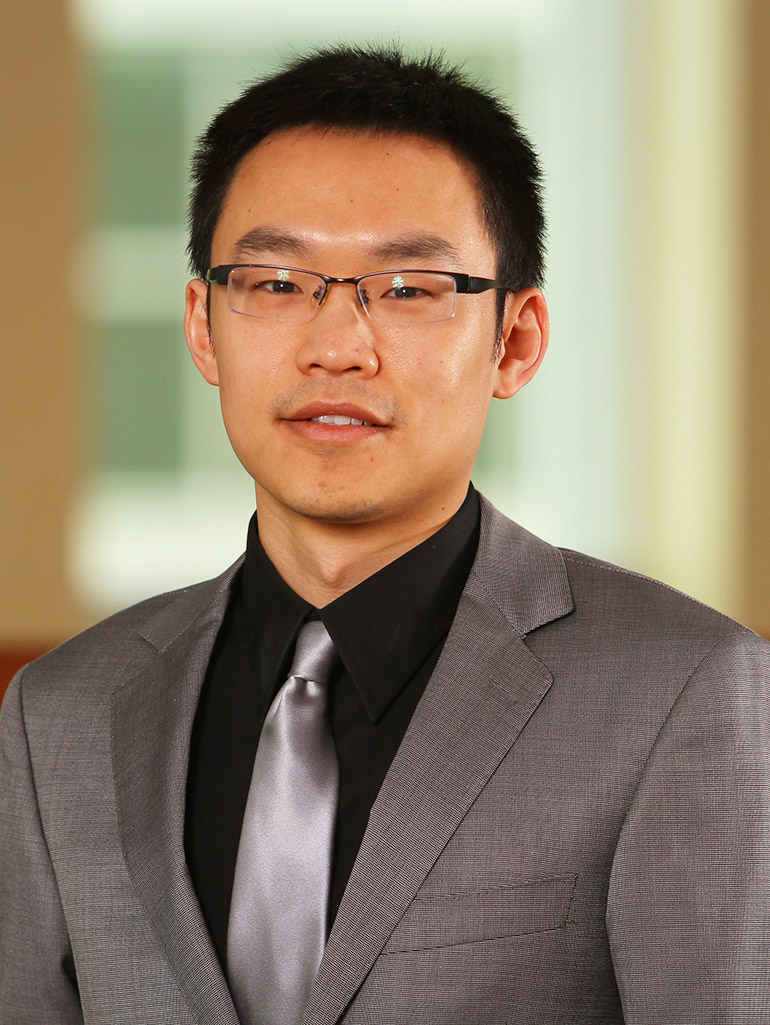
Gee Lee is an Associate Professor in the Department of Statistics & Probability and the Department of Mathematics at Michigan State University. His work bridges actuarial science with advanced statistical and machine learning methodologies, focusing on practical applications for insurance risk modeling. PhD, University of Wisconsin-Madison Associate (ASA), Society of Actuaries His research centers on insurance loss modeling for rate-making and loss reserving, multivariate insurance coverage optimization, dependence structure analysis, and integrating machine learning into actuarial frameworks. Current projects include deep neural networks for claim prediction, unstructured data analysis, and multivariate coverage optimization. Recent publications highlight trends in crop insurance modeling (2025), regularization techniques (2024), multivariate risk retention strategies (2023), textual data analysis (2022), copula regression (2022), and reinsurance game theory (2022). Earlier works explore shrinkage methods, word embeddings, longitudinal claims, healthcare data, and deductible ratemaking. Gee Lee supervises MS and PhD students in actuarial science. Former advisees include Leonard Korreshi (2024), Qiaozhen Qian (2023), and Scott Manski (2020, co-advised). He also supports undergraduate research through MSU’s REU program and directed study courses.
Gee Y. Lee is an Associate Professor with Tenure in the Department of Statistics and Probability and the Department of Mathematics at Michigan State University. Lee holds a PhD from the University of Wisconsin-Madison and is an Associate of the Society of Actuaries (ASA). Their research focuses on applying advanced statistical and machine learning methods to solve complex problems in actuarial science and insurance. Dr. Lee's educational background includes: PhD from the University of Wisconsin-Madison Associate (ASA) designation from the Society of Actuaries Dr. Lee's research spans several critical areas in modern actuarial science. Their primary focus includes insurance loss modeling for rate-making and loss reserving applications, optimization of multivariate insurance coverage, and dependence modeling. A significant portion of their recent work applies machine learning methods, particularly deep neural networks, to traditional actuarial problems. They are also pioneering research in analyzing unstructured data for insurance applications, which represents an emerging frontier in the field. Their work bridges theoretical statistical methods with practical insurance industry needs. Dr. Lee's publication record demonstrates a clear evolution from traditional actuarial methods toward more sophisticated and interdisciplinary approaches. Early work focused on fundamental aspects of insurance pricing and modeling, while more recent publications incorporate machine learning techniques, natural language processing, and advanced optimization methods. A notable trend is the increasing integration of unstructured data analysis into actuarial science, reflecting broader industry shifts. Their research consistently addresses both theoretical advancements and practical applications in insurance risk assessment and management. While specific awards aren't detailed in the available information, Dr. Lee's recognition includes: Associate (ASA) designation from the Society of Actuaries Michigan State University recognized by the Society of Actuaries as granting MS and PhD degrees focused on actuarial science (as of 2023) Dr. Lee actively mentors students at multiple levels, supervising undergraduate research through REU programs, directed studies (STT 490, MTH 490, MTH 491B), and graduate research for MS and PhD candidates. They have advised numerous students who have presented at UURAF (Undergraduate Research Assistant Fellowship) conferences. For graduate students, Dr. Lee supports research leading to MS degrees in Statistics, Applied Statistics, and Industrial Mathematics with actuarial science focus, as well as PhD dissertations in Statistics. Beyond direct student supervision, Dr. Lee has organized significant academic events including the Simon Conference for Young Researchers in Risk Management and Insurance (2019, 2023) and contributed to other workshops, demonstrating leadership in the actuarial research community. While specific lab names aren't mentioned, Dr. Lee appears to lead a research group focused on actuarial science and insurance analytics at Michigan State University. Their collaborative work with researchers like Scott Manski, Taps Maiti, Peng Shi, and others suggests an active research team working at the intersection of statistics, machine learning, and actuarial applications. The research group seems particularly focused on bridging traditional actuarial methods with modern data science techniques.
Christian Cech is a Professor at FH des BFI Vienna, serving as Department Head and Lecturer specializing in financial risk management and regulatory compliance. His institutional role centers on bridging academic research with banking practice through the Fachhochschule's applied science framework. His research focuses on quantitative risk modeling using copula-based methods to estimate Value-at-Risk and Expected Shortfall, with particular emphasis on Basel III regulatory requirements for banks. He investigates multivariate return distributions, capital adequacy frameworks, and liquidity risk measurement, contributing to financial stability through precise risk quantification methodologies. Recent work extends into climate-risk econometrics and regulatory reporting systems. Analysis of his 15 most recent publications reveals a consistent trajectory from foundational Basel II/III transition research toward integrated risk frameworks. His 2019-2022 output demonstrates growing interdisciplinary scope, connecting financial regulation with environmental economics while maintaining core expertise in copula-based portfolio modeling and regulatory reporting standards.
Jianxi Su is an Associate Professor in the Department of Statistics at Purdue University, where he serves as Director of the Actuarial Science Program. He joined Purdue in 2016 after completing his PhD at York University (Probability with Actuarial Specialization) and a post-doctoral position at Schulich School of Business. He holds professional designations as Fellow of the Society of Actuaries (FSA) and Associate of the Canadian Institute of Actuaries (ACIA). Education: PhD, York University, Probability (Specialization in Actuarial Science), 2016 Research Interests: Dr. Su's research spans three interconnected domains: 1) Actuarial Mathematics focusing on risk measures and premium principles, 2) Probability Theory exploring multivariate distributions and dependence structures, and 3) Statistical Analysis developing inference methods for actuarial/financial applications. His work consistently bridges theoretical frameworks with practical insurance solutions. Publication Trends: Recent articles demonstrate strong emphasis on risk allocation methodologies (9 papers), insurance applications (7 papers), and statistical modeling of dependent risks (6 papers). Common themes include tail risk quantification, catastrophe risk financing, and regulatory capital frameworks, with increasing focus on emerging risks like cyber threats and climate-related losses. Awards and Honors: College of Science Diversity Award (2021) Outstanding Assistant Professor Teaching Award (2021) College of Science Undergraduate Advising Award (2019) Research Leadership: Dr. Su has secured over $500,000 in research funding as PI/co-PI for 18+ grants since 2017, primarily from SOA/CAS. Current projects include disaster resilience modeling ($30k), synthetic data generation ($45k), and digital asset risks ($45k). He leads Purdue's actuarial curriculum development and mentors students through research collaborations evidenced by co-authored publications. Professional Engagement: He maintains extensive collaborations with industry (Sun Life Financial) and academics globally. As Actuarial Program Director, he coordinates industry-academia partnerships and oversees initiatives enhancing actuarial education through learning communities.
Bahaedin Khaledi is an Assistant Professor in the Department of Applied Statistics and Research Methods at the University of Northern Colorado (UNC), part of the College of Education and Behavioral Sciences. He holds a PhD in Statistics from the Indian Statistical Institute (2000), an M.Sc. from Shahid Beheshti University (1991), and a B.Sc. from Shahid Chamran University (1988, ranked 1st). His career includes visiting roles at institutions like Florida International University and Portland State University, alongside his primary faculty position at UNC since 2016. Dr. Khaledi's research focuses on stochastic comparisons, actuarial science, Bayesian analysis, and risk modeling. His work addresses challenges in insurance claims reserving, mortality forecasting, and reliability theory. Notable contributions include studies on policy limit allocations, stochastic orderings of systems, and machine learning applications in demographic projections. His publications span over 50 peer-reviewed articles in journals like Statistics and Probability Letters and Communications in Statistics . While no awards are explicitly listed, his extensive academic collaborations and global research engagements highlight his disciplinary impact. His teaching and advising roles at UNC further underscore his commitment to graduate education in applied statistics.
Muer Yang is a Professor in the Department of Operations and Supply Chain Management at the University of St. Thomas Opus College of Business. He holds a PhD in Operations Management from the University of Cincinnati, an MS in Management Science and Engineering, and a BS in Management Information System from Tsinghua University. His research applies simulation optimization to critical challenges in health care, public policy, and voting systems. His educational background includes: PhD in Operations Management, University of Cincinnati MS in Management Science and Engineering, Tsinghua University BS in Management Information System, Tsinghua University Professor Yang's research centers on simulation optimization techniques for health care management and public policy operations , with key focus areas: Voting systems and election operations Health care delivery and ICU management Affordable Care Act policy analysis His interdisciplinary work bridges operations research with real-world policy implementation. His 14 publications (2005-2018) reveal strong trends in public service operations research : Voting machine allocation models reducing voter wait times Health care operations for diabetic patients and ICU admissions Simulation-optimization for policy evaluation under uncertainty Work appears in premier journals including Production and Operations Management and Omega . Key honors include: Susan E. Heckler Research Excellence award (2015) INFORMS SPPSN best paper competition second place (2011) Professor Yang mentors students through operations management and analytics courses, with research attracting media coverage and election law expert testimony. His work aligns with: National Science Foundation-funded policy research Health care innovation grants He collaborates through the Behavioral Research Center and Risk Leadership Initiative, partnering with researchers like S. Kumar and M.J. Fry across institutions.