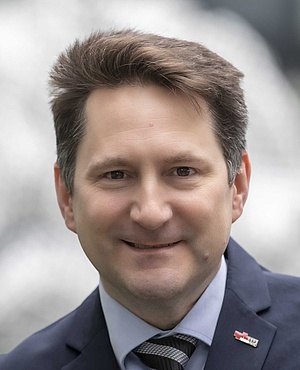
Josef Leydold is Associate Professor of Statistics and Mathematics at Vienna University of Economics and Business. His research develops computational methods for random variate generation and graph theoretical applications. Research Areas: Design of black-box algorithms for non-uniform random numbers; geometric properties of graph Laplacians; spherical harmonics applications; and optimization techniques. Publications: Focus on practical algorithms for statistical computing, including monographs on automatic random variate generation and mathematical foundations for economists. No awards or student supervision details are documented.
Tomas Masak is an Assistant Professor at the Department of Statistics and Mathematics, Vienna University of Economics and Business (WU). He holds a PhD in Mathematics from EPFL Lausanne (2018–2022) and an MSc in Mathematical Statistics from Charles University. His academic roles include Bernoulli Instructor at EPFL (2022–2024) and Research and Teaching Assistant at Technical University of Munich (2017–2018). Education Mathematics PhD, EPFL Lausanne (2018–2022) Mathematical Statistics MSc, Charles University (completed 2017) His research focuses on functional data analysis, covariance estimation, and statistical computing. Recent work includes the Functional Graphical Lasso and methods for sparsely observed random surfaces. Publications span journals like the Annals of Statistics , Journal of the American Statistical Association , and Biometrika , emphasizing open-access venues. Keywords across his work include functional analysis, covariance modeling, and high-dimensional statistics. He actively participates in scientific lectures and peer review, serving as a reviewer for the Annals of Statistics and Journal of Machine Learning Research in 2024. His collaborations span Europe and focus on data science applications.
Maath Musleh is a Researcher and PhD candidate at the Vienna University of Technology (TU Wien), affiliated with the Faculty of Informatics and the Department of Computer Graphics. His academic roles include serving as a University Assistant and teaching courses such as Methods for Data Generation and Analytics in Medicine and Information Visualization . He holds a BSc and MSc, with his Master’s thesis focusing on industrial multivariate time series analysis. Research interests center on Visual Analytics , Medical Visualization , and Uncertainty Visualization , with applications in healthcare, manufacturing, and agriculture. His work emphasizes explainable AI, user confidence measurement, and decision-support systems. Notable contributions include the TrustME model for explainable guidance and the ConAn framework for quantifying user confidence in uncertain analysis scenarios. Key achievements include the Best Short Paper Award at VINCI 2021 for industrial time-series visualization research. His ongoing PhD, supervised by Prof. Renata Raidou, explores Guided Visual Analytics for Decision-Making under Uncertainty . He collaborates on projects like Agritology , a multilingual decision-support system for farmers, and has developed dashboards for industrial and medical data analysis. Maath’s interdisciplinary approach integrates visualization, machine learning, and human-centered design to address challenges in complex decision-making environments.
Johanna Schmidt is a Lecturer at the Vienna University of Technology (TU Wien) and the Head of the Visual Analytics Research Group at VRVis Zentrum für Virtual Reality und Visualisierung Forschungs-GmbH. She holds a PhD in data visualization from TU Wien (2016) and has extensive experience in project management and industry collaboration. Her primary research focuses on visual analytics for large datasets, particularly time-series data from industrial and energy sectors, as well as immersive analytics for decision support. She leads the Visual Analytics group at VRVis, a COMET research center, and has contributed to projects such as ArtVis, GuidedVA, and KnoVA. Her work integrates human perception studies with visualization techniques to enhance data interpretation. She has been recognized as the FEMtech Expert of the Month (2021) for promoting women in technology. Her academic roles include teaching at TU Wien and the Salzburg University of Applied Sciences. Key research interests span data visualization literacy, exploratory data analysis, and the application of visual methods in healthcare and energy sectors. Notable collaborations include developing tools like Visplore for industrial data analysis and advancing immersive analytics for hydropower turbine lifecycle predictions. Her work bridges academia and industry, emphasizing practical solutions for complex data challenges.
Stefan Bruckner is Professor of Visualization at the University of Bergen, specializing in biomedical visualization, volume rendering, and visual data exploration. His work develops novel techniques for analyzing complex scientific datasets across meteorology, medicine, and materials science. Dr. Bruckner's research group develops interactive visual analytics tools for weather forecasting, medical diagnostics, and ensemble data analysis. His methodological innovations include GPU-accelerated rendering, visual parameter exploration, and uncertainty visualization. He received the 2011 Eurographics Young Researcher Award for contributions to illustrative visualization. Professional service includes program committee roles for IEEE VIS, Eurographics, and ECRTS conferences. His pedagogical contributions span visualization, computer graphics, and programming languages at institutions including École normale supérieure and École polytechnique.
Angeliki Grammatikaki is a University Assistant and PhD Student at Vienna University of Technology (TU Wien), affiliated with the Visualization Group since at least 2024. Her research focuses on illustrative terrain visualization , digital 3D mapping , and environmental data visualization . Research interests include: Automated 3D modeling of natural landmarks Human perception in geographic visualizations Scientific visualization for environmental monitoring Level-of-detail strategies in cartographic rendering Recent publications analyze tree representation in 3D maps (2025) and precipitation-water level correlations (2024), combining procedural modeling techniques with empirical user studies. She uses generative algorithms for terrain visualization and investigates factors affecting scene recognizability in digital cartography. Contact: angeliki.grammatikaki@tuwien.ac.at | Office: Favoritenstrasse 9 (Room HD0505)
Martin Ilcik is a Researcher at the Department of Computer Graphics within the Faculty of Informatics at Vienna University of Technology (TU Wien). His work focuses on procedural modeling, shape grammars, and related computer graphics techniques. He serves as a Scientist in the Rendering and Modeling workgroup and has been actively involved in research projects since 2008, including GameWorld, PAMINA, Wohnen 4.0, AgroEco, and currently Room Imageer and GreenFDT projects. Ilcik's research interests prominently feature procedural modeling techniques, with specializations in shape grammars, layout generation, semantic modeling, 3D reconstruction, and music generation. His work bridges computer science with practical applications in architecture, urban planning, and creative arts. He has made significant contributions to layer-based procedural design of building facades and collaborative modeling systems. His publication record spans from 2007 to 2024, with a strong focus on procedural modeling techniques. The research trajectory shows evolution from flow visualization to sophisticated procedural modeling systems, with increasing emphasis on shape grammars, collaborative design, and applications in architecture and music generation. His work demonstrates consistent innovation in making procedural modeling more intuitive and accessible. VC CultTech Hackathon winner category 'Vienna State Opera challenge' (2017) INiTS Award 2016 Ilcik has supervised student research, including Lukas Eibensteiner's 2021 Diploma Thesis on polyphonic music composition with grammars. He has been instrumental in organizing the Central European Seminar on Computer Graphics (CESCG) since 2008, which has grown into an important annual event for undergraduate students in computer graphics, vision, and visual computing across Central Europe. His community work includes creating educational resources and organizing EXPO events and Academy Videos through CESCG. He leads research in the Rendering and Modeling workgroup at TU Wien's Computer Graphics department, focusing on developing innovative procedural modeling techniques with applications in architecture, urban planning, and creative domains. His current projects (Room Imageer and GreenFDT) continue his longstanding interest in practical applications of procedural modeling techniques.
Thomas Bäck is a Full Professor at the Leiden Institute of Advanced Computer Science (LIACS), Leiden University, and Chief Scientist at NORCE Norwegian Research Center, Norway. His career spans roles as Director of the Center for Applied Systems Analysis (Germany) and Vice Scientific Director at LIACS (since 2017). He holds additional positions like Adjunct Professor at the University of Calgary and Visiting Professor at Xi'an Jiaotong University. Bäck's research focuses on evolutionary computation, machine learning, and their applications in sustainable smart industry and health. He leads interdisciplinary initiatives like the Society, Artificial Intelligence, and Life Sciences (SAILS) program, with expertise in natural computing, data-driven optimization, and quantum computing challenges. IEEE Fellow (2022) Member of KNAW (2021) IEEE CIS Pioneer Award (2015) Fellow of International Society of Genetic and Evolutionary Computation (2003) Best PhD Thesis Award from German Society of Computer Science (1995) Bäck has graduated 22 PhD students and currently supervises 14, with 62 MSc students mentored. His editorial roles include Editor-in-Chief of the Evolutionary Computation Journal and Associate Editor for multiple journals. He has secured grants from the Dutch Research Council and The Research Council of Norway for projects like ECOLE and CIMPLO.
Tobias Schreck is a Professor at the Institute of Visual Computing (formerly Computer Graphics and Knowledge Visualization) at Graz University of Technology, affiliated with the Faculty for Computer Science and Biomedical Engineering. His research focuses on Visual Data Analysis, 3D Object Retrieval, and Immersive Analytics, with applications in engineering and industrial contexts. He holds a Dr.rer.nat. from the University of Konstanz and has held academic positions including Assistant Professor at the University of Konstanz and Head of the Visual Search and Analysis Group at TU Darmstadt. Education: Dr.rer.nat., University of Konstanz (2006) M.Sc. in Information Engineering, University of Konstanz (2002) Dipl.-Volkswirt (M.Sc. Economics), University of Konstanz (1999) His research interests include visual analytics for high-dimensional and spatial-temporal data, digital libraries, and collaborative analysis tools. He leads funded projects like HEREDITARY (EU Horizon Europe) and VR4CPPS (FFG), and has served as a program chair for IEEE VAST and EuroVis. His work emphasizes user interaction, eye-tracking integration, and immersive visualization techniques. He supervises a research team including postdocs, PhD students, and student assistants, and collaborates on projects like CrossSAVE-CH and the Joint PhD Programme with Nanyang Technological University. His contributions span publications in IEEE Transactions, EuroVis, and ACM conferences, addressing challenges in data exploration, anomaly detection, and visualization design.
Dr. Vicente José is a Professor at the University of Sevilla, Spain, specializing in Algebraic Geometry. He has been an Ordinary Member of the Academy of Europe since 1992 and holds membership in the Real Academia Sevillana de Ciencias. His research focuses on algebraic structures, singularities resolution, and valuation theory, with contributions to computational mathematics through works involving Maple and MATLAB. Key academic contributions include groundbreaking studies on curve and surface singularities resolution, discrete valuations in power series fields, and polyhedral geometry techniques. His work bridges pure algebraic theory with computational tools, reflected in publications like Resolution of Curve and Surface Singularities (2004) and Matemáticas con Maple (1996). Professional recognition includes prestigious memberships that underscore his contributions to mathematical sciences. Despite no explicit grants or lab affiliations listed, his prolific publication record (1995–2011) highlights sustained academic engagement in core algebraic geometry and computational methods.
Georg Pölzlbauer is a researcher affiliated with the Department of Information and Software Engineering at Vienna University of Technology (TU Wien). His work focuses on machine learning, data visualization, and artificial intelligence, particularly leveraging self-organizing maps (SOM) for exploratory data analysis. He holds a Dipl.-Ing. (Diploma in Engineering) and a Dr.techn. (Doctor of Technical Sciences). His research emphasizes advanced visualization techniques for SOMs, including vector fields and graph-based methods, applied to diverse domains like petroleum data and political datasets. He has contributed to supervised learning algorithms inspired by self-organization, such as Decision Manifolds. Publications span algorithm design, cluster analysis, and pattern recognition, with applications in music feature extraction and industry-specific data visualization. No scientific awards are explicitly mentioned, but his work reflects sustained engagement with computational and visual data analysis. While no advising or grant information is provided, his affiliation with TU Wien’s research unit suggests active participation in collaborative academic projects.
Franz Berthiller is an Associate Professor at the University of Natural Resources and Life Sciences, Vienna (BOKU), affiliated with the Department of Agricultural Sciences and the Institute of Bioanalytics and Agro-Metabolomics in Tulln an der Donau. His research specializes in mycotoxin analysis, mass spectrometry, and metabolomics, with a focus on developing advanced detection methods and understanding toxin metabolism in food/feed systems. He leads significant projects like the EU-funded BIOTOXDoc (2023–2027) and FWF-supported studies on modified fumonisins. Research interests include: Development of LC-MS/MS methods for mycotoxin quantification Metabolic pathways of trichothecenes and fumonisins Plant-fungal interactions affecting toxin production Biomarker discovery for contaminant exposure Multi-omics approaches in food safety Berthiller's recent publications emphasize metabolomics method optimization, environmental impacts on mycotoxin biosynthesis, and enzymatic modification of toxins. His work integrates analytical chemistry, molecular biology, and agricultural science to address food safety challenges. He directs a research group at the Institute of Bioanalytics and Agro-Metabolomics, collaborating internationally on projects related to mycotoxin management. No awards or supervised students are documented.