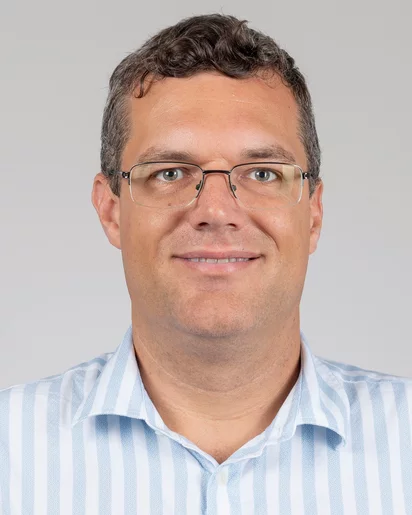
Georg Spinner is a Lecturer and Head of the Research Group for Medical Image Analysis & Data Modelling at the Institute of Computational Life Sciences, Zurich University of Applied Sciences (ZHAW). His work integrates computational methods with biomedical research, focusing on stroke management, intracranial aneurysm risk modeling, and quantitative medical imaging. Primary affiliation: Zurich University of Applied Sciences Research focus: Bayesian networks, medical imaging, computational epidemiology Projects: GEMINI (digital twins for stroke), Stroke DynamiX (causal networks in stroke care), IVIM muscle activation studies Using Bayesian networks and advanced imaging techniques like IVIM DWI, his research aims to develop data-driven decision support systems for neurovascular diseases. He has contributed to modeling stroke health data and intracranial aneurysm risk stratification through international multicenter collaborations. His work spans computational biology, neuroinformatics, and digital health, with publications in journals like Medical Image Analysis and conferences including the International Conference on Computational and Mathematical Biomedical Engineering. Key methodologies include causal inference, dynamic disease modeling, and quantitative image analysis.
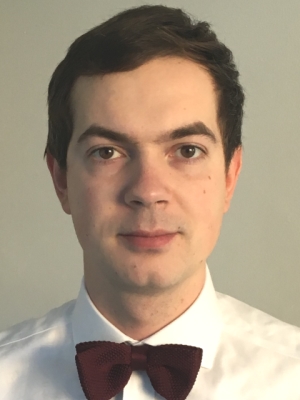
Antoine Sanner is a Researcher affiliated with the Institute of Construction Materials (Institute of Building Materials) at ETH Zurich, part of the College of Architecture, Civil and Environmental Engineering. His work focuses on computational mechanics of building materials, surface topography analysis, and adhesion science. He co-developed the dtool and dserver systems to enhance FAIR data practices in research. Research interests include the structural behavior of cement-based materials, mechanisms of material adhesion under varying surface conditions, and multiscale analysis of surface roughness effects. He has also contributed to engineering tools for characterizing surface topography across scales, emphasizing the creation and use of 'digital surface twins' for material studies. His publications consistently explore topics at the intersection of materials science and mechanical engineering, with recent work advancing understanding of surface adhesion dynamics and cement curing processes. No scientific awards are explicitly mentioned in the provided texts. As part of the Professorship for Computational Mechanics of Building Materials, Antoine contributes to research infrastructure and computational methods development. He has no listed advisees or grants, and his role appears to be full-time with no indication of part-time status. He collaborates on projects involving advanced materials characterization, particularly in polycrystalline diamond coatings and bearing component analysis, leveraging both experimental and computational methodologies.
Dr. John Provis is the Group Leader for Cement Systems at the Paul Scherrer Institute (PSI) in the Laboratory for Waste Management (LES). He holds a PhD in Chemical Engineering from the University of Melbourne, Australia, and was previously the Professor of Cement Materials Science and Engineering at the University of Sheffield, UK (2012–2023). His research focuses on cement chemistry, sustainable construction materials, and nuclear waste management, with a strong emphasis on standardization and beamline analysis. Provis has authored over 300 journal articles and secured major grants, including an ERC Starting Grant. He is a Fellow of multiple prestigious societies and has received awards such as the RILEM Robert L'Hermite Medal and a Doctor Honoris Causa from Universiteit Hasselt. He has supervised over 100 PhD/postdoc researchers and serves as an editorial board member for journals like Cement and Concrete Research and Materials and Structures . His research interests span cement durability, geopolymer development, and the environmental impact of construction materials. Provis also advises governments and agencies globally on funding and policy, contributing to projects like the Hanford Nuclear Reservation review. His work bridges academic research with industrial applications, emphasizing innovation in low-carbon materials and waste management solutions.
Meike Sievers is a Research Fellow at the Laboratory for Multiscale Bioimaging , part of the Center for Life Sciences at the Paul Scherrer Institute (PSI) in Switzerland. Her work focuses on advanced imaging techniques across multiple scales.
Franceschiello Benedetta is an Associate Professor at HES-SO Valais-Wallis School of Engineering, specializing in Technical and IT disciplines. She holds a PhD in Mathematical Neuroscience from Université Pierre et Marie Curie (Paris). Her work bridges applied mathematics, computational neuroscience, and neuroimaging, with a focus on visual perception modeling, MRI techniques, and neural dynamics. Teaching: Linear Algebra courses across multiple engineering bachelor programs Expertise: Combines mathematical modeling with neuroscientific applications to study optical illusions, brain connectivity, and ophthalmic diagnostics Key Affiliations: ISMRM, Organization for Human Brain Mapping (OHBM), Association for Research in Vision and Ophthalmology (ARVO) Research Interests: Computational modeling of visual cortex mechanisms underlying geometric optical illusions Development of MRI-based methods for eye structure segmentation and axial length estimation Analysis of brain network reliability through standardized MRI protocols Optimization techniques for medical imaging reconstruction (e.g., weighted LASSO problems) Recent Work Trends: Focus on integrating psychophysical experiments with computational models to elucidate perceptual mechanisms, emphasizing synergistic interactions between physical stimulus parameters. Active in advancing MRI applications for both clinical diagnostics and fundamental neuroscience research.
Igor V. Pivkin is a full professor at the Institute of Computing within the Faculty of Informatics at the University of Lugano (USI). He holds a B.Sc. and M.Sc. in Mathematics from Novosibirsk State University, followed by an M.Sc. in Computer Science and a Ph.D. in Applied Mathematics from Brown University. Before joining USI, he was a Postdoctoral Associate at MIT's Department of Materials Science and Engineering. His research focuses on multiscale/multiphysics modeling , numerical methods, and large-scale simulations of biological and physical systems. Key areas include biophysics, cellular/molecular biomechanics, stochastic modeling, and coarse-grained molecular simulations. He leverages high-performance computing and particle-based methods to address complex biological phenomena. His work spans diverse applications, including cancer cell dynamics, bioleaching bacterial biofilms, and erythrocyte mechanics in human spleen circulation. He has pioneered computational tools such as the Bayesian recursive global optimizer (BaRGO) and the in-silico lab-on-a-chip framework, enabling petascale simulations of microfluidic systems at cellular resolution. Pivkin collaborates extensively with institutions like the SIB Swiss Institute of Bioinformatics and has contributed to advancing methodologies for multi-model scientific simulations. His research integrates experimental data with computational models to bridge gaps between microscopic and macroscopic biological processes.
Prof. Arkadiy Simonov is an Assistant Professor at the Department of Materials, ETH Zürich. His research focuses on structural disorder in materials, particularly in Prussian Blue Analogues (PBAs), disordered crystalline systems, and ferroelectric materials. He employs advanced techniques such as single-crystal diffuse scattering and computational modeling to study local ordering, phase transitions, and correlated atomic-scale phenomena. Key research areas include: Crystal growth and defect engineering in PBAs Multiscale disorder-property relationships in functional materials Magnetoelectric domain engineering Interaction space modeling for disordered systems His work bridges theoretical and experimental approaches, with applications in optoelectronics, energy materials, and nanophotonics. Simonov collaborates on structural analysis using X-ray and electron diffraction techniques, and his contributions advance understanding of materials with tunable properties through atomic-scale disorder. Contact: arkadiy.simonov@mat.ethz.ch
Sophia Haussener is an Associate Professor at the Laboratory of Renewable Energy Science and Engineering (LRESE) within the School of Engineering at École polytechnique fédérale de Lausanne (EPFL). She contributes to research in Renewable Energy , Electrochemistry , and Materials Science , with a focus on solar energy conversion and CO2 reduction technologies. Her leadership extends to academic committees such as the Commission des prix de la recherche and Academic Strategy Committee . Her research group explores Multiphysics Modeling , CO2 Electrolysis , and Photoelectrochemical Systems , emphasizing scalability and industrial integration. Recent publications highlight advancements in Gas Diffusion Electrodes , Photostability , and Membrane Engineering , reflecting her interdisciplinary approach to renewable energy solutions. Scientific Awards Yellott Award (2024): ASME Solar Energy Division Cell Press’s 50 Scientists that Inspire (2024) Raymond Viskanta Award (2019): Elsevier & Journal of Quantitative Spectroscopy ABB Forschungspreis (2012) ETH Medal (2011) Dimitris N. Chorafas Prize (2011) PhD Students Agarwal Venu Gopal Delgado Díaz William Orlando Lorenzutti Francesca Mora-Monteros Jérémy Raphaël van Rooij Sarah and 21 others Article Trends Focus on CO2 Electrolysis , Photoelectrochemical Systems , and Multiphysics Modeling Key themes: Gas Diffusion , Membrane Technology , Photostability , and Industrial Integration
Michael Multerer is an Associate Professor at the Faculty of Informatics, Università della Svizzera italiana (USI). His research focuses on multiresolution methods, scattered data analysis, and numerical analysis with applications in computational mathematics and engineering. He leads projects such as the SNSF Starting Grant on multiresolution methods for unstructured data, emphasizing nonlinear approximation and kernel-based techniques. Research Interests: Development of fully discrete multiresolution methods for unstructured data Wavelet theory and kernel matrix algebra Uncertainty quantification in partial differential equations Scattered data compression and approximation Key Software Contributions: FMCA: Fast multiresolution covariance analysis for scattered data Bembel: Boundary element library for solving Laplace and Helmholtz equations SPQR: Anisotropic sparse grid quadrature in MATLAB Funding: Holder of the SNSF Starting Grant (2025) for advancing multiresolution techniques in unstructured data processing. Labs/Teams: Active in the research group at USI’s Faculty of Informatics, collaborating with institutions like TU Darmstadt and University of Basel on numerical methods and engineering applications.
Stéphane Joost is a Senior Scientist at the Laboratory for Biological Geochemistry (LGB) within EPFL's School of Architecture, Civil and Environmental Engineering (ENAC). His work bridges Geographic Information Science (GIS), molecular ecology, and precision population health through advanced spatial analysis techniques. PhD program committee member for Civil and Environmental Engineering Teaching Staff Member in EPFL's SSIE-ENS Member of the School Council ENAC Research focuses on: Spatial epidemiology and geomedicine Landscape/seascape genomics for climate adaptation Computational methods in environmental health Geospatial modeling of ecological systems Urban environmental exposome analysis Recent publications reveal a multidisciplinary focus combining neuroimaging with GIS, coral reef resilience studies, and spatiotemporal analysis of public health issues like cardiometabolic risk and SARS-CoV-2 spread. His work integrates high-resolution environmental proxies with genomic data to address climate adaptation challenges. Scientific Awards 2006 William L. Garrison Award for Computational Geography Dissertation Teaching includes GIS fundamentals for civil/environmental engineers and exploratory data analysis in environmental health. Mentors PhD candidates in molecular ecology, spatial statistics, and environmental DNA applications.
Prof. Dr. Jürgen Schumacher is Professor at the ZHAW School of Engineering and heads the research focus Electrochemical Cells & Energy Systems . Stationed in Winterthur, Switzerland, he spearheads numerous national and European projects aimed at advancing electrochemical energy conversion and storage technologies. Research Interests His work integrates multiscale modeling with experimental validation to address critical challenges in: Redox flow batteries – organic and hydrogen–bromine chemistries, membrane optimization, and system-level performance models. Proton exchange membrane fuel cells (PEMFC) – two-phase transport, water management, durability under heavy-duty cycles, and degradation coupling. Photoelectrochemical devices – band-structure engineering, optical and carrier-transport modeling for solar water splitting and dye-sensitized solar cells. Porous electrode theory – upscaling from pore-scale to macroscopic descriptions, Monte-Carlo and continuum approaches. Publication Trends Since 2014, his peer-reviewed output has concentrated on physics-based modeling frameworks that bridge electrochemical kinetics, transport phenomena, and material microstructure. Journal of Power Sources and Electrochimica Acta host the majority of his recent articles, reflecting a clear focus on flow batteries and PEMFC durability . A noticeable trend is the coupling of performance and degradation models , enabling predictive lifetime assessment. Ongoing Projects High-throughput screening & synthesis of active materials for flow batteries – Project leader. Robust PEMFC MEAs for heavy-duty applications – Project leader. Doctoral network on micro-process engineering for electrosynthesis – Project leader. Labs & Teams At ZHAW, Prof. Schumacher directs an interdisciplinary team combining electrochemical engineers , numerical modelers , and material scientists . The group operates state-of-the-art facilities for in-situ diagnostics , micro-computed tomography , and high-performance computing clusters dedicated to large-scale simulations of complete cells and stacks.
Dr. Paride Azzari is a researcher in the Sustainable Food Processing group at ETH Zurich , focusing on interdisciplinary approaches at the intersection of food science, biophysics, and soft matter physics. His work emphasizes scalable and sustainable bioprocessing techniques, particularly for microalgae and plant-based proteins. Key Research Areas : Pulsed electric field processing, liquid-liquid crystalline phase separation, and viscoelastic material behavior. Methodologies : Multiphysics simulations, experimental rheology, and open-source software development (e.g., Extrudion for tensile testing analysis). Recent publications highlight his contributions to optimizing biocompound extraction, understanding amyloid fibril organization, and advancing environmental bioremediation using agricultural waste. Notably, his work bridges fundamental soft matter research with industrial food processing applications.
Dr. Anne Bonnin serves as a Beamline Scientist at the Paul Scherrer Institute (PSI) in Switzerland, where she has been instrumental in X-ray imaging research since joining the X-ray Tomography Group in 2014 and assuming her current role at the TOMCAT Beamline in 2016. Affiliated with PSI's Center for Photon Science and Laboratory for Macromolecules and Bioimaging, she operates at the forefront of synchrotron-based imaging techniques. Her academic foundation includes a PhD from INSA de Lyon focused on material properties for explosive detection, followed by postdoctoral work at the European Synchrotron Radiation Facility (ESRF) in X-ray diffraction and phase contrast tomography, and an NSF Research Fellowship for paleontology research at Harvard University and ESRF. Specializing in X-ray imaging (micro/nano-tomography, phase-retrieval) and powder diffraction, Dr. Bonnin leads the bioimaging program at TOMCAT with particular emphasis on the international Heart Imaging Project. Her research develops novel methodologies for materials characterization across diverse domains including cardiac microstructure analysis, paleontology, and neurodegenerative disease modeling, with significant contributions to understanding material behavior at microscopic scales. Her recent publications (2019-2021) demonstrate strong interdisciplinary impact, advancing X-ray imaging applications in energy storage (battery materials), biomedical research (cardiac/auditory systems), and materials engineering (aerogels). A defining trend is the integration of machine learning for image analysis, alongside methodological innovations like non-rigid image stitching and Fourier ptychography. These works reflect extensive international collaboration and address critical challenges in healthcare, energy, and fundamental material science. Dr. Bonnin leads the Heart Imaging Project to quantify cardiac microstructure using contrast-agent-free X-ray phase-contrast imaging, while actively contributing to the SLS2.0 upgrade project preparing TOMCAT for multiscale, multimodal, and dynamic tomographic capabilities. Her collaborative framework spans global researchers in materials science, paleontology, and biomedical engineering. As manager of the TOMCAT nanoscope—a full-field imaging setup achieving 150 nm 3D resolution—she enables cutting-edge research in absorption and phase-contrast imaging. Her team within the X-Ray Tomography Group drives the bioimaging program forward, particularly through the Heart Imaging Project's dynamic cardiac studies using modified Langendorff setups.
Prof. Dr. Susanne Suter is a Professor in Data Science at the Institute for Data Science, FHNW School of Computer Science, University of Applied Sciences and Arts Northwestern Switzerland. Her research focuses on Artificial Intelligence, Machine Learning, Deep Learning, and Explainable AI, particularly in medical applications such as Computer Vision, Signal Processing, and Digital Health. She has led projects including Smart Hospital and Hospital @ Home, receiving the Prix D'Excellence SanteNeXt 2023. Her publications emphasize AI-driven solutions in healthcare, spanning medical imaging, real-time clinical decision systems, and high-performance computing. Recent work explores ophthalmic imaging, multimodal ICU data platforms, and tensor-based data compression for visualization. Awards include the Prix D'Excellence SanteNeXt 2023 for innovative healthcare solutions.
Nathan Beech is a Researcher affiliated with the Professorship for Environmental Physics at ETH Zurich's Department of Environmental Systems Science. His work focuses on advancing ocean modeling techniques, particularly in the Southern Ocean, and understanding the impacts of climate change on mesoscale ocean dynamics. He contributes to high-resolution climate modeling projects using tools like FESOM 2.5, emphasizing computational efficiency and accuracy. Research Interests: Beech's studies center on the interplay between ocean eddies and climate systems, with emphasis on anthropogenic climate change's effects. His work addresses challenges in modeling mesoscale processes, optimizing computational resources for large-scale simulations, and validating climate models against historical data. Recent projects include analyzing long-term eddy activity trends and assessing regional climate impacts on viticulture in British Columbia. Labs/Teams: Collaborates within the Environmental Physics research group at ETH Zurich. Current projects involve interdisciplinary climate modeling initiatives and Southern Ocean dynamics studies.