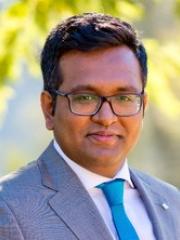
Dr Adnan Sufian is an Honorary Lecturer at the School of Civil Engineering, University of Queensland, with expertise in multiscale mechanics of granular materials. His research bridges geotechnical engineering and computational modeling, focusing on fluid-soil interactions and civil infrastructure resilience. PhD from UNSW Sydney Visiting scholar at MIT Postdoctoral work at Imperial College London Industry experience with SMEC Australia His research addresses granular material behavior under complex conditions, including internal erosion dynamics in dams, particle migration in gap-graded soils, and seismic stability of engineered landfills. Methodologically, he employs CFD-DEM coupling , pore network models , and Voronoi tessellation for granular simulations. The 15 most recent publications highlight a focus on erosion mechanisms , filter design , seismic stability , and microcapsule retention in granular media. These works utilize computational methods (CFD-DEM, PNM-DEM) and experimental techniques (X-ray CT, time domain reflectometry) to analyze soil-fluid interactions. Dr Sufian is available for supervision, with current projects on resilient infrastructure and past completions investigating micro-scale erosion conditions and particle migration dynamics . His research has been supported by grants from ARC and UQ, including projects on real-time erosion prediction and geotechnical data integration. Key collaborations span physicists, mathematicians, and engineers , reflecting the interdisciplinary nature of his work on granular material behavior. The ARC Advance Timber Hub and partnerships with institutions like Imperial College London and UNSW Sydney further contextualize his academic network.
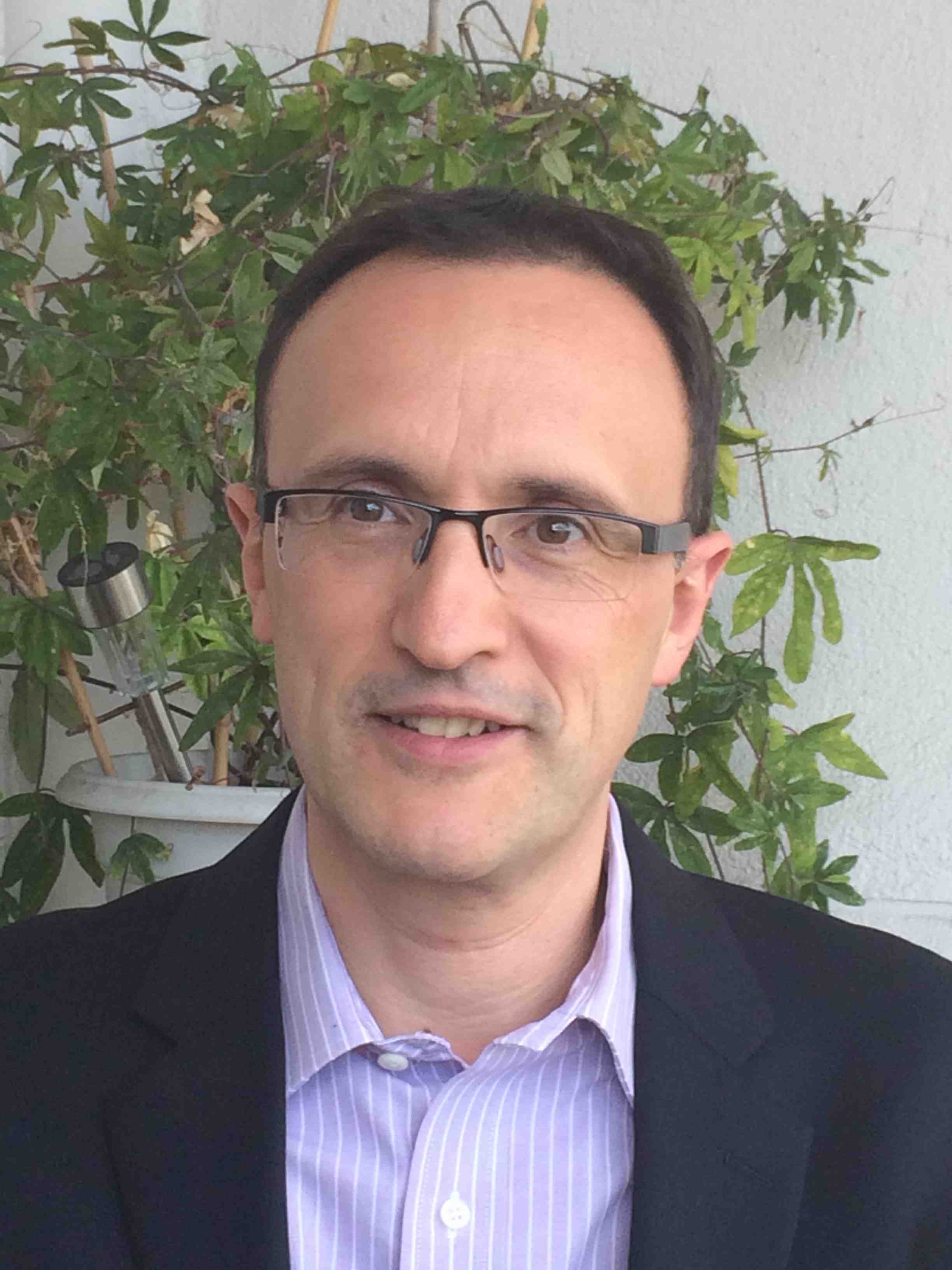
Eric Cancès is a Professor at Ecole des Ponts ParisTech and affiliated with INRIA Paris as part of the Molecular and Multiscale Modeling team. His research focuses on mathematical analysis of electronic structure models for quantum chemistry and materials science, algorithms for electronic structure calculations, numerical analysis of eigenvalue problems, implicit solvent models, and molecular dynamics. He has made significant contributions to the development of continuum solvation models, multiscale methods, and computational frameworks for quantum chemistry. Research Interests Mathematical foundations of quantum chemistry Algorithmic development for electronic structure Implicit solvent models and continuum electrostatics Multiscale and domain decomposition techniques Greedy algorithms for high-dimensional problems Scientific Awards Le Rivot prize (French Academy of Sciences, 1992) Best PhD award (Ecole des Ponts, 1998) Blaise Pascal prize (SMAI and French Academy of Sciences, 2009) Ordway visiting professor (University of Minnesota, 2013-2014) Invited lecturer at ICM (2014) Publications span over two decades, addressing Hartree-Fock and Kohn-Sham models, quantum Monte Carlo methods, domain decomposition for solvation models, and multiscale approaches. His work emphasizes mathematical rigor combined with computational efficiency, with recent studies on perturbation methods, polarization energy calculations, and embedded corrector problems for homogenization.
Lâmân LELÉGARD serves as a Researcher at the French National Institute of Geographic and Forest Information (IGN), currently assigned to the MATIS laboratory since 2018 after 10 years at LASTIG. As a Civil Servant Engineer and member of the GEOVIS research team, he contributes to geospatial research while occasionally teaching image processing, DTM manipulation, and colorimetry courses in the PPMD Master's program at the National School of Geographic Sciences (ENSG). His academic foundation includes an engineering degree (2004-2007) and Specialized Master in Geodesy (2006-2007) from ENSG, preceded by Mathematics and Physics preparatory classes at Charlemagne High School (2001-2004). Early career internships involved gravitational field analysis at Belgium's Royal Observatory (2006) and gravito-elastic equations at Paris Institute of Earth Physics (2007). LELÉGARD's research centers on image quality enhancement in photogrammetry, with sustained contributions to motion blur correction, radiometric processing, and colorimetry. His work addresses practical challenges in aerial/terrestrial imagery, including nighttime scanning systems, channel-dependent exposure artifacts, and scanned campaign inhomogeneities. Methodologies leverage adaptive filtering, principal component analysis, and multiscale transforms for real-world geospatial applications. Publication analysis reveals consistent focus on operational image processing solutions between 2010-2022, with recent work emphasizing radiometric correction for analogue airborne data and real-time vignetting estimation. His output bridges theoretical image science and field-deployable techniques for national mapping agencies. He has advised two significant internships: Emeric DELAYGUE's 2009 research on aerial motion blur deconvolution and Vincent DAVAL's 2012 work on nighttime mobile imaging restoration. These projects reflect his expertise in image degradation correction within ENSG's PPMD program framework. As an active GEOVIS team member, LELÉGARD continues advancing image quality methodologies at MATIS laboratory, focusing on radiometric processing innovations for IGN's geospatial data pipelines while maintaining selective teaching engagements at ENSG.
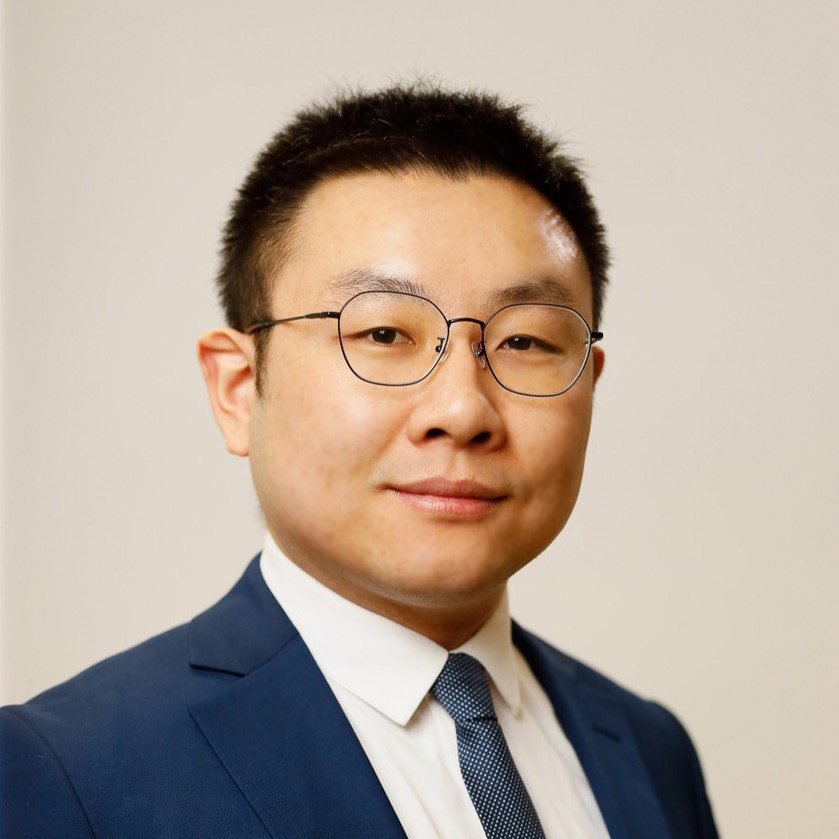
Zhenkun Li is a Postdoctoral Researcher at Aalto University’s Department of Civil Engineering, specializing in structural health monitoring (SHM) and computational methods. His research focuses on indirect SHM techniques, leveraging vehicle responses and machine learning for bridge damage detection. Research Interests: Structural Engineering, Bridge Health Monitoring, Machine Learning, Signal Processing, and Drive-By Inspection Methods. His work integrates convolutional neural networks, deep learning, and physics-guided models to analyze bridge dynamics via shared scooters, smartphones, and instrumented vehicles. Publication Trends: Recent articles (2023–2025) emphasize data-driven SHM, explainable machine learning for asphalt modeling, and innovative frameworks for bridge frequency identification. Techniques include multisynchrosqueezing transforms, Mel-frequency cepstral coefficients, and crowdsensing for real-time damage detection.
Prof. Vittorio Romano (b. 1966) is a Full Professor of Mathematical Physics at the Department of Mathematics and Computer Science, University of Catania, Italy. He obtained his Laurea Magna cum Laude (1989) and PhD in Mathematics (1994) from Catania. His research focuses on charge/phonon transport modeling in semiconductors and graphene , non-equilibrium thermodynamics , and numerical methods for hyperbolic systems . Research areas include relativistic fluid dynamics, nonlinear wave propagation, stability of shock waves, and applications in cosmology. He has led major EU projects like COMSON (FP6) and AMBEATION (MSCA-RISE), and developed MEP-based hydrodynamic models for nanoscale devices. Scientific leadership : Director of A.M. Anile Interdepartmental Center, ECMI Council member, GNFM Co-Chair Key publications : 24 (Scopus) and 35 (Google Scholar) H-index with over 3900 citations International collaborations : Autonomous University of Barcelona, Kaiserslautern University, ST-Microelectronics, Synopsys He has supervised 9 PhD students in topics ranging from quantum transport to Monte Carlo simulations, and organized conferences like SCEE 2018 and ICTT 2015. His editorial roles include associate editor for Frontiers in Applied Mathematics and Statistics and guest editor for Entropy.
Manfred Kaltenbacher is a University Professor at Vienna University of Technology, specifically in the Institute of Fundamentals and Theory in Electrical Engineering. He holds multiple prestigious positions and has received significant recognition including a Doctor Honoris Causa from Budapest University of Technology and Economics and election to the Austrian Academy of Sciences. His research spans computational electromagnetics, acoustics, and materials science with over 200 publications and numerous active research projects. Professor Kaltenbacher's research interests focus on advanced computational methods for electromagnetic and acoustic phenomena. His work encompasses finite element analysis for magnetics and acoustics, hysteresis modeling, aeroacoustics, and computational physics. He has made significant contributions to the simulation of electromagnetic devices, noise propagation, and the development of numerical methods for multiphysics problems. His research bridges theoretical developments with practical engineering applications across multiple domains including Advanced Materials Science, Information and Communication, Mobility & Production, and Sustainable Systems. His recent publications show a strong trend toward integrating machine learning with traditional physics-based modeling, particularly in magnetics and acoustics. There's significant focus on developing advanced numerical methods like the Discontinuous Galerkin method for outdoor noise propagation and improving hysteresis models for electromagnetic devices. His work often addresses multiphysics challenges, combining electromagnetics with acoustics, fluid dynamics, and structural mechanics, with applications spanning from electric motors to noise barriers and energy systems. Professor Kaltenbacher has received notable scientific recognition: Doctor Honoris Causa (Dr. h.c.) from Budapest University of Technology and Economics (2020) Election to the Austrian Academy of Sciences (Österreichische Akademie der Wissenschaft) (2017) He actively leads multiple research projects including "Verlust E-Blech" (focusing on loss models for electrical sheets), "VAMM" (noise barriers), "ECHODA" (energy efficient cooling), and "eMotorWinding" (eMotor winding design). His research funding spans multiple domains including electromagnetics, acoustics, and energy efficiency applications. While the text mentions "Supervised Work (1)", specific student names aren't provided in the available information. Professor Kaltenbacher collaborates extensively across institutions, with recent activities showing collaboration with Budapest University of Technology and Economics and other international partners. His research group appears to focus on computational methods for electromagnetic and acoustic phenomena, with particular expertise in finite element methods and multiphysics simulations, as evidenced by his numerous publications and active projects through 2025.
Prof. Dr. Gert Lube is a faculty member at the Institute for Numerical and Applied Mathematics (NAM) within the Faculty of Mathematics and Computer Science at Georg-August-University Göttingen. His research focuses on numerical methods for partial differential equations , with emphasis on stabilized finite element methods , turbulence modeling , and magnetohydrodynamics (MHD) . Workshops Organized : Calibration of Viscosity Models for Turbulent Flows (2010), Variational Multiscale Methods (2008), Local Projection Stabilization (2008), BAIL Conferences. His academic contributions include 15+ publications since 2010 on topics like Navier-Stokes simulations , LES/VMS methods , stabilized FEM , and FEM-BEM coupling . Collaborations span institutions like TU Graz, Saarbruecken University, and DLR Göttingen. Key Research Areas : Finite Element Methods, Turbulence Modeling, MHD, Incompressible Flows, Singularly Perturbed Problems, Parallel Computing. Advisees include PhD candidates working on topics such as non-isothermal flows , mass conservation , hybrid RANS/LES , and domain decomposition .
Frédéric Gibou is a Professor in the Department of Mechanical Engineering, Department of Computer Science, and Department of Mathematics at the University of California, Santa Barbara. He is also a core faculty member in the Computational Science and Engineering program. His academic journey began with a PhD in Applied Mathematics from UCLA, followed by post-doctoral research in the Departments of Mathematics and Computer Science at Stanford University. PhD in Applied Mathematics, UCLA Post-doctoral research, Stanford University (Mathematics and Computer Science) Professor Gibou's research sits at the interface between Applied Mathematics, Computer Science and Engineering Sciences, focusing on the design of high resolution computational methods for large scale computations. His work spans Computational Materials Science, Computational Fluid Dynamics, and Computational Image Analysis. The common thread across these applications is that they involve complex/free boundaries and similar classes of nonlinear partial differential equations. His group develops computational strategies on spatially adaptive grids for massively parallel environments, increasingly incorporating Machine Learning algorithms to solve forward and inverse problems. His research output shows a clear trend toward integrating traditional numerical methods with machine learning approaches, particularly for solving partial differential equations with complex interfaces. The publications reveal a strong focus on developing sharp interface methods, adaptive grid techniques, and novel computational paradigms that can handle multiscale phenomena across various scientific domains. Alfred P. Sloan Fellowship in Mathematics Regent's Junior Faculty Fellowship NSF Mathematical Sciences Postdoctoral Fellowship Robert Sorgenfrey Distinguished Teaching award Professor Gibou leads a multidisciplinary research group called Computational Applied Science Laboratory (CASL), which has strong collaborations with experimentalists at UCSB and worldwide. His group has received substantial funding from various agencies, enabling them to tackle challenging problems in computational science. CASL focuses on designing computational methods on Quad-/Oc-trees grids in the level-set formalism for solving previously intractable problems in science and engineering. The group's work spans Computational Materials Science (including nanostructured polymeric materials and high temperature multicomponent alloys), Computational Fluid Dynamics (including flow over superhydrophobic surfaces, flow in reactive porous media, and multiphase flows), and Computational Image Analysis (including image guided surgery and image segmentation).
Ioana Ciotir is an Associate Professor (Maître de Conférence) in the Department of Mathematical Engineering at INSA Rouen, France, where she has been employed since 2014. She previously served as an Assistant Professor at the Institute of Mathematics at the University of Neuchâtel, Switzerland (2012-2014) and as an Assistant at the Department of Mathematics at "Alexandru Ioan Cuza" University of Iasi, Romania (2008-2012). Her research focuses on stochastic partial differential equations, homogenization theory, and optimal control problems, with applications to porous media flow, traffic modeling, and financial mathematics. Dr. Ciotir earned her Ph.D. in Mathematics from "Alexandru Ioan Cuza" University of Iasi, Romania in 2010, with a thesis titled "Stochastic Porous Media Equations." She later obtained her Habilitation à Diriger des Recherches (HDR) from the University of Rouen, France in 2022. Her academic journey includes additional training in educational methodologies and summer schools in mathematical finance. Her primary research interests span stochastic analysis and partial differential equations, with a focus on stochastic porous media equations, homogenization of stochastic processes, optimal control theory, and probabilistic representations. She investigates the behavior of stochastic processes with singular diffusivity, including fast and super-fast diffusion equations with various types of noise (Stratonovich, Itô, gradient-type). Her work extends to applications in physics (plasma diffusion), engineering (porous media flow), and social sciences (traffic flow modeling, pandemic economic impacts). Dr. Ciotir's publication record demonstrates consistent contributions to high-impact mathematical journals, with recent work focusing on regularity theory for stochastic diffusion equations, state-constrained control systems for porous media, and non-local models for traffic flow. Her research often involves international collaborations with institutions in Switzerland, Germany, Japan, and China, reflecting the interdisciplinary nature of her work. Among her scientific recognitions are the Thesis Prize for Applied Mathematics from ROMAI (2011) and the Doctoral and Research Supervision Bonus (PEDR) for the periods 2018-2021 and 2022-2025. She has successfully supervised multiple doctoral students through completion of their theses and currently mentors several Ph.D. candidates working on topics related to stochastic PDEs and control theory. Dr. Ciotir has secured significant research funding through projects such as Scale Op (2024-2028, with Siemens Gamesa Renewable Energy), DEFHY3GEO (2022-2025), M2SiNum (2018-2021), M2Num (2015-2019), and the ANR Project QUantum Turbulence Exploration by High-Performance Computing (ANR-18-CE46-0013). She serves as the Sustainable Development Representative for the LMI laboratory and the GM Department since May 2020, and has been elected to the LMI laboratory council (2017-2021 and 2021-2025). She is actively involved in the Mathematics Laboratory (LMI) at INSA Rouen, where she serves as the SMAI correspondent and Mathrice correspondent via FR CNRS 3335. Her international collaborations include partnerships with Siemens-Gamesa, ENSTA Paris, universities in Romania, Switzerland, Germany, and Japan, demonstrating her position within a broad academic network focused on applied mathematics and stochastic analysis.
Dr Zahratu Shabrina is a Senior Lecturer in Spatial Data Science at the Geography Department, King's College London, School of Global Affairs, Faculty of Social Science & Public Policy. She joined King's in November 2019 after completing her PhD from the Centre for Advanced Spatial Analysis (CASA) at University College London in 2019. Dr Shabrina holds an MUP/Master in Urban Planning from the University of Southern California (2013) and a BEng from Institut Teknologi Bandung, Indonesia (2011). Her academic background as an urban planner with a focus on urban analytics informs her interdisciplinary research approach. Her research focuses on the implementation of quantitative methods to study platform urbanism, urban tourism, and housing, particularly examining disruptions from digital platforms in cities using spatial analysis methods and predictive modeling. Much of her work has centered on Airbnb impacts in various urban contexts worldwide. Her publication portfolio demonstrates expertise in spatio-temporal analysis, geographically weighted regression, entropy statistics, and gravity-spatial interaction models to analyze platform economy impacts in cities. Her research spans multiple continents, including studies in London, Brunei Darussalam, Indonesia, and China's Shenzhen-Dongguan-Huizhou region. Dr Shabrina is actively involved in the Research Centre for Urban Science and Progress (CUSP) London and the Geocomputation and Data Science Research Hub, contributing to interdisciplinary research on contemporary urban problems through data-driven approaches. She teaches multiple courses including Spatial Data Analysis, Applied Geocomputation and Spatial Analysis, Geographical Research Skills, and Geography in Action. She also organizes academic workshops, including the King's College London School of Global Affairs - University of North Carolina Curriculum in Global Studies Workshop in May 2023.
Hao Hu is an Assistant Professor in the Department of Geosciences at the University of Oklahoma's School of Geosciences (Mewbourne College of Earth and Energy). Previously, he served as a Senior Research Geophysicist at TGS and a Research Assistant Professor at the University of Houston. His office is located in the Sarkeys Energy Center, Room 754. Dr. Hu earned his Ph.D. in Geophysics from the Institute of Geology and Geophysics at the Chinese Academy of Sciences in Beijing and completed his undergraduate studies in Geophysics at Yunnan University in Kunming, China. His research focuses on using seismic signals and methods to address critical challenges in energy exploration and subsurface understanding. Specifically, he investigates how to balance climate change and energy consumption through exploration of geothermal/fossil resources and CO2 geological storage, solve scientific problems in understanding subsurface structures from shallow to deep, and conduct fundamental studies of seismic theory and algorithms. His work spans exploration of unconventional/conventional resources, understanding subsurface structures using seismic signals, and fundamental theory studies of seismic wave propagation, imaging, and inversion. Dr. Hu's recent publications demonstrate strong activity in seismic fracture characterization, imaging techniques, surface wave analysis, and machine learning applications in geophysics. His work shows a clear progression toward more sophisticated computational methods and interdisciplinary approaches combining traditional geophysics with modern machine learning techniques. Postdoctoral travel award (2019) Excellent Graduate student award (2014) Excellent paper award (2013) Dr. Hu has secured significant research funding from NSF, DOE, and industry partners including TGS and Aramco. His current projects include elastic full waveform inversion and imaging with TGS, and previously he was involved in research on heterogeneity signatures of mantle phase changes, seismic elastic double-beam characterization of faults/fractures for CO2 storage, and detecting fracture zones using convolutional neural networks. He has served as a reviewer and guest editor for over 80 manuscripts in professional journals including Geophysics, Geophysical Prospecting, and IEEE TGRS.
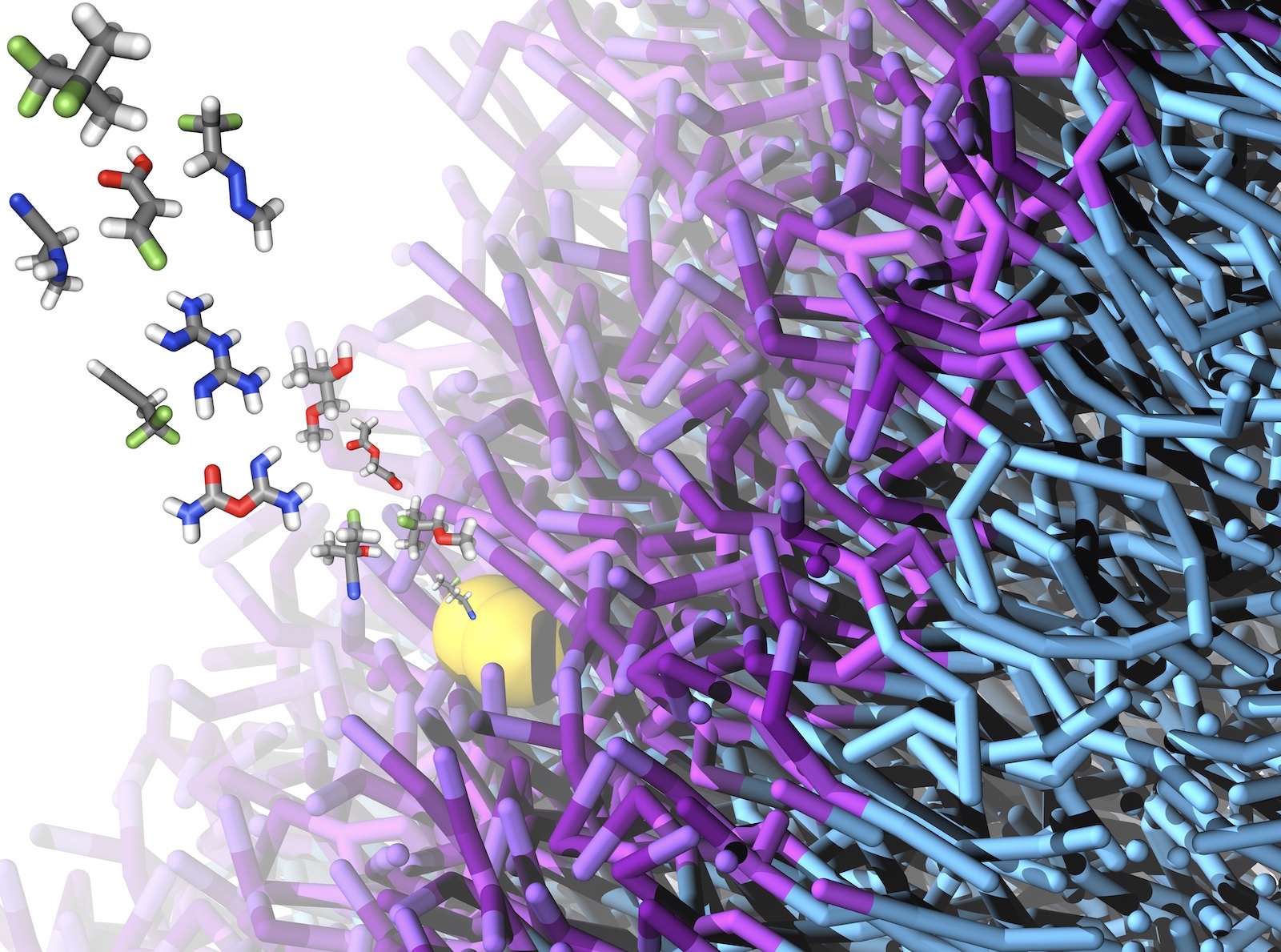
Tristan Bereau is a Professor at Heidelberg University, affiliated with the Institute for Theoretical Physics. His research focuses on computational physics and multiscale modeling of soft matter and biomolecules, integrating physics-inspired machine learning techniques. Current affiliation: Professor, Institute for Theoretical Physics, Heidelberg University Research themes: Multiscale modeling, coarse-graining, data-centric materials science Research interests center on multiscale modeling , machine learning for molecular systems , and chemical space exploration . Key trends in his recent publications include physics-based diffusion models , high-throughput computational screening , and data-driven design of biomolecular systems . His lab has produced 15 recent works spanning free-energy estimation , coarse-grained parameterization , and machine learning for membrane interactions , with a focus on reproducibility and FAIR data principles in materials science.
Dr. Martin Lenz is a researcher at the Institut für Numerische Simulation at the University of Bonn , specializing in numerical methods for materials science and mechanics. His work bridges computational mathematics with applications in magnetic-shape-memory materials, microstructure optimization, and multiscale modeling. Teaching: Lecturer for Ingenieurmathematik III (module M43), Ingenieurmathematik II (module B42), and Ingenieurmathematik (Master module M22). Current Research: Leads Numerical optimization of shape microstructures (Project C06, DFG SFB 1060) focusing on two-scale optimization of elastic materials. Past Research: Developed continuum models for magnetic-shape-memory materials (Project A6, DFG priority program 1239) and studied multiscale phase separation with elastic misfit. His recent publications (2023-2012) emphasize shape-memory alloys , microstructure dynamics , and adaptive numerical schemes . Key methodologies include finite volume methods, homogenization, and phase field modeling. Education: PhD (2007) and Diploma in Mathematics (2002) from the University of Bonn.
Niklas Kolbe is an interim professor at the Department of Mathematics, RWTH Aachen University . His research focuses on numerical analysis, modeling of partial differential equations, and applications in cancer biology and traffic flow systems. Current affiliation: Department of Mathematics, RWTH Aachen University Academic rank: Interim Professor Research Interests Dr. Kolbe specializes in: Numerical methods for hyperbolic/parabolic PDEs Adaptive mesh refinement Lagrange-Galerkin techniques Cancer invasion modeling (stem cells, extracellular matrix) Network models for blood vessels/road systems Notable Contributions Recent publications address: Lax-Friedrichs methods in hemodynamics Relaxation approaches for fluid-solid coupling Flux-limited PDEs for glioma invasion Stochastic TGF-β signaling models
Tina Lasisi is an Assistant Professor and LSA Collegiate Fellow at the University of Michigan, affiliated with the African Studies Center. She holds a PhD in Anthropology from Penn State University (2021) and a BA in Archaeology & Anthropology from the University of Cambridge (2014). Her primary research focuses on human biological variation, particularly hair and skin pigmentation, intersecting with evolutionary biology, genetics, and biometric technology. She leads the Lasisi Lab, which develops imaging tools for hair morphology and skin pigmentation, investigates genetic mechanisms of human diversity, and explores forensic and health implications of these traits. Her interdisciplinary work involves collaborations across population genetics, computer science, dermatology, and forensics. Notable achievements include the 2024 AABA-Leakey Foundation Award and being named to Popular Science’s 2023 Brilliant 10 list. She teaches courses such as Nature/Culture Now! and Introduction to Anthropology , and advises PhD candidate Paloma Contreras and Master’s student Kianna Hendricks. Her lab team includes researchers and students focused on advancing methodologies in human phenotypic analysis. Awards: 2024 AABA-Leakey Award, 2023 Popular Science Brilliant 10, 2022 Graff Prize, 2019 Wenner-Gren Grant, 2018 Juan Comas Prize Grants: NSF Dissertation Improvement Grant (2019), Wenner-Gren Foundation Grant (2019) Labs/Teams: Lasisi Lab (focusing on human phenotypic diversity and forensic genetics)